What Size Cutting Board Do I Need? A Complete Size Guide
Quick Answer
A 12 x 18-inch cutting board is a great starting point for most home kitchens. It offers enough space for chopping vegetables, preparing everyday meals, and moving ingredients without constant crowding. Choose a 10 x 14-inch board for smaller kitchens or an 18 x 24-inch board for large food-preparation tasks. Whatever size you select, follow the USDA food safety guidance for keeping cutting surfaces clean.
Recommended Cutting Board Sizes
- Small boards (8 x 10 inches): Best for lemons, herbs, garlic, and quick snacks.
- Medium boards (10 x 14 inches): Suitable for compact kitchens and light meal preparation.
- Standard boards (12 x 18 inches): A practical all-purpose size for most home cooks.
- Large boards (15 x 20 inches): Helpful for preparing several ingredients or larger meals.
- Extra-large boards (18 x 24 inches): Best for spacious countertops, bulk preparation, and carving.
Before Buying
- Measure your counter: Leave space for bowls, ingredients, and safe knife movement.
- Check your sink: Make sure the board can be cleaned comfortably.
- Consider storage: Large boards need suitable cabinet or countertop space.
Choosing a cutting board sounds simple until you realize how much the size affects everyday cooking. A board that’s too small creates clutter, while an oversized board can be inconvenient to wash and store.
I’m Michael, and in this guide I’ll walk you through practical cutting board dimensions, kitchen layouts, and food-preparation needs. You’ll also learn how to choose a board that feels comfortable for your cooking routine.
What Is the Standard Size of a Cutting Board?
There isn’t one universal standard cutting board size. However, a board around 12 x 18 inches is a practical all-purpose choice for many home kitchens.
This size provides enough room for a chef’s knife, chopped ingredients, and the food you’re preparing. It also fits on many ordinary kitchen countertops.
Cutting board sizes generally fall into five useful categories:
- Small: Approximately 8 x 10 inches.
- Medium: Approximately 10 x 14 inches.
- Standard: Approximately 12 x 18 inches.
- Large: Approximately 15 x 20 inches.
- Extra-large: Approximately 18 x 24 inches or larger.
These are practical shopping categories rather than fixed industry standards. Manufacturers often use slightly different dimensions.
Cutting Board Size Chart: Which Dimensions Are Best?
 Save
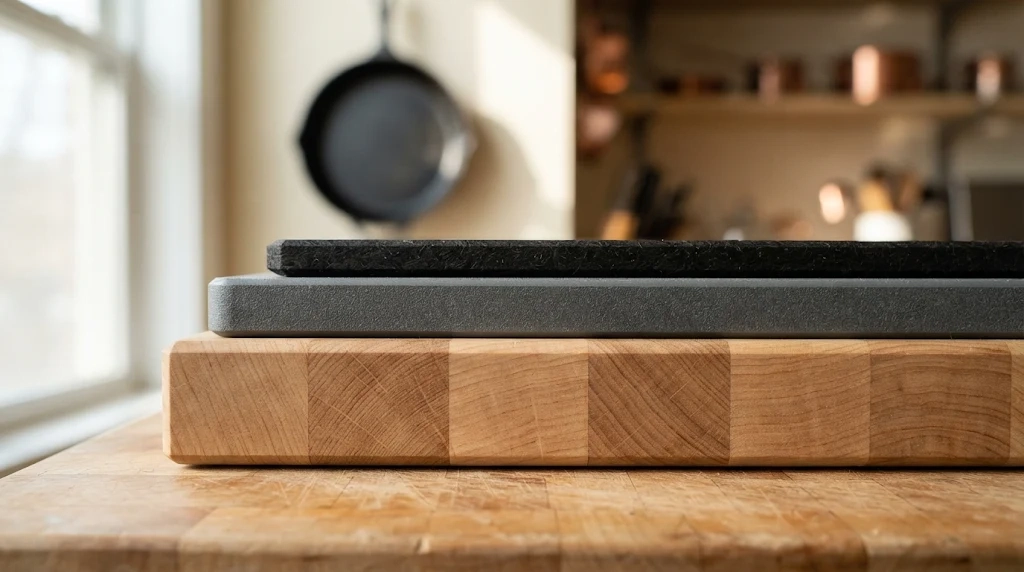
The easiest way to select a board is to compare its dimensions with your typical cooking tasks. The following chart shows common size categories and their recommended uses.
| Board Size | Approximate Area | Best For | Main Limitation |
|---|---|---|---|
| 8 x 10 inches | 80 sq. in. | Herbs, fruit, garnishes | Limited chopping space |
| 10 x 14 inches | 140 sq. in. | Small kitchens, light meals | Crowded during larger tasks |
| 12 x 18 inches | 216 sq. in. | Everyday meal preparation | Needs moderate counter space |
| 15 x 20 inches | 300 sq. in. | Large meals, batch preparation | Heavier and harder to store |
| 18 x 24 inches | 432 sq. in. | Bulk chopping, carving | Requires substantial counter space |
My practical recommendation: Start with a 12 x 18-inch board if your kitchen has enough room. Add a smaller board for quick cutting tasks instead of replacing your main board.
How Do I Choose the Right Cutting Board Size?
The right cutting board should match your available counter space, knife length, and typical meal preparation. It should also be easy to carry, clean, and store.
1. Measure Your Available Counter Space
Start by measuring the clear work area where you normally prepare food. Don’t assume your entire countertop is available for chopping.
You’ll need room for ingredients, mixing bowls, and nearby appliances.
- Measure the usable width and depth of your preparation area.
- Leave enough space to move your knife comfortably.
- Keep the board away from the edge of the countertop.
- Check that it lies flat without hanging over the edge.
- Allow room for a bowl or tray to collect chopped food.
For example, a 24-inch-wide preparation area may comfortably accommodate an 18-inch-long board. That leaves six inches of horizontal space, although the layout may require more.
2. Consider the Length of Your Knife
A larger chef’s knife benefits from a wider, longer cutting surface. An eight-inch chef’s knife is more comfortable on a medium or large board than a tiny board.
The blade needs room to travel through food without approaching the board’s edge.
- Paring knife: Small boards work well for detailed cutting.
- 6-inch chef’s knife: A medium board can handle many routine tasks.
- 8-inch chef’s knife: A 12 x 18-inch board offers useful working room.
- 10-inch chef’s knife: Consider a 15 x 20-inch board or larger.
These are comfort recommendations, not strict safety measurements. Your cutting technique and the size of the food matter too.
3. Think About What You Cook Most Often
A cutting board for slicing an apple doesn’t need the same surface area as one for preparing a family dinner. Your usual ingredients should guide the decision.
- Fruit and snacks: Choose a small, lightweight board.
- Daily vegetables: Choose a medium or standard board.
- Whole chickens: Use a larger board with room for the bird and knife.
- Large roasts: Look for a spacious carving board with a juice groove.
- Batch cooking: Select a large board with enough room for multiple ingredients.
4. Check Your Sink and Storage Space
A board may fit your counter perfectly but become frustrating when it’s time to wash it. Large wooden boards can be especially awkward in compact sinks.
Measure your sink opening and consider where the board will dry.
- Choose a manageable weight if you wash boards frequently.
- Check cabinet clearance before buying a thick wooden board.
- Consider a hanging board if drawer storage is limited.
- Avoid choosing a board so large that thorough cleaning becomes difficult.
What Size Cutting Board Is Best for a Small Kitchen?
A cutting board around 10 x 14 inches is a sensible choice for a small kitchen. It offers more working space than a tiny board without occupying the entire preparation area.
For particularly narrow counters, a compact board around 8 x 10 inches can handle simple tasks.
How to Make a Small Cutting Board Work Better
- Prepare one ingredient at a time.
- Move chopped ingredients into a nearby bowl.
- Use a damp towel or suitable nonslip mat beneath a board that lacks nonslip feet.
- Keep appliances away from the chopping area.
- Wash and clear the board between different food categories when needed.
A small board is not automatically a poor choice. It becomes a problem when food, your knife, and your hands compete for limited space.
Is a 12 x 18-Inch Cutting Board Big Enough?
Yes, a 12 x 18-inch cutting board is large enough for many everyday kitchen tasks. Its 216-square-inch surface provides a useful balance between working room and manageable dimensions.
It can accommodate vegetables, boneless meats, bread, and many common food-preparation jobs.
When This Size Works Well
- Chopping onions, carrots, and celery for dinner.
- Slicing fruit for several servings.
- Preparing boneless chicken portions.
- Cutting sandwiches, cheese, or bread.
- Preparing ingredients for two to four people.
When You May Need Something Bigger
A standard board may feel cramped when handling a large watermelon, whole turkey, or several pounds of vegetables. Extra preparation space can make these jobs more organized.
If those tasks are routine, a 15 x 20-inch or larger board could be worth the extra storage space.
What Size Cutting Board Should I Use for Meat?
 Save
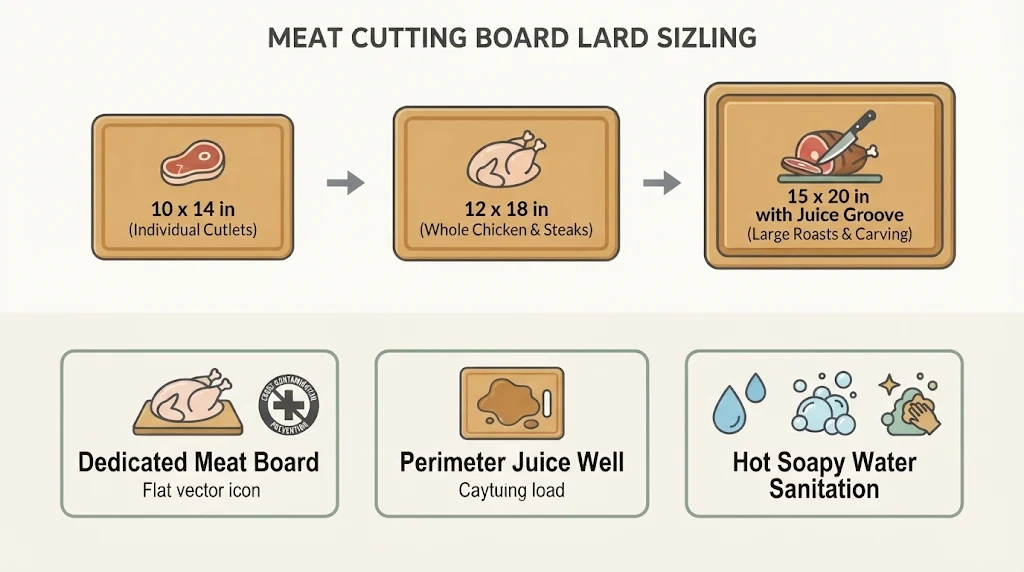
For ordinary meat preparation, a board around 12 x 18 inches is a useful starting point. Large cuts, whole poultry, and carving jobs may require more space.
Choose a board that keeps the entire food item securely supported. A juice groove can also help contain liquids during carving.
Recommended Sizes for Different Meat-Preparation Tasks
- Individual chicken breasts: Approximately 10 x 14 to 12 x 18 inches.
- Steaks and pork chops: Approximately 12 x 18 inches.
- Whole chicken: Approximately 12 x 18 to 15 x 20 inches.
- Large roast: Approximately 15 x 20 inches or larger.
- Turkey carving: A large carving board sized to support the whole bird.
These dimensions are starting points, not food-safety requirements. Always compare the actual food item with the usable cutting surface.
Why Separate Cutting Boards Matter
Raw meat, poultry, and seafood can carry harmful microorganisms. Keeping their preparation surfaces separate from ready-to-eat foods reduces cross-contamination risks.
The CDC’s food safety recommendations support using separate cutting boards for raw animal products and foods that won’t be cooked.
- Use a designated board for raw meat, poultry, and seafood.
- Keep ready-to-eat produce on a different clean board.
- Wash boards with hot, soapy water after food preparation.
- Follow manufacturer instructions for dishwasher-safe boards.
- Replace boards with deep, difficult-to-clean grooves.
What Is the Best Cutting Board Size for Vegetables?
A cutting board between 12 x 18 and 15 x 20 inches works well for vegetable preparation. The extra surface helps separate uncut vegetables from chopped ingredients.
For a single tomato, onion, or handful of herbs, a smaller board may be all you need.
Choosing by Vegetable Size
- Garlic and herbs: An 8 x 10-inch board is usually sufficient.
- Onions and potatoes: A 10 x 14-inch board offers useful room.
- Cabbage and squash: Consider a 12 x 18-inch board or larger.
- Watermelon: Use a board that supports the fruit securely before and during cutting.
- Large batches: A 15 x 20-inch board provides extra organizing space.
For large round produce, stability is especially important. Create a stable flat surface when appropriate before continuing with smaller cuts.
How Thick Should a Cutting Board Be?
 Save
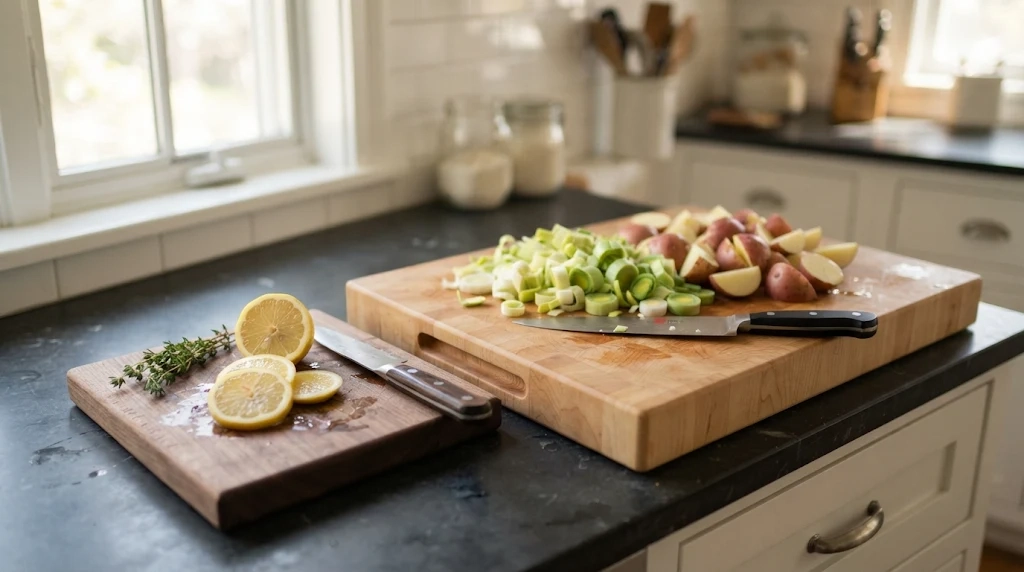
Cutting board thickness affects weight, stability, storage, and durability. A thicker board is not necessarily better for every kitchen.
The best thickness depends partly on its construction material.
| Thickness | Typical Use | Consideration |
|---|---|---|
| 1/4 inch | Thin composite boards | Lightweight, easy to store |
| 1/2 inch | Some utility and plastic boards | Moderate weight and handling |
| 1 to 1.5 inches | Many substantial wooden boards | Greater weight and rigidity |
| 2 inches or more | Heavy butcher blocks | Difficult to lift and wash |
For an everyday wooden board, roughly one to one-and-a-half inches is a reasonable range to consider. Thin composite and plastic boards can also work well when designed for their intended use.
Does Cutting Board Material Affect the Size You Need?
Yes, material affects how practical a board feels at a particular size. Weight, maintenance requirements, and construction influence whether a large cutting surface is convenient.
Wooden Cutting Boards
Wooden boards are popular for everyday chopping and attractive countertop setups. Maple and walnut are common choices.
A large wooden board can provide a comfortable work surface, but it may be heavy.
- Choose a size you can safely lift and wash.
- Follow the manufacturer’s care instructions.
- Do not put ordinary wooden boards in the dishwasher unless explicitly permitted.
- Allow washed boards to dry thoroughly.
Plastic Cutting Boards
Plastic cutting boards are often lightweight and convenient for raw-meat preparation. Many models are dishwasher-safe, although you should confirm this with the manufacturer.
A medium or large plastic board can be a useful second board alongside a wooden preparation surface.
Bamboo Cutting Boards
Bamboo boards are available in many compact and large dimensions. Their weight and rigidity depend on the construction.
Check the manufacturer’s washing instructions and inspect joints for damage. Size should still match your countertop and food-preparation needs.
Composite Cutting Boards
Composite boards may offer a thin profile with a substantial cutting surface. Some models are designed for dishwasher cleaning.
They can be useful when you want a larger board without the thickness of a traditional wooden butcher block.
Should I Buy One Large Cutting Board or Two Smaller Boards?
For most households, one roomy everyday board plus a separate board for raw meat is more versatile than relying on one surface. This arrangement supports both convenience and food safety.
A two-board setup also allows you to keep a smaller board available for quick tasks.
Practical Two-Board Setup
- Main preparation board: Approximately 12 x 18 inches for vegetables, bread, and everyday chopping.
- Raw-meat board: Approximately 10 x 14 to 12 x 18 inches, depending on typical cuts.
- Optional small board: Approximately 8 x 10 inches for citrus, garnishes, and snacks.
The FDA’s produce safety guidance recommends keeping raw animal products separate from fresh produce and washing preparation surfaces thoroughly.
How Can I Tell If My Cutting Board Is Too Small?
Your cutting board is probably too small when ingredients repeatedly fall off or you must constantly stop chopping to clear space. Limited knife movement is another sign.
Watch for these common problems:
- Food falls over the edge during chopping.
- Your knife approaches the edge of the board.
- Large vegetables extend beyond the cutting surface.
- You cannot separate chopped and uncut ingredients.
- You frequently move the board to make room for food.
These issues don’t always require the largest board available. Moving up one size category may solve the problem.
What Mistakes Should I Avoid When Choosing Cutting Board Dimensions?
The most common mistake is choosing a cutting board based only on appearance. A beautiful board is less useful when it doesn’t suit your kitchen.
Common Buying Mistakes
- Buying too small: The board becomes crowded during everyday chopping.
- Buying too large: Cleaning and storing it becomes inconvenient.
- Ignoring thickness: A heavy board may be difficult to move.
- Forgetting sink dimensions: Oversized boards can be awkward to wash.
- Ignoring stability: A sliding board makes knife work less controlled.
- Choosing by price alone: Materials, construction, and usability also matter.
- Using worn surfaces: Deep grooves can make thorough cleaning difficult.
Recommended Cutting Boards for Different Kitchen Sizes
If you’re ready to choose a board, these three real product lines offer different dimensions and features. The recommendations are based on published specifications and intended uses, not hands-on testing.
Affiliate disclosure: The following Amazon links are affiliate search links. Qualifying purchases may generate a commission at no additional cost to you.
🏆 Best Wooden Option
John Boos Chop-N-Slice Maple Cutting Board
★★★★☆
The Chop-N-Slice series includes a 16 x 10-inch model and larger sizes such as 18 x 12 inches. It features edge-grain hard maple construction and a reversible cutting surface.
I’d shortlist the 18 x 12-inch version for someone wanting a substantial wooden preparation board. Remember to allow room for hand washing and drying.
🧼 Best for Easy Cleaning
OXO Good Grips Carving & Cutting Board
★★★★☆
This polypropylene board measures approximately 21.1 x 14.5 inches. It includes nonslip feet, a juice-catching groove, and a dishwasher-safe design.
I’d consider this model for households that regularly prepare large ingredients or carve meat. Its size makes sink and dishwasher clearance worth checking.
🏠 Best for Compact Storage
Epicurean Kitchen Series Cutting Board
★★★★☆
The Kitchen Series comes in sizes including 11.5 x 9 and 14.5 x 11.25 inches. Its quarter-inch paper-composite construction is thin, lightweight, and dishwasher-safe.
I’d choose the 14.5 x 11.25-inch version for a compact kitchen. It offers useful preparation space without requiring thick-board storage.
These are product-category recommendations rather than performance rankings. Compare the exact dimensions, current specifications, and customer feedback before purchasing.
Frequently Asked Questions
Is a 12 x 18-inch cutting board a good size?
Yes. A 12 x 18-inch cutting board offers a useful balance between preparation space and manageable dimensions. It works well for chopping vegetables, slicing bread, and preparing everyday meals. Measure your counter and sink before buying because available workspace varies between kitchens.
Is a 10 x 14-inch cutting board too small?
A 10 x 14-inch cutting board isn’t too small for basic cooking. It works well for small kitchens, vegetables, fruit, and light meal preparation. However, preparing several ingredients or cutting large foods may feel cramped, so frequent home cooks may prefer a larger main board.
What size cutting board do professional chefs use?
Professional kitchen cutting boards vary according to station size and task. Large preparation surfaces, sometimes around 18 x 24 inches or more, are useful for bulk chopping. However, professional kitchens also use smaller boards for specialized tasks, and no single dimension fits every setting.
What size cutting board is best for an eight-inch chef’s knife?
A cutting board around 12 x 18 inches is a comfortable starting point for an eight-inch chef’s knife. It provides room for cutting movements and collecting chopped food. Larger boards may help when preparing bulky ingredients, while smaller boards can still work for simple tasks.
Should a cutting board be bigger than the knife?
A cutting board should provide enough space for the knife to move safely and for the food to remain supported. Its overall dimensions will usually exceed the blade length, especially for everyday chopping. The food’s shape and your cutting technique matter more than any fixed knife-to-board ratio.
Final Verdict: What Size Cutting Board Do You Really Need?
For most home cooks, a 12 x 18-inch cutting board is an excellent starting point. It offers ample everyday working space without being as bulky as an extra-large butcher block.
Choose a smaller board when counter space is limited, or move up to 15 x 20 inches for frequent large-scale preparation.
The right cutting board should make meal preparation comfortable, organized, and safe. Before purchasing, measure your countertop, confirm the board fits your sink, and decide where you’ll store it.
My final suggestion: Build your kitchen around one comfortable main board and one separate raw-meat board. You’ll have a more flexible setup without needing an oversized surface for every task.

