Are Paper Composite Cutting Boards Safe? A Complete Guide
Quick Answer
Yes, paper composite cutting boards are generally safe for everyday food preparation when manufactured with food-contact-safe materials and maintained properly. Quality boards use compressed paper fibers bonded with cured resin to create a durable cutting surface. Look for verified food-contact certifications, follow the manufacturer’s cleaning instructions, and replace heavily damaged boards. The Epicurean paper composite material is one well-documented example.
What Makes Them Safe?
- Food-safe construction: Reputable manufacturers use cured bonding materials intended for direct food contact.
- Easy cleaning: Smooth, intact composite surfaces are relatively straightforward to wash.
- Dishwasher compatibility: Many certified products tolerate dishwasher cleaning, although instructions vary.
- Knife-friendly design: Quality composite boards generally accommodate ordinary kitchen knives without requiring glass-hard surfaces.
- Durable construction: Properly manufactured boards resist ordinary moisture exposure and repeated food preparation.
- Independent verification: An applicable NSF certification provides additional confidence about sanitation and food-contact suitability.
Before You Buy
- Check certification: Confirm that the exact product is suitable for direct food contact.
- Inspect the surface: Avoid boards with cracks, exposed layers, or severe grooves.
- Follow care directions: Clean after every use and keep raw-meat preparation separate from ready-to-eat foods.
Paper composite cutting boards have become a popular alternative to traditional wooden and plastic boards. Their unusual paper-and-resin construction naturally raises questions about safety, durability, and chemical exposure.
I think the most useful way to evaluate these boards is to separate material safety from everyday kitchen hygiene. This guide explains both, including what to check before buying and when to replace a board.
What Is a Paper Composite Cutting Board?
A paper composite cutting board is a kitchen cutting surface manufactured by compressing layers of paper fibers with a bonding resin. Heat and pressure create a solid material that looks somewhat like wood but behaves differently around water.
The finished board is no longer ordinary paper. It becomes a rigid composite designed to handle cutting, washing, and repeated food preparation.
What Materials Are Used?
The exact formulation depends on the manufacturer. However, most paper composite cutting boards include two main components.
- Paper fibers: Layers of kraft paper or other cellulose-based material provide the structural foundation.
- Bonding resin: A cured resin binds the paper layers into a stable cutting surface.
Some brands also include silicone feet, decorative surface treatments, or other design components. These additional materials should also be appropriate for their intended kitchen use.
Richlite is a recognizable example of a resin-impregnated paper composite material. Epicurean uses this type of material in several cutting board collections.
How Are Paper Composite Boards Manufactured?
 Save
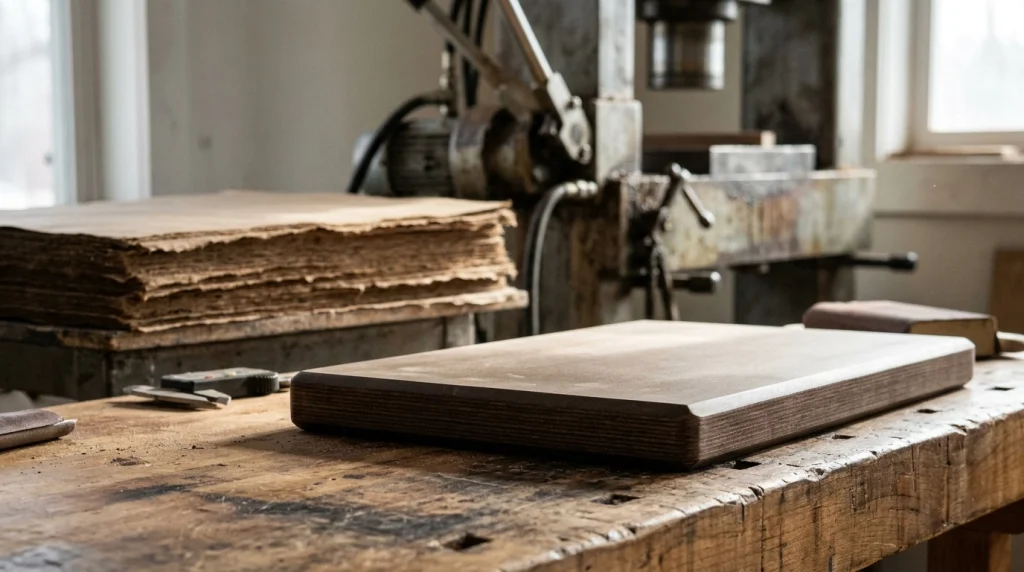
Manufacturers typically produce these boards through a controlled layering and curing process. The goal is to create a stable, durable surface from relatively thin materials.
- Prepare the paper: The manufacturer selects suitable paper sheets or rolls.
- Apply resin: Paper layers receive a bonding resin formulated for the intended material.
- Stack the layers: Multiple sheets create the desired thickness.
- Apply heat and pressure: The manufacturing process bonds and cures the layers.
- Shape the board: The finished material is cut, smoothed, and formed into a kitchen product.
- Inspect the product: Quality checks help verify consistent construction and appropriate performance.
The result can be considerably thinner than a traditional butcher block. That lighter construction appeals to cooks who frequently move boards between the counter and sink.
Are Paper Composite Cutting Boards Safe for Food Contact?
Yes, properly manufactured paper composite cutting boards can be safe for direct food contact. However, safety depends on the finished product’s materials, manufacturing quality, certification, and condition.
A board should not be considered food-safe simply because its packaging says it contains natural paper. The resin and finished surface matter just as much.
Food-Contact Certification Matters
Food-contact certification offers more meaningful evidence than vague marketing language. It helps buyers distinguish verified products from boards with limited material information.
For example, Epicurean identifies its Richlite-based cutting boards as NSF certified. NSF certification for an applicable cutting board indicates evaluation against relevant public health and sanitation requirements.
- NSF certification: Look for confirmation that the specific product meets applicable standards.
- Food-contact information: Check whether the manufacturer documents the board’s intended kitchen use.
- Care instructions: A reputable manufacturer should clearly explain washing and maintenance requirements.
- Product traceability: Clear brand, model, and manufacturer information makes verification easier.
A general safety statement does not automatically apply to every product made from the same material category. Verify the individual board rather than assuming all composites share identical qualifications.
Are Paper Composite Boards Nonporous?
Well-made paper composite boards have dense, resin-bonded surfaces that resist ordinary water absorption. However, calling every composite completely nonporous would oversimplify the differences between formulations.
Surface damage changes the picture. Cracks, separated layers, and deep grooves can create areas that become difficult to clean.
For that reason, I would prioritize the condition of the cutting surface over a manufacturer’s broad claim about water resistance. An intact surface is easier to maintain than a badly worn one.
Do Paper Composite Cutting Boards Contain Harmful Chemicals?
Paper composite cutting boards contain bonding resins, but resin content alone does not establish that a finished product is harmful. The important questions involve resin chemistry, proper curing, and food-contact suitability.
There is a difference between chemicals used during manufacturing and exposure from a finished, cured material. A properly manufactured product should meet the safety requirements applicable to its intended use.
Are Phenolic Resins Safe in Cutting Boards?
Some paper composite materials use phenolic resin systems. These are thermosetting materials that form hardened structures through a curing process.
Phenolic resin chemistry can involve substances that require careful control during manufacturing. However, the presence of phenolic resin does not by itself establish dangerous exposure from a finished cutting board.
Safety conclusions require evidence about the specific finished material and its potential migration into food. Buyers should look for relevant food-contact documentation rather than relying on broad claims that all resins are safe or unsafe.
Do They Contain Formaldehyde?
Some phenolic resin manufacturing processes involve formaldehyde chemistry. That does not mean every finished paper composite board releases harmful amounts of formaldehyde during ordinary use.
Actual exposure depends on the formulation, curing process, and finished-product characteristics. Manufacturers should be able to provide meaningful information about food-contact suitability.
If a board has an unexplained persistent chemical odor, unusual surface deterioration, or an unclear origin, I would avoid using it for food. Those signs cannot prove chemical exposure, but they justify caution.
Are Paper Composite Cutting Boards BPA-Free?
Some manufacturers market paper composite boards as BPA-free. However, BPA-free status should be verified for the particular product rather than assumed from its paper-based construction.
Remember that BPA-free does not automatically mean every possible food-contact concern has been resolved. Overall product testing and material suitability remain more useful indicators.
Can Composite Boards Release Microplastics?
Cutting any surface can produce wear particles, including fine material removed by repeated knife contact. Paper composite boards are not exempt from ordinary surface wear.
However, the amount and composition of particles depend on the particular board and how it is used. There is insufficient basis to claim that every paper composite board is entirely particle-free or that normal wear creates a specific health risk.
A practical approach is to prevent severe cutting damage and replace boards that begin shedding visible fragments. Avoid aggressive sawing and chopping techniques that unnecessarily damage the surface.
Are Paper Composite Cutting Boards Better Than Wood or Plastic?
 Save
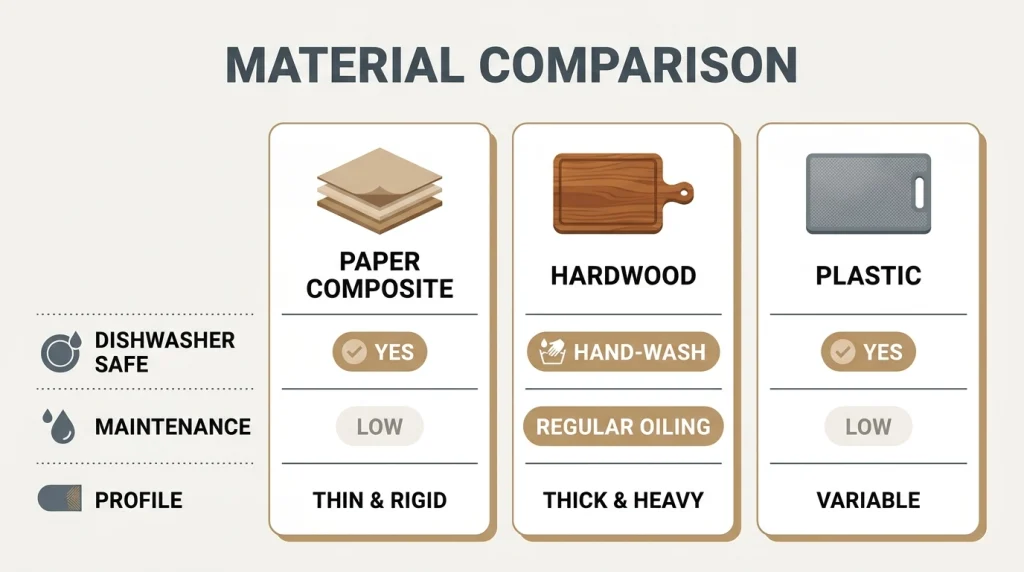
Paper composite boards offer a useful middle ground between wood and plastic. They combine relatively low maintenance with a thin, rigid design, although they are not automatically superior in every kitchen.
Wood can offer a forgiving cutting feel, while plastic is often inexpensive and easy to replace. Composite boards appeal most to cooks who want durability without regular oiling.
Cutting Board Material Comparison
| Feature | Paper Composite | Hardwood | Plastic |
|---|---|---|---|
| Common construction | Paper and cured resin | Solid or laminated wood | Usually polyethylene or polypropylene |
| Dishwasher compatibility | Many models, if approved | Generally hand-wash recommended | Many models, if approved |
| Regular oiling | Usually unnecessary | Often recommended | Unnecessary |
| Typical profile | Thin and rigid | Often thicker and heavier | Thin to thick |
| Knife marks | Possible with repeated use | Possible with repeated use | Possible with repeated use |
| Best suited for | Low-maintenance everyday prep | Traditional knife work | Budget-friendly food separation |
These are general material characteristics, not universal performance guarantees. Thickness, surface texture, brand, and maintenance can significantly affect the experience.
Which Material Is Best for Knife Edges?
Wood often provides a forgiving surface for knife work, especially when its grain and construction are appropriate. Quality composite boards can also be knife-friendly, although their firmer feel may not suit everyone.
Plastic boards vary widely in hardness and cutting performance. Glass and stone are generally poor choices for routine chopping because their hard surfaces can damage knife edges.
For a premium chef’s knife, I would compare surface feel, stability, and cleaning convenience before choosing. A board that moves during cutting is a safety problem regardless of its material.
Are Paper Composite Cutting Boards Safe for Raw Meat?
Yes, a food-contact-safe paper composite board can be used for raw meat when it is properly cleaned and sanitized. The most important concern is preventing cross-contamination between raw animal products and ready-to-eat foods.
According to the USDA, separating cutting boards for raw meat and fresh produce helps reduce contamination risks. This precaution matters for composite, wooden, and plastic boards alike.
How to Prevent Cross-Contamination
- Use separate boards: Keep one designated for raw meat, poultry, and seafood.
- Wash between foods: Clean the board before switching ingredients.
- Remove food residue: Scrub knife grooves and corners thoroughly.
- Sanitize when needed: Follow a suitable food-contact-surface sanitizer’s label.
- Dry completely: Avoid storing a wet board against another surface.
- Inspect regularly: Replace boards with damage that prevents effective cleaning.
For additional food safety guidance, review the four steps to food safety published by FoodSafety.gov.
How Do You Clean a Paper Composite Cutting Board Safely?
Cleaning a paper composite cutting board is usually straightforward. Wash it after every food preparation task, and follow its manufacturer’s dishwasher and sanitizing instructions.
The goal is to remove food residue, reduce contamination, and preserve the board’s surface. Stronger cleaning methods are not always better.
Step-by-Step Cleaning Instructions
- Remove scraps: Scrape remaining food into the trash before washing.
- Wash with soap: Use warm or hot water, dish soap, and a soft sponge or suitable brush.
- Scrub the surface: Pay attention to knife marks and textured areas.
- Rinse thoroughly: Remove soap and loosened residue with clean water.
- Sanitize when appropriate: Use a sanitizer approved for food-contact surfaces and follow its directions.
- Dry completely: Place the board upright or on a rack with good airflow.
These cleaning habits align with general guidance from the USDA Food Safety and Inspection Service. Proper cleaning matters even when the manufacturer describes a board as antimicrobial.
Can You Put Paper Composite Boards in the Dishwasher?
Many paper composite boards, including Epicurean’s Kitchen Series, are labeled dishwasher-safe. However, dishwasher compatibility depends on the particular manufacturer and product.
Never assume an unidentified composite board tolerates high-temperature cycles. Follow the care label and avoid washing methods that exceed the manufacturer’s recommendations.
Should You Oil a Paper Composite Board?
Most paper composite cutting boards do not require regular mineral oil or conditioning wax. Their resin-bonded surfaces differ from unfinished hardwood.
Applying unnecessary oils may leave a coating that attracts residue or changes the cutting feel. Unless the manufacturer specifically recommends conditioning, routine washing is usually enough.
What Are the Disadvantages of Paper Composite Cutting Boards?
Paper composite cutting boards have several practical limitations despite their durability and convenience. Understanding these drawbacks helps prevent disappointment after purchase.
- Firm cutting surface: Some cooks find the harder feel less comfortable than wood.
- Visible knife marks: Repeated chopping can leave permanent surface scratches.
- Possible slipping: Thin models without feet may need a non-slip mat.
- Higher purchase cost: Branded composite boards can cost more than basic plastic options.
- Limited refinishing: Resurfacing may not be practical or recommended by the manufacturer.
- Variable quality: Unverified products may lack clear information about resin chemistry and certifications.
One detail deserves special attention: lightweight boards can move when placed on wet or polished countertops. I would choose non-slip feet or use a clean, damp towel beneath a board that lacks them.
Are Paper Composite Cutting Boards Heat Resistant?
Some paper composite boards are designed to tolerate elevated temperatures, but heat resistance does not mean unlimited heat tolerance. Manufacturers may specify different limits for cutting, serving, and exposure to cookware.
Do not assume that a cutting board can replace a trivet. Very hot pans, direct flames, and prolonged heat exposure may damage materials or surface finishes.
Can You Put Hot Food on a Composite Board?
Serving warm cooked food is generally consistent with the intended use of a suitable food-contact board. However, placing an extremely hot pan directly on the surface is a different type of exposure.
Check the manufacturer’s heat instructions before using a board for hot cookware. If no temperature limit is provided, use a dedicated heat-resistant trivet instead.
How Long Do Paper Composite Cutting Boards Last?
A quality paper composite cutting board can remain useful for years with proper care. However, there is no reliable universal replacement schedule for every product.
Its lifespan depends on cutting frequency, knife technique, cleaning methods, surface condition, and manufacturing quality. A heavily used board may wear faster than one used occasionally for vegetables.
When Should You Replace Your Cutting Board?
 Save
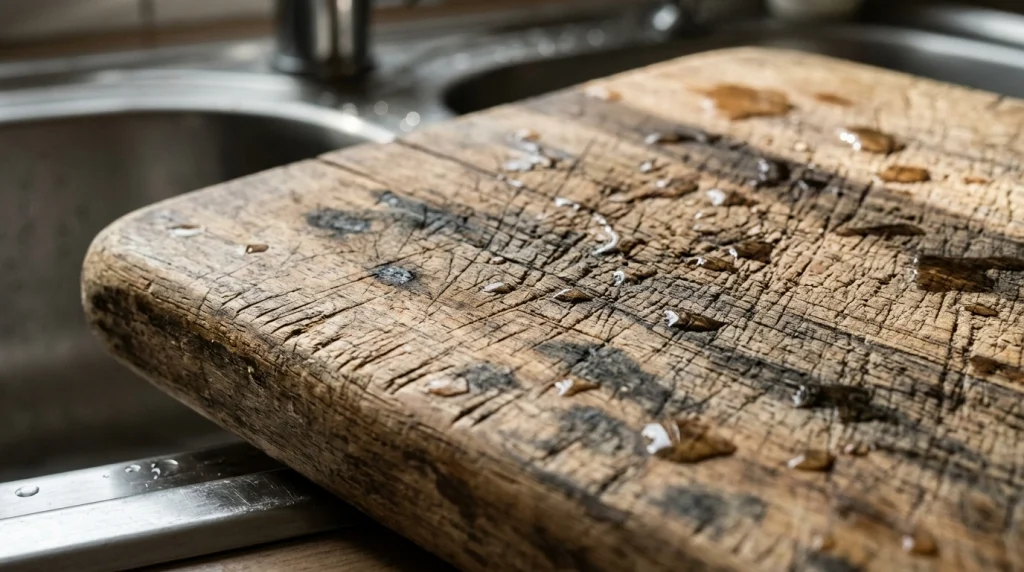
Replace a cutting board when its condition makes thorough cleaning difficult or when structural damage appears. Age alone is not the most useful replacement indicator.
- Deep grooves: Cut marks have become difficult to scrub clean.
- Cracking: The material develops visible fractures.
- Layer separation: Laminated sections begin lifting or peeling.
- Visible shedding: The board releases fragments during normal preparation.
- Persistent contamination: Food residue remains trapped in damaged areas.
- Loss of stability: Warping prevents the board from sitting securely on the countertop.
The University of Maine Cooperative Extension’s cutting board safety guidance also emphasizes replacing boards that develop excessive wear or hard-to-clean damage.
Are Paper Composite Cutting Boards Environmentally Friendly?
Paper composite boards can incorporate responsibly sourced paper and provide long service life. However, their environmental impact also includes resin manufacturing, transportation, durability, and end-of-life disposal.
Paper content alone does not make a finished product biodegradable. The cured resin can limit how a composite material is recycled or disposed of.
What Should Eco-Conscious Buyers Check?
- Paper sourcing: Look for credible sourcing documentation, such as applicable FSC certification.
- Product durability: A longer useful life can reduce frequent replacements.
- Manufacturing information: Favor brands that explain their materials and production practices.
- Disposal guidance: Confirm whether local recycling services accept the particular composite.
- Repair limitations: Understand whether surface damage can be addressed safely.
I would avoid treating words like natural, green, or sustainable as proof of a lower environmental footprint. Specific certifications and transparent manufacturing information are more meaningful.
How to Choose a Safe Paper Composite Cutting Board
The best paper composite board is one that fits your cooking habits while providing clear safety and care information. Certification, usable dimensions, and stability deserve more attention than color alone.
For a typical home kitchen, a medium board can offer enough space for vegetables and daily meal preparation. Larger boards become useful when handling substantial ingredients or multiple prep tasks.
Essential Buying Checklist
- Food-contact suitability: Choose a product with clear manufacturer documentation.
- Relevant certification: Check for independently verified standards when available.
- Useful size: A board around 14.5 × 11.25 inches provides practical space for common prep tasks.
- Stable base: Silicone feet or a non-slip mat help prevent movement.
- Cleaning compatibility: Confirm whether the product supports your preferred washing method.
- Appropriate thickness: Thin boards store easily, while thicker models may feel more substantial.
- Reliable manufacturer: Look for clear product information and customer support.
Best Paper Composite Cutting Boards to Consider
If you’re ready to choose a paper composite board, Epicurean offers several established options. These models serve different priorities, from simple everyday chopping to larger food-preparation tasks.
The product specifications below come from manufacturer information, while the suitability recommendations reflect the designs and features. The displayed ratings are manufacturer-reported customer ratings, not independent testing results.
Disclosure: The following Amazon links are affiliate links. A qualifying purchase may earn a commission at no additional cost to you.
🏆 Best for everyday use
Epicurean Kitchen Series Cutting Board
★★★★★ 4.9/5 manufacturer-listed customer rating
This paper composite board has a 1/4-inch profile, a hanging hole, and a reversible cutting surface. It is also dishwasher-safe and NSF certified. I favor this design for straightforward daily chopping because it avoids unnecessary features while remaining easy to store.
💧 Best for stability and juicy foods
Epicurean All-in-One Series Cutting Board
★★★★★ 4.9/5 manufacturer-listed customer rating
The All-in-One Series combines a reversible paper composite surface with a juice groove and four non-slip silicone feet. It is available in several sizes. I would choose this model when counter stability and liquid control matter more than having the simplest possible board.
🍽️ Best thicker premium option
Epicurean Gourmet Series Cutting Board
★★★★★ 4.9/5 manufacturer-listed customer rating
The Gourmet Series uses a thicker 3/8-inch profile and includes a juice groove on one side. Its reversible design provides a larger uninterrupted cutting surface on the other. I would prioritize this model for a more substantial serving and food-preparation board.
Frequently Asked Questions
Are Epicurean paper composite cutting boards food-safe?
Epicurean describes its paper composite cutting boards as food-safe and NSF certified. Their material combines paper layers with cured resin to form a durable cutting surface. Proper cleaning remains essential, and consumers should verify the certification and care instructions for their particular model.
Can bacteria grow on paper composite cutting boards?
Bacteria can contaminate any cutting board when food residue or raw meat juices remain on its surface. Paper composite boards should be washed after use and sanitized when appropriate. Deep scratches, cracks, or damaged layers increase cleaning difficulty and may justify replacement.
Are paper composite cutting boards safer than plastic?
Neither material is automatically safer in every kitchen. Food-contact compliance, cleaning habits, and board condition matter more than the material label alone. Both can be suitable for everyday food preparation when properly manufactured, maintained, and replaced after excessive wear.
Do paper composite cutting boards dull knives?
Paper composite cutting boards can cause normal knife-edge wear, just like other cutting surfaces. Quality boards are designed to be knife-friendly, although their cutting feel may be firmer than some wooden alternatives. Knife sharpness also depends on blade steel, technique, and cutting frequency.
Can paper composite cutting boards go in the dishwasher?
Many branded paper composite boards are dishwasher-safe, including several Epicurean collections. However, compatibility is product-specific and should never be assumed for an unknown board. Always follow the manufacturer’s instructions and inspect the board for changes in shape, surface condition, or bonding.
Final Verdict: Are Paper Composite Cutting Boards Worth Using?
Yes, paper composite cutting boards can be a safe and practical addition to a home kitchen. Their main advantages are easy cleaning, low maintenance, relatively light construction, and the availability of independently certified products.
The safest choice is not necessarily the most expensive model. It is the board with suitable food-contact materials, a stable surface, reliable cleaning instructions, and a design that matches your cooking habits.
As of 2026, Epicurean remains a useful example of a manufacturer offering documented paper composite products. That does not mean every alternative has equivalent certification or performance.
My recommendation is simple: choose a verified food-safe board, keep raw and ready-to-eat foods separate, and replace the board when damage prevents thorough cleaning. Those habits contribute more to practical kitchen safety than relying on a material’s marketing claims.
Ready to upgrade your cutting surface? Compare the Kitchen Series, All-in-One Series, and Gourmet Series to find the size and features that fit your daily food preparation.

