Do Bamboo Cutting Boards Dull Knives? What You Need to Know
Quick Answer
Yes, bamboo cutting boards can dull knives faster than softer, knife-friendly wooden boards. Bamboo’s hard surface and natural silica can contribute to edge wear, especially on thin, delicate chef knife blades. However, bamboo is much less damaging than glass or stone. For frequent chopping, I recommend maple, walnut, or suitable plastic boards. The University of Maine’s cutting board guidance also identifies knife dulling as a potential disadvantage of bamboo.
What Matters Most?
- Surface hardness: Bamboo offers less cushioning than many traditional cutting board woods.
- Natural silica: Mineral content may increase wear on fine knife edges.
- Knife design: Thin Japanese blades may be more vulnerable to edge damage.
- Cutting technique: Heavy chopping and sideways scraping increase unnecessary edge stress.
- Better alternatives: Maple, walnut, and appropriate plastic boards are practical options.
My Recommendation
- Keep an existing bamboo board for occasional preparation if it remains smooth and well maintained.
- Choose a quality wooden board for daily chef knife work, especially with a fine-edged knife.
Bamboo cutting boards look attractive, cost relatively little, and handle everyday kitchen tasks. But their reputation for durability raises an important question: are they too hard on your knives?
I’m Michael, and I believe choosing a cutting surface deserves as much attention as choosing a chef knife. This guide explains how bamboo affects sharpness, which materials offer better protection, and when keeping your bamboo board makes sense.
Why Do Bamboo Cutting Boards Dull Knives?
 Save
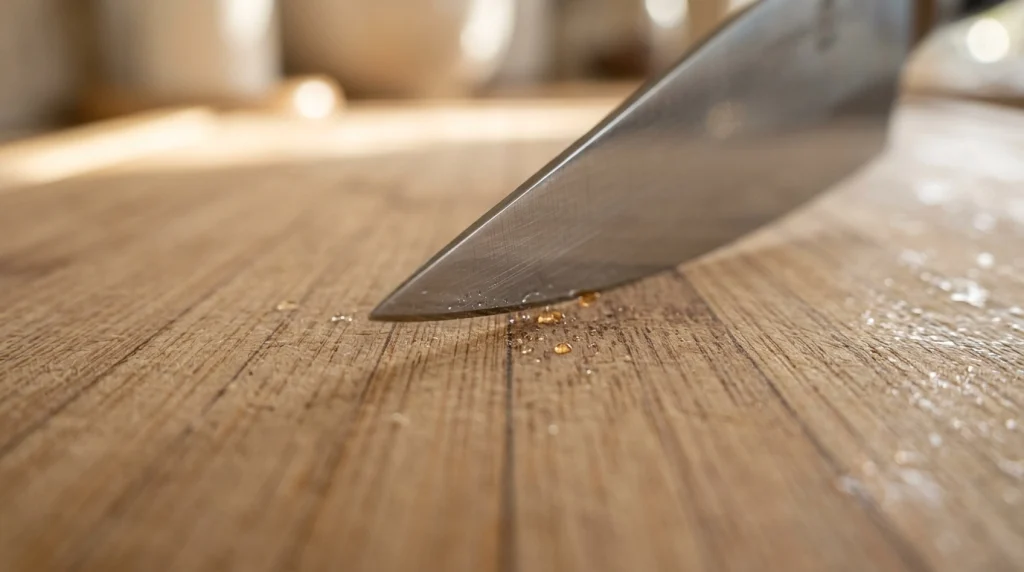
Bamboo boards can accelerate knife-edge wear because they combine a firm cutting surface with naturally occurring mineral content. The effect builds through repeated contact rather than ruining a blade immediately.
A knife edge is extremely thin. Even small changes along that edge can affect how easily it cuts food.
1. Bamboo Is Naturally Hard
Bamboo is a grass, not a hardwood tree. Nevertheless, many processed bamboo boards are harder and less forgiving than traditional maple or walnut boards.
The Wood Database’s cutting board material guidance explains why hardness matters. A cutting surface must resist excessive damage while remaining gentle enough for repeated knife contact.
When a sharp knife meets a firm surface, its edge experiences pressure. Repeated contact can gradually deform or wear the cutting edge.
2. Bamboo Contains Natural Silica
Silica is a naturally occurring mineral found in bamboo and many other plants. Its abrasive properties are one reason bamboo raises concerns among knife enthusiasts.
However, silica content varies, and an individual board’s actual effect depends on construction and use. It would be misleading to claim every bamboo board damages knives at the same rate.
3. Many Bamboo Boards Contain Glue Lines
Manufacturers commonly create cutting boards by bonding several narrow bamboo strips together. The resulting laminated construction produces an attractive, stable working surface when manufactured correctly.
Adhesive composition, strip orientation, and finishing quality can influence how a board behaves. Poorly finished joints or raised seams are especially undesirable around fine edges.
4. Cutting Technique Changes the Result
Heavy chopping applies more force to the blade and board than gentle slicing. Twisting the knife while its edge contacts the board can also increase stress.
I recommend using controlled movements instead of striking the surface aggressively. A properly sharpened knife should cut vegetables without excessive downward force.
How Much Faster Does Bamboo Dull a Knife?
There is no reliable universal percentage showing how much faster bamboo dulls every knife. Blade steel, sharpening angle, bamboo construction, cutting pressure, and testing conditions all influence the result.
One published cutting-board experiment illustrates why broad claims deserve caution. It evaluated different bamboo grain orientations using a controlled cutting procedure.
What Does Cutting-Board Testing Show?
A technical report from the Sharpening Handbook compared knife sharpness before and after 2,000 cuts. It used a Victorinox SWIBO knife with X50CrMoV15 steel and a specified cutting load.
The results were mixed. One bamboo configuration showed measurable dulling, while another did not show the same pattern.
| Board Orientation | Initial BESS | After 2,000 Cuts |
|---|---|---|
| Bamboo long-grain | 195 | 175 |
| Bamboo end-grain | 165 | 210 |
BESS means Brubacher Edge Sharpness Scale, a measurement of cutting-edge sharpness. Lower scores indicate sharper edges.
The end-grain bamboo sample became duller in this experiment. However, the long-grain sample registered a lower BESS score after testing, so the results do not establish a consistent dulling rate across all bamboo boards.
These measurements come from specific test conditions, not my own laboratory testing. See the published chopping-board experiment for its methodology and limitations.
Bamboo vs. Wood vs. Plastic: Which Cutting Board Is Best for Knives?
 Save
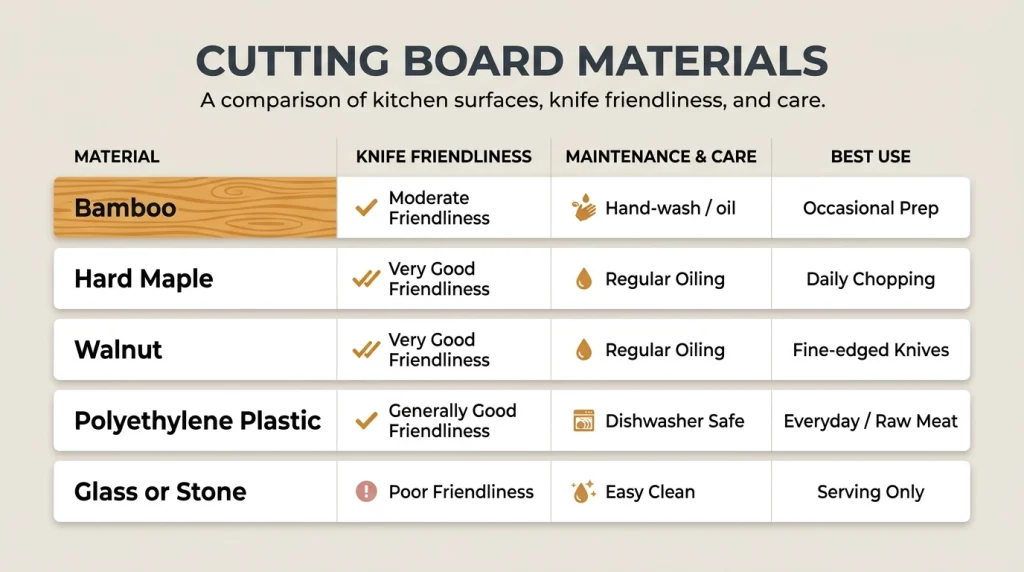
For protecting knife edges, I generally favor suitable hardwood or plastic boards over bamboo. Glass and stone are poor choices for routine knife work.
The comparison below summarizes practical material characteristics rather than claiming exact performance rankings from one experiment.
| Material | Knife Friendliness | Maintenance | Best Use |
|---|---|---|---|
| Bamboo | Moderate | Hand-washing and conditioning | Occasional food preparation |
| Hard Maple | Very good | Regular cleaning and oiling | Daily chopping |
| Walnut | Very good | Regular cleaning and oiling | Fine-edged knives |
| Polyethylene Plastic | Generally good | Easy cleaning; replace when deeply grooved | Everyday and raw-food preparation |
| Glass or Stone | Poor | Easy surface cleaning | Serving rather than cutting |
Maple Cutting Boards
Hard maple offers an effective balance between durability and knife friendliness. It is a traditional choice for butcher blocks and home kitchen cutting boards.
Both edge-grain and end-grain maple boards can work well. The best choice also depends on construction quality, cleaning habits, and budget.
Walnut Cutting Boards
Walnut is generally softer than hard maple and offers a pleasant cutting feel. Its darker color also makes it an appealing option for kitchens where appearance matters.
It still needs routine cleaning and occasional conditioning. A softer wood is not automatically maintenance-free.
Plastic Cutting Boards
Food-grade polyethylene boards provide an affordable alternative to wood. Many models are dishwasher-safe, although you should always check the manufacturer’s instructions.
Plastic eventually develops knife marks. Replace a board when deep grooves become difficult to clean properly.
Are Bamboo Cutting Boards Bad for Japanese Knives?
Bamboo can be a less suitable choice for thin Japanese chef knives, particularly those with hard steel and acute edge angles. These blades often prioritize precision cutting over resistance to sideways force or hard impacts.
A gyuto or santoku can perform beautifully on a suitable wooden board. I would avoid heavy chopping, twisting, and scraping with its sharpened edge.
Japanese vs. Western Chef Knife Edges
Japanese and Western chef knives do not all use identical steels or edge geometries. Nevertheless, some broad design differences help explain their behavior.
- Thin Japanese edges: Often provide excellent slicing performance but may be more vulnerable to chipping under unsuitable use.
- Western chef knife edges: Frequently prioritize toughness and versatility, although their sharpness still requires maintenance.
- Blade geometry: Edge angle and thickness matter alongside steel hardness.
- Cutting technique: Controlled slicing helps both categories maintain useful edges.
For someone investing in a premium Japanese knife, I recommend budgeting for a suitable board too. Protecting the edge is part of protecting the knife investment.
Can Bamboo Cutting Boards Damage or Chip Knives?
Yes, edge damage is possible, but routine cutting on bamboo does not guarantee chipping. Knife geometry, technique, existing edge condition, and board construction affect the risk.
Dulling and chipping are different problems. Knowing the difference helps you choose the correct remedy.
- Dulling: The edge gradually loses cutting performance through wear or deformation.
- Rolling: A thin portion of the edge bends away from its intended alignment.
- Chipping: Small pieces of metal break away from the cutting edge.
- Scratching: Surface marks appear on the blade, although they do not necessarily indicate edge failure.
Minor edge wear often responds to routine sharpening or appropriate honing. Visible chips usually require more deliberate sharpening to restore a continuous cutting edge.
How Can You Tell If Your Cutting Board Is Dulling Your Knife?
 Save
Watch for worsening cutting performance during normal food preparation. A knife that recently cut cleanly but now struggles with soft produce may need edge maintenance.
One test alone cannot prove the board caused the problem. Still, several observations can help you investigate.
Simple Signs to Watch
- Tomato skin resistance: The knife slips or presses into the skin rather than starting a clean cut.
- Crushed herbs: Delicate leaves bruise instead of separating cleanly.
- Increased effort: You need noticeably more pressure for familiar cutting tasks.
- Rough cuts: Food edges look torn rather than smoothly sliced.
- Frequent sharpening: Your knife loses useful sharpness sooner than expected under comparable use.
A Practical At-Home Comparison
If you own both bamboo and maple boards, compare how your knife performs during ordinary preparation. Use the same knife, similar foods, and controlled cutting technique.
- Begin with a properly sharpened, undamaged knife.
- Record how easily it slices a tomato before using either board.
- Perform comparable cutting tasks on the first board.
- Check cutting performance again using similar produce.
- Repeat on another occasion with the second board and a freshly restored edge.
- Compare observations without assuming a small difference proves causation.
This is a household comparison, not a scientifically controlled sharpness test. Differences in food, force, and edge condition can influence your impression.
How Do You Prevent Bamboo Cutting Boards From Dulling Knives?
You cannot eliminate every source of edge wear, but you can reduce unnecessary damage. A few simple habits make bamboo more practical for everyday cooking.
Use Gentle, Controlled Cutting Movements
Let the knife’s sharp edge perform the cutting instead of applying excessive pressure. Avoid pounding vegetables against the board.
Keep the blade aligned with each cut. Don’t twist it while its edge remains pressed against the surface.
Avoid Scraping With the Sharp Edge
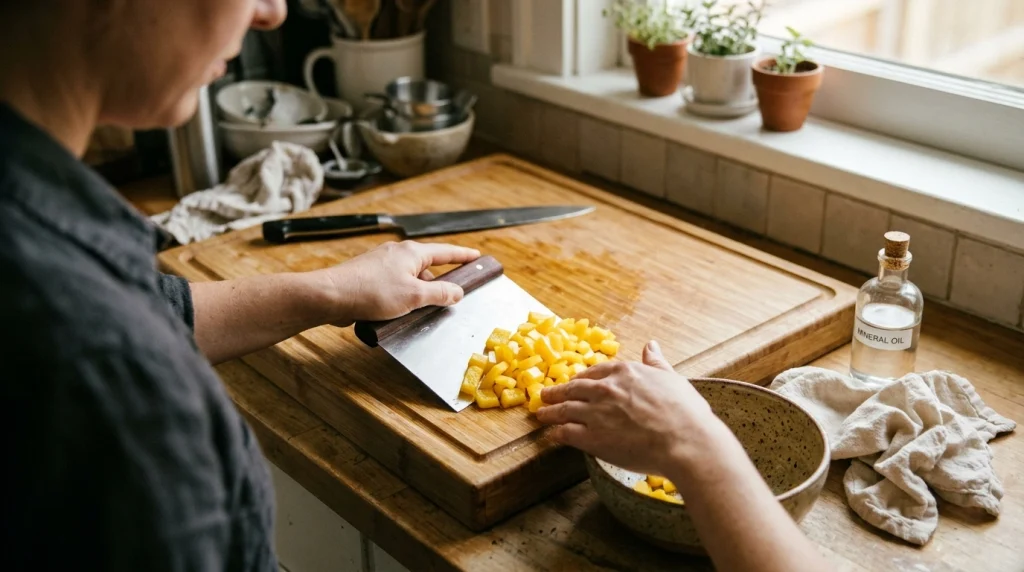
Moving chopped vegetables into a bowl is a common kitchen task. However, scraping sideways with the cutting edge adds unnecessary contact and possible deformation.
Turn the knife over and use its spine when appropriate. A dedicated bench scraper is another useful option.
Maintain a Smooth Cutting Surface
Inspect bamboo boards for raised joints, cracks, splinters, and rough patches. Stop using a board for food preparation if damage makes thorough cleaning difficult.
Some solid wooden boards can be professionally or carefully refinished. Laminated bamboo boards with separated joints may be better replaced.
Keep Your Knife Properly Sharpened
Regular edge maintenance reduces the temptation to force a dull knife through food. The correct sharpening method depends on the blade manufacturer’s guidance.
A ceramic honing rod or suitable whetstone can be useful for certain knives. Avoid aggressive sharpening techniques that remove more steel than necessary.
How Should You Clean and Maintain a Bamboo Cutting Board?
Clean bamboo boards promptly after use, and dry them thoroughly. Proper maintenance helps prevent cracking, warping, and hard-to-clean damage.
The USDA’s cross-contamination guidance emphasizes washing cutting surfaces between food items and replacing excessively worn boards.
Recommended Cleaning Routine
- Remove food scraps immediately after preparation.
- Wash the board with hot, soapy water and a clean sponge or brush.
- Rinse thoroughly with clean water.
- Dry the surface with a clean towel.
- Allow the board to air-dry completely before storage.
- Apply food-grade mineral oil when the board appears dry, following manufacturer guidance.
Avoid prolonged soaking, and don’t place laminated bamboo boards in a dishwasher unless the manufacturer explicitly approves it. Excess heat and moisture can damage bonded construction.
Separate Raw Meat and Ready-to-Eat Food
Use separate cutting boards for raw meat and fresh produce when possible. This reduces cross-contamination risks during food preparation.
The University of Illinois Extension’s cutting board guidance provides additional food-safety recommendations. Replace boards with deep, difficult-to-clean grooves regardless of their material.
Should You Replace Your Bamboo Cutting Board?
You don’t necessarily need to discard a smooth, well-maintained bamboo board. Occasional use with a sturdy knife is different from demanding daily chopping with a delicate blade.
However, I would consider switching if preserving sharpness is a top priority. A maple or walnut board is a sensible long-term kitchen upgrade.
Keep Your Bamboo Board If:
- You use it occasionally for light food preparation.
- The surface remains smooth, intact, and easy to clean.
- Your knife maintains satisfactory sharpness with normal care.
- You prefer its lightweight construction and convenient storage.
Consider Replacing It If:
- You frequently use thin, hard Japanese chef knives.
- You perform substantial chopping every day.
- The board has cracks, separated joints, or deep grooves.
- You want a more forgiving cutting surface for your primary knife.
You can also keep an intact bamboo board for serving cheese, bread, or other foods that need minimal cutting. This lets you reserve a knife-friendly board for intensive preparation.
What Should You Look for in a Knife-Friendly Cutting Board?
Material matters, but it shouldn’t be the only buying consideration. A board also needs to remain stable, provide enough workspace, and suit your cleaning routine.
For an everyday chef knife, I would evaluate these features before purchasing.
- Suitable material: Maple, walnut, or food-grade polyethylene are dependable starting points.
- Practical size: Around 18 by 12 inches offers useful workspace for many home kitchens.
- Stable base: The board should not slide during chopping.
- Reliable construction: Look for smooth edges, secure joints, and no visible defects.
- Appropriate thickness: Choose a board that feels stable without being unnecessarily difficult to move.
- Realistic maintenance: Select a surface you can clean and care for consistently.
In 2026, buyers can choose from many established wood and plastic cutting-board designs. I would prioritize construction and suitability over marketing claims about universal knife protection.
Recommended Cutting Boards for Chef Knives
If you’re ready to move beyond bamboo, these three established products are worth comparing. My selections focus on material, intended use, and design rather than unverified hands-on testing.
The scores below are editorial suitability assessments, not customer-review averages or laboratory performance ratings.
🏆 Best Everyday Wood Choice
John Boos Maple Edge-Grain Cutting Board
★★★★½ 4.5/5 editorial fit
A traditional hard-maple construction suited to regular slicing and chopping. I favor this type of board for everyday chef knife work because it balances durability and a comparatively forgiving cutting surface. Check the dimensions of the specific model before ordering.
💰 Best Easy-Care Alternative
OXO Good Grips Utility Cutting Board
★★★★☆ 4/5 editorial fit
This nonporous plastic board offers an alternative to wood maintenance, with a practical everyday format. I would consider it for cooks who value simple cleaning, easy handling, and separate preparation surfaces. Inspect it regularly for deep knife grooves.
🔪 Best Premium Wood Option
The Boardsmith Maple End-Grain Cutting Board
★★★★½ 4.5/5 editorial fit
This end-grain maple design is aimed at cooks seeking a substantial wooden preparation surface. I would shortlist it for a dedicated chopping station, particularly when long-term board care is part of the routine. Its weight and conditioning requirements deserve consideration.
Disclosure: As an Amazon Associate, the site may earn from qualifying purchases made through eligible links, at no additional cost to you.
Frequently Asked Questions
Do Bamboo Cutting Boards Dull Knives Faster Than Wood?
Bamboo can dull knives faster than suitable maple or walnut boards because its hard surface and natural silica may increase edge wear. However, the actual difference depends on board construction, blade steel, edge geometry, and cutting habits. Not every bamboo board performs identically.
Are Bamboo Cutting Boards Safe for Expensive Knives?
A bamboo board will not automatically damage an expensive knife, but it may be less forgiving than suitable wood. For thin Japanese blades or premium chef knives, I recommend maple or walnut for frequent cutting. Avoid forceful chopping and sideways blade movement regardless of the board material.
Is Bamboo Better Than Plastic for Knife Sharpness?
Good-quality polyethylene plastic is generally a practical choice for maintaining knife edges, although individual boards vary. Bamboo offers a firmer surface that may cause more edge wear. Plastic also develops grooves and must be replaced when those marks become too difficult to clean.
Does Oiling a Bamboo Cutting Board Stop Knife Dulling?
No. Food-grade mineral oil helps maintain the board and reduce moisture-related damage, but it does not remove bamboo’s natural hardness or silica content. Regular conditioning can support the board’s lifespan without making it equivalent to a softer wood cutting surface.
What Is the Best Cutting Board Material for Sharp Knives?
Hard maple and walnut are strong choices for preserving sharp chef knife edges during ordinary kitchen use. Suitable polyethylene boards also work well, especially for convenient cleaning. Avoid glass, marble, and stone for routine cutting because their rigid surfaces are particularly unfriendly to knife edges.
Final Verdict: Are Bamboo Cutting Boards Worth Using?
Yes, bamboo cutting boards can dull knives, but that doesn’t make them useless. Their durability, affordability, and moisture resistance still make them convenient for occasional kitchen tasks.
For daily chopping, I would choose maple, walnut, or a suitable plastic board. Those materials offer a more practical balance between cutting performance, care, and edge protection.
If you already own bamboo, keep it clean, smooth, and properly conditioned. But when you upgrade your chef knife, consider upgrading the cutting surface as well.
My final advice: Choose a cutting board that protects your knife, stays stable during use, and fits your cleaning routine. Good knives deserve thoughtful everyday care.

