Do Cutting Boards Need to Be Made in a Certified Facility?
Quick Answer
No, cutting boards sold for home use in the United States do not need to be made in a certified facility. The law regulates the materials that touch food, not the workshop itself, so a board is legal to sell when its wood, plastic, glue, and finish all meet food-contact rules. Once you learn how to use a cutting board safely, the facility question matters far less than the material and the care.
What actually decides if a board is legal and safe
- FDA material rules: Every food-contact substance must fall under Title 21 of the Code of Federal Regulations.
- No FDA approval: The FDA does not approve or certify finished cutting boards, only the substances in them.
- NSF is voluntary: NSF certification is a third-party listing, yet many commercial kitchens and inspectors require it.
- Local rules govern: The FDA Food Code is a model code, so your health department has the final say.
- Sellers carry risk: Makers stay responsible for safe materials, honest claims, and a clean, documented process.
Check before you buy or sell
- Ask the maker to name the wood species, glue, and finish, then confirm each one is food-contact safe.
- For restaurant use, search the exact board model in the NSF certified-product listing before you order.
I first heard this question at a craft fair, from a buyer holding one of my maple boards. She asked if my shop was certified, and I had to admit I had never heard of a cutting board facility certificate.
That moment sent me down a research path. This guide shares what I found, so you can buy or sell with confidence.
What does “certified facility” mean for cutting boards?
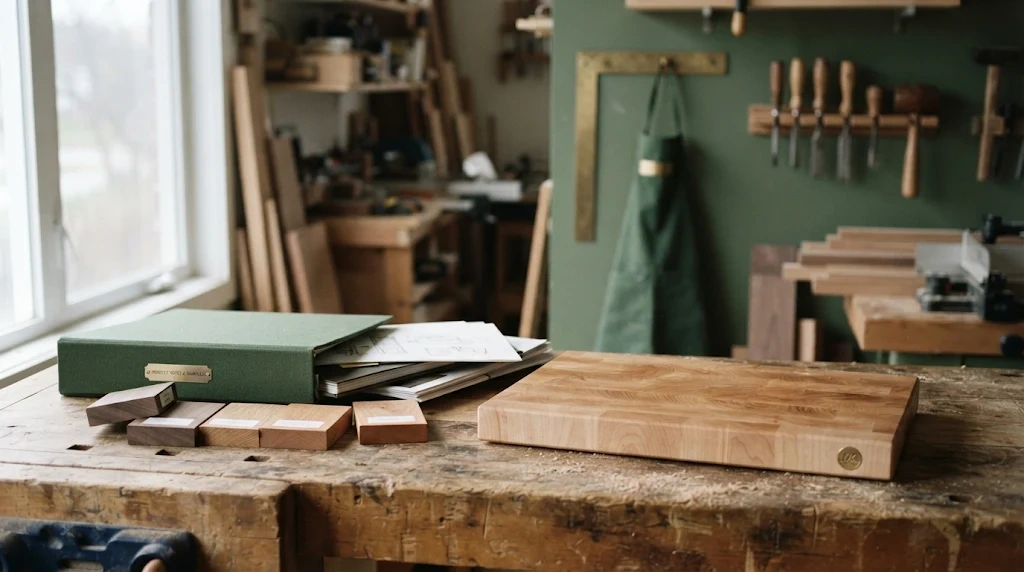
A certified facility is a workshop or factory that an outside body has inspected and listed against a written standard. The certificate covers the site, its process, and its records, not a single finished board.
No single certificate covers every cutting board maker. The term usually points to one of three different things, and people mix them up.
- FDA compliance: the materials meet food-contact rules in Title 21 of the Code of Federal Regulations.
- NSF certification: a finished product is tested and listed under a standard such as NSF/ANSI 2.
- Food facility registration: a site that makes or handles food itself registers with the FDA, which is a different world from making boards.
Do cutting boards need to be made in a certified facility?
No, there is no federal law in the United States that requires a home cutting board to come from a certified facility. A small maker can build boards in a home workshop and sell them legally, as long as the materials are food-contact safe.
That answer surprises most people. It surprised me too, because “food safe” sounds like it should need a stamp.
Commercial kitchens are a different story. A restaurant buyer or health inspector may demand an NSF-listed board, even though no federal rule forces every board maker to get listed.
Why the confusion is so common
Listings online often say “FDA approved” or “FDA certified” next to a cutting board. Those phrases sound official, yet neither one describes a real status for a finished board.
The FDA clears substances, not products. A plastic resin, a glue, or a finish can comply with a specific section of Title 21, and that compliance belongs to the substance and its conditions of use.
What does the FDA actually require?
The FDA requires every material that touches food to comply with its food-contact rules. Those rules live mainly in Title 21 of the Code of Federal Regulations, Parts 170 through 199.
The agency does not test your board before sale. It sets the permitted substances, and the maker must use them correctly and keep proof from suppliers.
- Plastics: common board plastics such as HDPE and polypropylene fall under 21 CFR 177.1520.
- Rubber: rubber articles used with food must meet 21 CFR 177.2600.
- Adhesives: glue used in a laminated board must comply with 21 CFR 175.105.
- Coatings: a resinous or polymeric finish must meet 21 CFR 175.300.
Each citation covers a substance under stated conditions. A glue that is safe behind a barrier may not be safe as an exposed food-contact layer, so the detail matters.
Makers should keep letters of guarantee from every material supplier. Those letters name the regulation each substance complies with, and they form the backbone of a compliance file.
You can read the current food-contact rules on the FDA food pages. I check them before I switch a glue or finish, because the listings change over time.
When does NSF certification matter?
NSF certification matters most in commercial kitchens, schools, hospitals, and other inspected food operations. It is a voluntary third-party listing, yet many local health departments treat it as a practical requirement.
The main standard for food equipment is NSF/ANSI 2. It sets sanitation rules for materials, design, fabrication, and cleanability, and cutting boards used as worktops fall within its scope.
Here is the trap I see most often. A seller claims a board is “made from NSF material,” which proves almost nothing about the finished board.
Only a listing for the exact model counts. Search the model number in the NSF certified-product listing on the NSF website before you buy for a commercial kitchen.
What NSF testing checks on a board
NSF testing looks at cleanability first. Surfaces must be smooth, free of hard-to-clean seams, and able to stand up to the cleaning routine the kitchen actually uses.
Wood boards face extra checks under NSF/ANSI 2. The wood must pass hardness and shear-strength testing, and a board used as a worktop must be readily removable and weigh no more than 50 pounds.
Are wood cutting boards allowed in restaurants?
Yes, wood cutting boards are allowed in many restaurants, within clear limits. The FDA Food Code permits hard maple, or an equivalently hard, close-grained wood, for cutting boards, cutting blocks, bakers’ tables, and utensils.
The relevant section is Food Code 4-101.17. It limits wood as a food-contact surface in general, then carves out this specific exception for boards.
Condition matters as much as species. Section 4-501.12 requires cutting surfaces to stay cleanable, so a deeply scored board must be resurfaced or replaced.
- Species: hard maple or an equally hard, close-grained wood.
- Condition: no deep grooves, cracks, or open glue joints that trap food.
- Cleanliness: no residue, odor, or staining that points to poor sanitizing.
- Storage: stored clean and dry, off wet surfaces, with air flow around it.
Some inspectors still prefer plastic in a commercial kitchen. Plastic is non-porous, runs through a commercial dishwasher, and shows soil at a glance.
Home use vs commercial use vs selling: what changes?
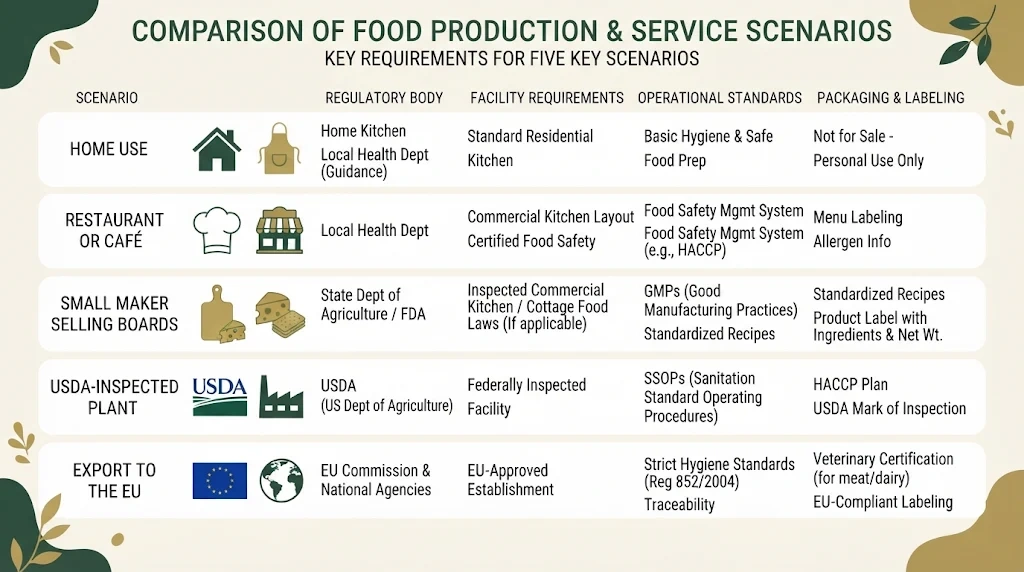
The same board faces three very different sets of expectations. A home cook, a restaurant, and a maker each answer to a different audience.
The table below sums up the split as of 2026.
| Situation | Certified facility needed? | What matters most |
|---|---|---|
| Home use | No | Food-safe materials, sound finish, good cleaning habits |
| Restaurant or café | Often, in practice | NSF-listed model, local health code, cleanable surface |
| Small maker selling boards | No, federally | Compliant glue and finish, supplier letters, honest claims |
| USDA-inspected plant | Yes, for the plant | Non-absorbent, smooth, easily cleanable surfaces |
| Export to the EU | No single certificate | Declaration of Compliance under Regulation (EC) 1935/2004 |
The USDA row deserves a note. Plants inspected by the Food Safety and Inspection Service must use equipment that meets strict sanitation rules, and that pushes them toward plastic boards.
You can find the agency’s food safety guidance on the USDA FSIS site. Home makers do not fall under that regime, but the material logic still helps.
What should makers check before selling cutting boards?
Makers carry the legal risk, even without a facility certificate. A buyer trusts your claims, and a regulator can ask for your paperwork at any point.
I learned this the slow way. My first batch used a glue I liked for furniture, and only later did I check whether it was rated for food contact.
It was not the right glue for an exposed joint. I remade the batch, and now I check every adhesive before it touches a board.
Wood, glue, and finish: the three checks that count
Start with the wood species. Hard, close-grained woods such as maple, walnut, and cherry are the usual picks, and each one needs a food-safe finish to seal it.
Next, check the glue. A laminated board lives or dies by its joints, so use an adhesive with a food-contact compliance statement from its maker.
Then check the finish. Food-grade mineral oil and board wax are the common safe choices, while Danish oil and other hardening finishes need a closer look at their ingredients.
If you want a step-by-step build, my guide to how to make an end-grain cutting board walks through the process. The build steps matter, but the material checks come first.
Paperwork and claims
Keep a simple file for each board design. Supplier letters, safety data sheets, and finish labels take little space and answer most questions.
Watch your wording on listings. Say “made with FDA-compliant materials” only when you can name the regulation for each one, and never claim “FDA approved” for a finished board.
Finally, check local business rules. A business license, a sales tax permit, and a clean workshop matter more in practice than any facility certificate.
Selling boards can pay well when the basics are right. My notes on whether you can make money selling cutting boards cover pricing, demand, and the costs people forget.
How can buyers spot a safe cutting board?
Buyers cannot inspect a factory, but they can ask five sharp questions. The answers tell you more than any badge on a listing.
- What wood or plastic is it? Look for a named species or resin, not just “hardwood” or “plastic.”
- What glue holds it together? A maker who knows the glue brand and its food-contact status is a good sign.
- What finish is on it? Food-grade mineral oil, beeswax blends, and named board finishes are the usual safe answers.
- Is the exact model NSF-listed? This matters for commercial use, and the listing should match the model number.
- What care does it need? Clear oiling, cleaning, and resurfacing guidance shows the maker understands the product.
Plastic has its own questions. My guide to whether plastic cutting boards are safe covers microplastics, wear, and when to replace one.
If sanitation is your top priority, my guide to what is the most sanitary cutting board compares wood, plastic, and composite on cleanability and care. The winner depends on how you clean it, not just what it is made from.
Do imported cutting boards face extra rules?
Imported boards must meet the same food-contact rules as domestic ones. The FDA can hold a shipment at the port when the materials look non-compliant or the paperwork is thin.
Importers should hold supplier declarations for every food-contact layer. That means the board material, the glue, the finish, and any coating on the surface.
Europe works on a similar principle with different paperwork. Regulation (EC) 1935/2004 sets the framework, and sellers need a Declaration of Compliance for the finished article.
For everyday food safety habits at home, FoodSafety.gov is a solid starting point. Its guidance on cleaning, separating raw meat, and storage pairs well with a good board.
What I do in my own workshop
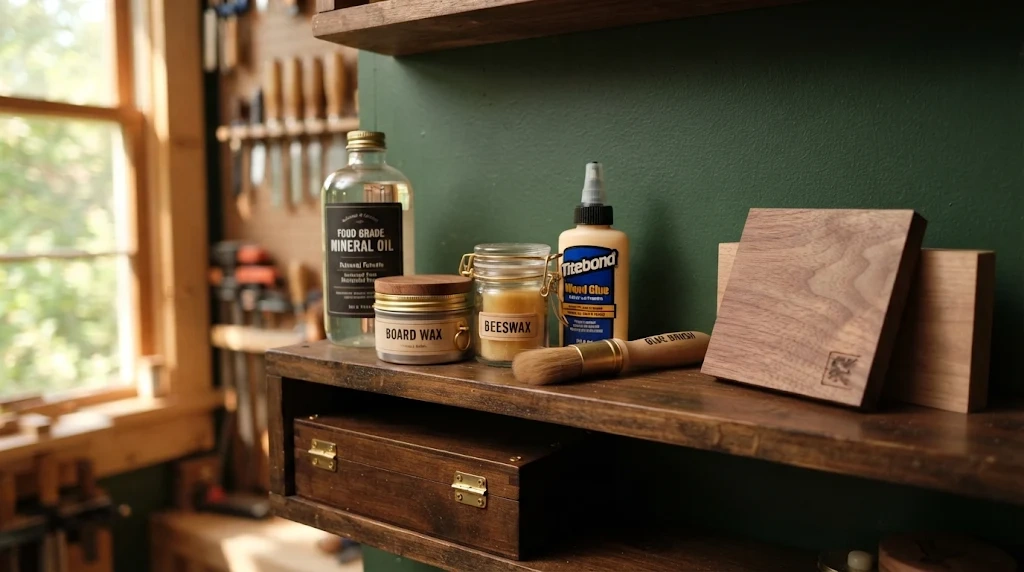
I run a small home workshop, and I have never held a facility certificate. My safety system is simpler, and it fits on one shelf.
Every material I buy goes into a folder with its supplier letter. If a letter is missing, the material does not go into a board.
I keep food-contact glue, oil, and wax apart from my furniture finishes. A single shelf mix-up could put the wrong finish on a board, so separation is my rule.
I also test each new finish on a scrap piece first. I oil it, wash it, dry it, and cut on it for a week, and that habit once caught a finish that turned tacky after three washes.
If you’re ready to pick one, here’s what I’d actually recommend:
🏆 Best Overall
John Boos Maple Edge Grain Cutting Board
★★★★★
Hard maple edge-grain board, NSF certified in listed models, with a reversible flat surface. I reach for mine daily because it stays kind to knives and cleans up fast.
💰 Best Budget
OXO Good Grips Plastic Cutting Board Set
★★★★☆
Dishwasher-safe polypropylene boards with non-slip edges, sold as a set for raw meat and produce. I keep a set for chicken nights because they sanitize in one wash.
🧑🍳 Best for Commercial Kitchens
Epicurean Kitchen Series Cutting Board
★★★★☆
Thin paper-composite board, heat resistant to 350°F, dishwasher safe, with NSF-certified models in the range. I use mine for prep work where a slim, light board helps.
Frequently Asked Questions
Does the FDA approve cutting boards?
No, the FDA does not approve or certify finished cutting boards. It clears the substances used in them under Title 21 of the Code of Federal Regulations, and the maker must use compliant materials.
Do I need NSF certification to sell cutting boards?
No, NSF certification is voluntary for most makers selling to home cooks. It becomes important when you sell to restaurants, schools, or hospitals, because their inspectors often require NSF-listed equipment.
Can I make cutting boards at home and sell them?
Yes, you can make and sell boards from a home workshop in most places. Use food-contact-safe wood, glue, and finish, keep supplier paperwork, and check your local business license and sales tax rules.
What wood is allowed for commercial cutting boards?
The FDA Food Code allows hard maple or an equivalently hard, close-grained wood for cutting boards. The board must stay in good repair and remain cleanable, or it must be resurfaced or replaced.
How do I verify an NSF claim on a cutting board?
Search the exact model number in the NSF certified-product listing and check that the listing matches the product. A claim about “NSF material” alone does not prove the finished board is certified.
The takeaway
Cutting boards do not need a certified facility, but they do need honest materials and a careful maker. That is the real test, whether you buy one board or sell a hundred.
Ask about the wood, the glue, and the finish before you buy. Keep the paperwork if you sell, and check the NSF listing when a commercial kitchen is involved.
Got a board you love, or a maker question I missed? Drop a comment below, and I will answer it in a future guide.