
Can You Make Money Selling Cutting Boards? A Complete Profit Guide
Quick Answer
Yes, you can make money selling cutting boards, especially handmade hardwood boards, personalized gifts, and premium designs. Profit depends on your materials, labor, selling price, shipping costs, and customer demand. Platforms like Etsy’s handmade marketplace can help you reach buyers, while local markets offer opportunities to sell without shipping individual orders. The key is charging enough to cover every cost and pay yourself fairly.
What Determines Your Profit?
- Material costs: Hardwood, adhesives, finishes, and packaging affect your production expenses.
- Labor time: Cutting, gluing, sanding, finishing, and personalization must be included in your pricing.
- Board design: Custom engraving and premium construction can justify higher prices when buyers value them.
- Sales channels: Online platforms, craft fairs, and direct orders have different fees and customer acquisition costs.
- Production efficiency: Making several boards together can reduce labor time per finished piece.
A Practical Starting Point
- Start small: Make three quality designs, calculate your true costs, and test buyer interest before investing heavily.
Turning a woodworking hobby into a small business sounds appealing. Cutting boards are useful, customizable, and attractive enough to make thoughtful gifts.
However, a beautiful board doesn’t automatically produce a profitable sale. I’ll walk through realistic pricing examples, startup expenses, selling options, and practical ways to protect your earnings.
Is Selling Cutting Boards a Profitable Business?
Selling cutting boards can be profitable when your selling price covers production, labor, overhead, and selling expenses. Success depends on finding customers willing to pay for your workmanship.
A handmade cutting board business involves creating or sourcing boards and selling them to customers. Your product might be a simple chopping board, a decorative serving board, or a personalized gift.
There are several reasons this business can appeal to woodworkers:
- Practical demand: Cutting boards serve a regular purpose in home kitchens.
- Gift potential: Personalized boards can suit weddings, housewarmings, and holidays.
- Product variety: Different woods, shapes, sizes, and finishes create distinct options.
- Flexible production: You can begin with small batches instead of manufacturing hundreds of pieces.
- Repeatable designs: Standard patterns can simplify cutting, assembly, and finishing.
The challenge is standing out from inexpensive, mass-produced boards. Competing only on price can leave little money for your time.
Can beginners make money selling cutting boards?
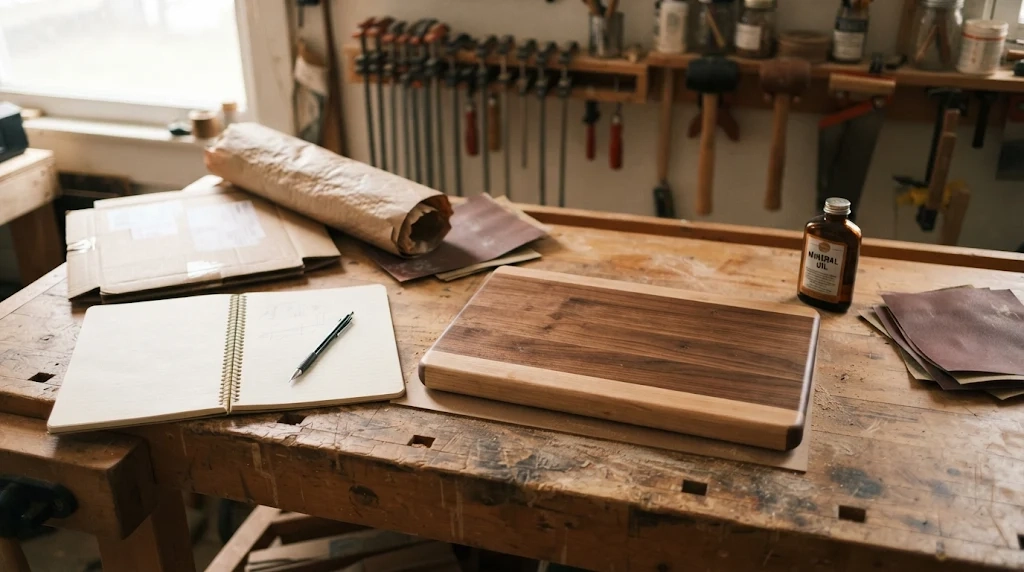
Yes, beginners can earn money, but their first goal should be consistent quality and accurate pricing. Woodworking skill alone doesn’t guarantee profitable orders.
I’d start with a straightforward edge-grain board rather than an elaborate end-grain pattern. It requires fewer assembly stages and makes production costs easier to estimate.
A beginner should focus on:
- One reliable hardwood species.
- Two or three standard board sizes.
- Safe, repeatable construction methods.
- Accurate measurements and smooth finishing.
- Clear customer care instructions.
How Much Money Can You Make Selling Cutting Boards?
Your earnings depend on how much remains after paying every expense. Selling a board for $95 doesn’t mean you’ve earned $95.
Let’s calculate the economics of a hypothetical handmade hardwood cutting board sold online.
Example: Profit from a $95 cutting board
Assume a board sells for $95 with free domestic shipping. The following numbers are an illustrative budget, not verified industry averages or guaranteed results.
| Expense | Amount |
|---|---|
| Hardwood lumber | $18.00 |
| Glue, finish, and sandpaper | $5.00 |
| Packaging | $4.00 |
| Shipping postage | $10.00 |
| Allocated workshop overhead | $5.00 |
| Labor: 1.5 hours at $20/hour | $30.00 |
| Estimated U.S. Etsy fees | $9.48 |
| Total estimated costs | $81.48 |
| Profit after paying labor | $13.52 |
This example uses Etsy’s published U.S. listing fee, transaction fee, and payment processing rate. It excludes advertising charges, refunds, business income taxes, and other situation-specific expenses.
Notice that the $30 labor allowance is already included. The remaining $13.52 is business profit before taxes, not your entire compensation.
How does your selling price change your earnings?
Keeping production costs constant reveals how strongly pricing affects profitability. Here’s the same board at three different selling prices.
| Selling Price | Estimated Etsy Fees | Profit After Labor |
|---|---|---|
| $75 | $7.58 | -$4.58 |
| $95 | $9.48 | $13.52 |
| $120 | $11.85 | $36.15 |
These calculations assume one listing fee per sale, U.S. Etsy Payments rates, and no additional advertising costs. Actual fees vary by country and transaction.
The $75 board loses money after paying the planned hourly wage. A higher price improves the result only when customers are willing to pay it.
How Should You Price Handmade Cutting Boards?
A profitable price includes material expenses, labor, overhead, selling fees, fulfillment, and a business profit allowance. Calculating only the wood cost leads to underpricing.
I prefer building a price from costs first, then comparing it with similar products. That shows whether the design is commercially realistic.
A simple cutting board pricing formula
Required price = (Fixed per-order costs + Materials + Labor + Overhead + Desired profit) ÷ (1 – Percentage selling fees)
For this formula, include packaging and postage among the per-order costs. Add payment processing flat charges and listing fees before dividing.
For example, Etsy’s standard U.S. transaction and payment processing percentages total 9.5% under the assumptions above. Other charges can increase that amount.
Why shouldn’t you use a simple markup alone?
Doubling your lumber cost ignores the work required to transform wood into a finished product. Some boards require much more sanding and assembly than others.
Record your actual production time across several attempts. Use the average time per saleable board rather than your fastest result.
- Materials: Record all usable wood consumed, including reasonable waste.
- Labor: Include preparation, construction, finishing, packing, and order communication.
- Overhead: Allocate electricity, equipment wear, maintenance, and workspace expenses.
- Fulfillment: Include boxes, cushioning, labels, and postage.
- Profit: Leave room for business growth after paying yourself.
Which Types of Cutting Boards Are Best to Sell?
Simple edge-grain boards are a sensible starting product, while custom and end-grain boards offer different opportunities. The most profitable design is the one buyers value relative to your total production cost.
Compare popular cutting board styles
| Board Type | Production | Selling Advantage | Main Challenge |
|---|---|---|---|
| Edge-grain hardwood | Simpler | Everyday kitchen use | Price competition |
| End-grain butcher block | More complex | Premium construction | More assembly time |
| Engraved hardwood | Depends on equipment | Personalized gifting | Custom order errors |
| Charcuterie serving board | Varies by design | Gift and entertaining appeal | Food-contact finish selection |
Edge-grain cutting boards
Edge-grain boards combine long hardwood strips into a practical cutting surface. Their relatively straightforward construction makes them easier to produce consistently.
For an initial product line, I’d consider two standard sizes. Limiting variations makes purchasing lumber and estimating production time simpler.
End-grain cutting boards
End-grain boards expose the ends of the wood fibers on the cutting surface. Their patterns can look impressive, but assembly requires careful cutting and multiple glue-ups.
These boards may support premium pricing when craftsmanship justifies the cost. However, extra labor can erase that advantage.
Personalized cutting boards
Engraved names, dates, and meaningful messages can turn ordinary boards into gifts. Personalization also makes products harder to compare solely by price.
Custom work still needs a clear pricing structure. Include design preparation, proofing, engraving, and potential remake expenses.
Charcuterie and serving boards
Serving boards appeal to customers interested in entertaining and kitchen presentation. Decorative shapes can help distinguish them from conventional chopping boards.
Explain whether your product is intended for food serving, direct cutting, or both. Our guide to using a cutting board for charcuterie explains practical considerations.
What Materials Do You Need to Make Cutting Boards for Sale?
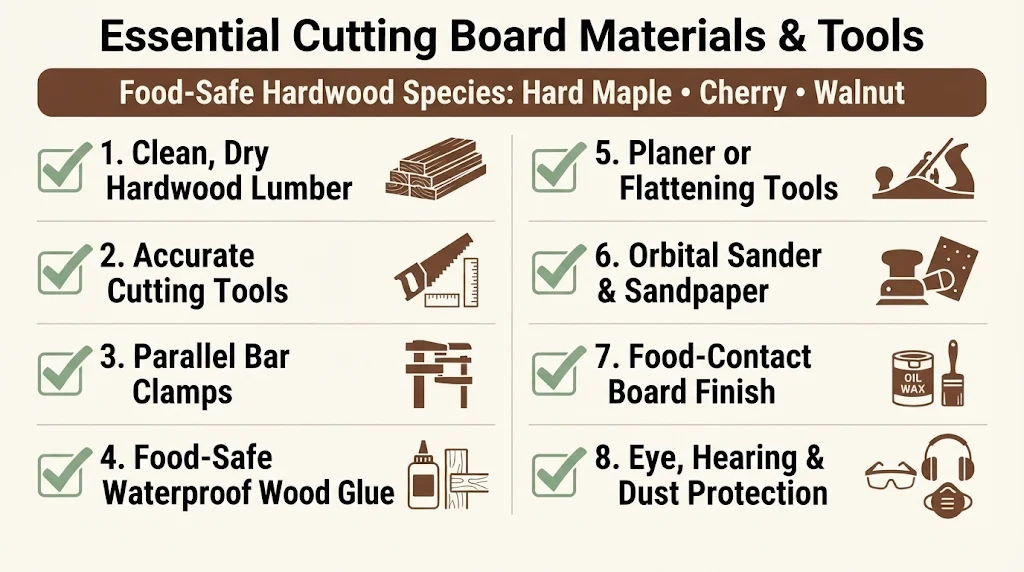
Quality hardwood, suitable glue, a safe finishing product, and dependable woodworking tools form the foundation. Material selection affects both your expenses and customer safety.
Start by choosing a wood species suitable for the board’s intended use. Hard maple, cherry, and walnut are common options for properly made hardwood boards.
For a closer comparison, read our guide explaining which woods are suitable for cutting boards.
Basic tools and supplies
- Hardwood lumber: Select clean, dry, identifiable material appropriate for food preparation.
- Accurate cutting tools: Use suitable saws and properly maintained cutting equipment.
- Clamps: Hold accurately fitted wood joints during assembly.
- Appropriate wood glue: Choose a product approved for the intended cutting board application.
- Flattening tools: Use a planer or appropriate hand tools to establish a level surface.
- Sandpaper and sander: Remove roughness and prepare the wood for finishing.
- Food-contact finish: Select a product explicitly intended for wooden cutting boards.
- Safety equipment: Wear suitable eye, hearing, and dust protection.
Accurate glue joints are particularly important when producing boards for customers. Our cutting board glue-up tutorial covers the main construction steps.
How important is food safety?
Food-contact safety is essential when a product will touch ingredients during preparation. Choose suitable materials and provide clear cleaning and maintenance instructions.
The University of Maine Cooperative Extension’s cutting board guidance explains material choices, hygiene, and maintenance considerations.
The USDA also recommends cleaning boards thoroughly and separating raw animal products from ready-to-eat foods when practical. Review its cross-contamination recommendations.
Avoid unidentified reclaimed lumber, questionable coatings, and products not intended for food contact. A decorative appearance doesn’t prove a board is safe for kitchen use.
Where Can You Sell Handmade Cutting Boards?
You can sell cutting boards through online marketplaces, local events, direct commissions, and your own website. Each channel involves different costs and customer expectations.
Selling cutting boards on Etsy
Etsy provides an established marketplace for handmade and personalized goods. It can be a useful place to test product listings without developing a separate online store.
As of November 2026, its standard U.S. selling information lists a $0.20 listing fee and a 6.5% transaction fee. U.S. Etsy Payments processing is listed at 3% plus $0.25 per order.
Other charges, including advertising or country-specific fees, may apply. Confirm your location’s eligibility and current rates before planning your business around Etsy.
Local craft fairs and markets
Local events let shoppers see the wood grain, feel the finish, and compare different sizes. They also eliminate individual shipping requirements for purchases taken home.
However, booth fees, transportation, display materials, and time spent selling still count as business expenses.
Selling through your own website
A dedicated website gives you more control over branding, product descriptions, and customer relationships. It also requires you to attract visitors and manage your own sales process.
Factor in hosting, payment fees, marketing, customer support, and returns. Avoid assuming every direct sale is automatically more profitable.
Custom orders and local partnerships
Personalized boards may appeal to wedding shoppers, gift buyers, real estate professionals, and corporate clients. Local kitchen stores may also consider suitable wholesale products.
Wholesale orders usually require lower prices per board. Check whether batch production can support those prices before accepting large commitments.
How Do You Start a Cutting Board Business Step by Step?
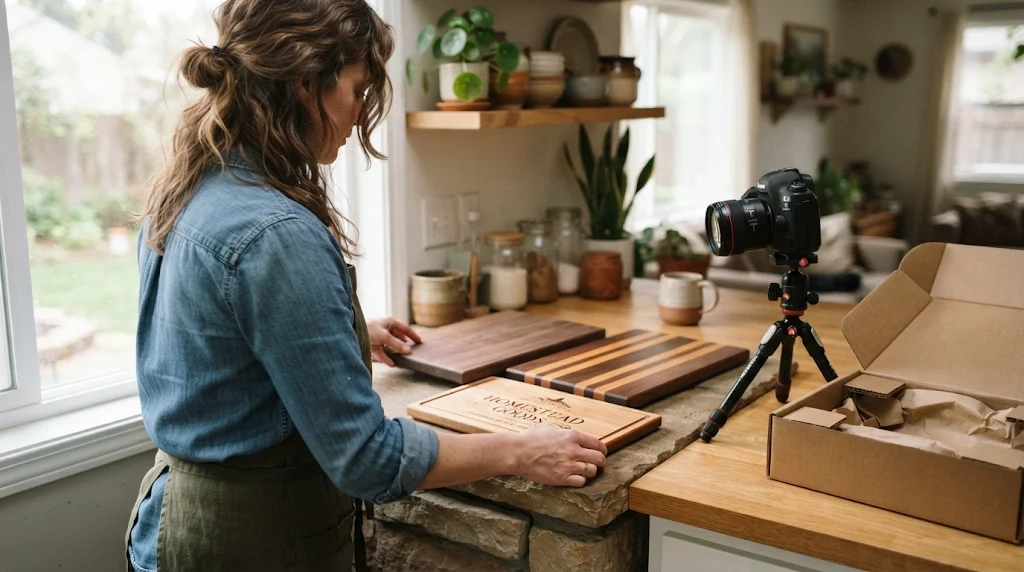
Begin with a small product range, establish consistent quality, and test pricing with real customers. The goal is to learn what sells before expanding your equipment or inventory.
- Research your customers. Compare board materials, sizes, designs, and customer questions in your target market. Separate everyday kitchen buyers from premium gift shoppers.
- Select three starter designs. Consider one basic board, one upgraded hardwood design, and one customizable option. Avoid buying materials for a large catalog immediately.
- Build and inspect prototypes. Check dimensions, stability, smoothness, edges, and glue joints. Reject pieces with defects that could affect safe use.
- Measure every production expense. Record wood consumption, supplies, labor time, packaging, overhead, and potential selling fees.
- Choose a sustainable price. Calculate your minimum acceptable price, then compare it with relevant competing products.
- Take clear product photographs. Show the entire board, close-up grain, edge thickness, and realistic kitchen use. Include measurements so shoppers understand its size.
- Publish accurate listings. Describe the species, construction, dimensions, care requirements, and personalization options. Avoid unsupported safety or durability claims.
- Test packaging and delivery. Protect board corners, prevent moisture exposure, and confirm postage costs using the packed weight.
- Review results and improve. Track inquiries, orders, defects, refunds, production time, and earnings. Expand designs that show consistent demand and worthwhile profit.
How Can You Increase Cutting Board Profit Margins?
Profit margins improve when you reduce waste, work efficiently, and sell products customers value. Cutting material quality to save money is rarely a sensible shortcut.
Make boards in small batches
Batch production can reduce repeated setup work. For example, prepare stock for several identical boards before moving to the next manufacturing stage.
Record whether batching actually lowers labor time per piece. More inventory isn’t helpful if customers don’t buy it.
Offer personalization carefully
Personalization can create a meaningful reason to choose your product. It also adds work and opportunities for mistakes.
- Charge separately for engraving when it requires extra time.
- Set clear character limits and design options.
- Request approval for complicated personalized layouts.
- Explain return rules for custom products.
Reduce production defects
A warped or cracked board can become an expensive remake. Good lumber storage and consistent construction help reduce avoidable losses.
For preventive techniques, see our article on keeping cutting boards from warping.
Include care instructions
Customer education can reduce misuse and misunderstandings. Provide clear guidance on washing, drying, and conditioning wooden boards.
Recommend suitable board-care products instead of ordinary kitchen oils. Our explanation of using vegetable oil on cutting boards covers why common cooking oils aren’t ideal for routine conditioning.
What Are the Biggest Mistakes When Selling Cutting Boards?
The most costly mistakes involve underpricing, inconsistent construction, and unrealistic sales expectations. Avoiding these problems matters more than launching with dozens of designs.
- Ignoring labor: A product isn’t profitable simply because its selling price exceeds lumber costs.
- Underestimating shipping: Heavy hardwood boards can be expensive to pack and deliver.
- Buying too much equipment: Expensive tools increase the amount your business must earn to recover startup costs.
- Using unsuitable materials: Unsafe wood, finishes, or adhesives can create serious customer problems.
- Offering too many variations: Excessive customization complicates production and inventory.
- Ignoring quality control: Unstable joints, splinters, and cracks damage customer trust.
- Weak product photography: Buyers need to understand wood appearance, thickness, and scale.
- Skipping financial records: Sales revenue alone doesn’t reveal whether the business earns money.
Do You Need a Business License or Insurance to Sell Cutting Boards?
Business requirements depend on your location, sales channels, and operating structure. You may need local registration, tax compliance, permits, or insurance.
The U.S. Small Business Administration’s business launch guidance explains several common startup considerations. Requirements outside the United States will differ.
Because cutting boards touch food, you should also investigate product safety obligations in every market where you sell. Don’t assume that a material or adhesive label approves every finished product design.
What records should you keep?
Keep records of income, material purchases, equipment expenses, selling fees, and shipping costs. These figures help you evaluate profitability and prepare accurate tax records.
The IRS recordkeeping guidance explains why maintaining reliable business records matters for U.S. sellers.
Recommended Tools and Supplies for Cutting Board Makers
If you’re preparing to make cutting boards for sale, these three established products are worth considering. My recommendations reflect their published specifications and intended uses, not personal hands-on testing.
The ratings below are editorial suitability scores for their described purposes, not customer-review averages.
🏆 Recommended Glue
Titebond III Ultimate Wood Glue
★★★★☆ 4.5/5 editorial
This waterproof wood glue is identified by its manufacturer as suitable for indirect food-contact applications, including cutting boards. I’d shortlist it for hardwood glue-ups because its published specifications suit the job, provided the maker follows the instructions.
🔧 Recommended Clamping Tool
BESSEY K Body REVO 24-Inch Parallel Clamp
★★★★☆ 4/5 editorial
BESSEY’s K Body REVO range includes a 24-inch parallel clamp with broad clamping jaws. I’d consider it for accurately prepared edge-grain glue-ups, while remembering that several clamps may be necessary for one board.
🌿 Recommended Wood Conditioner
Howard Butcher Block Conditioner
★★★★☆ 4/5 editorial
Howard’s conditioner combines food-grade mineral oil with beeswax and carnauba wax. I’d consider it for conditioning completed wooden boards because the manufacturer specifically markets it for food-contact kitchen surfaces.
Frequently Asked Questions
How much should I charge for a homemade cutting board?
Calculate materials, labor, overhead, packaging, shipping, selling fees, and your desired profit before setting a price. Then compare that figure with similar products in your market. A price that looks competitive isn’t sustainable if it fails to pay for your time and expenses.
Are cutting boards good products to sell on Etsy?
Cutting boards can be suitable for Etsy because the marketplace supports handmade and personalized goods. However, marketplace competition, fees, photography, and delivery expenses affect results. Check current seller eligibility and costs, then test a small selection rather than assuming sales will come automatically.
What wood is best for cutting boards to sell?
Hard maple is a practical starting choice because it is hard, relatively close-grained, and widely used for cutting boards. Cherry and walnut offer other attractive possibilities. Whatever wood you choose, verify its identity, condition, construction suitability, and intended food-contact use before selling the finished product.
Can you make cutting boards without expensive woodworking equipment?
Yes, a small operation can begin with basic, suitable woodworking tools and accurately prepared lumber. However, reliable cutting, flattening, clamping, sanding, and safety equipment remain important. Starting with simpler designs can reduce initial expenses, but cutting corners on precision or product safety isn’t worth the savings.
Is a cutting board business a good side hustle?
It can be a worthwhile side hustle for someone who enjoys woodworking and can produce consistent products efficiently. Earnings aren’t guaranteed, and startup tools may take time to pay for themselves. Begin with a limited range, track actual profitability, and expand only when customer demand supports it.
Final Verdict: Can You Make Money Selling Cutting Boards?
Yes, selling cutting boards can become a profitable side business or a larger woodworking operation. The opportunity comes from combining reliable craftsmanship with sensible pricing and effective selling.
I would begin with a small range of edge-grain hardwood boards, then explore premium and personalized options after learning what customers want. That approach limits unnecessary investment while providing useful information about real demand.
Most importantly, don’t confuse revenue with profit. Pay attention to your time, reject unsafe or defective products, and calculate every expense before committing to a selling price.
Your next step: Design one cutting board, create a complete cost sheet, and compare your required price with similar products. If the numbers work, make a small batch and test the market.

