Can You Use Any Wood for a Cutting Board? A Guide to Safe Wood Choices
Quick Answer
No, you cannot use just any wood for a cutting board. Choose a hard, close-grained wood such as maple, beech, birch, cherry, or a suitable walnut. Avoid unknown, chemically treated, or heavily porous wood. The FDA Food Code specifically recognizes hard maple or equivalently hard, close-grained wood for cutting boards in food establishments.
What makes a wood suitable?
- Close grain: Small pores help make a board easier to clean.
- Appropriate hardness: The surface withstands cutting without being excessively harsh on knives.
- Known species: Identifiable, suitable hardwood is safer than mystery lumber.
- Safe construction: No pressure treatment, questionable coatings, or unsuitable adhesives.
- Good condition: A smooth, intact board cleans more reliably than one with deep cracks.
A practical rule
- When unsure: Buy a board explicitly sold for food preparation rather than converting scrap wood.
A beautiful piece of lumber can look perfect for a kitchen project. But appearance alone tells you very little about whether it belongs under your dinner.
I like to judge cutting-board wood by three practical questions: Is it suitable for food contact, can I clean it thoroughly, and will it stand up to everyday chopping?
What Makes Wood Safe for a Cutting Board?
 Save
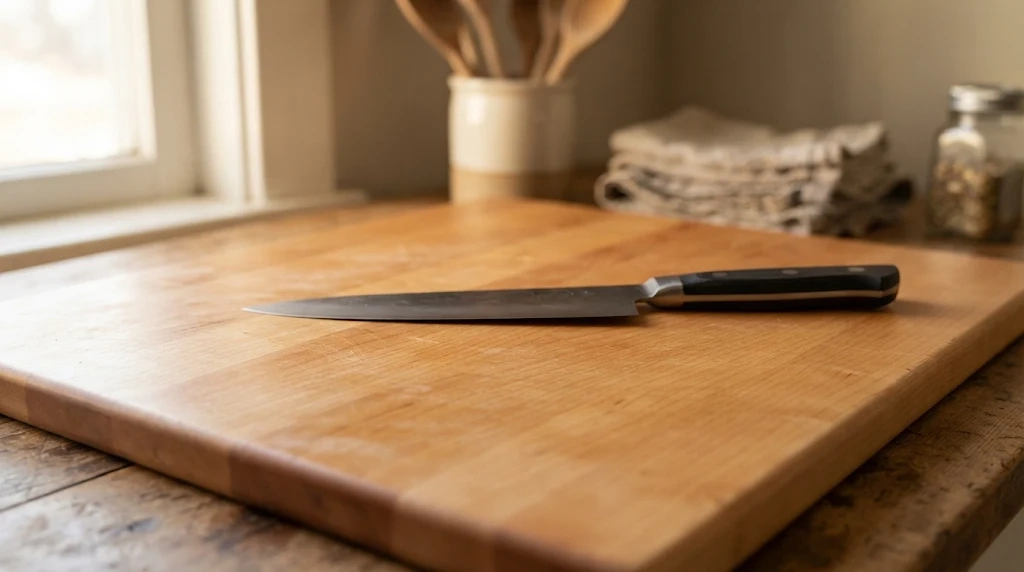
A cutting-board wood is a wood species and construction suitable for repeated direct food contact, knife cuts, washing, and drying. The best choices balance tight grain, reasonable hardness, durability, and a safe finish.
The 2022 FDA Food Code permits hard maple or equivalently hard, close-grained wood for cutting boards in regulated food settings. That is a useful benchmark for home kitchens too, although local commercial rules may differ.
- Grain structure: Fine, close grain generally gives food residue fewer large openings to enter.
- Hardness: Wood must resist deep dents while remaining usable with kitchen knives.
- Stability: Well-dried, properly built boards are less likely to cup or split.
- Source: Food-contact lumber should be free of preservatives and unknown chemical exposure.
- Finish: Any oil, wax, or adhesive used must be suitable for the intended food-contact application.
Does wood hardness matter?
Yes, but harder does not automatically mean better. Extremely hard surfaces can be unpleasant for knife work, while soft wood develops deep grooves quickly.
For most cooks, hard maple provides an excellent middle ground. Walnut and cherry are also popular choices when properly constructed and maintained.
Why does grain matter?
Wood grain describes the arrangement and visible direction of its fibers. Open-grained woods have larger pores, which can complicate thorough cleaning.
For example, red oak has more conspicuous open pores than hard maple. I would choose maple for a frequently used chopping surface rather than experiment with red oak.
Which Types of Wood Are Best for Cutting Boards?
Hard maple, beech, and birch are dependable starting points. Cherry and walnut offer attractive alternatives with different colors and wear characteristics.
Hard maple: a reliable all-purpose choice
Hard maple has a fine grain and a firm working surface. It is widely used in commercial and household cutting boards for good reasons.
It also has a light color that makes leftover stains easier to notice. If I were choosing one straightforward board material, maple would lead my list.
Beech and birch: practical light-colored options
Beech and birch can make good kitchen boards when sourced and constructed correctly. Their relatively fine grain suits everyday chopping.
Quality matters as much as the species label. Look for smooth surfaces, solid joints, and clear care instructions from the maker.
Walnut: a darker, attractive hardwood
American black walnut is frequently used for premium cutting boards. Its darker color can look beautiful, but stains and residue may be harder to spot.
Choose reputable manufacturers and clean the board carefully. Do not assume every dark tropical wood has the same suitability as American walnut.
Cherry: a slightly softer kitchen option
Cherry offers a warm reddish appearance and is commonly used in quality hardwood boards. It tends to show cutting marks sooner than hard maple.
That trade-off can be worthwhile if you prefer its appearance. A cherry board still needs prompt washing and thorough drying.
Teak: moisture resistance with trade-offs
Teak is used in commercially manufactured cutting boards because of its natural oils and moisture resistance. However, it contains mineral components that can increase knife-edge wear compared with some alternatives.
I would consider teak for a well-made, easy-care board. Maple remains my simpler recommendation when knife friendliness is the top priority.
Cutting Board Wood Comparison Table
The table below provides practical, qualitative guidance rather than laboratory food-safety rankings. Cleaning habits and manufacturing quality matter across every category.
| Wood | Grain / character | Typical use | Verdict |
|---|---|---|---|
| Hard maple | Fine, close-grained | Daily chopping | Excellent choice |
| Beech | Fine, fairly uniform | General prep | Good choice |
| Birch | Fine, close-grained | General prep | Good choice |
| American walnut | Relatively fine, dark | Prep and presentation | Good choice |
| Cherry | Fine, somewhat softer | Light to regular prep | Good with care |
| Teak | Oily, moisture-resistant | Kitchen prep | Consider knife-wear trade-off |
| Red oak | Coarse, open-pored | Furniture | Avoid for cutting surfaces |
| Pine | Soft, easily marked | Non-cutting projects | Not recommended |
What Woods Should You Avoid for Cutting Boards?
 Save
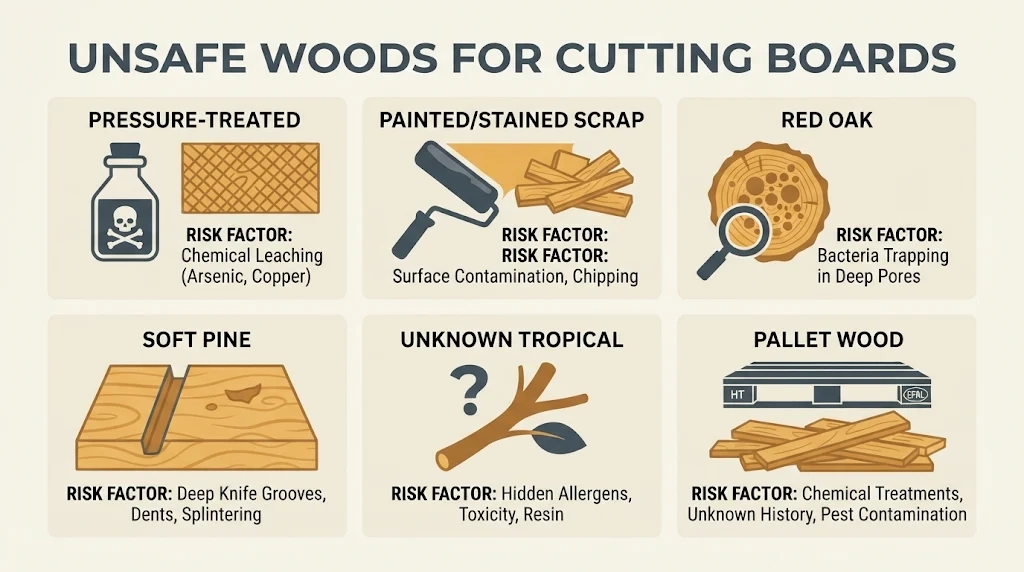
Avoid pressure-treated lumber, reclaimed wood with unknown exposure, poorly identified exotic woods, and wood with questionable finishes. Also avoid species that are too soft or have large, open pores.
- Pressure-treated lumber: Preservatives designed for construction do not belong on food-preparation surfaces.
- Painted or stained scrap: Unknown coatings may not be suitable for repeated food contact.
- Red oak: Its larger pores make it a less practical choice than close-grained hardwoods.
- Pine and other softwoods: They dent and groove more easily under kitchen knives.
- Unknown tropical species: Do not assume unfamiliar wood is harmless simply because it is dense or attractive.
- Old pallets or reclaimed boards: Prior chemical exposure and contamination can be impossible to establish.
A particularly important distinction is that a wood species can be suitable while a specific piece of that wood is not. A maple board coated with an unknown industrial finish is not equivalent to a food-preparation board.
Can You Make a Cutting Board From Scrap Wood?
Yes, but only if you know exactly what the scrap is and how it was handled. Unfinished, clean, suitable hardwood offcuts from a controlled woodworking project are very different from discarded construction lumber.
Checklist before using leftover lumber
- Identify the species rather than guessing from color.
- Confirm the wood was not pressure-treated, painted, stained, or chemically contaminated.
- Check that the stock is dry, stable, and free of rot or insect damage.
- Use adhesives explicitly suitable for indirect or incidental food contact in the finished application.
- Plane, sand, and finish the surface until it is smooth and free from splinters.
- Discard any board that develops unstable glue joints or difficult-to-clean cracks.
Suppose you have a few clean maple offcuts from a cabinetmaking project. Those might be suitable after proper preparation if their history is known.
By contrast, a mystery board rescued from a demolition site is not worth the uncertainty. Food-contact safety comes before saving a small amount of lumber.
Is End-Grain or Edge-Grain Wood Better?
Both can work for cutting boards. The difference is how the wood fibers meet the knife, which affects appearance, construction, maintenance, and cost.
End-grain cutting boards
On an end-grain board, the ends of the wood fibers face upward. This construction can be forgiving during repeated chopping, but usually involves many glue joints.
Choose a reputable board with sound joinery. End-grain construction does not excuse poor cleaning or prolonged exposure to water.
Edge-grain cutting boards
Edge-grain boards show long fibers across the cutting surface. They are common, generally simpler to manufacture, and often more affordable.
For a first hardwood cutting board, I favor a solid edge-grain maple model. It offers straightforward cleaning and usually enough durability for daily meals.
Which Cutting Board Finish Is Food Safe?
Choose a finish specifically labeled appropriate for wooden cutting boards and direct food-contact use. Food-grade mineral oil and board conditioners designed for kitchen use are common options.
- Food-grade mineral oil: Helps reduce moisture uptake and is easy to renew.
- Board wax or conditioner: Often combines suitable mineral oil and wax for additional surface protection.
- Unknown furniture finishes: Avoid products without clear food-contact suitability instructions.
- Cooking oils: Many can oxidize or become rancid, making them poor long-term board conditioners.
Use the maker’s application instructions rather than guessing at drying or curing times. A food-safe finish does not make an unsuitable wood species or contaminated piece of lumber safe.
How Do You Clean and Maintain a Wooden Cutting Board?
 Save
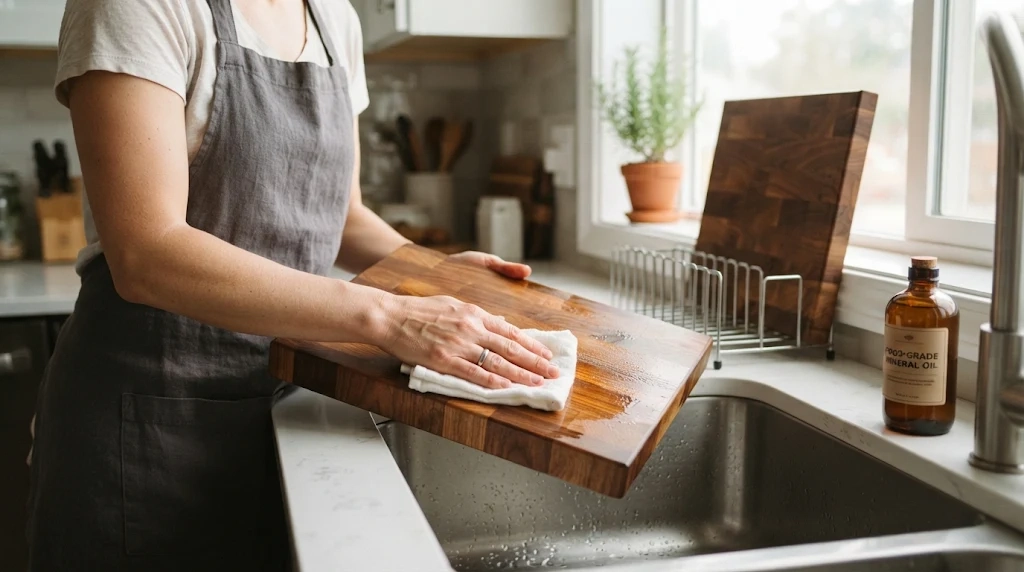
Wash after food preparation, dry thoroughly, and keep raw animal foods separate from ready-to-eat ingredients. Replace a board when cracks or grooves become difficult to clean.
- Remove scraps: Scrape away food pieces before washing.
- Wash: Use hot, soapy water and scrub both sides and the edges.
- Rinse: Remove soap and food residue with clean water.
- Sanitize when appropriate: Follow a current food-safety authority’s instructions, especially after raw animal foods.
- Dry: Wipe away water and stand the board upright with airflow on both faces.
- Condition: Reapply the recommended food-safe board oil when the wood starts looking dry.
The USDA advises washing cutting boards after each food item and using separate surfaces for raw meat and fresh produce when possible. You can review its cross-contamination guidance for more detail.
University of Minnesota Extension also emphasizes replacing boards with deep grooves and drying them before storage. See its home food-preparation guidance.
Can a wooden cutting board go in the dishwasher?
Most wood-board manufacturers recommend handwashing, particularly for glued or laminated boards. Dishwasher heat, long soaking, and repeated wet-dry cycles may damage the board or its joints.
The USDA distinguishes solid wood from laminated wood in its dishwasher guidance. Regardless, follow your particular board manufacturer’s instructions instead of assuming every wooden board is dishwasher-safe.
How Do You Know When a Wooden Cutting Board Needs Replacing?
Replace a cutting board when it has deep, persistent grooves, open cracks, unstable glued sections, or damage you cannot clean properly. Cosmetic knife marks alone do not always mean a board is unusable.
- Deep grooves continue to trap visible residue after scrubbing.
- Cracks or seams open where food can collect.
- The board is severely warped and moves during chopping.
- The surface sheds splinters or the finish is peeling.
- Persistent contamination cannot be safely removed.
A minor rough patch may be repairable by careful refinishing. Structural cracks and extensive wear are stronger reasons to replace the board.
Recommended Cutting Boards for Different Kitchens
If you prefer buying a ready-made board, these are three real product lines worth comparing. These are editorial suggestions based on published product details, not personal testing or verified customer-review averages.
🏆 Best overall
John Boos 4-Cooks Maple Cutting Board
★★★★☆ Editorial suitability: 4/5
Made from northern hard rock maple with edge-grain construction, a reversible surface, and a 1-inch thickness. It is my practical first choice for a straightforward wood-prep setup, based on its design.
💰 Simple everyday option
John Boos Chop-N-Slice Maple Board
★★★★☆ Editorial suitability: 4/5
A reversible northern hard rock maple series with edge-grain construction and several size options. I would compare it first when shopping for a basic chopping board.
🌿 Best teak alternative
TeakHaus Reversible Teak Cutting Board
★★★☆☆ Editorial suitability: 3/5
TeakHaus describes its boards as FSC-certified teak and reversible. I would consider this range for its wood appearance and moisture resistance while weighing potential knife wear.
Frequently Asked Questions
Can I use pine wood for a cutting board?
Pine is not a good choice for a frequently used cutting board because it is comparatively soft and can develop grooves and dents quickly. Choose a suitable, close-grained hardwood such as maple, beech, or birch for a more practical cutting surface.
Is oak safe for a cutting board?
Oak species differ in their pore structure, so the answer is not identical for every oak board. Red oak is notably open-grained and generally less desirable for kitchen cutting surfaces than hard maple. A purpose-made, properly evaluated product is preferable to untreated oak scrap.
Can I use plywood to make a cutting board?
Ordinary plywood is not recommended for cutting boards. Its layered construction exposes multiple glue lines and may include adhesives and veneers not specified for direct food contact. Choose solid, known hardwood or a professionally manufactured food-contact cutting board instead.
Is bamboo better than hardwood for cutting boards?
Bamboo is a grass, not a wood species, but it is widely used for cutting boards. Its performance depends on manufacturing quality, adhesives, and care. Some bamboo boards can feel harder on knife edges, so a quality maple board remains an appealing alternative.
Can I use a cutting board without oiling it?
A wooden board may still function without frequent oiling, but a suitable conditioner can help limit moisture absorption and surface drying. Follow the manufacturer’s care guidance. Oiling is not a replacement for washing, sanitizing when needed, and drying the board thoroughly.
Final Takeaway: Choose Wood for Safety, Not Just Looks
Not every piece of wood belongs in food preparation. Start with a known, close-grained hardwood, verify its construction and finish, and keep the cutting surface clean and dry.
For most home kitchens in 2026, a well-made hard maple board is an easy recommendation. Choose the size you will actually use, follow its care instructions, and replace it when wear makes safe cleaning difficult.

