Can Corian Be Used as a Cutting Board? What You Need to Know
Quick Answer
Corian solid surface is not recommended as a cutting board. Although its nonporous construction makes it convenient for kitchen countertops, direct chopping can scratch the material and may affect your knife’s edge. The manufacturer specifically advises against cutting directly on Corian. Instead, use a separate wooden or plastic board, following the official Corian use and care guidance.
Important Things to Know
- Surface protection: Knife blades can leave visible scratches and grooves in Corian.
- Knife maintenance: A dedicated cutting board offers a more suitable surface for repeated cutting.
- Food preparation: Nonporous construction helps with cleaning but does not eliminate cross-contamination risks.
- Repair options: Some superficial scratches can be refinished using manufacturer-approved methods.
- Better alternatives: Maple, food-safe plastic, and suitable composite boards are more practical choices.
Best Practical Approach
- Protect your countertop: Put a stable cutting board on top of Corian before slicing, dicing, or chopping food.
Corian countertops look clean, modern, and almost effortless to maintain. That smooth finish naturally raises a question: can Corian be used as a cutting board?
I’m Michael, and I want to explain why cutting directly on Corian is a poor kitchen habit. We’ll cover scratches, knife care, food safety, and better cutting surfaces.
What Is Corian, and What Is It Made Of?
Corian is a branded solid-surface material commonly used for countertops, sinks, and other interior applications. Its composition includes acrylic polymer and mineral fillers.
Unlike natural stone, solid-surface material can often be joined with inconspicuous seams. It also offers a consistent appearance throughout its thickness.
What Makes Corian Different From Other Countertops?
Corian combines a relatively smooth, nonporous surface with a repairable finish. These qualities make it useful around sinks and food preparation areas.
However, a material suitable for kitchen countertops is not automatically suitable for chopping. Cutting boards have different performance requirements.
- Nonporous construction: Routine spills stay on the surface rather than soaking into the material.
- Renewable finish: Certain scratches and dull areas can be refinished.
- Design flexibility: Fabricators can create integrated sinks and curved shapes.
- Appearance options: Corian comes in various colors and patterns.
- Maintenance needs: Sharp blades, high heat, and unsuitable chemicals can cause damage.
These features explain why Corian works well as a countertop. They do not change the manufacturer’s cutting-board recommendation.
Can You Cut Directly on a Corian Countertop?
No. Cutting directly on Corian is not recommended because knife contact can score its surface. Corian’s official care instructions specifically warn against chopping on the material.
Even when a single cut appears harmless, repeated chopping can create visible wear. The risk becomes more noticeable during demanding meal preparation.
What Happens When You Use a Knife on Corian?
 Save
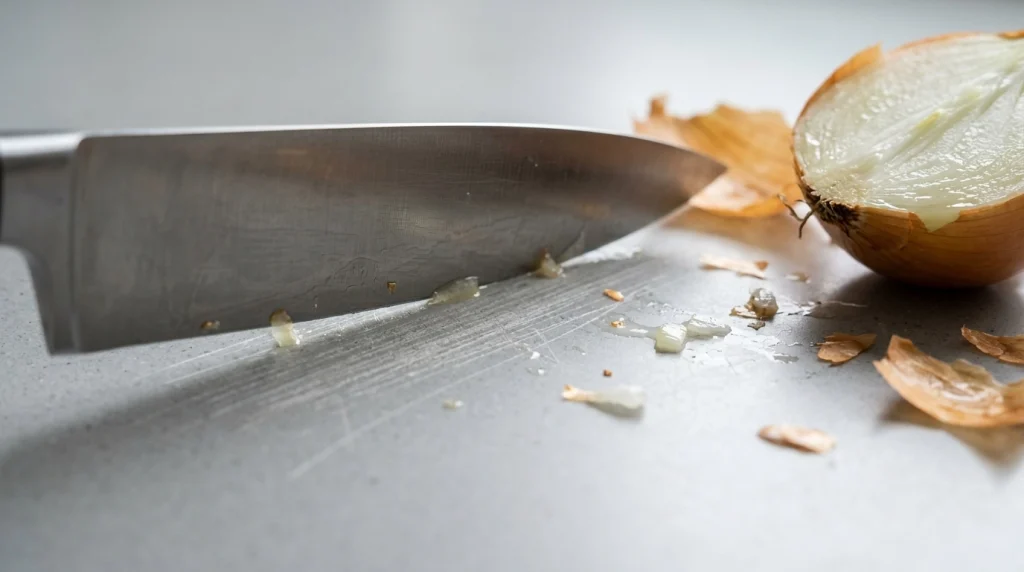
The immediate result depends on the blade, pressure, cutting motion, and surface finish. A light slicing movement may leave a minor mark, while forceful chopping can create deeper scratches.
Consider a typical onion preparation session. A chef’s knife repeatedly contacts the surface while slicing and dicing.
On a proper cutting board, that contact is expected. On Corian, the same repeated movement creates unnecessary countertop wear.
Why Are Scratches a Problem?
Scratches affect appearance and complicate cleaning when they become pronounced. They can also produce an uneven surface over time.
Corian’s repairability is useful, but it shouldn’t be treated as permission to damage the countertop. Refinishing takes effort and may alter the surrounding finish.
- Fine scratches: These can appear as dull areas under angled lighting.
- Deeper cuts: These may need professional refinishing.
- Uneven gloss: Incorrect sanding can leave visibly different patches.
- Dark finishes: Scratches often show more clearly than on lighter, patterned surfaces.
Does Cutting on Corian Damage Your Knives?
Corian is not an ideal cutting surface for maintaining a sharp kitchen knife. However, the amount of edge wear depends on the blade steel, technique, and cutting frequency.
It’s important not to confuse countertop damage with knife damage. A knife can mark Corian even when its edge experiences no immediately noticeable deterioration.
Why Does Cutting Board Material Matter?
A knife’s edge is thin and experiences repeated contact with the board beneath the food. A suitable board should support cutting without causing unnecessary impact or excessive edge wear.
For general food preparation, wood and purpose-made plastic are practical options. Both are commonly used with chef’s knives.
Could Corian Chip a Chef’s Knife?
Knife chipping is not an inevitable result of touching Corian. Edge damage depends heavily on blade construction and cutting technique.
Thin, hard knife edges may be more vulnerable to twisting, impacts, and sideways pressure. A stable, appropriate cutting board helps reduce avoidable risks.
For a sharp Japanese chef’s knife, I’d avoid experimenting with unusual countertop materials. A dedicated board is a simpler choice.
Is Corian Food-Safe for Cutting and Preparing Food?
Corian’s nonporous surface is useful for kitchen hygiene when properly maintained. Still, being easy to clean does not make a countertop a recommended cutting board.
Food safety involves more than the countertop material. Handling, cleaning, separation, and sanitation also matter.
Does Corian Absorb Food Juices?
Corian solid surface is nonporous, so ordinary food liquids do not penetrate it as they might penetrate untreated porous materials. Spills still need prompt cleaning.
Raw meat juices can contaminate any preparation surface. Nonporous construction does not neutralize bacteria.
Can Bacteria Collect in Scratches?
Deep grooves and surface damage can make thorough cleaning more difficult. This concern applies to worn cutting boards as well as damaged work surfaces.
The FDA’s home food safety guidance emphasizes cleaning countertops and cutting boards between food preparation tasks.
- Wash hands before preparing food and after handling raw animal products.
- Keep raw meat away from ready-to-eat ingredients.
- Clean knives and preparation surfaces after each food task.
- Sanitize food-contact surfaces when necessary, following suitable product instructions.
- Use separate boards for raw meat and fresh produce whenever practical.
These habits are more effective than relying on a material’s nonporous characteristics alone.
Corian vs Wood vs Plastic: Which Cutting Surface Is Better?
 Save
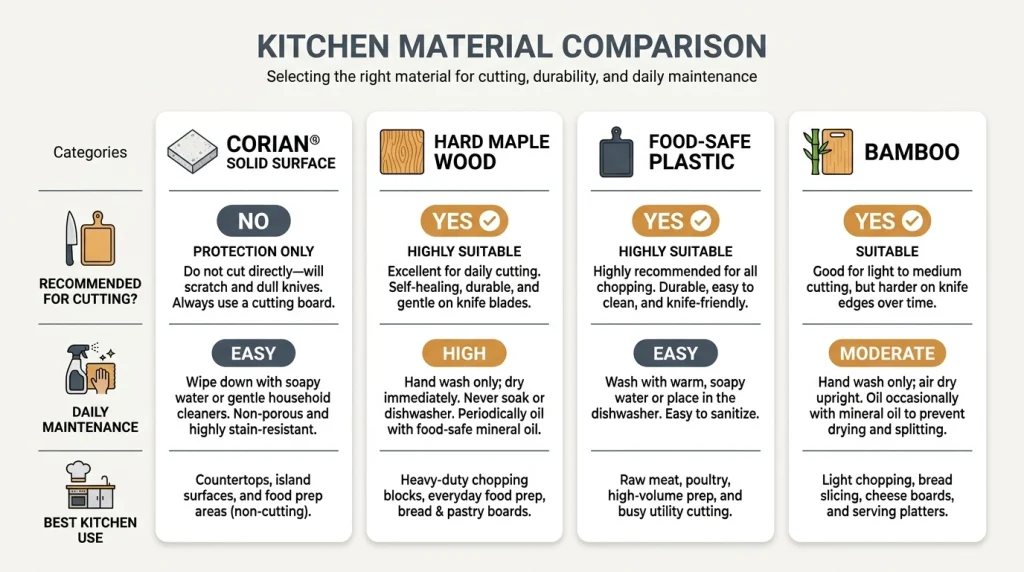
For routine chopping, dedicated wooden and plastic cutting boards are generally better choices than Corian. Each material offers different benefits and maintenance requirements.
The comparison below focuses on common household use rather than controlled laboratory measurements.
| Material | Recommended for Cutting? | Maintenance | Best Use |
|---|---|---|---|
| Corian solid surface | No | Wipe clean; protect from cutting damage | Kitchen countertop |
| Hard maple wood | Yes | Hand wash, dry, condition when needed | Everyday chopping |
| Food-safe plastic | Yes | Wash; dishwasher if approved; replace when worn | Meat and general preparation |
| Bamboo | Yes | Hand wash and dry; follow manufacturer care | Vegetables and general preparation |
| Glass or marble | Possible, but not preferred | Easy surface cleaning; inspect for damage | Serving and limited preparation |
Wood Cutting Boards
Wood offers a dependable surface for daily chopping, slicing, and dicing. Maple is especially popular for traditional kitchen cutting boards.
Wood requires careful drying and occasional conditioning. It should not be left soaking in a sink.
Plastic Cutting Boards
Food-safe plastic is convenient for busy kitchens, particularly when preparing raw meat. Many purpose-made plastic boards are dishwasher safe.
Plastic boards eventually develop knife marks. Replace them when deep grooves become difficult to clean.
Bamboo and Composite Boards
Bamboo boards are often lightweight and relatively firm. Their surface characteristics vary with construction and manufacturing quality.
Purpose-made composite boards provide another option. Always check their cutting-surface and cleaning instructions before buying.
Can You Make a Cutting Board From Leftover Corian?
A leftover Corian offcut can be fabricated into a flat work surface, but that does not make it an ideal cutting board. The manufacturer’s advice against cutting directly on Corian still applies.
It’s worth distinguishing between a decorative serving slab and a surface meant for repeated knife contact.
What About a Corian Serving Board?
A properly finished piece may be useful for presenting certain foods, provided its specific food-contact suitability is confirmed. Presentation involves much less blade contact than chopping.
For example, a finished slab might hold cheese or prepared appetizers. Cut those foods on a separate board first.
What Should You Check Before Reusing an Offcut?
- Material identity: Confirm that the piece is genuine Corian or another known solid-surface product.
- Previous exposure: Avoid pieces contaminated by adhesives, solvents, or unsuitable chemicals.
- Edge finishing: Sharp corners and rough edges require professional attention.
- Surface condition: Check for cracks, gouges, and residue.
- Food-contact suitability: Confirm that the particular material and finished item are appropriate for the intended use.
Fabricating solid-surface materials requires proper equipment and dust controls. For an unfinished offcut, consult an experienced fabricator rather than improvising with kitchen tools.
How Do You Protect Corian Countertops While Cutting Food?
 Save
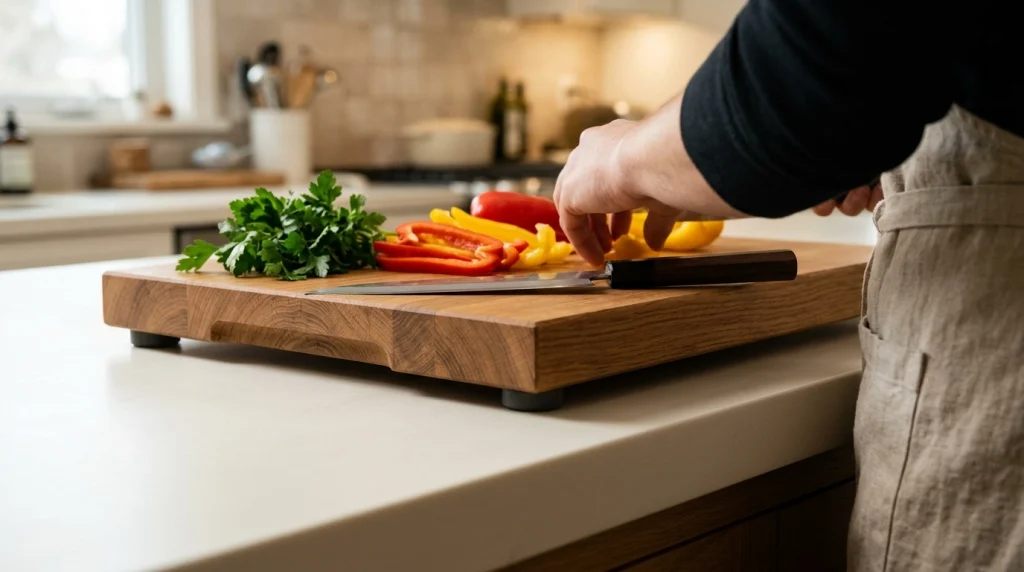
The easiest method is to place a stable, appropriately sized cutting board on the countertop. This protects the Corian surface and creates a dedicated preparation area.
Five Simple Protection Steps
- Clean the countertop. Remove crumbs and debris before placing your board.
- Choose a stable board. Use a model with nonslip feet or suitable grip support.
- Check board size. A larger surface helps contain ingredients while chopping.
- Keep sharp tools on the board. Avoid sliding exposed knife edges across Corian.
- Clean after preparation. Remove the board and wipe the countertop using approved cleaning methods.
One practical detail deserves attention: a cutting board should not slide during use. Stable footing matters as much as the board material.
Should You Put a Towel Under a Cutting Board?
A clean, slightly damp towel can sometimes reduce movement beneath a board without nonslip feet. Keep it flat and confirm the board remains secure before cutting.
A board with built-in nonslip grips may be more convenient. Never continue chopping if the board shifts unexpectedly.
How Do You Remove Knife Scratches From Corian?
Minor scratches on certain Corian finishes can sometimes be removed through careful refinishing. The appropriate method depends on the finish and severity of damage.
Corian provides official repair instructions for different surface finishes. Follow those instructions rather than applying a universal sanding method.
Start With Cleaning
Before treating a scratch, wash the affected area with mild soapy water. Rinse thoroughly and dry with a clean, soft cloth.
Some apparent marks come from residue rather than actual material damage. Cleaning helps you identify the difference.
Evaluate the Finish
- Matte finishes: Certain minor scratches may be suitable for manufacturer-guided refinishing.
- Semi-gloss finishes: Matching the surrounding appearance can be more difficult.
- High-gloss finishes: Professional repair is often the safer choice.
- Deep scratches: Ask an authorized fabricator to assess the damage.
Don’t sand a countertop simply because it has a visible mark. Incorrect abrasives can create a larger, dull patch.
When Is Professional Repair Worthwhile?
Professional assessment makes sense when cuts are deep, widespread, or located in highly visible areas. It also helps when matching a glossy finish is important.
For instructions specific to your countertop, consult the official Corian website.
How Should You Clean Corian After Food Preparation?
Routine cleaning generally involves soapy water, appropriate cleaners, thorough rinsing, and drying. More demanding cleaning or disinfection should follow the manufacturer’s instructions.
Daily Cleaning Routine
- Remove dishes, cutting boards, and loose food debris.
- Wipe the countertop with warm soapy water and a soft cloth.
- Clean any remaining residue with an approved cleaner.
- Rinse away cleaning products thoroughly.
- Dry the countertop to reduce water marks and residue buildup.
For food hygiene, the FoodSafety.gov four-step guidance explains the importance of cleaning and separating ingredients.
What Cleaning Products Should You Avoid?
Strong solvents and incompatible chemicals can damage Corian. Some substances may change the surface finish or leave permanent marks.
Avoid using paint remover, harsh drain cleaners, and other aggressive chemicals on your countertop. Always check the care instructions before trying a new product.
What Cutting Board Is Best for a Corian Countertop?
A good cutting board should protect Corian, remain stable, accommodate your ingredients, and be easy to maintain. Material choice depends on your cooking routine.
For Everyday Vegetables
I would prioritize a medium or large maple board for routine vegetable preparation. A generous cutting area makes chopping and ingredient organization easier.
For Raw Meat
A dishwasher-safe plastic board is convenient when handling raw poultry, seafood, or meat. Choose a model that remains stable during cutting.
Keep raw animal products separate from ready-to-eat foods. The University of Illinois Extension cutting board guidance explains this practical precaution.
For Small Kitchens
Compact cutting boards can work well when storage space is limited. However, avoid choosing a board so small that ingredients regularly fall off its edges.
For most home kitchens, stability, cleaning convenience, and sufficient space matter more than decorative features.
Recommended Cutting Boards for Corian Countertops
If you’re choosing a board to protect Corian, these three real products are worth considering. Each serves a different kitchen priority.
The star scores below are editorial suitability assessments for these uses, not verified customer-review averages or results from hands-on testing.
🏆 Best for Everyday Prep
OXO Good Grips Utility Cutting Board
★★★★½ (4.5/5)
This double-sided cutting board features nonslip feet, a juice-catching groove, and dishwasher-safe construction. I favor its practical design for protecting a Corian countertop during everyday chopping and food preparation.
🌳 Best Traditional Wood
John Boos Maple Chop-N-Slice Cutting Board
★★★★½ (4.5/5)
Made from hard rock maple, this series includes reversible designs with a juice groove. I recommend considering it for cooks who prefer a traditional wooden surface and don’t mind regular hand washing and conditioning.
💰 Best for Compact Kitchens
OXO Good Grips Prep Cutting Board
★★★★☆ (4/5)
At approximately 7.23 by 10.75 inches, this small double-sided board includes nonslip feet and dishwasher-safe construction. I favor it for quick tasks such as trimming vegetables or slicing fruit when countertop space is limited.
Whichever board you choose, check its stability before cutting. Replace any board that develops severe damage or hard-to-clean grooves.
Frequently Asked Questions
Can you use Corian as a chopping board?
No, Corian is not recommended as a chopping board. The manufacturer specifically advises against cutting directly on solid-surface countertops because knives can scratch and score the material. Use a separate, stable cutting board instead. Wood and food-safe plastic are more suitable for everyday chopping tasks.
Will a knife scratch Corian countertops?
Yes, a kitchen knife can scratch Corian, especially during repeated chopping or forceful cutting. Even small scratches may become noticeable over time. Some superficial damage can be repaired, but refinishing depends on the finish and severity. Using a separate cutting board is the easiest preventive measure.
Is Corian harder than wood?
There is no single meaningful hardness comparison covering every wood species and Corian formulation. Hardness measurements also do not fully predict cutting-board performance. What matters is that Corian is designed as a solid-surface material, while suitable wooden cutting boards are intended to withstand repeated contact with kitchen knives.
Can you put raw meat directly on Corian?
Corian’s nonporous surface can be cleaned after contact with food, but raw meat still presents cross-contamination risks. Use a separate cutting board for meat preparation rather than cutting directly on the countertop. Clean and appropriately sanitize contacted surfaces and utensils, especially before preparing ready-to-eat foods.
Can scratches be removed from Corian?
Some minor Corian scratches can be removed with manufacturer-approved refinishing techniques. The proper approach depends on whether the finish is matte, semi-gloss, or glossy. Deep scratches and visible finish damage may require a professional fabricator. Avoid random sanding methods that could make the affected area look worse.
Final Verdict: Should You Use Corian as a Cutting Board?
Corian is a versatile countertop material, but it isn’t the right choice for direct chopping. The manufacturer’s guidance is clear: use a separate cutting board.
That recommendation protects the countertop and gives your knives a more appropriate working surface. It also makes separating and cleaning food preparation areas easier.
- Choose wood for traditional everyday chopping and slicing.
- Choose food-safe plastic for convenient cleaning and raw meat preparation.
- Protect Corian from direct knife contact, heavy scratches, and improper refinishing.
- Prioritize hygiene by cleaning boards and countertops between food preparation tasks.
My recommendation is straightforward: enjoy Corian as your countertop, not your cutting board. A dependable, easy-to-clean chopping board is a worthwhile addition to any kitchen.

