How to Store a Chef Knife Safely and Keep It Sharp
Quick Answer
Store a chef knife clean and completely dry, with the edge protected and the blade separated from other utensils. A knife block, a securely mounted magnetic strip, a fitted in-drawer tray, or a blade guard all work well. Do not leave it loose in a drawer, in a sink, or on a countertop edge.
A chef knife spends far more time in storage than on a cutting board, and that idle time causes most avoidable damage. Good storage solves three problems at once: it protects the edge, protects hands, and keeps the blade dry. Any method that does all three and fits your kitchen is a good method.
Before You Put It Away: Clean and Dry First
No storage method can rescue a wet or dirty knife. Dampness inside a block, guard, or roll has nowhere to go, and carbon steel spots and rusts more readily than stainless steel.
Wash it by hand soon after use, moving a sponge from the spine toward the edge, then towel-dry both faces and the handle junction. Air-drying alone is not enough before closed storage. See our guides to how to clean a chef knife and how to dry a chef knife.
Warning
Never leave a chef knife in a sink full of soapy water. A hand reaching in blind cannot see the blade, and the knife can knock against other items while it soaks.
The Main Storage Options, Compared
Most kitchens use one of four approaches, and none is universally best.
| Method | Best for | Watch out for |
|---|---|---|
| Knife block | Countertop access | Damp slots, a slot too narrow for the blade |
| Magnetic strip | Small kitchens, airflow | Weak mounting, dragging the edge |
| In-drawer tray | Clear counters, family kitchens | A tray too short or shallow for an 8-inch blade |
| Blade guard or saya | Drawers, travel, long-term storage | Storing the knife damp inside the guard |
A well-fitted block beats a poorly mounted strip, and a guarded knife in a drawer beats a loose knife in a tight slot.
How to Use a Knife Block Well
 Save
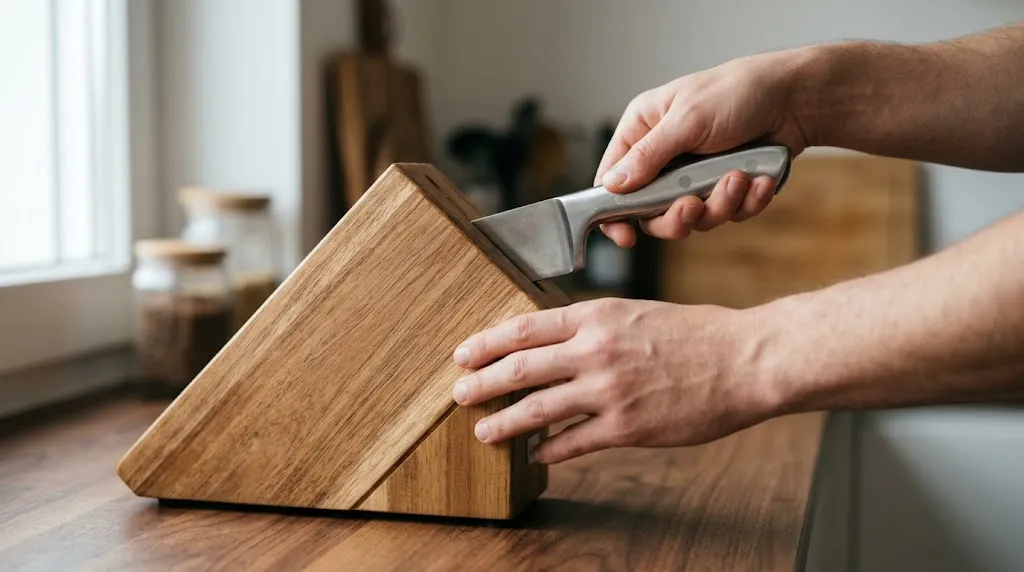
A block works when the knife goes in and out without the edge scraping the slot. The blade should slide in without forcing, and the handle should sit securely. A tight slot scrapes the edge on every use.
Insert it deliberately, spine first where the slot allows, and lift it straight out by the handle. Store only dry knives in it, and clean the slots regularly. See how to clean a knife block inside.
Advice differs on whether the edge should face up or down in a block. The useful point is shared: use a slot that fits, move deliberately, and grip only the handle. If a block forces a choice between scraping the edge and an awkward grip, it is the wrong fit.
How to Use a Magnetic Strip Safely
A magnetic strip keeps the blade in open air, which helps it stay dry, and uses no counter or drawer space. Makers describe wall-mounted holders similarly, as a safe, space-saving option when securely mounted. For example, WÜSTHOF’s magnetic holder is presented as a wall-mounted holder that keeps knives in place while saving space.
Do not snap the blade flat onto the magnet, or drag it sideways across the strip. Bring the spine to the strip first, let the magnet take hold gently, then rotate the blade flat against it. Remove it by rotating off at the spine, then pulling away. That spine-first habit protects a thin edge from chipping.
Fix it into a stud or with anchors rated for the load, at adult height but out of reach of young children, away from sink splash and stove steam. Wipe it regularly, since grease can reduce grip. If a knife hangs by only part of its blade, the strip is too weak or short. See whether a magnetic knife strip is safe.
How to Store a Chef Knife in a Drawer
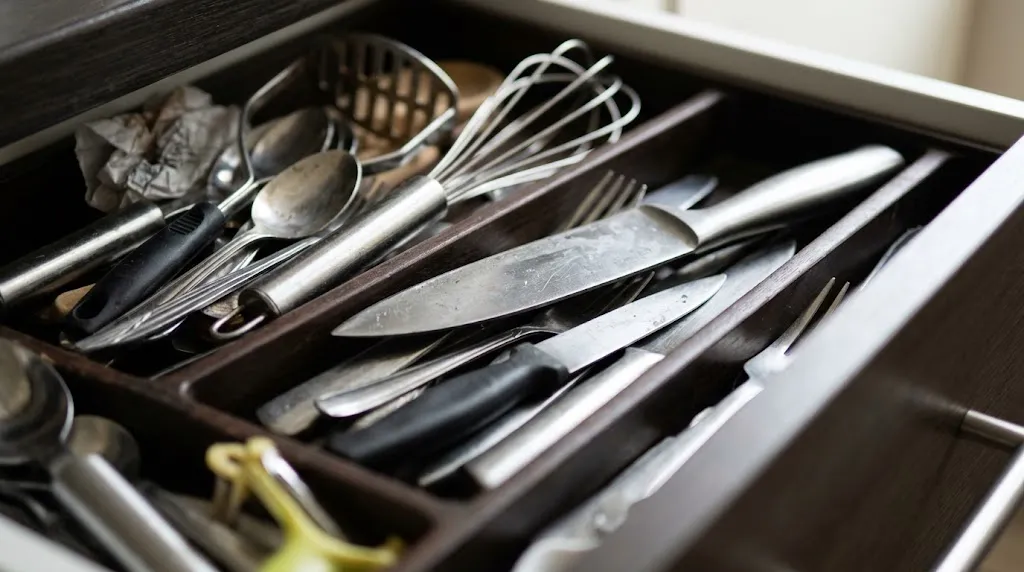
A drawer can be the safest-looking option and the most dangerous one, depending on one distinction: separated or loose. A loose knife knocks against hard objects every time the drawer moves.
A fitted tray changes that. Choose an insert with a separate slot long enough for the full blade plus handle. Place the knife handle-first toward you, tip toward the back, so the blade touches no other blade.
Without a tray, a blade guard is the minimum protection. Slide it fully over the blade, check that it stays on when the drawer closes, and keep the guarded knife where heavy items will not bury it. A latched drawer that children do not routinely open adds another layer that a countertop block does not offer.
Blade Guards, Sayas, and Knife Rolls
A blade guard slides over the edge; a saya is a fitted wooden sheath, common for Japanese-style knives. Both stop the blade touching anything else, but fit decides whether they work: too short, and the tip is exposed; too loose, and it can slip off.
Dry the knife fully first, since a damp knife sealed inside a guard stays damp. A knife roll is the transport version of the same idea, useful for another kitchen or a class. For everyday home use, a block, strip, or tray is usually easier. If you use a roll, add guards inside the pockets and never roll up a wet knife.
Choosing by Your Kitchen
The best method is the one you will use after every meal, not the one that looks best in a photograph.
- Tight on counter space: a magnetic strip or in-drawer tray usually wins. A strip needs suitable wall space; a tray needs a drawer deep enough for the blade.
- Renting or cannot drill: a block, drawer tray, or guarded knife avoids wall fixings. Adhesive alone is a poor choice for a heavy chef knife unless the maker clearly rates it for that weight and wall surface.
- Young children at home: height and concealment matter most. A high wall strip, a latched drawer, or a block set well back from the counter edge beats a low, open display. No method replaces supervision.
- One good chef knife: you do not need a large block with empty slots, which collect dust and crumbs. A single guard, short strip, or one tray slot can protect it better.
- Humid kitchen or carbon steel: favour open-air storage and stricter drying. See how to maintain a carbon steel chef knife and how to store knives in a small kitchen.
Tip
Put the knife away in the same place every time, immediately after drying it. A consistent home prevents the two most common failures: leaving it on the counter “for a minute” and dropping it loose into a drawer when you are in a hurry.
Mistakes That Dull or Damage a Stored Knife
 Save
Most storage damage accumulates in small contacts that are easy to overlook:
- Storing the knife wet, so moisture sits inside a block, guard, or roll.
- Letting blades touch, whether in one slot or loose among utensils.
- Forcing a tight slot, guard, or saya that scrapes the edge on every insertion.
- Dragging the edge sideways across a magnetic strip, or snapping it on flat.
- Leaving the knife on the counter near the edge, within reach of children and pets.
- Ignoring worn storage: a loose strip, cracked tray, or musty block stops protecting the knife.
If a knife that was sharp starts feeling dull soon after sharpening, check storage before blaming the sharpening method. Edge contact in storage is a common and easily fixed cause.
Long-Term Storage, Travel, and a Monthly Check
For a knife unused for weeks or months, clean and dry it thoroughly and, for carbon steel, follow the maker’s guidance on oiling. Use a guard that fully covers the blade, in a dry, stable place, not a damp garage. Do not wrap it in a damp cloth or sealed plastic bag, which can trap moisture.
For travel, a guarded knife in a roll or hard case, packed so it cannot shift, is the usual approach in checked luggage; knives do not belong in hand luggage. Once a month, check the strip is firm, block slots are clean and dry, the tray still holds the knife snugly, and the guard has no exposed tip.
Related Product
Magnetic Knife Strip
A wall-mounted magnetic strip keeps a chef knife dry, visible, and separated from other utensils, which suits small kitchens and daily cooking.
As an Amazon Associate, we earn from qualifying purchases.
Frequently Asked Questions
Is it safe to store a chef knife in a drawer?
Yes, if the blade is separated and protected. Use a fitted tray with its own slot, or a guard that fully covers the edge. A loose knife in a mixed drawer is not safe.
Is a magnetic strip better than a knife block?
Neither is better in every kitchen. A strip offers airflow and saves counter space, while a block hides the blades and needs no wall fixing. Choose by space, mounting options, and household safety.
Should a chef knife be stored blade up or blade down?
Advice differs, and fit matters more than a single rule. In a block, use a slot that fits without scraping and grip only the handle. On a strip, place the blade flat with the edge facing down or away from your hand.
Can I store a chef knife in its original box?
For short-term storage, yes, if the knife is dry and the box is intact. For everyday use, a box is awkward, so switch to a block, strip, tray, or guard. For long-term storage, a dry guard in a dry drawer is more practical than cardboard that can absorb moisture.
How do I store a chef knife if I have children at home?
Keep knives out of reach and, where possible, out of sight. A high wall strip, a latched drawer with a fitted tray, or a block set well back from the counter edge are practical options, with supervision for younger children.
Why does my chef knife get dull even when I rarely use it?
Storage contact is a likely cause. Blades knocking against other utensils, scraping inside a tight slot, or dragging across a strip can dull an edge without any cutting. Check that the blade touches nothing else in storage.
Conclusion
Storing a chef knife well comes down to a simple habit and a fitting home for the blade. Clean it, dry it fully, and put it in the same protected place every time, with the edge separated from other utensils. A block, strip, tray, or guard can all do that job, so choose the one that fits your space and that you will use without thinking.

