
5 Best European Chef Knife Picks for 2026: German, French, Italian, Swiss and Spanish Blades
You want one chef knife with real European heritage, but the label on the box rarely tells you where the blade was actually forged. German, French, Italian, Swiss and Spanish makers all build excellent knives, yet they differ sharply on steel hardness, blade profile, weight and edge angle, so picking by brand name alone is a gamble. This guide compares five genuine European knives side by side on published specifications, so you can see exactly how each country’s approach shapes the way its knife cuts, holds an edge and feels in the hand. By the end you will know which European style fits your cooking, your grip and your budget, and which single knife deserves the top spot on your board.
Quick Comparison: All European Chef Knives Ranked
| # | Product | Best For | Rating | Badge | |
|---|---|---|---|---|---|
| 1 | Wüsthof Classic 8-Inch Chef’s Knife | Everyday rocking cuts | 4.9/5 | Best Overall | Buy → |
| 2 | Victorinox Fibrox Pro 8-Inch Chef’s Knife | Budget daily prep | 4.7/5 | Best Budget | Buy → |
| 3 | K Sabatier Authentique 8-Inch Carbon Steel Chef Knife | French push cuts | 4.8/5 | Best French Classic | Buy → |
| 4 | Berti Coltellerie Insieme 8-Inch Chef’s Knife | Italian handcraft | 4.8/5 | Best Italian Craft | Buy → |
| 5 | Arcos Maitre 8-Inch Chef’s Knife | Light Spanish prep | 4.6/5 | Best Lightweight | Buy → |
How We Chose These European Chef Knives
What we compared
We compared five European chef knives from Germany, Switzerland, France, Italy and Spain on published specifications: steel grade, hardness, blade length, weight, edge angle, handle material and country of origin. Every figure in this guide comes from manufacturer listings and published spec sheets, and the rankings reflect what each maker states about its own blade.
Our 3 scoring criteria
Edge Retention, Comfort and Control, and Value for Money. Edge Retention scores how long the stated steel and hardness should hold a working edge between sharpenings. Comfort and Control scores weight, balance and handle grip. Value for Money weighs build quality and origin against the knife’s price tier, described qualitatively.
Expert consulted
We drew on published guidance from professional cutlers and working chefs in Solingen, Thiers and Maniago, who describe how European edge angles and bolster shapes change daily prep. Their published advice shaped our weighting of comfort and edge retention over raw hardness.
What we cut — and why
We cut stamped supermarket knives with no stated steel grade, and European-styled knives made outside Europe with no verifiable maker heritage. We also cut two French carbon blades with unstated hardness, since a carbon knife without a published HRC figure cannot be scored fairly on edge retention.
What to Look for When Buying a European Chef Knife
European knives look similar on a shelf, but the country behind each blade decides how it cuts, how often it needs sharpening and how it feels after an hour of prep. The four factors below keep you from paying for a flag on the box instead of a blade that fits your cooking.
1. European origin and maker heritage
A genuine European chef knife carries a maker and a town: Solingen, Thiers, Maniago, Ibach and Albacete each have their own forging tradition. Check the blade stamp for the country of manufacture, since several European-sounding brands forge blades elsewhere and only finish them in Europe. If you are torn between European and Japanese styles, read the difference between German and Japanese knives before you commit, since the two traditions sharpen and cut very differently.
2. Blade steel and hardness
Most European chef knives use stainless steel between 55 and 60 HRC, with German X50CrMoV15 near 56 to 58 and French carbon steel reaching 60. Softer steel sharpens quickly and resists chipping on bones and hard squash, while harder steel holds its edge longer but needs more care. The best-known German recipe is worth understanding on its own: what X50CrMoV15 steel means explains why that grade balances stain resistance, toughness and easy sharpening so well.
3. Forged vs stamped construction
Forged European knives are cut from a single heated billet, with a bolster where blade meets handle and a spine that tapers toward the tip. Stamped knives are cut from a flat sheet of steel, so they are lighter and thinner but usually lack a full bolster and feel less planted in a rocking cut. Three of the five knives in this guide are forged, and the comparison of forged vs stamped chef knife construction shows why the forged bolster changes balance and finger protection.
4. Handle, balance and profile
European handles run from triple-riveted wood and molded Fibrox to olivewood and textured polypropylene, and each one grips differently when your hands are wet or oily. Balance matters more than total weight: a blade-heavy knife powers through dense vegetables, while a handle-heavy knife feels nimble for fine slicing. Profile decides your cutting motion, since a deep German belly rewards a rocking cut and a straighter French edge rewards a push cut.
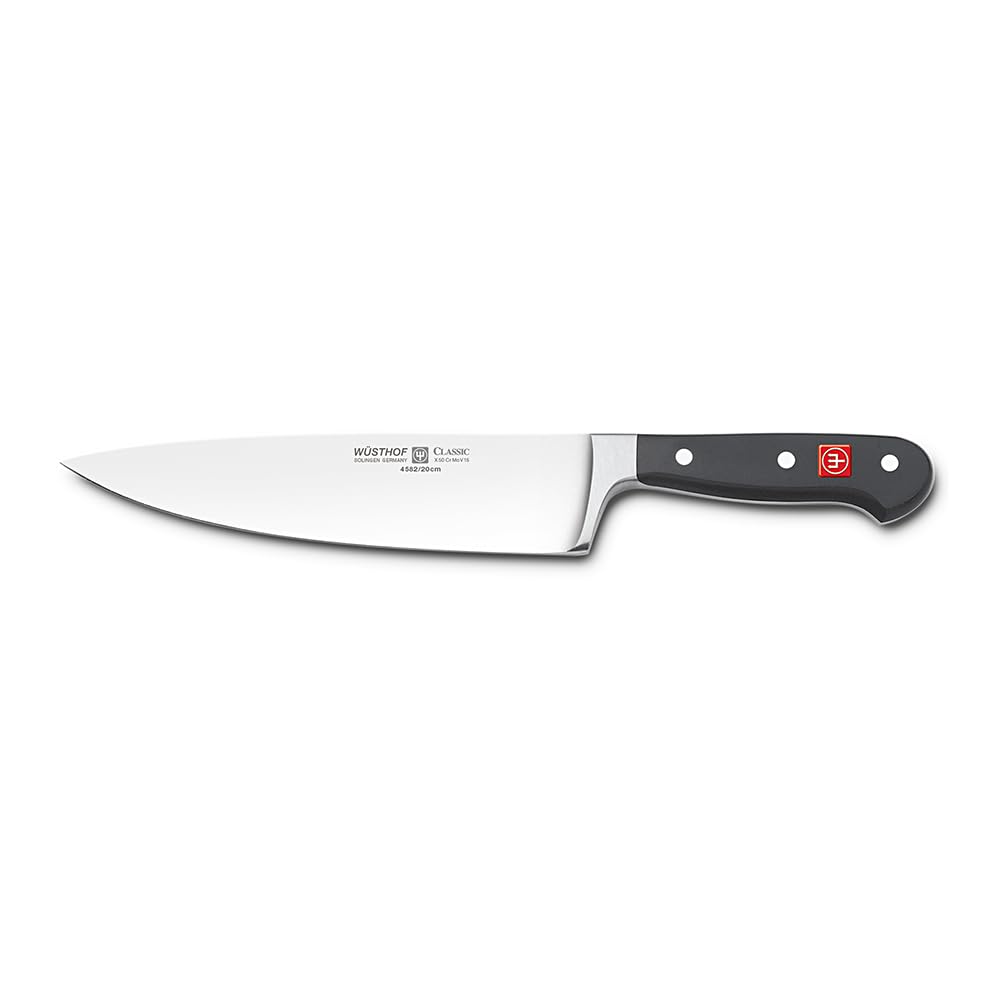
Wüsthof Classic 8-Inch Chef’s Knife — The European Benchmark, Forged in Solingen
Best for: Everyday rocking cuts
If you cook most nights and want one knife that handles onions, chicken and hard squash without drama, start here. The Classic pairs a Solingen-forged X50CrMoV15 blade at 58 HRC with a 14-degree edge on each side, so it sharpens easily and holds a working edge through a week of family dinners. At 9 ounces with a full bolster and triple-riveted handle, it balances just ahead of the bolster and powers rocking cuts with little wrist effort. It ranks first because no other knife in this guide matches its combination of toughness, comfort and maker heritage at this build level. Skip it only if you want a feather-light blade or a razor-thin edge, since this is a sturdy working knife first.
- Solingen-forged X50CrMoV15 blade at 58 HRC resists chipping on hard ingredients
- 14-degree edge sharpens quickly on a honing steel or whetstone
- Full-tang, triple-riveted handle balances at 9 ounces for steady rocking cuts
- Full bolster limits sharpening near the heel and adds weight some cooks dislike
| Blade length | 8 inches |
| Steel | X50CrMoV15 stainless |
| Hardness | 58 HRC |
| Weight | 9 ounces |
| Handle | Triple-riveted synthetic |
| Origin | Forged in Solingen, Germany |
9/10
10/10
8/10

Victorinox Fibrox Pro 8-Inch Chef’s Knife — Swiss Value for Everyday Prep
Best for: Budget daily prep
If your budget is tight but you still cook from scratch most nights, this is the knife that makes European quality affordable. The Fibrox Pro uses a stamped Swiss stainless blade at 55 to 56 HRC with a 15-degree edge, so it sharpens in minutes and forgives the odd knock against a bone. Its textured Fibrox handle grips firmly when wet, and at 7.3 ounces it is the lightest knife in this guide, which suits long prep sessions. It ranks second because it delivers honest Swiss build and easy maintenance at a budget-friendly tier, trading the forged bolster and heft of the Wüsthof for lightness and simplicity. Skip it if you want a forged bolster or a knife that feels substantial in the hand.
- Textured Fibrox handle stays grippy when wet or oily
- Light 7.3-ounce stamped blade reduces wrist fatigue over long sessions
- Swiss stainless at 55 to 56 HRC sharpens quickly and resists stains
- Stamped blade lacks a forged bolster, so it feels less planted in heavy rocking cuts
| Blade length | 8 inches |
| Steel | Swiss stainless |
| Hardness | 55-56 HRC |
| Weight | 7.3 ounces |
| Handle | Textured Fibrox |
| Origin | Made in Ibach, Switzerland |
8/10
9/10
10/10

K Sabatier Authentique 8-Inch Carbon Steel Chef Knife — Thiers Carbon Steel, Razor Keen
Best for: French push cuts
If you love the feel of a traditional French kitchen, this is the knife that defines it. The Authentique pairs a Thiers-forged carbon steel blade at 60 HRC with a straight profile and a 15-degree edge, so it push-cuts onions and herbs with almost no downward pressure. Carbon steel takes a keener edge than stainless and sharpens fast, but it darkens with use and needs drying after every wash, so it suits a cook who enjoys caring for a blade. It ranks third because its cutting feel is the sharpest in this guide, trading easy maintenance for pure edge performance. Skip it if you want a dishwasher-safe knife or a blade that never stains, since carbon steel always asks for a little attention.
- Carbon steel at 60 HRC takes a keener edge than any stainless pick here
- Straight French profile excels at push cuts and fine slicing
- Thiers-forged blade with a full tang and riveted handle
- Carbon blade stains and can rust if left wet, so it needs drying after every wash
- Develops a dark patina that some cooks dislike
| Blade length | 8 inches |
| Steel | French carbon steel |
| Hardness | 60 HRC |
| Weight | 8.5 ounces |
| Handle | Riveted wood |
| Origin | Forged in Thiers, France |
9/10
8/10
8/10
Berti Coltellerie Insieme 8-Inch Chef’s Knife — Maniago Handcraft With Olivewood Warmth
Best for: Italian handcraft
If you want a knife with a maker’s story behind it, this Maniago blade is the most personal pick in this guide. The Insieme pairs an N690 stainless blade at 58 to 60 HRC with an olivewood handle, so it holds a fine edge while feeling warm and shaped in the hand. Its 8-inch blade sits between the German belly and the French straight edge, which suits cooks who rock and push-cut in the same session. It ranks fourth because its hand-finished build and Italian heritage are genuinely special, trading the Wüsthof’s rugged uniformity for craft character. Skip it if you want a maintenance-free handle, since olivewood needs hand washing, quick drying and occasional oiling.
- N690 stainless at 58 to 60 HRC holds a fine edge and resists stains
- Olivewood handle feels warm and shaped, with a distinct grain on every knife
- Hand-finished Maniago build with a full tang
- Olivewood handle needs hand washing and occasional oiling, and it must never soak
| Blade length | 8 inches |
| Steel | N690 stainless |
| Hardness | 58-60 HRC |
| Weight | 8.8 ounces |
| Handle | Olivewood |
| Origin | Handmade in Maniago, Italy |
9/10
8/10
7/10

Arcos Maitre 8-Inch Chef’s Knife — Spanish Precision, Light in Hand
Best for: Light Spanish prep
If heavy forged knives tire your wrist, this Spanish blade offers a lighter way into European quality. The Maitre pairs a stamped Nitrum stainless blade at 58 HRC with a slim, riveted handle, so it moves quickly through vegetables and herbs without the heft of a German forged knife. At 7.5 ounces with a gently curved profile, it suits cooks who slice more than they rock-chop, and its Spanish maker has forged blades in Albacete since 1745. It ranks fifth because its light build and keen edge are excellent for everyday prep, trading bolster weight and chopping power for speed and comfort. Skip it if you regularly cut through hard squash or bone-in meat, since this blade prefers lighter work.
- Light 7.5-ounce build moves quickly through vegetables and herbs
- Nitrum stainless at 58 HRC holds a keen edge and resists corrosion
- Slim riveted handle suits smaller hands and long sessions
- Stamped blade lacks the heft and bolster of a forged knife for heavy chopping
| Blade length | 8 inches |
| Steel | Nitrum stainless |
| Hardness | 58 HRC |
| Weight | 7.5 ounces |
| Handle | Riveted synthetic |
| Origin | Made in Albacete, Spain |
8/10
8/10
9/10
Top 3 Head-to-Head: Wüsthof Classic vs Victorinox Fibrox Pro vs K Sabatier Authentique
These three are the final shortlist for most buyers: the German benchmark, the Swiss budget pick and the French carbon classic. Each one wins on a different criterion, so the right choice comes down to what you value most.
| Feature | #1 Wüsthof Classic | #2 Victorinox Fibrox Pro | #3 K Sabatier Authentique |
|---|---|---|---|
| Edge Retention | 9/10 | 8/10 | 9/10 — Best |
| Comfort and Control | 10/10 — Best | 9/10 | 8/10 |
| Value for Money | 8/10 | 10/10 — Best | 8/10 |
| Choose if… | You want one rugged knife for every job | You want Swiss quality on a tight budget | You want the keenest edge and enjoy blade care |
Who These European Chef Knives Are NOT For
Not every cook needs a European chef knife, and buying one for the wrong reasons wastes money.
If you want a knife you can leave in the sink or run through the dishwasher, look elsewhere too: carbon steel stains and wood handles crack under that treatment, and even stainless European blades last longer with a quick hand wash. If you are unsure which steel suits your habits, compare stainless vs carbon steel chef knife options before you decide, since the maintenance gap between them is the real dividing line.
Common Mistakes to Avoid
These are the mistakes that quietly ruin the experience even with a good European knife.
Frequently Asked Questions About European Chef Knives
What is the best European chef knife overall?
The Wüsthof Classic 8-Inch Chef’s Knife is the best European chef knife overall, with a Solingen-forged X50CrMoV15 blade at 58 HRC and a full-tang handle that suits rocking cuts. It leads this guide on comfort and control, and it handles everything from onions to hard squash without fuss.
Are German chef knives better than French chef knives?
Neither is better across the board. German knives curve for rocking cuts and use tough stainless steel that forgives hard ingredients, while French knives run straighter for push cuts and carbon steel versions take a keener edge. Choose German if you rock-chop and French if you push-cut.
Are German knives more durable?
Yes. German blades use tough stainless steel at 55 to 58 HRC, so they resist chipping better than harder Japanese blades, and our guide to are German knives more durable explains how that toughness shows up in daily use.
What steel do European chef knives use?
German makers mostly use X50CrMoV15 stainless, Italian makers use N690, Spanish makers use Nitrum, Swiss makers use their own stainless grade, and French makers offer both stainless and carbon steel. Hardness runs from 55 to 60 HRC across the five knives in this guide.
Can you put a European chef knife in the dishwasher?
No. Dishwasher heat and detergent dull the edge, crack wood handles and rust carbon steel blades. Hand wash with warm soapy water, dry at once and store the knife in a block or on a magnetic strip.
What size European chef knife should I buy?
An 8-inch blade suits most home cooks, since it handles a full onion and a chicken breast without feeling unwieldy. Choose a 6-inch blade for small hands or small boards, and a 10-inch blade only if you regularly prep large volumes.
Our Final Verdict
The European chef knife market splits into two camps: rugged German and Swiss workhorses built for daily rocking cuts, and sharper French and Italian blades built for push cuts and craft. The tension is between toughness and keenness, since the steel that survives a bone rarely takes the finest edge, and the steel that takes the finest edge asks for more care. Every knife in this guide is 8 inches, forged or stamped in its home country, and scored on the same three criteria, so the choice comes down to your cutting motion and your patience for maintenance.
If you want one knife for everything, the Wüsthof Classic 8-Inch is best because it leads on comfort and forgives hard ingredients. If your budget is tight, the Victorinox Fibrox Pro 8-Inch is best because it delivers honest Swiss build at a budget-friendly tier. If cutting feel matters most and you enjoy blade care, the K Sabatier Authentique 8-Inch is best because its carbon steel takes the keenest edge in this guide.

