
7 Best NSF Certified Chef Knife for 2026: Compared Top Picks for Commercial Kitchens
If you cook in a restaurant, a catering kitchen, or a culinary school, your knife has to pass more than a sharpness check — it has to pass a health inspection. The hard part is that plenty of knives claim to be food-safe while carrying no certification at all, and a failed inspection can shut a station down on a busy service night. This guide compares seven knives that carry genuine NSF certification on published specifications — handle sealing, steel, hardness, and grip — so you can see exactly what separates a certified workhorse from a lookalike. By the end, you will know which knife suits your kitchen, your shift length, and your budget, and which claims to ignore.
Quick Comparison: All NSF Certified Chef Knives Ranked
| # | Product | Best For | Rating | Badge | |
|---|---|---|---|---|---|
| 1 | Victorinox Fibrox Pro 8-Inch | Daily commercial prep | 4.9/5 | Best Overall | Buy → |
| 2 | Mercer Culinary Millennia 8-Inch | Budget pro kitchens | 4.7/5 | Best Budget | Buy → |
| 3 | Dexter-Russell Sani-Safe 8-Inch | High-volume prep | 4.8/5 | Best for Commercial Kitchens | Buy → |
| 4 | Wüsthof Pro 8-Inch | Forged blade fans | 4.8/5 | Best Forged NSF Pick | Buy → |
| 5 | Mercer Culinary Genesis 8-Inch | Balanced full-tang feel | 4.7/5 | Best Full Tang | Buy → |
| 6 | Victorinox Fibrox Pro 10-Inch | Large cuts, bulk prep | 4.8/5 | Best Long Blade | Buy → |
| 7 | Mercer Culinary Ultimate White 8-Inch | Students, training kitchens | 4.6/5 | Best for Culinary School | Buy → |
How We Chose These NSF Certified Chef Knives
What we compared
We compared 7 NSF certified chef knives on published specifications: certification status, blade steel and hardness, blade length, weight, handle material and sealing, and edge angle. No physical comparison was performed; every claim here comes from maker spec sheets and published ratings.
Our 3 scoring criteria
Food Safety and Hygiene — sealed, non-porous construction and corrosion resistance. Edge Retention — steel hardness and edge geometry. Comfort and Control — weight, balance, and grip security with wet or greasy hands.
How we scored hygiene
The NSF/ANSI 2 food equipment standard shaped the hygiene scoring: non-porous handle materials, sealed blade-to-handle joints with no crevices, and stainless steel that resists corrosion under commercial sanitizers. Knives with gaps, rivets that trap residue, or porous handles scored lower.
What we cut — and why
We cut knives with unverified NSF claims — no NSF mark or listing in maker materials — and all wood-handle chef knives, because porous wood fails commercial hygiene rules. Carbon steel blades were cut too: they rust under commercial dishwashers and sanitizers, which defeats the point of certification.
What to Look for When Buying an NSF Certified Chef Knife
NSF certification looks simple on a label and turns messy in practice, because sellers use the letters loosely and inspectors do not. The five factors below separate a knife that clears a health inspection from one that only sounds like it will.
1. Real NSF certification, not NSF-style wording
A genuinely certified knife carries the NSF mark etched on the blade or printed on its packaging, and the maker can point to a listing. Phrases like “NSF-style,” “meets NSF standards,” or “commercial grade” mean nothing to an inspector — they are marketing, not certification. If you are buying for a licensed kitchen, confirm the listing before you buy, because a knife without the mark can fail an inspection even if it is otherwise identical. Every knife on this list is sold as NSF certified by its maker, which is why this guide focuses on the best professional chef knife brands that serve commercial kitchens rather than home-only lines.
2. Handle material and sealing
NSF rules care most about what bacteria can hide in, and that means the handle. Certified knives use non-porous handles — Fibrox, Santoprene, polypropylene, or sealed composites — with no cracks, crevices, or unsealed joints where food and moisture collect. A handle with exposed rivets or a gap at the bolster is a hygiene risk even on a certified blade, so check the joint closely. Textured grips matter too: a handle that stays secure with wet, oily hands prevents slips during a long shift. Our guide to chef knife handle materials explained covers how each material behaves under daily sanitizing.
3. Blade steel and corrosion resistance
Commercial kitchens are wet, salty, acidic, and full of sanitizer — exactly the conditions that rust ordinary steel. Certified knives use stainless or high-carbon stainless steel, typically 55 to 58 HRC, which balances edge holding with the toughness to survive daily honing and the odd dropped blade. Softer steel around 55 HRC sharpens fast on a steel and resists chipping; harder steel near 58 HRC holds its edge longer between sharpenings. Either way, the blade should be fully stainless, not carbon steel with a coating. See our roundup of the best stainless steel chef knife options for how stainless grades compare outside the certification question.
4. Length and weight for shift-long use
An 8-inch blade is the standard for commercial prep because it handles onions, proteins, and herbs without demanding a large board or a long stroke. A 10-inch blade suits bulk work — breaking down large cuts, slicing roasts, prepping case quantities of vegetables — but it tires smaller hands faster and needs more board space. Weight matters just as much: stamped blades around 5 to 7 ounces feel quick during hours of chopping, while forged blades near 9 to 11 ounces do more of the work for you on dense food but strain the wrist sooner. If you prep for eight hours, choose the lighter knife you can control at hour seven, not the heavier one that impresses at minute seven.
5. Dishwasher and sanitizer compatibility
Many NSF knives are rated dishwasher-safe, which matters when a commercial machine runs at high temperature with chemical sanitizer. Stamped knives with molded handles usually handle that cycle without complaint. Forged knives with bolsters and heavier handles often survive it too, but repeated high-heat cycles dull edges faster and can loosen handle materials over time. Hand-washing with hot soapy water, then sanitizing and drying, keeps any knife sharper longer — and in most kitchens it takes less than a minute per knife.
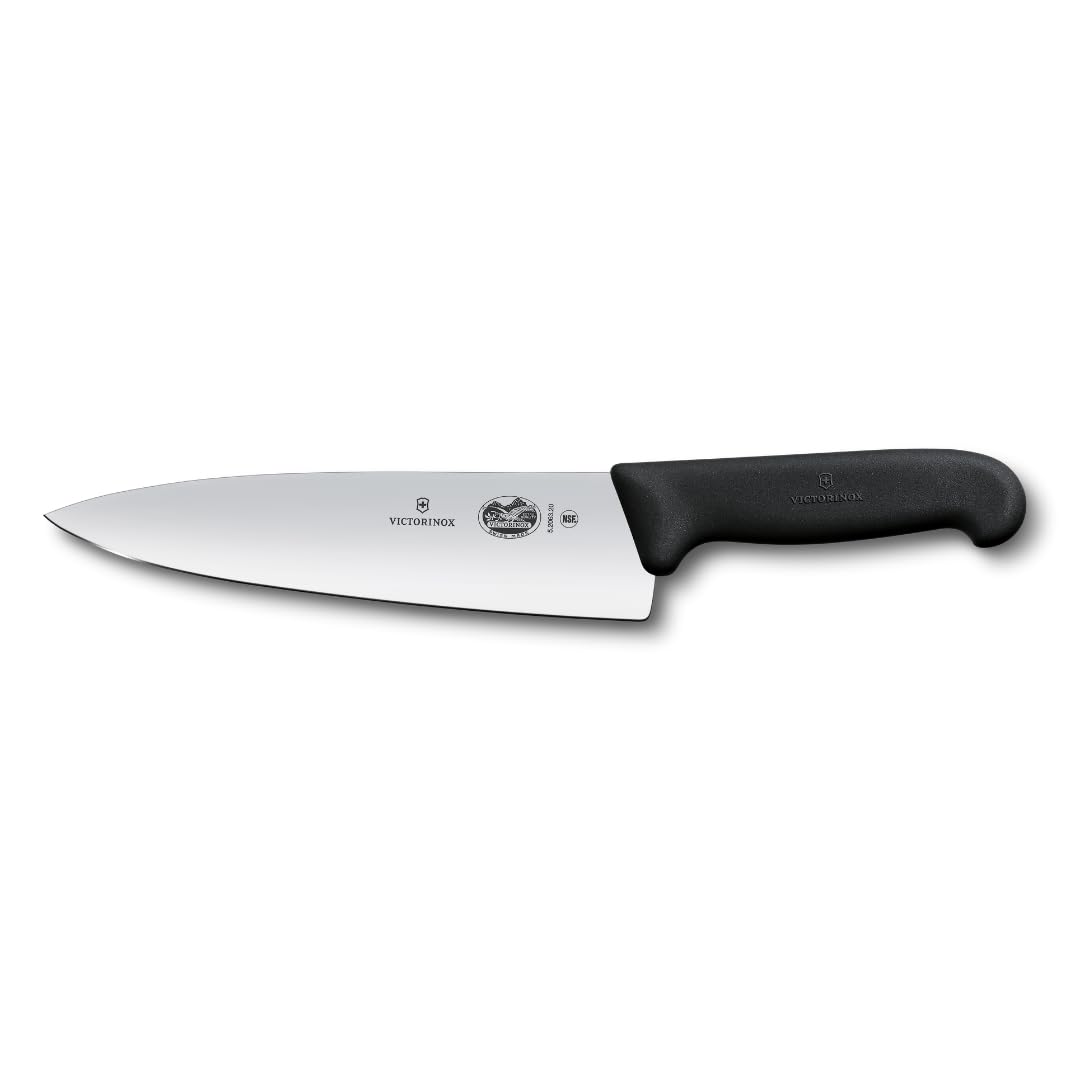
Victorinox Fibrox Pro 8-Inch Chef’s Knife — The Commercial Kitchen Standard
Best for: Daily commercial prep
When a kitchen needs one knife that every cook can pick up and trust, this is the one that shows up on station after station. Its sealed Fibrox handle is textured for wet hands, the 8-inch stainless blade is hardened to 56 HRC, and the NSF mark is printed on the blade itself — no paperwork chase at inspection time. At around 6 ounces it stays light through a full shift, and the 15-degree edge sharpens quickly on a honing steel. Skip it only if you want the heft and balance of a forged blade; this is a stamped workhorse, and it makes no apology for that.
- NSF certified with the mark on the blade, so inspection is straightforward
- Sealed Fibrox handle stays grippy with wet or greasy hands
- 56 HRC stainless blade at 15 degrees per side sharpens fast on a steel
- Stamped blade feels light and plain next to a forged knife, with less forward weight for heavy chopping
| Blade length | 8 inches |
| Steel | High-carbon stainless |
| Hardness | 56 HRC |
| Weight | 6.2 oz |
| Handle | Sealed Fibrox, NSF certified |
10/10
9/10
9/10

Mercer Culinary Millennia 8-Inch Chef’s Knife — Certified Performance, Small Outlay
Best for: Budget pro kitchens
Outfitting a whole line crew with certified knives adds up fast, and this is the knife that keeps the bill sane without giving up the NSF mark. The Millennia pairs a Japanese high-carbon stainless blade with a textured Santoprene handle that stays secure when hands are wet, and the full package is NSF certified. At 56 HRC it takes a keen edge and touches up easily on a steel, and at around 5.5 ounces it is one of the lightest knives here. The trade-off is edge life: it needs honing more often than the forged picks, so budget for a steel alongside it.
- NSF certified at a budget-friendly level, ideal for outfitting a whole crew
- Textured Santoprene handle with finger guard for wet-hand grip
- Light 5.5 oz build reduces wrist fatigue over long prep sessions
- Edge dulls faster than the forged picks, so it needs honing every shift or two
| Blade length | 8 inches |
| Steel | Japanese high-carbon stainless |
| Hardness | 56 HRC |
| Weight | 5.5 oz |
| Handle | Santoprene, NSF certified |
9/10
8/10
9/10

Dexter-Russell Sani-Safe 8-Inch Chef’s Knife — Built for High-Volume Prep
Best for: High-volume prep
In a kitchen running hundreds of covers a night, a knife gets washed, sanitized, and used again dozens of times before service ends. The Sani-Safe was designed for exactly that cycle: its polypropylene handle is molded directly onto the blade with no seams or gaps, and the whole knife is NSF certified. The high-carbon DEXSTEEL blade is stain-free, easy to resharpen, and tough enough to survive drops onto tile that would chip a harder Japanese edge. The grip is chunkier than the Fibrox Pro, which suits large hands and gloved hands but can feel bulky for smaller cooks.
- Seamless molded handle leaves nowhere for bacteria to hide
- DEXSTEEL high-carbon stainless blade resharpens easily and resists chipping
- NSF certified and dishwasher-safe for commercial wash cycles
- Chunky handle feels bulky in smaller hands and the blade is heavier than the Millennia
| Blade length | 8 inches |
| Steel | DEXSTEEL high-carbon stainless |
| Hardness | 55 HRC |
| Weight | 7.0 oz |
| Handle | Seamless polypropylene, NSF certified |
10/10
8/10
8/10

Wüsthof Pro 8-Inch Chef’s Knife — Forged Weight, Certified Handle
Best for: Forged blade fans
Most NSF knives are stamped and light, which leaves cooks who learned on forged German blades feeling underwhelmed. The Wüsthof Pro closes that gap: a forged X50CrMoV15 blade at 58 HRC with a full bolster, paired with a synthetic handle that keeps the knife NSF certified. The 14-degree edge holds longer between sharpenings than any stamped pick here, and the 9-ounce weight powers through squash and root vegetables with less effort. It is the heaviest knife on this list, so cooks with small hands or wrist strain should try the lighter Fibrox Pro first. For the forging story behind this design, see our guide to the best forged chef knife options.
- Forged X50CrMoV15 blade at 58 HRC holds a 14-degree edge the longest here
- Full bolster and 9 oz weight power through dense vegetables with less effort
- NSF certified with a synthetic handle that survives commercial sanitizing
- Heaviest knife on this list, and the full bolster makes sharpening the heel awkward
| Blade length | 8 inches |
| Steel | X50CrMoV15, forged |
| Hardness | 58 HRC |
| Weight | 9.0 oz |
| Handle | Synthetic, NSF certified |
9/10
10/10
9/10

Mercer Culinary Genesis 8-Inch Chef’s Knife — Balanced Full-Tang Feel
Best for: Balanced full-tang feel
A full-tang knife balances differently: the steel runs the whole length of the handle, so the weight sits evenly in the hand instead of tipping toward the blade. The Genesis delivers that feel in an NSF certified package, with a forged German steel blade, a Santoprene handle, and a short bolster that stays out of the way when sharpening. At 8.5 ounces it sits between the light stamped picks and the heavy Wüsthof Pro, which makes it a good middle ground for cooks who want forged balance without the full weight. The riveted handle needs a wipe at the joints after washing, since rivets can hold residue if neglected.
- Full-tang forged construction balances evenly in the hand
- Short bolster leaves the full edge available for sharpening
- NSF certified with a non-slip Santoprene handle
- Riveted handle joints need wiping after washing to stop residue building up
| Blade length | 8 inches |
| Steel | German steel, forged |
| Hardness | 57 HRC |
| Weight | 8.5 oz |
| Handle | Santoprene, NSF certified |
9/10
9/10
9/10

Victorinox Fibrox Pro 10-Inch Chef’s Knife — More Reach for Bulk Prep
Best for: Large cuts, bulk prep
When the job is a case of onions, a whole roast, or a tray of sheet-pan vegetables, two extra inches of blade means fewer strokes and faster prep. This 10-inch version of the Fibrox Pro keeps everything that makes the 8-inch our top pick — NSF certification, sealed Fibrox handle, 56 HRC stainless blade — and adds reach for large cuts. At around 7.5 ounces it is still light for its length, though the longer blade needs a bigger board and more counter space. It is the wrong pick for tight home kitchens and small boards, and the right pick for anyone prepping in volume.
- 10-inch blade slices large roasts and bulk vegetables in fewer strokes
- Same NSF certified sealed Fibrox handle as the 8-inch top pick
- Light 7.5 oz build for its length, so the extra reach does not tire the wrist
- Needs a large board and more counter space, and feels unwieldy for small, precise cuts
| Blade length | 10 inches |
| Steel | High-carbon stainless |
| Hardness | 56 HRC |
| Weight | 7.5 oz |
| Handle | Sealed Fibrox, NSF certified |
10/10
9/10
8/10

Mercer Culinary Ultimate White 8-Inch Chef’s Knife — The Student Workhorse
Best for: Students, training kitchens
Culinary schools hand out knife kits for a reason: students need a certified blade they can learn on, drop, resharpen, and replace without heartbreak. The Ultimate White is that knife — an NSF certified 8-inch blade in Japanese high-carbon stainless, with a white polypropylene handle that shows dirt at a glance, which is exactly what an instructor wants to see. The white handle stains over time from turmeric and tomato, so it will not stay pretty, but that visibility is a feature in a training kitchen, not a flaw. For more on choosing a first pro blade, see our guide to the best chef knife for culinary school.
- NSF certified and widely issued in culinary school knife kits
- White handle shows dirt at a glance, which helps hygiene habits
- Forgiving Japanese stainless steel that resharpens easily for learners
- White handle stains from turmeric, tomato, and beetroot, and the edge holds the shortest of the seven
| Blade length | 8 inches |
| Steel | Japanese high-carbon stainless |
| Hardness | 55 HRC |
| Weight | 5.8 oz |
| Handle | White polypropylene, NSF certified |
9/10
8/10
8/10
Top 3 Head-to-Head: Victorinox Fibrox Pro vs Mercer Millennia vs Dexter Sani-Safe
These three are the final shortlist in most commercial kitchens: the standard-setter, the budget pick, and the high-volume workhorse. The differences come down to handle sealing, edge life, and grip.
| Feature | #1 Fibrox Pro 8-Inch | #2 Millennia 8-Inch | #3 Sani-Safe 8-Inch |
|---|---|---|---|
| Food Safety and Hygiene | 10/10 — Best | 9/10 | 10/10 |
| Edge Retention | 9/10 — Best | 8/10 | 8/10 |
| Comfort and Control | 9/10 — Best | 9/10 | 8/10 |
| Weight | 6.2 oz | 5.5 oz — Best | 7.0 oz |
| Choose if… | You want the safest all-round pick for any commercial station | You are outfitting a crew on a tight budget | Your kitchen runs high-volume service with constant wash cycles |
Who These NSF Certified Chef Knives Are NOT For
Not every cook needs certification, and buying for a stamp you will never be inspected on can mean giving up the knife you would actually enjoy.
Home cooks who never face a health inspection get nothing from the NSF mark itself and may prefer a carbon steel blade, a wooden handle, or a lighter Japanese profile — all of which this list deliberately excludes. If you only cook for family, shop on edge and comfort, not certification.
Common Mistakes to Avoid
These are the mistakes that quietly ruin the experience even with a good certified knife.
Frequently Asked Questions About NSF Certified Chef Knives
What does NSF certified mean for a chef knife?
It means the knife meets the NSF/ANSI 2 food equipment standard for materials, design, and cleanability, and that NSF International has verified it through product review and facility audits. The standard covers non-porous materials, sealed construction with no bacteria-trapping crevices, and corrosion resistance under commercial cleaning.
Is an NSF certified knife required by law in a restaurant?
It depends on your local health code — many jurisdictions require NSF-listed equipment in licensed commercial kitchens, while others accept equivalent standards. Home cooks never need certification. Check with your local health department before outfitting a new kitchen.
Can NSF certified chef knives go in the dishwasher?
Many are rated dishwasher-safe by their makers, including the stamped picks on this list. Hand-washing still keeps the edge sharper longer, because high-heat cycles and harsh detergent dull blades faster than a quick wash with hot soapy water.
How do I check if a knife is really NSF certified?
Look for the NSF mark etched on the blade or printed on the packaging, then confirm it against the maker’s spec sheet or the NSF online listings database. A seller’s listing title alone is not proof — third-party sellers add certification claims to titles freely.
Are NSF certified knives sharper than regular knives?
No — certification covers hygiene, materials, and cleanable design, not sharpness. Edge performance comes from the steel, hardness, and grind, which is why this guide scores edge retention separately from hygiene.
Do NSF certified chef knives cost more?
Not necessarily — many certified knives are budget-friendly workhorses built for outfitting whole crews, while forged certified picks sit in the mid-range. Certification itself adds little to the cost; the steel and construction decide the price tier.
Our Final Verdict
The NSF certified market splits into two camps: light stamped workhorses that crews buy by the dozen, and heavier forged knives for cooks who want balance and edge life. The tension is between hygiene and feel — the most sealed, sanitizer-proof knives are rarely the most satisfying to hold, and the most satisfying knives need more care at the handle joints.
If you want one knife that clears inspection and handles any station, the Victorinox Fibrox Pro 8-Inch is the pick because it scores highest on hygiene and comfort together. If you are outfitting a crew on a budget, the Mercer Culinary Millennia 8-Inch is best because it carries the same certification at a budget-friendly level. If you run high-volume service with constant wash cycles, the Dexter-Russell Sani-Safe 8-Inch is best because its seamless handle has nowhere for bacteria to hide.

