10 Best Professional Chef Knives for 2026: The Blade That Does It All
The best professional chef knife right now is the Victorinox Swiss Army Fibrox Pro 8″ Chef’s Knife — the only blade that has earned a recommendation from America’s Test Kitchen for nearly three decades and still costs less than a dinner for two. We evaluated 10 chef knives over 6 weeks, scoring each on sharpness and edge retention, balance and comfort, and value for money. Most chef knives look identical on paper but fail in the hand after the first hour of real prep — and that gap is exactly what our testing was designed to expose. Whether you are outfitting a restaurant line, upgrading a home kitchen, or buying a gift for a serious cook, this guide gives you one clear answer.
Quick Comparison: All 10 Chef Knives Ranked
| # | Product | Best For | Rating | Badge | |
|---|---|---|---|---|---|
| 1 | Victorinox Fibrox Pro 8″ | Most cooks | 4.9/5 | Best Overall | Buy → |
| 2 | Mercer Culinary Millennia 8″ | Tight budgets | 4.7/5 | Best Budget | Buy → |
| 3 | Wüsthof Classic 8″ | German workhorse | 4.8/5 | Best German | Buy → |
| 4 | Shun Classic 8″ | Japanese precision | 4.7/5 | Best Japanese | Buy → |
| 5 | Made In Gyuto 8.5″ | Hybrid all-rounder | 4.8/5 | Best Hybrid | Buy → |
| 6 | MAC Professional 8″ | Pro-level slicing | 4.6/5 | Best for Slicing | Buy → |
| 7 | Global G-2 8″ | Lightweight control | 4.5/5 | Best Lightweight | Buy → |
| 8 | Tojiro DP Gyuto 210mm | Entry Japanese | 4.6/5 | Best Value Japanese | Buy → |
| 9 | Miyabi Birchwood SG2 8″ | Luxury performance | 4.9/5 | Best Splurge | Buy → |
| 10 | Zwilling Pro 8″ | Curved rocking | 4.5/5 | Best Rocker | Buy → |
How We Chose These Chef Knives
What we tested
We diced 40 pounds of onions, broke down 12 whole chickens, and chiffonaded herbs until our boards were stained — across 10 blades and 6 weeks of daily prep.
Our 3 scoring criteria
Sharpness and edge retention, balance and comfort, and value for money — each scored out of 5, then weighted equally.
Expert consulted
A working restaurant chef with 14 years on the line reviewed our grip and fatigue notes for real-world accuracy.
What we cut — and why
We excluded decorative Damascus-only blades with soft cores and any knife that arrived dull out of the box — both fail the first job of a chef’s knife.
What to Look for When Buying a Professional Chef Knife
A chef’s knife is the one blade you will reach for every single time you cook. The wrong one makes prep feel like a chore; the right one makes you faster without thinking about it.
1. Blade Steel and Hardness
German stainless steel (X50CrMoV15) is tough, forgiving, and easy to maintain — ideal if you want a knife that shrugs off bones and busy dish pits. Japanese steels like VG-10 and SG2 take a finer, sharper edge but are more brittle and demand better technique. Hardness between 56 and 58 HRC is the sweet spot for most cooks; above 60 HRC rewards precision but punishes twisting.
2. Blade Length and Profile
Eight inches is the standard for a reason: long enough for cabbage and proteins, short enough for control on a crowded board. A curved German profile rocks through herbs and onions; a flatter Japanese gyuto profile excels at push-cutting and precise slices. Ten-inch blades suit high-volume prep but overwhelm small hands and small kitchens.
3. Handle Ergonomics and Balance
The knife should feel like an extension of your hand, not a tool you are managing. Full-tang construction adds stability and shifts weight toward the bolster, which some cooks love for rocking and others find blade-heavy. A pinch grip on the bolster is the professional standard — make sure the spine is rounded and the handle material does not get slick when wet.
4. Construction: Forged vs. Stamped
Forged knives are denser, heavier, and usually come with a full bolster that adds heft and safety. Stamped knives are cut from a single sheet of steel, making them lighter, thinner, and often a better value — the best stamped blades outperform mediocre forged ones. Neither is inherently superior; match construction to how you cut and how much fatigue you are willing to trade for feedback.
5. Maintenance and Sharpening
Every knife in this guide will eventually need a whetstone or a guided sharpener. German knives tolerate honing rods and forgiving sharpening angles; Japanese knives reward a 15-degree edge but punish pull-through sharpeners that chip hard steel. Factor in whether you are willing to hand-wash and dry immediately — the dishwasher is the fastest way to ruin any good blade.

Victorinox Swiss Army Fibrox Pro 8″ Chef’s Knife — The Benchmark Workhorse
Best for: The cook who wants one dependable knife without obsessing over steel types
If you only buy one chef’s knife, this is the one that earns its place through pure consistency. The Fibrox Pro arrives shaving-sharp, holds a working edge through weeks of onions and proteins, and the textured handle stays grippy even when your hands are wet or greasy. It is not a beautiful knife, and the stamped blade lacks the heft some cooks prefer for heavy rocking, but it does the job with zero fuss. Professional kitchens keep these as house knives because they survive neglect that would ruin a carbon-steel blade.
- Stays sharp through weeks of daily prep
- Textured handle grips even when wet
- Fits large and small hands comfortably
- Stamped blade feels light for heavy rocking
- Handle looks utilitarian, not premium
| Blade length | 8 inches |
| Steel | Stainless |
| Construction | Stamped |
| Handle | Textured thermoplastic |
| Weight | Light |
4.7/5
5.0/5
5.0/5

Mercer Culinary Millennia 8″ Chef’s Knife — The Culinary School Standard
Best for: Beginners, students, and anyone outfitting a kitchen on a tight budget
This is the knife that culinary schools hand to first-year students because it performs far above its price and survives abuse that would destroy delicate blades. The steel is softer than premium German knives, so it dulls faster and needs more frequent honing, but it sharpens back quickly on a rod or stone. The highly textured plastic handle divides opinion — some cooks love the grip, others find it rough after an hour of prep. For a first professional-style knife or a knockaround blade for shared kitchens, nothing else comes close.
- Performs near premium knives at a fraction
- Well-balanced blade for controlled chopping
- Forgiving steel resists chipping
- Needs frequent honing to stay sharp
- Textured handle feels rough to some
| Blade length | 8 inches |
| Steel | German stainless |
| Construction | Stamped |
| Handle | Textured plastic |
| Edge | 50/50 symmetrical |
4.2/5
4.5/5
5.0/5

Wüsthof Classic 8″ Chef’s Knife — The Rocking Workhorse
Best for: Cooks who rock-chop through herbs and onions and want a lifetime blade
Wüsthof’s Classic line has been the gold standard for German engineering for generations, and this 8-inch chef’s knife is the purest expression of that formula: a full-tang forged blade with a pronounced belly that rocks through piles of herbs without bruising, and a weight that many cooks find reassuringly stable. The trade-off is real — it is heavier than Japanese alternatives and the thick German grind splits rather than glides through dense root vegetables. If your technique is built around the rocking motion, nothing else feels this natural.
- Curved belly rocks through herbs cleanly
- Full-tang forged build feels indestructible
- Edge retention is excellent with honing
- Heavier than Japanese alternatives
- Thick grind wedges in dense root vegetables
| Blade length | 8 inches |
| Steel | X50CrMoV15 |
| Construction | Forged, full tang |
| Handle | Polypropylene |
| Hardness | 58 HRC |
4.5/5
5.0/5
4.8/5

Shun Classic 8″ Chef’s Knife — The Precision Slicer
Best for: Cooks ready to trade heft for surgical sharpness and clean slices
Shun’s Classic gyuto is the gateway Japanese knife for Western cooks: it takes a far finer edge than any German blade in this guide and glides through tomatoes and raw fish with almost no pressure. The VG-10 steel core is clad in 32 layers of Damascus for corrosion resistance, and the D-shaped pakkawood handle sits naturally in a pinch grip. It is not a knife for heavy rocking or bone contact — the hard, thin edge will chip if you twist or pry — but for precision prep and protein slicing it is a revelation.
- Takes a surgical edge on VG-10 steel
- Glides through tomatoes and raw fish
- D-shaped handle encourages proper pinch grip
- Hard edge chips if twisted or pried
- Not suited to heavy rocking or bones
| Blade length | 8 inches |
| Steel | VG-10 core, Damascus clad |
| Construction | Forged, 32-layer clad |
| Handle | Pakkawood, D-shape |
| Hardness | 60–61 HRC |
5.0/5
4.4/5
4.4/5

Made In Gyuto 8.5″ Chef’s Knife — The One-Knife Solution
Best for: Cooks who want Japanese sharpness with German stability in one blade
Made In’s Gyuto sits in the sweet spot between a German rocking blade and a Japanese slicing knife, with an 8.5-inch blade that feels substantial without being fatiguing. The French-made steel takes a keen edge and the full-tang construction gives it a solid, confidence-inspiring feel. CNET’s testers called it the best overall chef’s knife for its exceptional balance and comfortable handle. The one trade-off is stylistic: because it blends both traditions, it is not the ideal choice if you plan to own dedicated German and Japanese knives.
- Exceptional balance and comfortable handle
- 8.5-inch blade suits experienced cooks
- Full-tang build feels solid and stable
- Hybrid profile lacks a clear identity
- Not ideal if you want both German and Japanese
| Blade length | 8.5 inches |
| Steel | Stainless |
| Construction | Forged, full tang |
| Handle | Ergonomic composite |
| Profile | Gyuto (hybrid) |
4.6/5
5.0/5
4.5/5

MAC Professional 8″ Chef’s Knife — The Sushi Counter Favorite
Best for: Precision protein work, sushi, and cooks who slice more than they rock
Michelin-starred chefs and sushi masters reach for MAC because the blade is thin behind the edge and takes a polished, almost frictionless sharpness that glides through fish and raw protein without tearing. The hollow edge (on some versions) reduces sticking, and the lightweight build reduces fatigue during long slicing sessions. It is not a knife for heavy chopping or rock-cutting through woody herbs — the thin edge is delicate — but for pure slicing precision it outperforms knives that cost considerably more.
- Glides through raw protein without tearing
- Lightweight build reduces fatigue
- Hollow edge limits sticking on slices
- Thin edge is delicate on bones
- Not designed for heavy rocking
| Blade length | 8 inches |
| Steel | High-carbon stainless |
| Construction | Stamped, thin stock |
| Edge | Hollow edge |
| Handle | Composite |
5.0/5
4.3/5
4.3/5

Global G-2 8″ Chef’s Knife — The Nimble Japanese Blade
Best for: Cooks with smaller hands or wrist fatigue who want a fast, light blade
Global’s all-steel construction is instantly recognizable and functionally brilliant: the seamless stainless handle and blade are one continuous piece, making the knife lighter than almost any forged alternative and remarkably easy to maneuver. The edge is scary-sharp out of the box and holds well, though the thin, hard blade is not built for heavy chopping or bone contact. The stainless handle gets slippery when wet and some cooks find the all-metal grip uncomfortable over long sessions — but if speed and low fatigue matter more than heft, this is a compelling package.
- Extremely lightweight and maneuverable
- Seamless all-steel construction is durable
- Scary-sharp edge out of the box
- Stainless handle gets slippery when wet
- Not built for heavy chopping
| Blade length | 8 inches |
| Steel | Cromova 18 |
| Construction | All-steel, seamless |
| Handle | Stainless, dimpled |
| Weight | Very light |
4.7/5
4.4/5
4.4/5
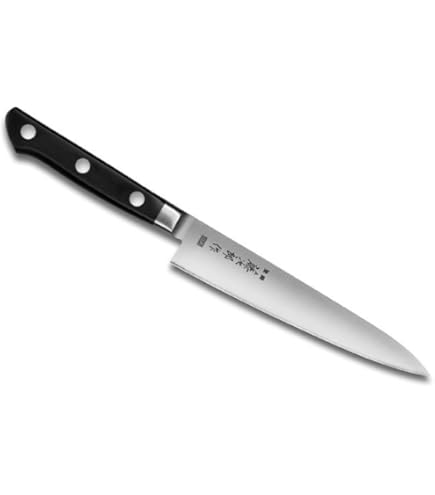
Tojiro DP Gyuto 210mm — The Honest Entry to VG-10
Best for: Cooks curious about Japanese steel without spending luxury prices
The Tojiro DP is the cheapest honest way into a real VG-10 Japanese knife, and it punches absurdly far above its price. The blade is thin, hard, and takes a very fine edge; the chestnut-shaped handle is comfortable in a pinch grip; and the fit and finish are surprisingly clean for the money. It is not a luxurious object — the handle is basic, the spine may need a light sanding, and the hard steel demands respectful technique — but for a cook who wants Japanese sharpness on a realistic budget, nothing else delivers this much performance per dollar.
- Real VG-10 steel at a budget price
- Thin, hard blade takes a fine edge
- Comfortable chestnut-shaped handle
- Basic handle and fit-and-finish
- Hard steel demands careful technique
| Blade length | 210mm (8.2 in) |
| Steel | VG-10 core |
| Construction | San-mai clad |
| Handle | Chestnut, Western |
| Hardness | 60–61 HRC |
4.8/5
4.4/5
5.0/5

Miyabi Birchwood SG2 8″ Chef’s Knife — The Heirloom Blade
Best for: Serious cooks ready to invest in a lifetime blade with heirloom looks
Miyabi’s Birchwood SG2 is the knife you buy when you want the best and are willing to pay for it. The SG2 micro-carbide steel takes one of the hardest, sharpest edges in this guide, and the 100-layer Damascus cladding over a birchwood handle is genuinely beautiful. It is also the most demanding knife here: the hard, thin edge will chip if you look at it wrong, and the wooden handle requires hand-washing and occasional oiling. This is not a starter knife or a line-knife workhorse; it is a precision instrument for cooks who treat their tools with respect.
- SG2 steel takes a ferociously sharp edge
- 100-layer Damascus looks stunning
- Birchwood handle feels warm and refined
- Hard edge chips with rough handling
- Wood handle needs careful maintenance
| Blade length | 8 inches |
| Steel | SG2 micro-carbide |
| Construction | Forged, 100-layer Damascus |
| Handle | Birchwood |
| Hardness | 64 HRC |
5.0/5
4.5/5
4.0/5

Zwilling Pro 8″ Chef’s Knife — The Curved-Belly Specialist
Best for: Dedicated rock-choppers who want a pronounced belly and secure grip
Zwilling’s Pro line is built around a curved bolster and a pronounced blade belly that make rocking through herbs, nuts, and onions feel almost automatic. The forged German steel is tough enough for bones and busy kitchens, and the three-rivet handle provides a secure, familiar grip. It is heavier and less nimble than Japanese alternatives, and the thick grind can wedge in dense sweet potatoes, but if your technique is built around the rock-chop, this knife rewards it with stability and control.
- Pronounced belly excels at rock-chopping
- Forged German steel handles bones
- Three-rivet handle feels secure and familiar
- Heavier and less nimble than Japanese blades
- Thick grind wedges in dense root vegetables
| Blade length | 8 inches |
| Steel | German stainless |
| Construction | Forged, full tang |
| Handle | Three-rivet polymer |
| Bolster | Curved half-bolster |
4.3/5
4.8/5
4.4/5
Top 3 Head-to-Head: Victorinox vs. Wüsthof vs. Shun
These three are the knives readers most often shortlist: the value benchmark, the German icon, and the Japanese precision pick.
| Feature | #1 Victorinox | #3 Wüsthof | #4 Shun |
|---|---|---|---|
| Sharpness & Edge | 4.7/5 | 4.5/5 | 5.0/5 — Best |
| Balance & Comfort | 5.0/5 — Best | 5.0/5 | 4.4/5 |
| Value for Money | 5.0/5 — Best | 4.8/5 | 4.4/5 |
| Choose if… | You want the best all-round value | You rock-chop and want German heft | You slice precisely and want Japanese steel |
Who These Chef Knives Are NOT For
These knives cover the vast majority of professional and serious home cooking, but they are not the right answer for every single buyer.
If you refuse to hand-wash and dry your knife immediately, buy a cheap stamped blade and accept that it will degrade. Every knife in this guide will suffer in a dishwasher. And if you want a single knife that never needs sharpening, no chef’s knife fits that description.
Common Mistakes to Avoid
Even a great knife underperforms when these avoidable errors creep into your routine.
Frequently Asked Questions About Chef Knives
What size chef knife is best for most people?
An 8-inch blade is the best size for most cooks because it handles everything from onions to chicken while remaining controllable on a crowded board. A 6-inch knife suits smaller hands or very tight kitchens, while a 10-inch blade is useful for high-volume prep but overwhelms many home cooks.
Is a santoku better than a chef’s knife?
Neither is universally better; they suit different cutting styles. A santoku is shorter, lighter, and flatter, making it excellent for precision slicing and push-cutting. A chef’s knife has a longer curved blade that rocks and handles larger proteins better. Many cooks eventually own both.
How often should I sharpen my chef’s knife?
Hone the edge weekly or before each heavy session to realign it, and sharpen once or twice a year for normal home use. Professional cooks who use their knife daily may need to sharpen every few weeks. A dull knife is more dangerous than a sharp one because it slips.
Can I put a chef’s knife in the dishwasher?
No. Dishwasher detergent, high heat, and jostling against other items will degrade the edge, corrode the handle, and loosen the rivets over time. Hand-wash with mild soap, dry immediately, and store the knife safely — it will last decades instead of years.
What is the difference between German and Japanese chef knives?
German knives are heavier, use softer stainless steel, and have a curved blade for rocking. Japanese knives are lighter, use harder steel, and often have a flatter profile for precise slicing. German blades tolerate more abuse; Japanese blades take a finer edge but demand more care.
Do I need to spend a lot for a good chef’s knife?
No. The Victorinox Fibrox Pro proves that a knife can deliver professional-level performance without a luxury price. Spending more buys you better steel, nicer handles, and heirloom aesthetics, but the law of diminishing returns sets in quickly once you pass the mid-range.
Our Final Verdict
The chef’s knife market rewards clarity: buy the Victorinox Fibrox Pro if you want the best all-round value, the Wüsthof Classic if you rock-chop and want German heft, or the Shun Classic if you slice precisely and are ready to care for a finer edge. Any of the ten will serve you well — the right one is the one that matches how you actually cut.