What Is a Chef’s Knife Used For? A Complete Guide to Its Uses, Grip, and Limits
Quick Answer
A chef’s knife is the all-purpose kitchen blade used for chopping, slicing, dicing, and mincing most everyday ingredients, including vegetables, boneless meat, fish, fruit, and herbs. Its curved blade allows a rocking cutting motion, and its tip, belly, and heel each handle a different kind of cut. It is not designed for bread, bones, frozen food, or delicate peeling, where a bread knife, cleaver, or paring knife does a better job.
A chef’s knife is the one blade most cooks reach for before any other, and for good reason. It is built to handle a wide range of cutting jobs without needing to be swapped out mid-task, which is why culinary schools teach it as the first knife every cook should master.
This guide breaks down exactly what the knife is built for, how its shape supports different cuts, where it falls short, and how to hold it so you get clean results without unnecessary risk to your fingers.
Why the Chef’s Knife Handles So Many Jobs
The reason a single knife can chop, slice, mince, and dice comes down to its shape. A chef’s knife typically has a blade between 6 and 10 inches long, with 8 inches being the most common size sold and used in home kitchens. The blade is wide at the heel, curves gently along the bottom edge, and tapers to a point at the tip.
That curve is not decorative. It lets the blade rock forward and back on the cutting board without lifting off the surface, which is what makes fast chopping and mincing possible. According to Wikipedia’s entry on the chef’s knife, the design originated for slicing and disjointing large cuts of beef and mutton, and it has since evolved into the general-purpose prep knife used in home and professional kitchens worldwide.
Three sections of the blade each do different work, and knowing them changes how precisely you cut.
Key Insight
The tip handles precision work like mincing garlic or scoring meat, the belly (midsection) does most general slicing and chopping, and the thick heel provides the leverage needed for denser vegetables. Matching the task to the right zone is what separates a clean cut from a crushed one.
The Everyday Tasks a Chef’s Knife Handles Best
 Save
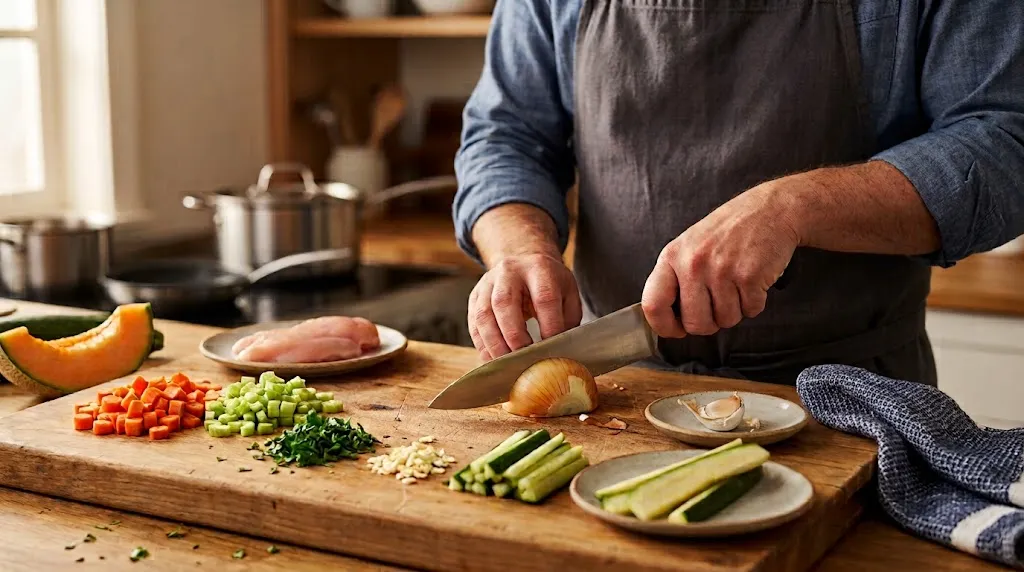
SaveMost of what happens on a cutting board, day to day, falls into one of these categories.
Chopping Vegetables
Onions, celery, carrots, peppers, and potatoes get chopped with a chef’s knife more than any other tool. The wide blade gives stability, and the curved belly makes the rocking motion efficient for roughly uniform pieces. The broad flat side of the blade also works as a makeshift scoop for transferring chopped vegetables straight into a pan.
Slicing Boneless Meat, Poultry, and Fish
A sharp chef’s knife slices chicken breast, pork tenderloin, beef sirloin, and fish fillets cleanly as long as there’s no bone involved. Once bone enters the picture, the knife’s rigid, wide blade is harder to control around joints, which is where a boning knife becomes the better tool.
Mincing Herbs and Garlic
For fine mincing, the tip stays anchored on the board while the heel rocks up and down repeatedly over the ingredient. This technique turns garlic, basil, and parsley into a fine mince quickly. The flat side of the blade also crushes garlic cloves when pressed with the palm, loosening the skin for faster peeling.
Dicing Onions and Aromatics
Dicing an onion into even cubes follows a repeatable pattern: halve it, make horizontal slices toward the root, vertical slices from top to bottom, then cross-cuts. The same method works for shallots, leeks, and fennel, and a chef’s knife’s length makes it easier to keep cuts consistent across a larger ingredient.
Slicing Fruit
Pineapple, melon, mango, and papaya all cut cleanly with a chef’s knife. For round fruit, slicing off a flat edge first and setting that side down on the board keeps the fruit from rolling and keeps fingers clear of the blade.
Julienning and Fine Cuts
Thin matchstick cuts, known as julienne, are achievable with a chef’s knife once the basic grip and rocking motion feel natural. Carrots, zucchini, and cucumber are common candidates for this cut, though it takes more practice than basic chopping.
Breaking Down a Whole Chicken
A chef’s knife can break down a whole chicken into parts, using the heel for leverage at the joints and the tip for trimming connective tissue. It is not as precise as a dedicated boning knife around bones, but it gets the job done for home cooking.
Crushing and Smashing
Laying the flat side of the blade over garlic, cardamom pods, or a chicken breast and pressing down is a standard technique for crushing or flattening. It’s one of the more overlooked uses of the knife, but professional cooks rely on it regularly.
What a Chef’s Knife Should Not Be Used For
A chef’s knife is versatile, but it is not the right tool for every job in the kitchen. Using it for the wrong task can damage the blade or produce worse results than a more specialized knife would.
| Task | Better Knife | Why |
|---|---|---|
| Slicing crusty bread | Serrated bread knife | The serrated edge grips crust without crushing the soft interior |
| Peeling fruit or vegetables | Paring knife | Short blade gives more control for small, precise cuts |
| Boning meat around joints | Boning knife | A thinner, often flexible blade navigates around bone safely |
| Cutting through bone | Cleaver | The added weight provides the force needed without chipping a thinner edge |
| Thin slices of smoked salmon | Slicing knife | A longer, narrower blade produces thinner, cleaner slices |
In short, a chef’s knife is built for everyday prep, not for tasks that require a serrated edge, extreme flexibility, or heavy chopping force.
Warning
Avoid using a chef’s knife to pry open jar lids, scrape hardened food off a pan, or cut through frozen food. These actions can chip or bend the edge, and a damaged blade is harder to control and more dangerous than a dull one.
How to Hold and Use a Chef’s Knife Safely
Most kitchen cuts happen because of poor grip or an unstable guide hand, not because the knife itself is sharp. The pinch grip is the technique taught in most culinary programs because it gives the most control with the least fatigue.
- Pinch the blade between your thumb and the side of your index finger, just above the bolster (the thick junction between blade and handle).
- Wrap your remaining three fingers around the handle.
- Keep the grip firm but relaxed; squeezing too hard slows you down and tires your hand faster.
- Curl the fingertips of your guide hand under, knuckles facing the blade, so the flat side of the knife rests against your knuckles rather than your fingertips.
- Let the knuckles of your guide hand set the thickness of each slice as you move it back along the ingredient.
This combination, sometimes called the claw grip for the guide hand, keeps fingertips away from the blade while still letting you feel exactly where the edge is. It takes practice to feel automatic, but most cooks pick it up within a week of consistent use.
Tip
Keep the tip of the blade in contact with the cutting board during mincing and chopping. Lifting the whole blade off the board for each cut slows you down and makes uniform pieces harder to achieve. For a closer look at grip and board positioning, see our guide on how to hold a kitchen knife correctly.
Chef’s Knife vs. Santoku: When the Alternative Makes Sense
 Save
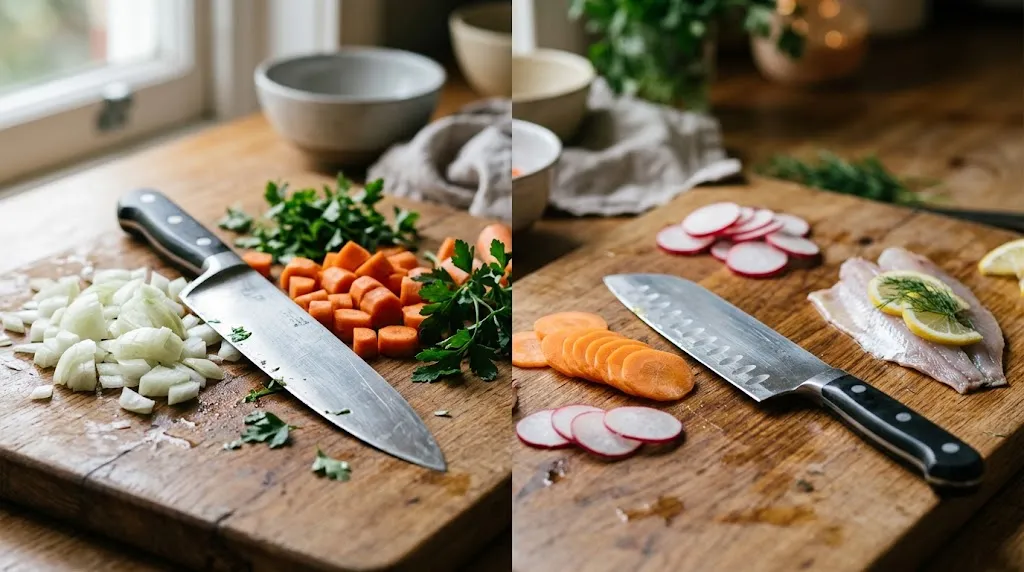
SaveThe santoku is the most common alternative shape to a Western chef’s knife, and it’s worth understanding the difference since both are marketed as all-purpose blades. According to America’s Test Kitchen, a chef’s knife blade typically runs 8 to 10 inches, while a santoku is usually shorter, around 5 to 7 inches.
The chef’s knife has a curved belly built for a rocking motion. The santoku has a flatter profile and is generally used with a push-cut motion instead. The santoku’s shorter, lighter blade appeals to cooks who find a full-size chef’s knife tiring over long prep sessions, and it tends to excel at fine vegetable and fish work.
If you’re choosing your first knife, the chef’s knife is still the better starting point because its longer blade and rocking motion cover a wider range of ingredient sizes. A santoku makes a strong second knife once you’ve built basic technique. For a deeper breakdown of blade geometry and steel differences, see our comparison of German versus Japanese knife styles.
Relevant Product
8-Inch German-Style Chef’s Knife
If you’re building a kitchen around a single workhorse blade, an 8-inch German-style chef’s knife is a practical, widely recommended starting point for the tasks covered in this guide.Check on Amazon
As an Amazon Associate, we earn from qualifying purchases.
Frequently Asked Questions
Is a chef’s knife the same as a cook’s knife?
Yes. “Chef’s knife” and “cook’s knife” refer to the same blade. The terms are used interchangeably in culinary schools and kitchens, with no functional difference between them.
What size chef’s knife should I buy first?
An 8-inch blade is the most common starting size because it’s long enough to handle larger ingredients like squash or melon while still being manageable for someone still building technique. Six-inch blades suit smaller hands or tighter workspaces, and 10-inch blades are better suited to cooks already comfortable with larger knives.
Can a chef’s knife cut through bone?
It can handle small, soft bones in some poultry cuts, but it is not designed for repeated bone contact. Cutting through larger or denser bones with a chef’s knife risks chipping the edge; a cleaver is built for that kind of force instead.
Why does my chef’s knife feel like it’s dragging instead of cutting cleanly?
This is usually a sign the edge needs honing or sharpening, not that your technique is wrong. A simple test: try slicing a ripe tomato without pressing down. A properly sharp blade glides through the skin with minimal pressure. If you have to saw or push hard, the edge needs attention.
Do I need both a chef’s knife and a santoku?
Not necessarily. Many cooks use a chef’s knife as their only everyday blade for years. A santoku is a useful addition once you want a lighter option for precise vegetable or fish work, but it’s not a required purchase for someone just starting out.