Can You Use Danish Oil on a Cutting Board? A Food-Safety Guide
Quick Answer
Can you use Danish oil on a cutting board? Only if the manufacturer explicitly approves that exact product for direct food contact and knife-used surfaces, and you follow its complete curing instructions. Danish oil is a product category, not one standardized formula. For everyday chopping boards, food-grade mineral oil or a purpose-made board conditioner is usually the simpler choice, consistent with USDA wood-finishing guidance.
What to check before applying anything
- Exact product: Read the label for the specific brand and formulation.
- Food-contact claim: Look for explicit permission for cutting boards, not just furniture or countertops.
- Knife contact: Consider whether repeated chopping could abrade the finish.
- Full cure: Follow the maker’s stated waiting period; touch-dry is not the same as cured.
- Safer default: Choose food-grade mineral oil when product suitability is uncertain.
The warm, darker grain left by Danish oil can make an ordinary wood board look beautiful. But a finish that looks good on furniture isn’t automatically suitable for food preparation.
I’ll separate what manufacturers actually say from common workshop assumptions. You’ll also find practical options for finishing a new board and handling one you’ve already treated.
In This Guide
What Is Danish Oil and Why Does Its Formula Matter?
Danish oil is a name used for wood finishes that create a natural-looking, penetrating appearance. The name doesn’t guarantee one particular ingredient list or food-contact rating.
Some formulas combine drying oils, varnish resins, and solvents. Others use different blends, so the brand and product label matter more than the words “Danish oil.”
What does Danish oil do to wood?
A suitable Danish oil can deepen the grain, reduce moisture absorption, and leave a subtle sheen. Its appeal is especially clear on hardwood furniture and decorative wooden objects.
- Appearance: It often creates a warmer, richer wood tone.
- Penetration: Many formulas soak partly into the wood rather than sitting entirely on top.
- Hardening: Drying-oil components cure through chemical reactions over time.
- Maintenance: Touch-ups depend on the product and how the surface wears.
For example, Rust-Oleum describes Watco Danish Oil as an oil-and-varnish blend. That description alone doesn’t make the finish appropriate for a board you chop vegetables on.
Why isn’t every Danish oil the same?
“Danish oil” describes a finish style more than a strict recipe. One company may authorize food-contact use, while another may not recommend its product for that purpose.
The distinction also matters for cleaning and refinishing. A product that leaves a cured resin component may behave differently from a simple mineral-oil conditioner under repeated knife cuts.
Keep the actual can or photograph its complete label. If the manufacturer changes its formula, the advice for an older product may not apply to the new one.
Is Danish Oil Food-Safe for Cutting and Chopping?
 Save
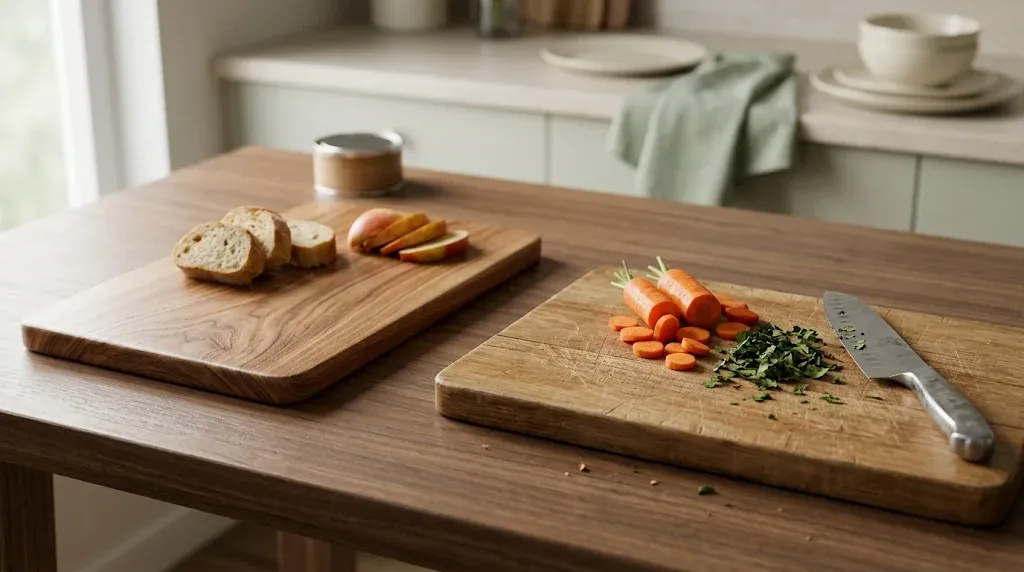
Some Danish oil products are described as food-contact safe after curing, but that doesn’t make every Danish oil a good cutting-board finish. Direct food contact and repeated knife abrasion are separate questions.
The safest decision starts with the precise product documentation. Don’t assume a general “non-toxic when dry” statement covers active cutting surfaces.
Food-safe after curing is not the same as suitable for chopping
Drying usually means the surface no longer feels wet. Curing means the finish has completed the hardening process required by its manufacturer.
A cured finish may be acceptable for occasional food contact yet still perform poorly when sliced repeatedly. If a finish flakes or wears unevenly, it is a poor match for a knife-work surface.
- Serving board: Food rests on it, but knives rarely strike the wood.
- Chopping board: Regular cutting creates scratches and exposes fresh wood.
- Butcher block: Heavy chopping and frequent washing increase surface wear.
- Countertop: Food may touch it without the same constant knife abrasion.
What do manufacturers actually say?
Rustins states in its Danish oil FAQ that its specified oils meet food-contact requirements. That is a claim about those products, not a universal certification for Danish oil.
Other manufacturers offer a separate butcher-block finish intended for cutting boards. That difference is a useful signal: don’t substitute a furniture finish just because the brand name matches.
Before buying, check the label and ask customer support a precise question: “Is this exact product recommended for a board used for daily knife cutting?”
Ask for the approved curing time and cleaning instructions too. If the response mentions only decorative food contact, use a dedicated board finish instead.
Section takeaway: A manufacturer’s product-specific food-contact claim is essential, but knife-use suitability matters just as much. When the label is unclear, don’t use that Danish oil on your cutting surface.
Danish Oil vs. Mineral Oil: Which Is Better?
For a regularly used wooden cutting board, food-grade mineral oil is usually the easier choice. It conditions the wood without creating a hard surface film that knives might damage.
Here is how common options compare in practical kitchen use.
| Finish | Best use | Key advantage | Main caution |
|---|---|---|---|
| Danish oil | Only approved food-contact applications | Rich grain appearance | Formulas and knife-use suitability vary |
| Food-grade mineral oil | Everyday cutting boards | Simple to refresh | Needs periodic reapplication |
| Mineral oil and beeswax | Routine conditioning | Adds a buffable water-repellent layer | Wax wears with washing and use |
| Pure tung oil | Projects with verified food-safe instructions | Cures to a more water-resistant finish | Requires careful product selection and full curing |
| Ordinary cooking oil | Not preferred for board conditioning | Often already in the kitchen | Can develop rancid odors |
Why is mineral oil easier to live with?
Food-grade mineral oil is a non-drying conditioner. You can renew it when the wood looks pale or begins absorbing water more readily.
There is no special chemical cure to wait for, although excess oil should be wiped away. Pick a plain product labeled food-grade or intended specifically for cutting boards.
What about beeswax, tung oil, and olive oil?
Beeswax adds a buffable surface layer, especially in a mineral-oil blend. It can help the board resist brief splashes, but no conditioner makes wood waterproof.
Pure tung oil hardens differently from mineral oil, and it may need extended curing. Make sure the bottle is truly pure tung oil, not an unrelated “tung oil finish” blend.
Olive and other common cooking oils may eventually smell rancid. Their availability doesn’t make them the best long-term board treatment.
How Should You Finish a Wooden Cutting Board?
 Save
For a new or freshly restored chopping board, a food-grade mineral-oil treatment is straightforward. Start with clean, thoroughly dry wood and avoid using more oil than the surface needs.
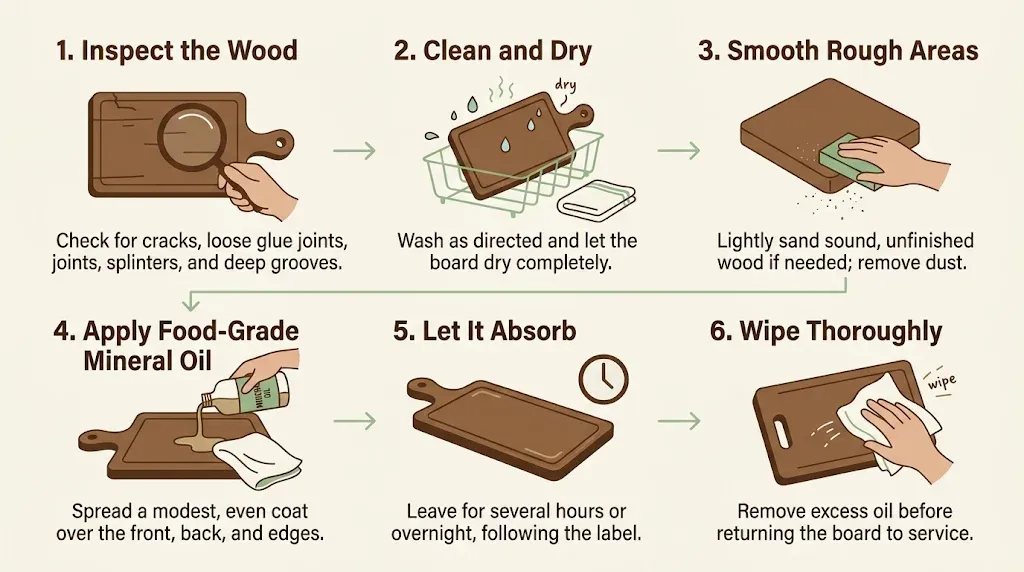
A simple mineral-oil method
- Inspect the wood. Check for cracks, loose glue joints, splinters, and deep grooves before finishing.
- Clean and dry. Wash as directed by the board manufacturer, then let the board dry completely.
- Smooth rough areas. If needed, lightly sand sound, unfinished wood along the grain, then remove every trace of dust.
- Apply food-grade mineral oil. Spread a modest, even coat over the front, back, and edges with a clean cloth.
- Let it absorb. Leave the board for several hours or overnight, following the conditioner label.
- Wipe thoroughly. Remove any oily residue before putting the board back into service.
For extra conditioning, use a commercially prepared, food-contact-safe mineral-oil-and-beeswax cream. Buff away excess product so the board doesn’t feel sticky.
Can you apply a food-approved Danish oil instead?
Only follow this route if its maker confirms suitability for the exact cutting-board use. The specific label controls surface preparation, number of coats, ventilation, and curing.
Don’t transfer dry times from another brand. For example, Watco Butcher Block Oil & Finish is a distinct product specifically described for boards and bowls.
- Confirm whether the finish is approved for knife-used food surfaces.
- Use it only on the substrate and existing finish condition the manufacturer allows.
- Apply and wipe coats exactly as specified on that product’s label.
- Keep the board out of food service until the full required curing period passes.
- Follow all ventilation, cleanup, and rag-disposal warnings.
Pro tip: Oil-soaked rags can ignite if stored improperly. Follow the product’s fire-safety disposal directions; never leave used rags bunched in a bin.
Section takeaway: A dedicated board conditioner involves fewer judgment calls than a general furniture finish. Whatever you choose, the product label must support your exact use.
What If You Already Used Danish Oil?
Don’t panic, but stop preparing food on that board until you identify the product. A dry-looking surface doesn’t establish food-contact approval or full cure.
Check the exact finish before using the board again
- Identify the can. Find the brand, product variant, color, and current technical instructions.
- Ask the manufacturer. Confirm direct food contact and knife-cutting suitability in writing if possible.
- Review curing conditions. Temperature, humidity, and heavy coats can lengthen drying or curing.
- Inspect the board. Avoid use if it feels tacky, smells strongly of solvent, or shows damaged coating.
- Choose the next step. Resume use only when the maker confirms it is suitable and fully cured.
Should you sand the Danish oil off?
Sanding may remove surface finish, but penetrating products can remain below the visible surface. A quick pass with sandpaper cannot guarantee complete removal.
If the formulation is unknown or unsuitable, replacing the board is the conservative option. You can also reserve an intact board for non-food decorative use after following its finish instructions.
Don’t pour mineral oil over an uncertain Danish-oil treatment and assume the problem is solved. A new conditioner does not make the underlying finish food-safe.
What if food has already touched the board?
Remove the board from service and identify the product before using it again. For a concern about actual exposure, keep the label and contact an appropriate poison-information service or healthcare professional.
A label’s hazard information is more useful than speculation about what might have transferred. Don’t try to judge chemical exposure from appearance or smell alone.
How Do You Clean and Maintain the Board?
 Save
Even a properly finished board still needs cleaning after every use. Oil conditions the wood; it doesn’t sanitize food residue or prevent cross-contamination.
Clean it after chopping
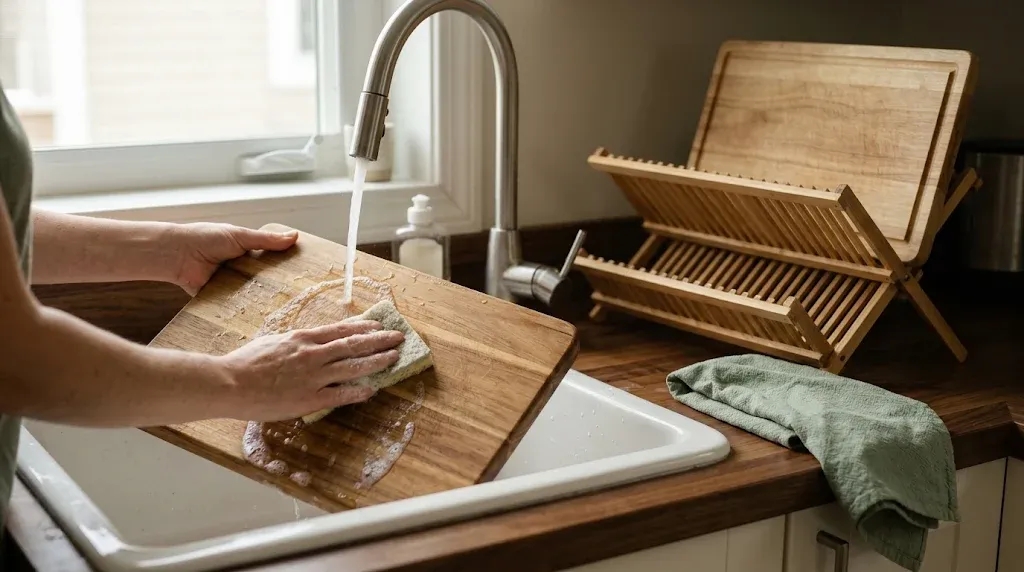
- Wash: Scrub with warm or hot water and dish soap after use.
- Rinse: Remove soap and food particles thoroughly.
- Dry: Towel-dry, then air-dry upright where air can reach both faces.
- Separate: Use different boards for raw meat and ready-to-eat foods when possible.
- Sanitize when needed: Follow food-safety directions for your board material and an appropriate sanitizer.
The University of Maine Cooperative Extension cutting-board guide provides cleaning, sanitizing, and conditioning advice. It also recommends a food-safe mineral oil or beeswax conditioner around once a month.
Don’t soak wooden boards or put laminated boards through the dishwasher. Follow the board maker’s instructions, since construction affects how wood handles heat and water.
How often should you oil a cutting board?
Monthly conditioning is a useful starting point, not a fixed rule. Frequent washing, dry indoor air, and heavy use may make earlier treatment necessary.
Look for a pale, dry appearance or quick water absorption. Reapply a thin coat of food-grade conditioner to clean, completely dry wood when needed.
When is it time to replace the board?
Oil won’t repair serious damage or make a deeply grooved board sanitary. Watch for cracks that hold food, separating glue joints, mold, or rough cuts that remain hard to clean.
Shallow knife marks are normal, but extensive grooves can trap debris. Replace a board that cannot be cleaned reliably or safely resurfaced.
Section takeaway: Good washing, complete drying, and periodic conditioning protect a cutting board together. No wood finish replaces safe kitchen hygiene.
Frequently Asked Questions
Is Danish oil toxic after it dries?
The answer depends on the precise formula and how fully it has cured. Some manufacturers make food-contact claims for their own Danish oils, but others do not. Dry to the touch isn’t proof that a finish is approved for repeated contact with food or knives.
Can you use Watco Danish Oil on a cutting board?
Don’t assume standard Watco Danish Oil is suitable for chopping surfaces. It is marketed as a penetrating oil-and-varnish finish, while the company sells a separate Butcher Block Oil & Finish designed for boards. Check the exact product label or contact Rust-Oleum before food use.
Can you use Danish oil on a serving board?
A serving board may see less knife damage than a chopping board, but direct food contact still matters. Use a Danish oil only when its manufacturer expressly permits that application and the finish has fully cured. A decorative tray is not automatically a food-safe platter.
How long should Danish oil cure before food contact?
There is no universal waiting period. Cure time varies with the specific formula, coat thickness, temperature, and humidity. Follow the manufacturer’s stated requirements for the approved food-contact application, and don’t substitute a generic 24-hour or 72-hour rule.
Is food-grade mineral oil better than Danish oil for cutting boards?
For most everyday chopping boards, food-grade mineral oil is simpler to apply and replenish. It doesn’t create a hard, easily chipped surface film, though it needs periodic reapplication. Danish oil may be appropriate only when the exact product is expressly approved for the board’s intended use.
Can I use olive oil or vegetable oil on wood?
Common cooking oils are not the best long-term conditioning choice because some can turn rancid and create unpleasant odors. Food-grade mineral oil is a more predictable option. You can add a cutting-board conditioner containing beeswax if you prefer a buffed finish.
Bottom line: Use Danish oil on a cutting board only when the exact manufacturer-approved formula suits direct food contact and knife use. If there’s any doubt, choose food-grade mineral oil or a purpose-made board conditioner.
Before your next kitchen project, read the finish label first, keep your board dry, and make maintenance part of your routine. A dependable cutting board should be practical to clean, not just attractive on the counter.

