Can You Put a Cutting Board in the Microwave? Safety Guide
Quick Answer
Can you put a cutting board in the microwave? Usually, no. Most wooden, bamboo, plastic, and composite cutting boards aren’t intended for microwave heating. Only consider microwaving a board if its manufacturer explicitly approves that use and your appliance instructions permit it. The USDA’s microwave utensil guidance recommends using items specifically labeled microwave-safe.
Important Safety Facts
- Wooden boards: Heat and moisture changes can cause drying, warping, cracking, or damage to glued joints.
- Bamboo boards: Most aren’t designed for microwave heating, and bonded layers may separate.
- Plastic boards: Unless explicitly microwave-safe, plastic can soften, warp, or melt.
- Microwave sanitizing: Heating a board doesn’t guarantee reliable bacterial removal.
- Safer alternative: Wash with dish soap, sanitize appropriately, and dry thoroughly.
A cutting board might seem harmless enough to place inside a microwave. After all, it handles food every day, so why shouldn’t it tolerate a little heat?
The problem is that food-safe and microwave-safe mean different things. I prefer a simple kitchen rule: use cutting boards for preparation and microwave-approved dishes for heating.
Here’s how different materials react to microwave heating, what research says about sanitizing boards, and how to clean yours without damaging it.
In This Guide
Is It Safe to Put Any Cutting Board in the Microwave?
Most cutting boards should stay out of the microwave. The exception is a board specifically approved for microwave use by its manufacturer, within the stated limitations.
A cutting board is a durable food-preparation surface designed to withstand repeated knife contact. That doesn’t mean its materials, adhesives, finishes, or accessories can withstand microwave heating.
Why Microwave Safety Matters
Microwaves primarily heat food by transferring energy into substances containing water and other microwave-responsive molecules. A board can heat unevenly depending on its material, moisture content, and anything resting on it.
Consider a thick wooden board with damp knife grooves. Certain areas may heat faster than others, placing stress on the wood and its bonded joints.
Plastic introduces another concern. A cutting board designed for chopping may lack the heat resistance needed for microwave cooking.
Food-Safe Doesn’t Mean Microwave-Safe
These labels describe different uses, and they shouldn’t be treated as interchangeable.
- Food-safe: The material is suitable for its intended food-contact use.
- Microwave-safe: The manufacturer permits specified microwave use.
- Dishwasher-safe: The product can withstand approved dishwasher cleaning conditions.
- BPA-free: This doesn’t establish that a plastic product tolerates microwave heating.
- Recycling code: A numbered plastic recycling symbol doesn’t independently certify microwave safety.
A dishwasher-safe plastic board isn’t automatically microwave-safe. Likewise, a board that tolerates warm food isn’t necessarily suitable for direct microwave exposure.
If the manufacturer’s instructions are missing, avoid experimenting with heat settings or short cooking times. A microwave-safe plate is the simpler choice.
Section Takeaway: Confirm microwave compatibility for the exact product rather than making assumptions based on material or appearance.
What Happens to Different Cutting Board Materials in the Microwave?
 Save
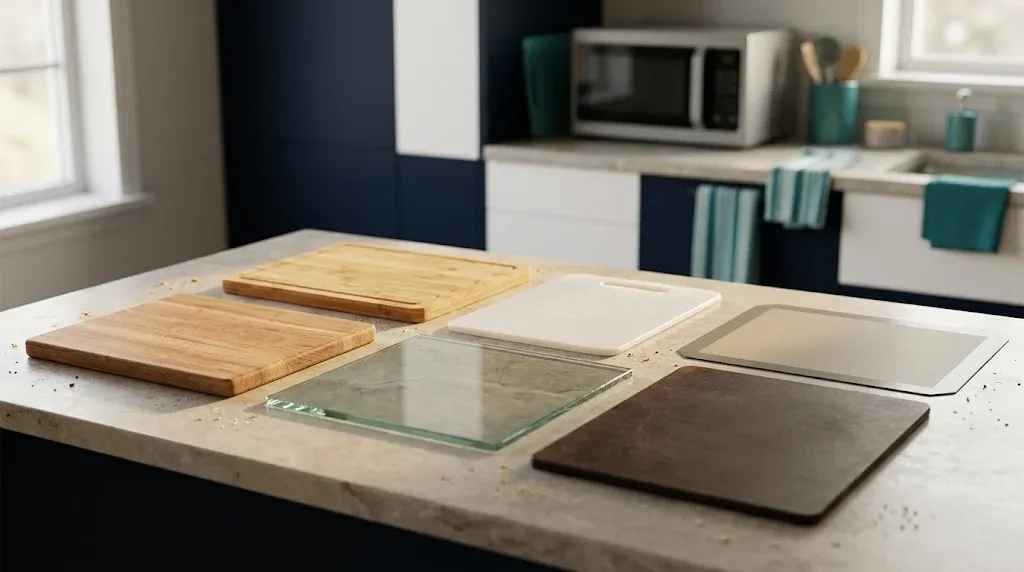
Wood, bamboo, plastic, glass, and composite boards behave differently under heat. Their construction matters almost as much as the material itself.
Wooden Cutting Boards
Wooden cutting boards can absorb moisture, especially around knife marks and unfinished areas. Microwave heating may produce uneven temperature changes that encourage warping or cracking.
Edge-grain and end-grain boards often contain bonded pieces of wood. Heat and moisture stress can affect these glue joints, even when the adhesive is food-safe.
Prolonged heating may also dry or scorch wood. Don’t assume that a solid hardwood board is microwave-approved.
Bamboo Cutting Boards
Bamboo cutting boards commonly consist of compressed or laminated strips. Their adhesive joints can be vulnerable to repeated moisture and temperature changes.
Some bamboo products also contain protective finishes or attached components. Unless the manufacturer specifically permits microwaving, wash them by hand instead.
Plastic Cutting Boards
Plastic boards vary widely in composition, thickness, and heat tolerance. Common materials include polyethylene and polypropylene, but their names alone don’t establish microwave compatibility.
A thin board may distort when exposed to heat from food. More importantly, microwaving an ordinary plastic board isn’t a reliable method of sanitizing it.
Glass, Stone, Silicone, and Composite Boards
Heat-resistant glass and ceramic cookware can be microwave-safe, but that doesn’t automatically apply to every glass cutting board. Decorative surfaces, coatings, and attachments can introduce additional restrictions.
Stone and marble boards aren’t practical microwave accessories. Composite boards also require specific manufacturer guidance because their fibers, resins, and other materials vary.
Some silicone kitchen products are microwave-safe, but silicone cutting mats need their own approval. Don’t assume that flexibility means microwave compatibility.
Cutting Board Material Comparison
| Material | Microwave Guidance | Main Concern |
|---|---|---|
| Solid wood | Avoid unless explicitly approved | Drying, cracking, or scorching |
| Bamboo | Generally avoid | Warping and joint separation |
| Plastic | Only with explicit approval | Softening, warping, or melting |
| Glass | Only if the exact item is approved | Thermal stress or attachments |
| Silicone | Check the specific product | Temperature limits and additives |
| Wood-fiber composite | Avoid without approval | Resin, bonding, and heat tolerance |
These recommendations concern typical household cutting boards, not products independently designed and labeled for microwave cooking.
Section Takeaway: Material alone isn’t enough to confirm safety. The exact board’s construction and manufacturer instructions determine whether microwave use is appropriate.
Can You Sanitize a Cutting Board in the Microwave?
Microwave heating can reduce certain bacteria under controlled conditions, but it isn’t a dependable universal cutting-board sanitizing method.
That distinction matters because people often search for microwave cleaning instructions after preparing raw meat, poultry, or seafood.
What Does Research Say?
A 1996 study published in the Journal of Food Protection examined microwave disinfection of wooden and plastic cutting boards.
Researchers found substantial bacterial reductions on certain wooden boards after approximately three to four minutes at a high setting. Results depended on board size, moisture content, and bacterial load.
However, the same experiments found that microwaving plastic boards for 12 minutes didn’t significantly reduce the tested bacteria.
The findings are available through the published cutting-board disinfection study.
Why Isn’t This a Recommended Household Shortcut?
Laboratory results don’t establish a safe microwave time for every board. Modern products use different adhesives, coatings, dimensions, and materials.
Microwave ovens also differ in wattage and heating patterns. The older experiment doesn’t replace current product-specific safety instructions.
- Uneven heating: Different board areas may reach different temperatures.
- Material damage: Heat may affect the surface before reliable sanitization occurs.
- Uncertain exposure: The microwave setting alone doesn’t verify bacterial reduction.
- Food residue: Grease and debris should be physically removed before sanitizing.
Don’t use the study’s exposure times as household operating instructions. Proper washing and suitable sanitizing methods are more practical.
Section Takeaway: Microwave disinfection has been studied, particularly for wood, but routine cleaning and approved sanitizing remain the better household approach.
How Should You Clean and Sanitize Cutting Boards Safely?
 Save
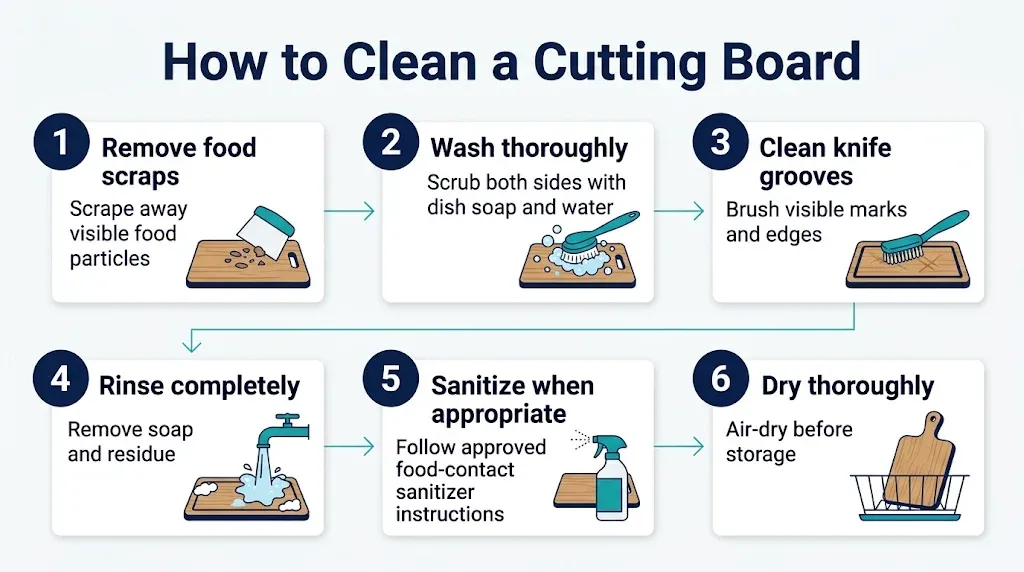
Clean cutting boards with dish soap and water after use. Sanitize when needed, particularly after handling raw animal products.
Cleaning removes food debris and grease. Sanitizing reduces microorganisms on a surface that has already been cleaned.
Step-by-Step Cutting Board Cleaning
- Remove food scraps. Scrape away visible particles without damaging the board.
- Wash thoroughly. Scrub both sides with warm or hot water and dish soap.
- Clean knife grooves. Use a suitable brush to reach visible marks and edges.
- Rinse completely. Remove soap and loosened residue with clean water.
- Sanitize when appropriate. Use a sanitizer approved for food-contact surfaces and follow its instructions.
- Dry thoroughly. Let the board air-dry completely before storage.
The University of Maine Cooperative Extension cutting-board guide offers material-specific cleaning and maintenance recommendations.
How to Sanitize a Cutting Board
For household boards, USDA guidance describes a diluted sanitizing solution made with one tablespoon of unscented liquid chlorine bleach per gallon of water.
Apply the solution to a previously washed board, allow several minutes of contact, then rinse and dry. Check the sanitizer’s current label for appropriate food-contact use and directions.
- Use plain, unscented household bleach suitable for the intended sanitizing task.
- Follow the product label’s concentration and contact-time instructions.
- Never mix bleach with vinegar, ammonia, or other cleaners.
- Avoid prolonged soaking, particularly with wooden and bamboo boards.
- Let the surface dry before preparing food again.
Vinegar and lemon juice can help with certain odors and residues. However, they aren’t dependable substitutes for a correctly prepared food-contact sanitizer.
Wooden vs. Plastic Cutting Board Care
Wooden boards generally benefit from prompt handwashing and careful drying. Follow the manufacturer when deciding whether a solid hardwood board can tolerate a dishwasher.
Many plastic boards can go in the dishwasher. Confirm that yours is dishwasher-safe, especially when it’s thin or flexible.
Wood also benefits from occasional conditioning with food-grade mineral oil or a board-specific product, when recommended by its manufacturer.
Prevent Cross-Contamination
I recommend keeping separate boards for raw animal products and foods that won’t be cooked afterward. This makes it easier to manage contamination during meal preparation.
The University of Minnesota Extension’s food-safety guidance also emphasizes separation, thorough washing, and replacing heavily damaged boards.
Watch for deep knife grooves, permanent warping, loose joints, and cracks. Replace a board when its surface becomes too damaged to clean effectively.
Section Takeaway: Thorough washing, appropriate sanitizing, and complete drying offer reliable cutting-board care without unnecessary microwave exposure.
What Should You Do If You Already Microwaved a Cutting Board?
 Save
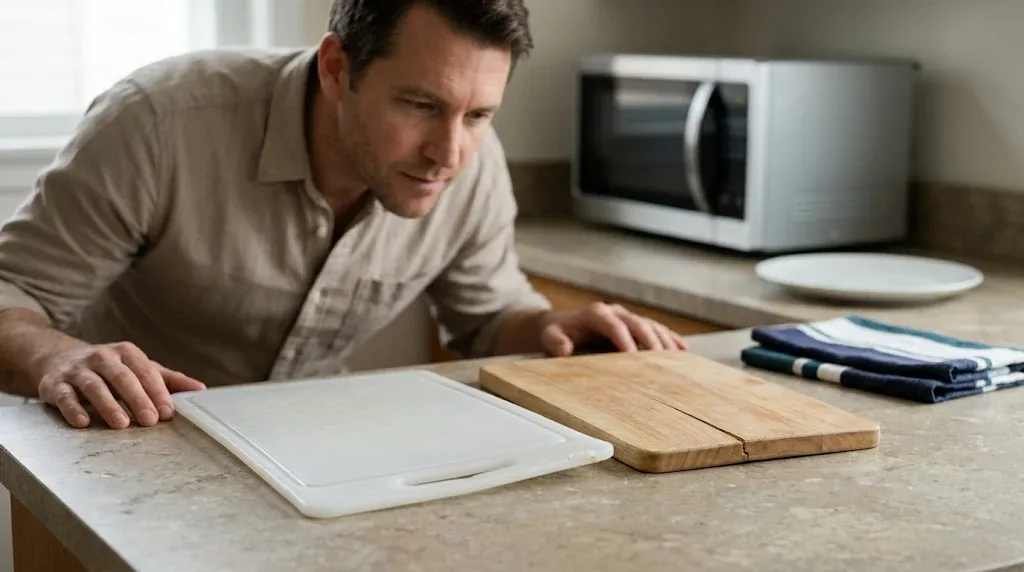
If you accidentally microwaved a cutting board, stop using it for food preparation until it cools and you can inspect it safely.
A brief exposure doesn’t automatically mean permanent damage. However, melted plastic, scorching, cracking, or unusual odors deserve attention.
Check for Visible Damage
- Wood: Look for darkened spots, raised grain, cracks, and separated seams.
- Bamboo: Inspect laminated strips for gaps, lifting, or movement.
- Plastic: Check for softened areas, distortion, bubbles, or melting.
- Composite: Look for unusual surface changes, cracks, or separation.
- Attachments: Inspect rubber feet, handles, and other components for heat damage.
If the board is warped, scorched, cracked, or visibly melted, replacing it is the safer choice. A damaged surface may also become difficult to clean.
Don’t attempt to reshape melted plastic with additional heat. Similarly, don’t keep heating wood to remove moisture or odors.
What If the Microwave Smelled Burnt?
Stop the appliance immediately if you notice smoke, sparks, or burning. If a fire starts, keep the microwave door closed, switch it off, and disconnect power if safe.
Follow your appliance instructions and contact emergency services if the fire doesn’t stop. Panasonic’s microwave safety guidance provides additional advice about unusual smells and appliance operation.
What Can You Use Instead?
If your goal is reheating food, use cookware specifically identified as microwave-safe. An appropriate glass or ceramic dish is usually more convenient than a cutting board.
- For leftovers: Transfer food to a microwave-safe bowl or plate.
- For chopping: Prepare ingredients on a clean board, then move them to suitable cookware.
- For defrosting: Use a microwave-approved dish that catches liquid.
- For board sanitizing: Use correct washing, sanitizing, and drying methods.
Never operate a microwave with an empty board as an experiment. Some microwave manufacturers warn that operating without an appropriate food or liquid load can damage the appliance.
Frequently Asked Questions
1. Can You Microwave a Wooden Cutting Board for 30 Seconds?
Don’t assume 30 seconds is safe. Moisture content, board construction, microwave power, and adhesives can affect the outcome.
Unless the manufacturer explicitly permits microwave heating, wash the wooden board by hand instead.
2. Can You Microwave a Plastic Cutting Board?
Only consider doing so if the exact board carries manufacturer approval for microwave use. Ordinary plastic cutting boards aren’t automatically microwave-safe, even when they are food-safe or dishwasher-safe.
Microwaving also doesn’t reliably sanitize plastic cutting surfaces.
3. Does Microwaving a Cutting Board Kill Bacteria?
Some laboratory research found bacterial reductions on wooden boards under specific microwave conditions. That doesn’t provide a universal household sanitizing procedure.
For plastic boards, the same research found that microwave exposure was ineffective under the conditions tested.
4. Can You Microwave a Bamboo Cutting Board?
Most bamboo cutting boards shouldn’t be microwaved without explicit manufacturer approval. Many contain glued strips, and heat or moisture stress may damage their construction.
Handwashing and thorough drying are generally better for routine bamboo-board maintenance.
5. Can You Put a Dishwasher-Safe Cutting Board in the Microwave?
Not necessarily. Dishwasher-safe and microwave-safe are separate manufacturer claims.
A board that withstands an approved dishwasher cycle may still distort under microwave heating. Always check the instructions for the exact product.
6. How Often Should You Sanitize a Cutting Board?
Wash your board after every use and sanitize appropriately, especially after preparing raw meat, poultry, or seafood. Avoid using the same unwashed board for ready-to-eat foods.
Follow approved food-contact sanitizer instructions and replace boards with deep, hard-to-clean damage.
Final Verdict: Should You Microwave a Cutting Board?
For most household cutting boards, the safest answer is no. Wood and bamboo can suffer heat-related damage, ordinary plastics may distort, and microwave exposure doesn’t guarantee proper sanitization.
As of 2026, the practical recommendation remains straightforward: follow product-specific microwave instructions and use conventional cleaning methods for cutting-board maintenance.
Keep a suitable microwave-safe dish available for reheating food. Wash your cutting boards after preparation, sanitize when needed, and allow them to dry thoroughly.
The bottom line: A clean, well-maintained cutting board is more useful than one exposed to unnecessary microwave heating.

