Can You Use a Serving Board as a Cutting Board? Safety, Materials, and Practical Tips
Quick Answer
Yes, you can use a serving board as a cutting board if it has a food-safe, knife-friendly surface and a stable, durable construction. Solid hardwood boards are often suitable for light slicing, while glass, marble, slate, and decorative boards are better reserved for presentation. Always check the manufacturer’s instructions and follow proper food safety guidelines before using a serving board for food preparation.
What to Check Before Cutting
- Board material: Choose suitable hardwood, bamboo, or another material approved for knife use.
- Food-safe finish: Avoid decorative coatings, unknown paints, and finishes not intended for food contact.
- Surface condition: Check for cracks, splinters, deep grooves, and loose decorative pieces.
- Board stability: Ensure the board stays securely in place during cutting.
- Cleaning instructions: Use only boards that you can clean properly after food preparation.
The Safest General Approach
- For light slicing: A suitable wooden serving board may work well.
- For heavy chopping: Use a dedicated cutting board designed for regular knife work.
- For raw meat: Use a separate, easy-to-clean cutting board.
A beautiful serving board can make almost any kitchen look more inviting. But can that same board handle a sharp knife without creating problems?
It’s an important question because serving boards and cutting boards may look nearly identical. Their surfaces, finishes, and intended uses can be surprisingly different.
In this guide, I’ll explain which serving boards can handle cutting, which materials to avoid, and how to protect both your knives and your food.
What Is the Difference Between a Serving Board and a Cutting Board?
 Save
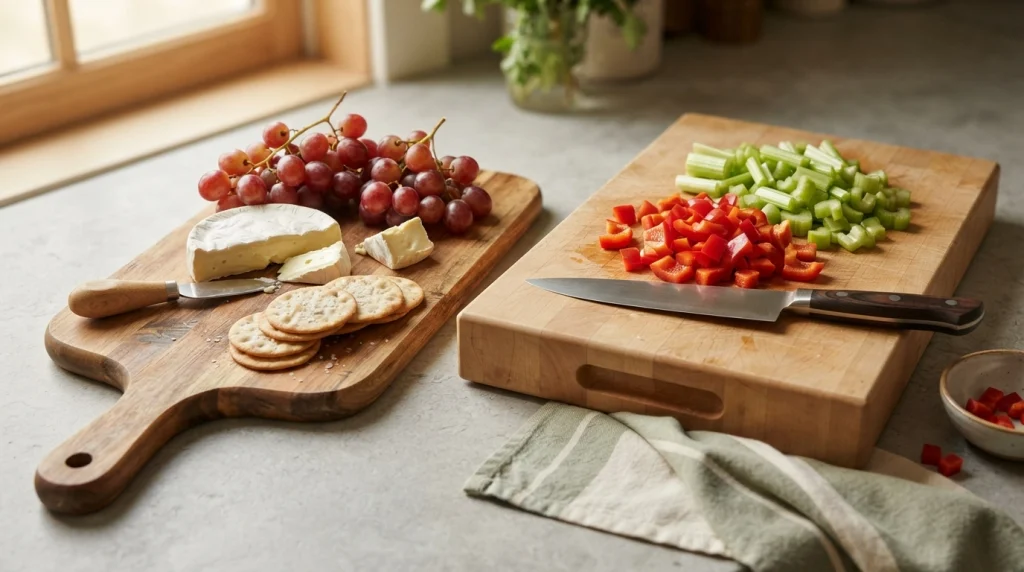
A serving board is a flat food presentation surface designed for arranging and serving items such as cheese, bread, fruit, and appetizers. A cutting board is a food preparation surface intended to withstand repeated contact with kitchen knives.
Some products are designed to perform both functions. Others are suitable for serving only.
What Is a Serving Board?
A serving board focuses primarily on presentation. It may feature decorative wood grain, a handle, raised edges, or an unusual shape.
Common serving board materials include:
- Acacia wood
- Olive wood
- Maple or walnut
- Bamboo
- Marble
- Slate
- Glass
These materials do not all perform equally well under a knife. Their suitability depends on hardness, construction, finish, and manufacturer guidance.
What Is a Cutting Board?
A cutting board is designed to provide a stable working surface for slicing, chopping, and dicing food. Suitable cutting boards also support effective cleaning and help protect knife edges.
They commonly use materials such as wood, plastic, rubber, bamboo, and paper composite.
The most useful cutting board is not necessarily the hardest one. A surface should balance durability, knife compatibility, stability, and hygiene.
Serving Board vs. Cutting Board Comparison
| Feature | Serving Board | Cutting Board |
|---|---|---|
| Main purpose | Food presentation | Food preparation |
| Typical materials | Wood, slate, marble, glass | Wood, plastic, rubber, composite |
| Knife compatibility | Varies significantly | Designed for knife contact |
| Heavy chopping | Usually not recommended | Suitable when designed for the task |
| Decorative features | Often emphasized | Usually secondary |
| Cleaning | Depends on material and finish | Designed for routine cleaning |
| Best use | Bread, cheese, appetizers | Vegetables, ingredients, meal prep |
Key takeaway: The name of the board does not determine whether it is safe for cutting. The actual material, finish, condition, and intended use matter more.
Can You Safely Cut Food on a Wooden Serving Board?
Yes, many wooden serving boards can safely handle light slicing when their construction and finish are suitable. However, not every wooden serving board is intended for direct knife contact.
Solid wood is often a practical choice because it offers a relatively forgiving cutting surface. Still, wood species and surface treatments can change its performance.
Which Wooden Serving Boards Work Best?
The following materials may be appropriate when the manufacturer confirms that the board is intended for cutting.
- Maple: A popular cutting board hardwood with a smooth, durable surface.
- Walnut: A relatively forgiving hardwood commonly used for attractive kitchen boards.
- Cherry: A hardwood option that combines visual appeal with practical cutting performance.
- Acacia: Often durable and attractive, although hardness varies between products.
- Bamboo: Available in many dual-purpose designs, but some surfaces can be harder on knife edges.
Always confirm that the specific board is intended for food preparation. A decorative hardwood board is not automatically a cutting board.
When Should You Avoid Cutting on Wood?
A wooden serving board should not be used for cutting simply because it looks solid. Several warning signs make it a poor choice.
- Its finish is decorative rather than approved for food contact.
- The manufacturer labels it for serving or display only.
- It has deep cracks, splinters, or damaged joints.
- Its surface contains decorative resin areas not intended for knife contact.
- It has an uneven or unstable base.
- It cannot be cleaned adequately after use.
Practical tip: If you want to keep a serving board looking beautiful, do most chopping on another board. Even safe cutting creates visible knife marks over time.
Which Serving Board Materials Should Never Be Used for Regular Cutting?
 Save
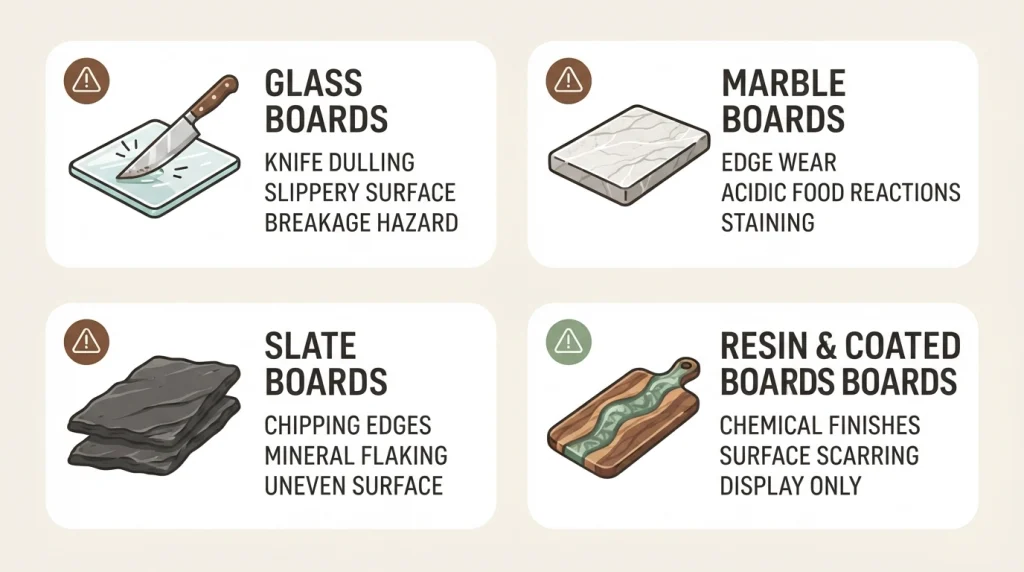
Glass, marble, slate, and other hard decorative surfaces are generally poor choices for regular knife work. Their rigid surfaces can damage knife edges and may create handling or breakage risks.
They can still be excellent presentation surfaces when used for their intended purpose.
Glass Serving Boards
Glass is smooth and relatively easy to wipe clean, but it provides almost no give under a knife. Repeated cutting can wear an edge faster than suitable wood or plastic.
Glass boards can also be slippery. Chips or breakage make them especially unsuitable for food preparation.
Marble Serving Boards
Marble is popular for presenting cheese, desserts, and chilled appetizers. Its solid appearance does not make it a good cutting surface.
Knife contact against stone can contribute to edge damage. Marble can also stain or react with acidic ingredients depending on its finish.
Slate Serving Boards
Slate creates an attractive background for cheese and charcuterie. However, it is not an ideal surface for repeated slicing.
Some slate products may chip or shed particles at damaged edges. Use them for presentation unless the manufacturer provides specific cutting guidance.
Decorative Resin and Coated Boards
Some wooden boards feature resin rivers, painted designs, or decorative coatings. These details may be beautiful but are not necessarily designed for knife contact.
A food-contact-safe finish does not automatically mean the surface tolerates cutting. Always check the manufacturer’s intended-use instructions.
What Foods Can You Cut on a Serving Board?
A suitable serving board can handle several light food preparation tasks. The safest choices involve limited knife pressure and ingredients that do not introduce unnecessary contamination risks.
Best Foods for Light Cutting
- Bread: Slice baguettes, rolls, and soft loaves on a suitable wooden board.
- Cheese: Cut soft or moderately firm cheese into serving portions.
- Fresh fruit: Slice apples, pears, strawberries, and similar produce after washing.
- Vegetables: Cut cucumbers, tomatoes, and other soft vegetables.
- Cooked foods: Portion ready-to-eat items on a clean board reserved for that purpose.
Foods Better Prepared on a Dedicated Cutting Board
- Raw chicken and turkey
- Raw beef, pork, and other meats
- Raw fish and seafood
- Hard squash requiring significant cutting pressure
- Ingredients requiring repeated heavy chopping
Raw meat requires particular attention because its juices can contaminate ready-to-eat foods. The CDC’s food safety guidance recommends keeping boards used for raw animal products separate from those used for produce and other foods.
Using a decorative serving board for raw chicken and then arranging cheese on it is a risk worth avoiding. A dedicated raw-meat board makes the workflow easier to manage.
How Can You Tell Whether a Serving Board Is Safe for Cutting?
The best approach is to inspect the board and check the manufacturer’s instructions before using it. Appearance alone cannot confirm whether a board is food-safe or knife-friendly.
A Five-Step Board Inspection
- Read the product label. Look for descriptions such as cutting board, chopping board, or suitable for food preparation.
- Identify the surface material. Favor materials designed for direct knife contact.
- Check the finish. Confirm that coatings and adhesives are appropriate for the intended food-contact use.
- Inspect for damage. Avoid boards with cracks, splinters, loose parts, or hard-to-clean grooves.
- Test stability. Place the board on a level counter and check whether it rocks or slides.
If the manufacturer describes the product only as decorative, do not assume it is suitable for cutting. Contact the maker when instructions are unclear.
Does Thickness Matter?
Thickness affects board stiffness, handling, and stability, but it does not guarantee cutting suitability. A thin board can work for light slicing if it is properly designed and supported.
For example, a sturdy 1-inch wooden board may feel more stable than a very thin decorative paddle. However, both still require suitable finishes and surfaces.
How Do You Use a Serving Board for Cutting Without Damaging It?
Use gentle cutting techniques and control the board’s movement. Avoid treating a decorative serving board like a heavy-duty butcher block.
Follow These Simple Steps
- Wash the board according to the manufacturer’s directions before first use.
- Place it on a clean, level countertop.
- Use a clean, slightly damp towel or suitable non-slip mat underneath if needed.
- Choose an appropriate sharp kitchen knife.
- Cut with controlled movements rather than excessive downward force.
- Move prepared ingredients to a clean serving area.
- Wash the board after use and dry it thoroughly.
Important: Never use a board that slides during cutting. An unstable work surface can turn an ordinary slicing task into a knife injury risk.
Can You Use a Serrated Knife?
A serrated knife can work well for bread, but its teeth may leave noticeable scratches in a wooden serving board. Repeated sawing directly against the surface can increase wear.
If maintaining a smooth presentation surface matters, use a separate bread cutting board. This also helps preserve the serving board’s appearance.
How Do You Clean a Serving Board After Cutting Food?
 Save
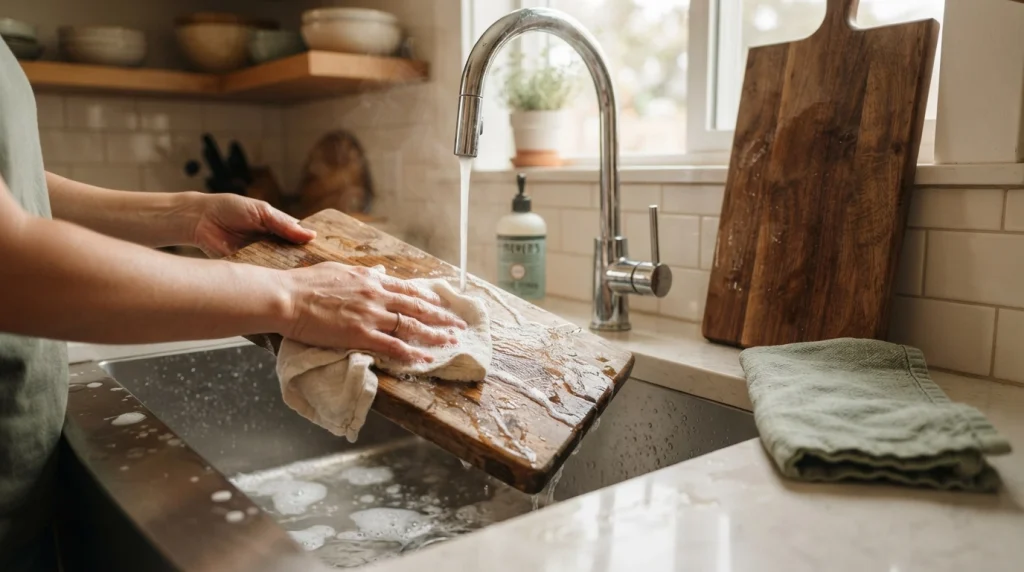
Cleaning depends on the board’s material and manufacturer’s care instructions. For most wooden boards, washing promptly with warm water and dish soap is the basic approach.
The USDA recommends washing cutting surfaces between food preparation tasks and replacing boards with grooves that are difficult to clean. Its guidance is especially important when moving between raw and ready-to-eat foods.
Cleaning a Wooden Serving Board
- Remove loose crumbs and food scraps.
- Wash the food-contact surface with warm water and mild dish soap.
- Clean all sides and edges that contacted food or contaminated hands.
- Rinse thoroughly with clean water.
- Dry with a clean towel.
- Allow the board to finish drying with adequate airflow before storage.
Do not soak a wooden board unless its manufacturer specifically permits it. Extended moisture exposure can cause swelling, warping, and joint damage.
For more information, review the USDA guidance on cutting board cross-contamination.
Should You Sanitize a Serving Board?
Sanitizing may be appropriate following contamination, particularly when a board contacts raw animal products. However, some decorative materials and finishes cannot tolerate every sanitizer.
Follow the product manufacturer’s care instructions and use a food-contact-appropriate sanitizing method. If a board cannot be cleaned and sanitized adequately, do not use it for raw meat preparation.
When Should You Replace the Board?
Replace or retire a board when damage prevents effective cleaning. Deep knife grooves, persistent cracks, splitting joints, and loose components are common warning signs.
The University of Illinois Extension’s cutting board guidance also emphasizes replacing cutting surfaces with extensive damage.
Can You Use the Same Wooden Board for Cutting and Serving?
Yes, a properly designed dual-purpose wooden board can handle both jobs. The key is maintaining a clean serving surface and preventing cross-contamination.
I would use a dual-purpose board mainly for bread, cheese, fruit, and other ready-to-eat items. It is a simpler arrangement than moving between raw meat preparation and serving.
How to Switch From Cutting to Serving
- Finish preparing the ingredients.
- Remove scraps and crumbs.
- Clean the board when necessary, following its care instructions.
- Dry the surface before arranging the food.
- Use clean utensils and freshly prepared ingredients.
If a board has touched raw meat, do not immediately use it as a charcuterie platter. It must be thoroughly cleaned and appropriately sanitized before any ready-to-eat food touches it.
What About Reversing the Board?
Some dual-purpose wooden boards have two usable sides. One may serve as a cutting surface, while the other stays cleaner and more attractive for presentation.
That arrangement works only when both sides are food-safe and the entire board is properly cleaned. Flipping an unwashed board does not remove contamination.
Is a Charcuterie Board the Same as a Cutting Board?
No, a charcuterie board is primarily intended for serving cured meats, cheeses, crackers, fruit, and accompaniments. It may resemble a cutting board, but appearance does not prove cutting suitability.
Some wooden charcuterie boards can support light slicing. Others are decorative presentation pieces that should never be used with sharp knives.
Can You Slice Cheese on a Charcuterie Board?
Yes, when its surface is food-safe, stable, and approved for cutting. A suitable wooden board can make cheese preparation and presentation convenient.
For slate, marble, and glass boards, use a separate cutting board for slicing. Transfer the finished cheese portions onto the serving surface afterward.
Can You Cut Meat on a Charcuterie Board?
Cooked or cured ready-to-eat meat can be sliced on a clean, suitable board. Raw meat preparation deserves a separate cutting surface to reduce contamination risks.
Keep raw and ready-to-eat ingredients apart throughout preparation. The FDA’s guidance on separating foods provides additional handling recommendations.
Which Type of Board Is Best for Cutting and Serving?
A well-made hardwood board designed for both cutting and serving is often the most practical option. It provides a functional preparation surface while maintaining an attractive presentation.
However, your priorities should determine the final choice.
| Your Priority | Suggested Material | Main Consideration |
|---|---|---|
| Everyday cutting | Maple or walnut cutting board | Knife-friendly work surface |
| Cutting and serving | Dual-purpose hardwood | Practical and attractive |
| Easy routine cleanup | Dishwasher-safe plastic | Replace when badly scored |
| Elegant presentation | Marble or slate | Avoid direct knife work |
| Lightweight kitchen use | Paper composite | Check knife feel and care guidance |
Recommended Cutting Boards for Different Kitchen Needs
If your serving board is too delicate for regular cutting, a dedicated cutting board is a practical solution. These established product lines are useful options to consider based on their intended designs.
The recommendations below are editorial suggestions, not claims of hands-on testing. Confirm current specifications, prices, and availability before purchasing.
🏆 Best for Wood Lovers
John Boos Maple Cutting Board
Editorial pick — not independently rated
John Boos offers established maple cutting board designs in different sizes and constructions. I would consider a model suitable for cutting and serving when wood appearance and a substantial work surface are priorities.
💰 Best for Easy Cleanup
OXO Good Grips Utility Cutting Board
Editorial pick — not independently rated
The OXO Good Grips utility-style cutting board is designed for practical food preparation rather than decorative serving. I would shortlist it for routine ingredient preparation and easier cleaning.
🍽️ Best Lightweight Alternative
Epicurean Kitchen Series Cutting Board
Editorial pick — not independently rated
Epicurean’s Kitchen Series uses a thin paper-composite board design. I would consider it when compact storage, easy handling, and a practical everyday work surface matter more than traditional hardwood styling.
Frequently Asked Questions
Can you use a cheese serving board as a cutting board?
Yes, if the cheese serving board is made from a suitable cutting material and the manufacturer approves knife use. Solid wooden boards may work for light slicing. Avoid cutting directly on marble, slate, glass, or decorative surfaces that could damage knife edges or chip.
Can you use a bamboo serving board for cutting?
Yes, some bamboo serving boards are designed for both serving and cutting. Check the product instructions, glue construction, and surface condition. Bamboo can be relatively hard, so repeated cutting may feel less forgiving than on certain hardwood or plastic boards.
Can you cut bread directly on a wooden serving board?
Yes, a suitable wooden serving board can handle bread slicing. However, serrated bread knives may leave scratches on the surface. Use controlled movements and avoid aggressive sawing against the board if you want to maintain its appearance.
Can you use a decorative charcuterie board for chopping vegetables?
Only if its manufacturer confirms that it is suitable for cutting. Decorative coatings, resin details, uneven surfaces, or fragile materials may make it unsuitable. A dedicated cutting board is a safer and more practical choice for regular vegetable chopping.
Is it safe to use the same board for cutting and serving food?
Yes, when the board is designed for both tasks and cleaned properly between uses. Keep raw meat, poultry, and seafood preparation separate from ready-to-eat foods. Never move directly from raw meat preparation to serving without thorough cleaning and appropriate sanitizing.
Final Verdict: Should You Cut on a Serving Board?
Yes, but only when the serving board is genuinely suitable for cutting. A sturdy, food-safe hardwood board can often serve both purposes, while decorative glass, marble, and slate boards should generally remain presentation surfaces.
For occasional bread, cheese, or fruit slicing, a properly designed dual-purpose board can be convenient. For heavy chopping and raw meat preparation, choose a dedicated cutting board.
My recommendation: Keep one reliable board for everyday knife work and another attractive board for serving. This approach protects your knives, preserves your presentation surfaces, and simplifies food safety.
Before using any serving board for cutting, check its material, finish, manufacturer’s instructions, and condition. A few quick checks can help you make a safer decision.

