Are Rubber Cutting Boards Safe? Benefits, Risks, and Care
Quick Answer
Yes, rubber cutting boards are generally safe for food preparation when made from food-contact-appropriate materials and properly maintained. Quality synthetic rubber boards resist moisture absorption, provide a knife-friendly surface, and are relatively easy to clean. However, they still require washing and sanitizing to prevent cross-contamination, as recommended by the USDA Food Safety and Inspection Service.
What Makes a Rubber Cutting Board Safe?
- Food-safe materials: Choose boards specifically manufactured and documented for food contact.
- Low moisture absorption: Quality rubber boards resist absorbing food juices and water.
- Knife-friendly surface: Resilient rubber cushions knife edges during chopping.
- Proper cleaning: Washing removes food residue and reduces contamination risks.
- Regular inspection: Replace damaged boards that cannot be cleaned effectively.
Important Safety Tip
- Prevent cross-contamination: Keep separate boards for raw animal products and ready-to-eat foods.
Rubber cutting boards are increasingly popular among cooks who want a durable surface without sacrificing knife sharpness. But their unusual texture raises an important question: are they truly safe for everyday food preparation?
I believe the best way to evaluate a cutting board is to examine its material, hygiene requirements, and maintenance needs. This guide explains those factors and helps you decide whether rubber belongs in your kitchen.
What Is a Rubber Cutting Board?
A rubber cutting board is a food preparation surface made from natural or synthetic rubber compounds. Professional kitchen models commonly use engineered synthetic rubber designed to resist moisture and repeated knife contact.
Unlike ordinary rigid plastic boards, rubber surfaces have some elasticity. This flexibility helps cushion knife blades while providing a stable cutting surface.
What Are Rubber Cutting Boards Made Of?
Not every product marketed as a rubber cutting board uses the same construction. Understanding the material helps you choose a suitable board.
- Synthetic rubber: Engineered compounds used in products such as Asahi Cookin’ Cut cutting boards.
- High-density rubber: Resilient material used in commercial products such as NoTrax Sani-Tuff boards.
- Soft synthetic composites: Flexible cutting surfaces sometimes marketed alongside rubber boards.
- Wood-core synthetic boards: Products such as Hasegawa Pro-Soft combine a sealed wood core with soft synthetic outer layers.
The exact composition matters because heat resistance, cleaning instructions, and food-contact suitability differ. A board’s product label is more reliable than its general marketing category.
Are Rubber Cutting Boards Food Safe?
Yes, quality rubber cutting boards intended for food contact can be a safe choice for home and professional kitchens. Safety depends on the board’s material, condition, and cleaning routine.
A smooth rubber surface resists liquid absorption, which can make routine cleaning straightforward. However, no cutting surface remains hygienic without proper maintenance.
How Can You Verify Food-Contact Safety?
Look for clear material information and food-contact documentation from the manufacturer. A product simply described as rubber is not automatically appropriate for preparing food.
- Manufacturer information: Check that the board is explicitly intended for food preparation.
- Independent certification: Look for applicable NSF certification or other credible food-contact compliance information.
- Material transparency: Prefer manufacturers that explain their construction and cleaning requirements.
- Surface condition: Avoid sticky, crumbling, cracked, or deteriorating rubber.
- Reputable sellers: Purchase from established kitchenware suppliers offering identifiable products.
Food-contact compliance and sanitation are separate issues. A suitable material can still become contaminated during normal kitchen use.
Are NSF-Certified Rubber Cutting Boards Safer?
NSF certification can provide additional confidence that a specific product meets applicable sanitation-related standards. However, certification applies to identified products, not every board sold under a brand name.
Check the product’s actual certification rather than relying on broad advertising claims. You can learn more about food preparation safety through NSF’s food preparation guidance.
Do Rubber Cutting Boards Harbor Bacteria?
Rubber cutting boards can collect bacteria whenever they contact contaminated food. Their low-absorption surfaces do not eliminate the need for washing, sanitizing, and separating ingredients.
Raw chicken, seafood, and meat juices can contaminate the cutting surface. Bacteria may then transfer to vegetables or cooked foods if the board is reused without proper cleaning.
Can Bacteria Grow in Knife Marks?
Yes, cuts and grooves can trap food residue and make cleaning more difficult. This problem affects rubber, plastic, and wooden cutting boards.
Some rubber boards resist deep scoring or permit manufacturer-approved resurfacing. Nevertheless, excessively damaged surfaces should not remain in use.
Does Antimicrobial Rubber Prevent Food Poisoning?
No. Some rubber cutting boards incorporate antimicrobial additives, but these features do not replace normal food safety practices.
Antimicrobial claims may concern the growth of microorganisms on the product itself. They do not guarantee that food prepared on the board will be free from harmful bacteria.
- Wash the board after handling each ingredient group.
- Sanitize after contact with raw animal products.
- Use separate preparation surfaces whenever practical.
- Dry boards thoroughly before storage.
These habits matter more than antimicrobial marketing. The same principle applies to cutting boards made from other materials.
Are Rubber Cutting Boards Better Than Wood or Plastic?
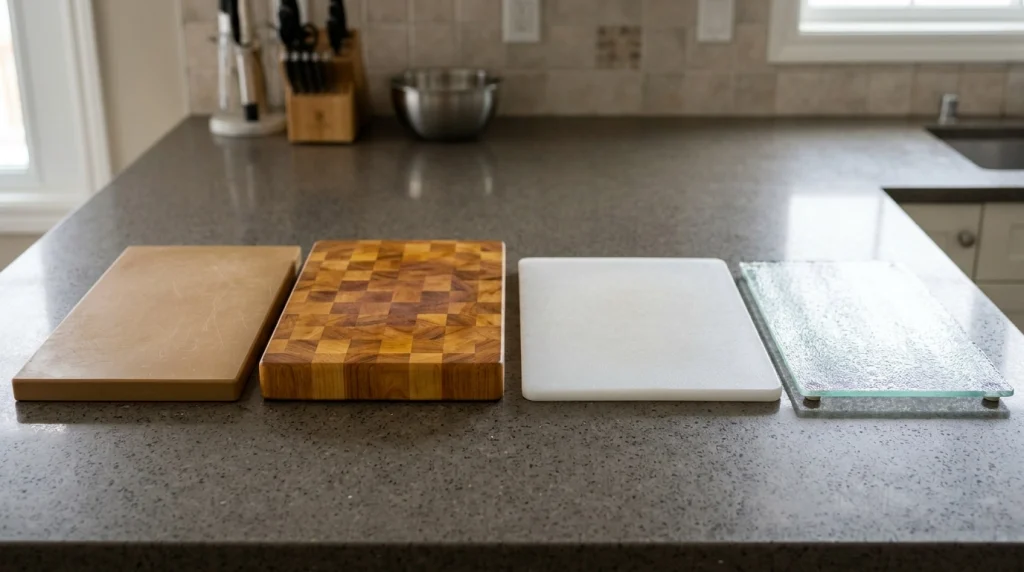 Save
Rubber boards often provide an excellent balance of knife protection, moisture resistance, and durability. Wood and plastic remain practical alternatives depending on budget and cleaning preferences.
Here is how common cutting board materials compare in everyday use.
| Feature | Rubber | Wood | Plastic | Glass |
|---|---|---|---|---|
| Knife friendliness | Excellent on resilient models | Generally good | Varies by hardness | Poor |
| Water absorption | Low on quality models | Varies by species and finish | Low | Very low |
| Dishwasher compatibility | Model-dependent | Usually hand wash recommended | Many models compatible | Often compatible |
| Surface maintenance | Some models can be resurfaced | May need oiling or sanding | Replace when deeply scored | Easy to wash |
| Typical price category | Midrange to premium | Budget to premium | Usually budget-friendly | Usually budget to midrange |
My practical preference: A resilient board makes particular sense when protecting a sharp chef’s knife matters. However, I would choose a dishwasher-compatible plastic board for someone who prioritizes simple automated cleaning.
Rubber vs. Wooden Cutting Boards
Wood provides a classic cutting feel, attractive appearance, and a firm working surface. Hardwood boards can also last for years when maintained properly.
Rubber generally avoids the oiling requirements associated with many wooden boards. Its resilience can also feel more forgiving under a sharp knife.
Wood does not automatically become unsafe because it absorbs moisture. Both materials can work well when maintained according to food safety guidance.
Rubber vs. Plastic Cutting Boards
Plastic boards are typically lighter, more affordable, and easier to replace. Many polypropylene and polyethylene models also tolerate dishwasher cleaning.
Premium rubber boards often offer a more cushioned cutting feel. Their main disadvantages can include higher prices, heavier construction, and model-specific washing restrictions.
Why Is Glass Less Suitable for Chopping?
Glass is nonporous and relatively straightforward to clean. Unfortunately, its hard surface offers little cushioning when a knife strikes it.
Repeated cutting on glass can accelerate edge wear. I would reserve glass boards for serving rather than regular chopping.
What Are the Benefits of Rubber Cutting Boards?
Rubber cutting boards offer several meaningful advantages for cooks who use sharp knives frequently. Their greatest strengths involve blade protection, controlled cutting, and surface maintenance.
1. They Help Protect Knife Edges
Resilient rubber absorbs some of the impact when a knife contacts the board. That makes it particularly appealing for precision slicing and repeated chopping.
Japanese knives with relatively delicate cutting edges may benefit from a forgiving surface. However, cutting technique and knife construction still influence edge retention.
2. They Resist Moisture Absorption
Many commercial rubber boards have low-absorption surfaces that resist soaking up food juices. This simplifies washing compared with some porous materials.
Moisture resistance does not mean the surface is sterile. Always remove residue after preparing food.
3. They Provide a Stable Cutting Surface
Rubber often produces a grippy feeling beneath ingredients. This can help reduce unwanted movement while slicing vegetables or preparing fish.
Still, stability depends on the board’s underside and countertop. Place a damp, clean towel beneath a sliding board when appropriate.
4. Some Models Can Be Resurfaced
Certain solid rubber cutting boards support surface restoration with manufacturer-approved abrasives. This can help remove shallow marks and extend usable service life.
Resurfacing is not appropriate for every composite board. Never sand through a protective layer or expose an internal core.
5. They Usually Do Not Need Oiling
Many rubber boards require only routine washing and drying. Unlike wooden boards, they generally do not need mineral oil to maintain their surfaces.
This can simplify everyday maintenance. Nevertheless, cleaning instructions still vary between brands.
What Are the Disadvantages of Rubber Cutting Boards?
Rubber cutting boards are not perfect for every kitchen. Their weight, cost, and care requirements deserve consideration before buying.
- Higher purchase cost: Premium Japanese rubber boards can cost considerably more than basic plastic boards.
- Heavy construction: Thick solid rubber models can be inconvenient to lift and wash.
- Heat sensitivity: Some boards warp when exposed to excessive temperatures.
- Initial rubber odor: New boards may have a noticeable material smell.
- Possible surface wear: Heavy chopping can create marks that require cleaning or maintenance.
- Limited dishwasher options: Many solid rubber models require hand washing.
These disadvantages do not automatically make rubber unsafe. They simply influence which product works best for your cooking habits.
Are Rubber Cutting Boards Toxic or Chemical-Free?
A reputable food-contact rubber board is not inherently toxic simply because it contains synthetic materials. However, its safety must be evaluated using the actual formulation and intended use.
Rubber compounds may contain polymers, processing aids, pigments, and other ingredients. Their presence alone does not establish whether a finished product is harmful.
Do Rubber Cutting Boards Contain BPA?
BPA is associated mainly with certain plastics and resins, not rubber as a general material category. However, a BPA-free claim cannot establish complete chemical safety.
Choose a manufacturer that provides relevant food-contact information. Avoid unknown industrial rubber sheets marketed as inexpensive cutting board substitutes.
Can Rubber Cutting Boards Shed Particles?
Repeated knife contact can gradually wear cutting surfaces, including rubber. Heavy use or aggressive scraping may release small particles from some materials.
The health significance depends on particle composition and exposure, and available evidence does not justify treating every rubber board as hazardous. Inspect your board and remove it from use if it begins crumbling or shedding visible fragments.
Is a Strong Rubber Smell Dangerous?
A new rubber board may have a noticeable odor. Smell alone cannot determine whether a material is safe or unsafe.
Wash the board according to its instructions before first use. If a strong odor persists alongside stickiness, discoloration, or deterioration, contact the manufacturer before preparing food on it.
How Do You Clean a Rubber Cutting Board Safely?
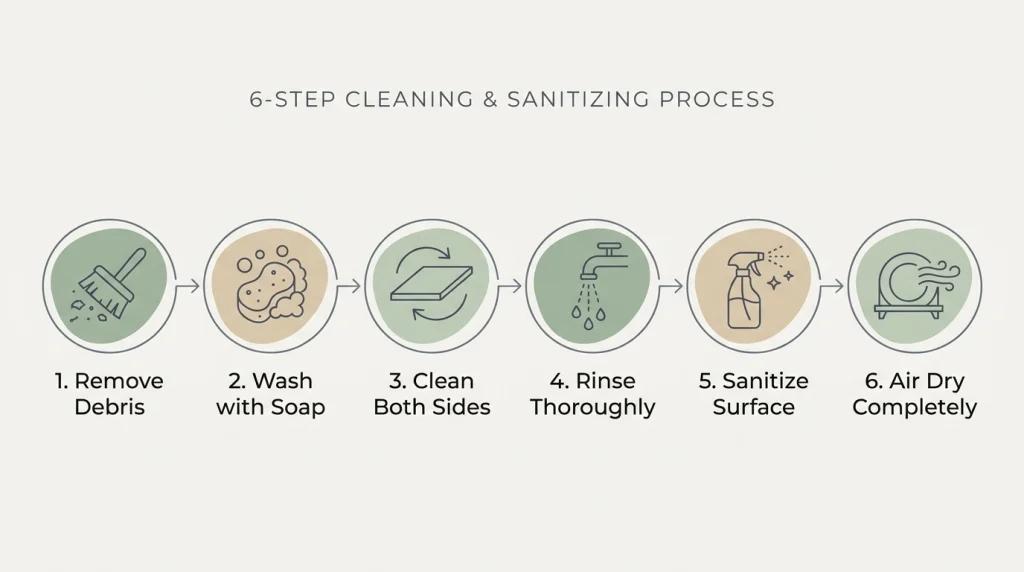 Save
Wash a rubber cutting board after every food preparation session and whenever switching between potentially contaminated ingredients. Proper cleaning removes food residue before bacteria have an opportunity to accumulate.
Step-by-Step Cleaning Instructions
- Remove food debris: Scrape remaining ingredients from the surface using a suitable non-damaging utensil.
- Wash with dish soap: Use warm water, mild detergent, and a sponge or approved brush.
- Clean both sides: Pay attention to edges, corners, and visible knife marks.
- Rinse thoroughly: Remove soap and loosened food particles with clean water.
- Sanitize when needed: Use a food-contact-appropriate sanitizer compatible with the board.
- Dry completely: Air-dry in a suitable position or use clean paper towels.
- Store correctly: Follow the manufacturer’s instructions to prevent warping.
How Should You Sanitize a Rubber Cutting Board?
After cutting raw poultry, meat, or seafood, wash the board thoroughly before sanitizing. Use a sanitizer approved for food-contact surfaces and compatible with your board’s material.
The USDA describes a household cutting board sanitizing solution of one tablespoon of unscented liquid chlorine bleach per gallon of water. However, some rubber manufacturers advise against bleach, so their material-specific instructions must also be considered.
Follow the sanitizer’s dilution, contact-time, rinsing, and ventilation directions. Never mix bleach with ammonia, vinegar, or other cleaners.
For additional food safety information, see the Academy of Nutrition and Dietetics cutting board safety guidance.
Can Rubber Cutting Boards Go in the Dishwasher?
Some can, but many cannot. Dishwasher compatibility depends on the exact board construction and manufacturer’s heat limits.
For example, Hasegawa identifies its Pro-Soft products as dishwasher compatible. Parker Asahi advises against using dishwashers for its Cookin’ Cut synthetic rubber boards because heat may soften or deform them.
- Hasegawa Pro-Soft: Dishwasher compatible within manufacturer specifications.
- Asahi Cookin’ Cut: Hand washing recommended by the manufacturer.
- NoTrax Sani-Tuff: Follow the manufacturer’s hand-washing guidance.
Do not assume every rubber board has the same heat resistance. Always verify the specific model before using heated cleaning equipment.
Can You Use Rubber Cutting Boards for Raw Meat?
Yes, a suitable rubber cutting board can be used for raw meat when properly cleaned and sanitized afterward. The main concern is cross-contamination rather than rubber itself.
Keep raw meat juices away from foods that will not receive further cooking. A separate board for raw animal products makes this easier.
How Can You Prevent Cross-Contamination?
- Designate one board for raw meat, poultry, and seafood.
- Use another board for vegetables, bread, and ready-to-eat food.
- Wash knives and other utensils when switching food categories.
- Sanitize contaminated preparation surfaces before reuse.
- Wash hands thoroughly after handling raw ingredients.
The USDA specifically recommends separating cutting boards for raw animal foods and fresh produce whenever practical. This approach helps prevent harmful microorganisms from transferring between ingredients.
More information is available from USDA food safety resources.
How Long Do Rubber Cutting Boards Last?
A well-maintained rubber cutting board may remain usable for many years. Its actual lifespan depends on cutting frequency, storage conditions, material quality, and cleaning methods.
Some manufacturers describe exceptionally long service lives for their products. These examples should not be interpreted as guarantees for every board.
When Should You Replace a Rubber Cutting Board?
Replace your board when its condition makes effective cleaning or safe cutting difficult. Visible damage is more useful than an arbitrary replacement date.
- Deep grooves: Cuts trap residue that cannot be thoroughly removed.
- Cracks or splits: Damage creates difficult-to-clean areas.
- Persistent deformation: Warping makes the board unstable.
- Surface breakdown: Sticky, brittle, or crumbling rubber indicates deterioration.
- Exposed internal core: Damaged composite construction may no longer be hygienic.
- Unremovable contamination: Persistent residue may indicate that replacement is the safer option.
Manufacturer-approved resurfacing can extend the life of certain solid rubber boards. However, it cannot repair every form of structural damage.
What Should You Look for When Buying a Rubber Cutting Board?
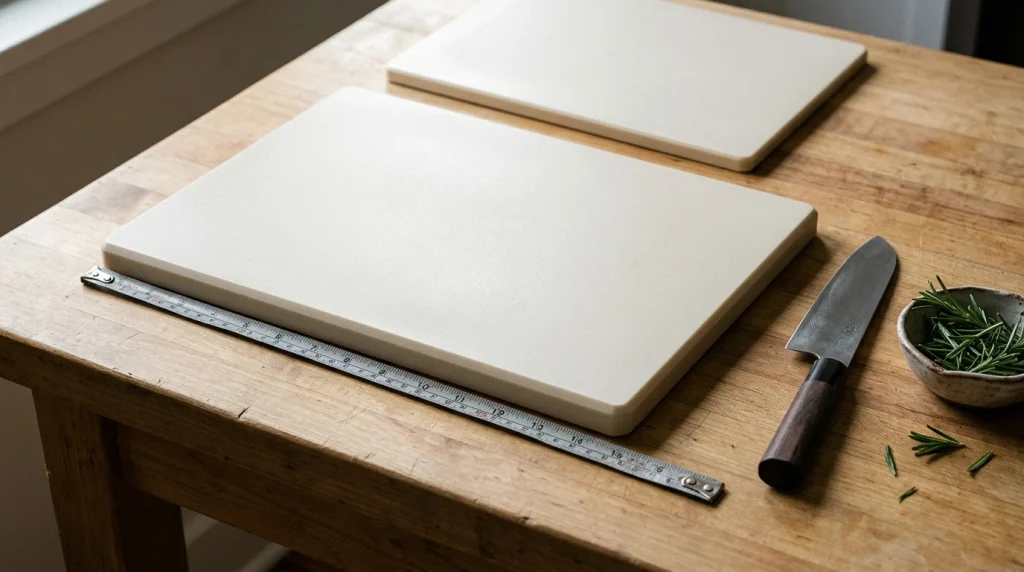 Save
The best rubber cutting board is one that suits your knife collection and cleaning habits. Material quality matters more than appearance alone.
Important Buying Features
- Food-contact suitability: Choose a board intended specifically for food preparation.
- Thickness: Select a stable board that remains practical to lift and clean.
- Dimensions: Make sure the surface accommodates your most common ingredients.
- Blade protection: Look for a resilient surface suited to your knives.
- Maintenance requirements: Check whether the board requires hand washing.
- Surface restoration: Verify whether sanding is permitted.
- Manufacturer support: Prefer clear care instructions and identifiable model numbers.
What Size Rubber Cutting Board Is Best?
A medium board is generally practical for everyday vegetable and meat preparation. Larger boards offer more workspace but can be heavier and harder to wash.
| Approximate Size | Suggested Use |
|---|---|
| 12 × 8 inches | Small vegetables, herbs, and compact kitchens |
| 16 × 10 inches | General home cooking and daily chopping |
| 18 × 12 inches | Larger ingredients and frequent meal preparation |
| 24 × 12 inches | Spacious workstations and demanding preparation tasks |
These dimensions are general buying examples rather than universal standards. Measure your countertop and sink before selecting a particularly large board.
Recommended Rubber and Soft-Surface Cutting Boards
If you’re considering a premium cutting board, these three established product lines are worth comparing. I’ve selected them for their distinct materials, construction, and maintenance characteristics rather than claiming personal hands-on testing.
Affiliate disclosure: As an Amazon Associate, I earn from qualifying purchases made through eligible links, at no extra cost to you.
🏆 Best for Knife Protection
Hasegawa Pro-Soft Cutting Board
★★★★☆ 4.5/5
Hasegawa Pro-Soft uses a sealed wood core with resilient synthetic cutting surfaces. The manufacturer specifies dishwasher compatibility and a 90°C heat-resistance limit for its FSR series.
I would shortlist this for someone who frequently uses delicate Japanese knives and wants a cushioned surface.
🍣 Best Traditional Rubber Surface
Asahi Cookin’ Cut Rubber Cutting Board
★★★★☆ 4.5/5
Asahi Cookin’ Cut uses synthetic rubber designed to offer a wood-like cutting feel. It is known for its stable surface and manufacturer-supported resurfacing procedures.
I would consider it for precise slicing when hand washing is not an inconvenience. Avoid dishwasher cleaning unless your exact model’s manufacturer instructions explicitly permit it.
👨🍳 Best for Commercial-Style Prep
NoTrax Sani-Tuff T45 Rubber Cutting Board
★★★★☆ 4/5
The Sani-Tuff T45 uses high-density rubber designed for demanding kitchen environments. Its resilient construction and resurfacing capability make it an appealing commercial-style option.
I would shortlist this for frequent preparation work, provided the weight and hand-washing requirements suit the kitchen.
The scores above are editorial suitability assessments, not verified customer review averages or hands-on test results. Confirm the current specifications and seller details before purchasing.
Frequently Asked Questions About Rubber Cutting Board Safety
1. Are rubber cutting boards safe for everyday cooking?
Yes, rubber cutting boards made for food contact are generally suitable for everyday cooking. Choose a reputable manufacturer, wash the surface after use, and prevent cross-contamination between raw and ready-to-eat foods. Replace the board when its surface becomes too damaged to clean effectively.
2. Are rubber cutting boards better for knives?
Many rubber boards are gentler on knife edges than hard glass or stone surfaces. Their resilient construction absorbs some cutting impact and may help reduce edge wear. The benefit depends on the rubber compound, knife design, and cutting technique.
3. Can you cut raw chicken on a rubber cutting board?
Yes, you can prepare raw chicken on a food-safe rubber cutting board. Wash and sanitize the board afterward using compatible products and manufacturer guidance. Ideally, keep a separate board for raw poultry and other animal products to minimize cross-contamination.
4. Are rubber cutting boards dishwasher safe?
Dishwasher suitability varies by model. Hasegawa Pro-Soft boards are identified as dishwasher compatible, while Asahi Cookin’ Cut boards generally require hand washing. Always follow your specific product’s instructions because excessive heat can deform certain rubber compounds.
5. Do rubber cutting boards release harmful chemicals?
A properly manufactured food-contact rubber board is not automatically hazardous. Chemical safety depends on its actual composition, production controls, and intended use. Choose identifiable products with credible food-contact information, and stop using any board that becomes sticky, brittle, or visibly deteriorated.
Final Verdict: Are Rubber Cutting Boards Worth Using?
Yes, quality rubber cutting boards can be a safe and worthwhile addition to a home kitchen. They combine resilient cutting surfaces with practical moisture resistance and potentially long service lives.
Their biggest appeal is the balance between knife protection and everyday hygiene. However, good sanitation practices remain essential regardless of the material you choose.
For cooks who prioritize knife care, I would consider a reputable rubber or soft-surface board. If budget and dishwasher convenience matter more, a quality plastic board may be the better fit.
My final advice: Choose a verified food-contact product, follow its cleaning instructions, and replace it when necessary. A clean, well-maintained cutting board is always more important than an expensive material.

