
How to Keep a Cutting Board from Sliding
Quick Answer
Put a damp kitchen towel or a sheet of non-slip shelf liner under your cutting board, and it will stay put on almost any counter. The thin layer of water creates grip between the board and the counter, so the board stops creeping while you chop. This quick fix works in seconds, costs nothing, and pairs well with the rest of how to use a cutting board safely.
Fastest fixes, ranked
- Damp towel: Wet a tea towel, wring it out, and lay it flat under the board.
- Shelf liner: Cut a piece of rubberized liner to fit under the board.
- Silicone mat: Place a thin silicone baking mat between board and counter.
- Wet paper towel: Dampen two sheets and tuck them under each end.
- Non-slip feet: Stick rubber bumpers or feet on the board’s underside.
Check it before you chop
- Push the board sideways with one hand before you pick up your knife.
- If it moves at all, re-wet the towel or swap in a grip liner.
I’ve chased a runaway cutting board across the counter more times than I care to admit. It usually happens right when I’m halfway through an onion, knife in hand, and the board starts creeping toward the edge.
That sliding isn’t just annoying. It’s the moment a safe task turns risky, so this guide walks through every fix I’ve tested, from the ten-second towel trick to boards built to stay put.
Why Does My Cutting Board Slide?
A cutting board slides when there isn’t enough friction between the board and the counter. Friction is the grip that resists motion when two surfaces press together, and smooth surfaces like polished stone or laminate offer very little of it.
Every knife stroke pushes the board a tiny bit sideways. Those tiny pushes add up, and the board starts to travel.
Several things make sliding worse, and most of them are easy to spot:
- Smooth counters: Granite, quartz, and polished laminate give the board almost nothing to grab.
- Light boards: Thin plastic boards weigh so little that each cut can shift them.
- Water on the counter: A wet surface acts like a lubricant under a flat board.
- Warped boards: A board that rocks touches the counter at only two points, so it slides and wobbles.
- Aggressive chopping: A rocking knife motion drives the board forward with every stroke.
Weight helps, but it isn’t the whole story. A heavy board on a wet quartz counter can still glide, and a light board on a grip mat won’t budge.
What Is the Fastest Way to Stop a Cutting Board from Sliding?
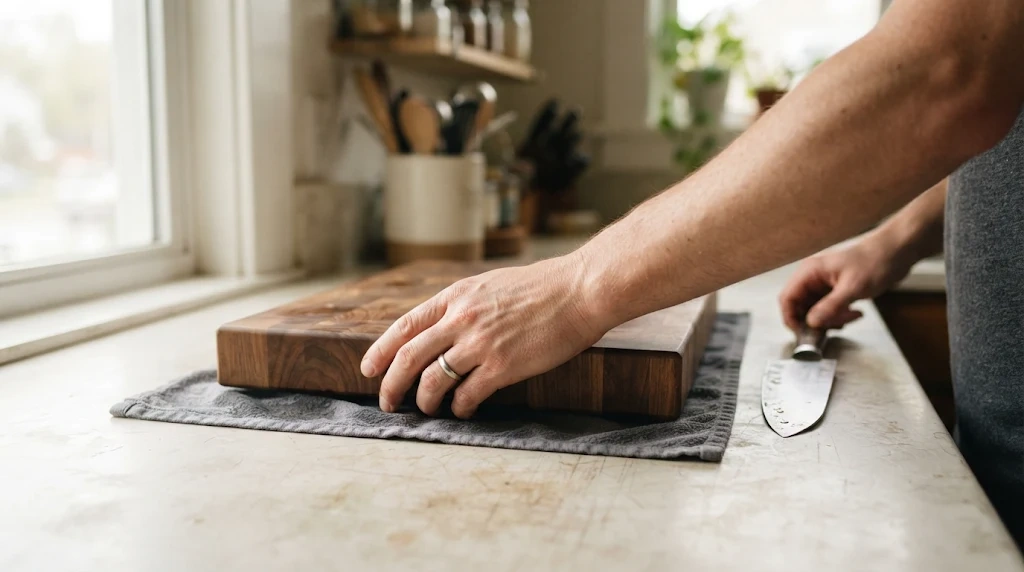
The fastest fix is a damp kitchen towel under the board. It takes about ten seconds, and it works on wood, plastic, and bamboo boards alike.
I’ve used this trick in rental kitchens, at friends’ houses, and on a slick hotel countertop. It has never failed me yet.
Here’s the exact method I use:
- Dampen a tea towel. Run it under the tap, then wring it until it stops dripping.
- Lay it flat. Spread the towel on the counter with no folds or bunches.
- Set the board on top. Press down once so the board makes full contact.
- Test it. Push the board sideways with one hand before you start cutting.
- Re-wet as needed. If the towel dries out during a long prep session, dampen it again.
The towel should be damp, not soaking. A puddle under the board makes things worse, not better.
One more detail matters. The towel should be a little smaller than the board, so no damp fabric sticks out where your knife hand rests.
Does a Damp Paper Towel Work as Well as a Cloth Towel?
A damp paper towel works in a pinch, but a cloth towel grips better and lasts longer. Paper towels tear, bunch up, and dry out fast under a heavy board.
I keep paper towels as my backup plan. They’ll hold a light board steady for a quick job, like slicing a lemon or mincing garlic.
For anything longer, cloth wins. A tea towel stays damp for an hour of prep, and it won’t shred into your food.
If paper towels are all you have, use two sheets per end. Fold each sheet into a small pad, dampen it, and tuck one pad under each end of the board.
What Can I Put Under a Cutting Board to Stop It Sliding?
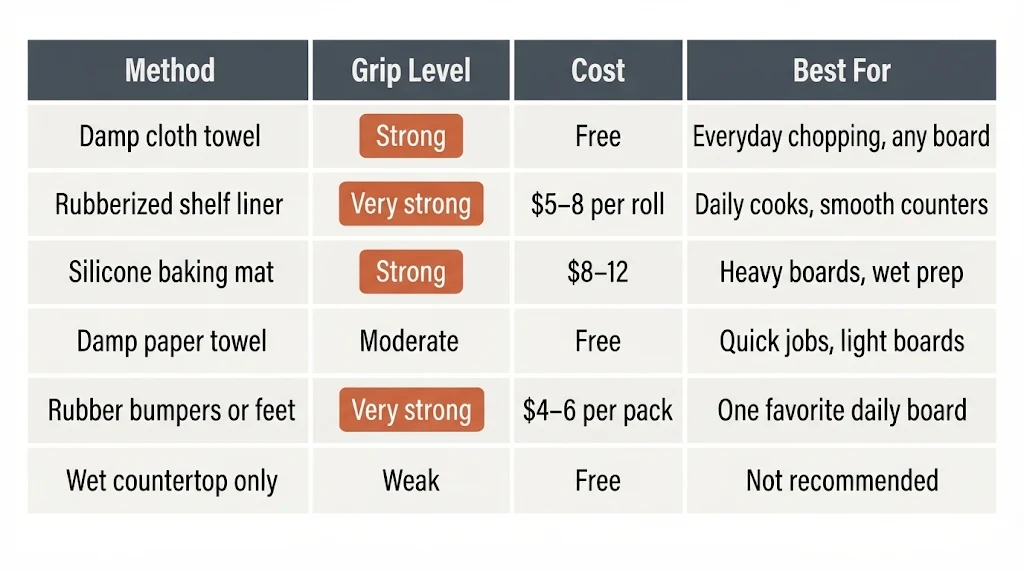
You have more options than the towel trick, and each one suits a different kitchen. Some are free, some cost a few dollars, and one or two are worth buying if you cook every day.
The table below compares the fixes I’ve actually used, with honest notes on grip, cost, and upkeep.
| Method | Grip level | Cost | Best for |
|---|---|---|---|
| Damp cloth towel | Strong | Free | Everyday chopping, any board |
| Rubberized shelf liner | Very strong | About $5–8 per roll | Daily cooks, smooth counters |
| Silicone baking mat | Strong | About $8–12 | Heavy boards, wet prep |
| Damp paper towel | Moderate | Free | Quick jobs, light boards |
| Rubber bumpers or feet | Very strong | About $4–6 per pack | One favorite board you use daily |
| Wet countertop only | Weak | Free | Not recommended on its own |
Shelf liner is my pick for a permanent fix. Cut a piece to match your board, keep it in the drawer, and you’ll never hunt for a towel mid-recipe.
One caution: wash the liner often. It sits under a board that touches raw food, so treat it like a dishcloth and rinse it with hot, soapy water after messy prep.
How do I use shelf liner under a cutting board?
Cut the liner about half an inch smaller than the board on each side. That keeps the edges hidden, so the liner doesn’t curl up or catch your knife hand.
Place the liner shiny side down if it has one. Most rubberized liners grip on both sides, but the textured side holds the counter best.
Replace the liner when it gets stiff or torn. A worn liner loses grip, and a cracked one traps food bits.
How Do I Keep a Cutting Board from Sliding on Granite or Quartz?
Smooth stone counters are the hardest surface for a board to grip. Polished granite and quartz feel almost frictionless under a flat board, especially when wet.
On stone, the damp towel still works, but shelf liner works better. The rubberized mesh bites into the polished surface in a way a towel can’t match.
Here are a few extra tricks that help on stone:
- Dry the counter first. Wipe up splashes before you set the board down.
- Use a heavier board. A thick end-grain board stays put better than a thin plastic one.
- Anchor one edge. Push the board’s short end against the backsplash for extra stability.
- Try a silicone mat. Silicone grips stone well, even when damp.
I tested all four on my own quartz counter last year. The shelf liner won by a clear margin, with the silicone mat a close second.
If your board still slides on stone, check whether it’s warped. A rocking board will slide on any surface, and no grip mat can fix that.
How Do I Stop a Small or Light Cutting Board from Moving?
Small boards slide more because they have less weight and less contact area. A bar board or a mini prep board can skate across the counter with one firm cut.
The damp towel trick still works, but scale it down. A full tea towel bunches under a small board, so fold it into a pad that matches the board’s size.
Size matters more than most people think. If your board is too small for the job, you’ll push it around without meaning to, so it’s worth checking what size cutting board you need before you blame the counter.
Another option is to nest the small board on a larger one. Set the big board on a towel, then set the small board on top of it.
That sounds odd, but it works. The big board acts as a stable base, and the small board’s job becomes much easier.
What If My Cutting Board Is Warped?
A warped board rocks, and a rocking board will slide no matter what you put under it. The fix starts with flattening the board, not with a better grip mat.
First, check the warp. Set the board on a flat counter and press each corner in turn, and note which corners lift.
For a mild warp, try the towel trick with a thicker fold under the low side. That can level the board enough for a single session.
For a real fix, follow the steps in how to fix a warped cutting board. Most wood boards can be flattened with moisture, weight, and patience.
Prevention beats repair here. Store boards upright with air flow, and oil wood boards on schedule, as explained in how to prevent a cutting board from warping.
Plastic boards warp too, usually from dishwasher heat. A warped plastic board rarely flattens again, so it’s often time to replace it.
Should I Buy a Cutting Board with Non-Slip Feet?
Yes, if you cook most days and you’re tired of the towel routine. Boards with built-in rubber feet or a silicone grip ring solve sliding at the source.
Look for feet that are molded into the board, not glued on. Glued feet fall off in the dishwasher, and they leave a sticky patch behind.
There is one trade-off to know. Feet mean you can only use one side of the board, so you lose the flip-it-over habit that many cooks love.
If you like using both sides, read can you use both sides of a cutting board before you decide. A flat board on a grip mat keeps both faces in play.
As of 2026, most major brands offer a non-slip line. OXO, Joseph Joseph, and Epicurean all build grip into their popular boards, and the price gap over a plain board is small.
What features stop a board sliding best?
Rubber feet beat a rubber edge strip, in my experience. Feet lift the board slightly and grip at four points, while an edge strip only helps if the board sits perfectly flat.
Weight helps too. A board over three pounds resists sliding far better than a featherweight one, even without feet.
Look for these features when you shop:
- Molded rubber feet: Stay on through washing and hold firm on stone.
- Juice groove: Keeps liquid off the counter, so the board stays dry underneath.
- Thick build: Boards at least half an inch thick flex less and grip better.
- Textured underside: A rough base adds friction on smooth counters.
Mistakes That Make Sliding Worse
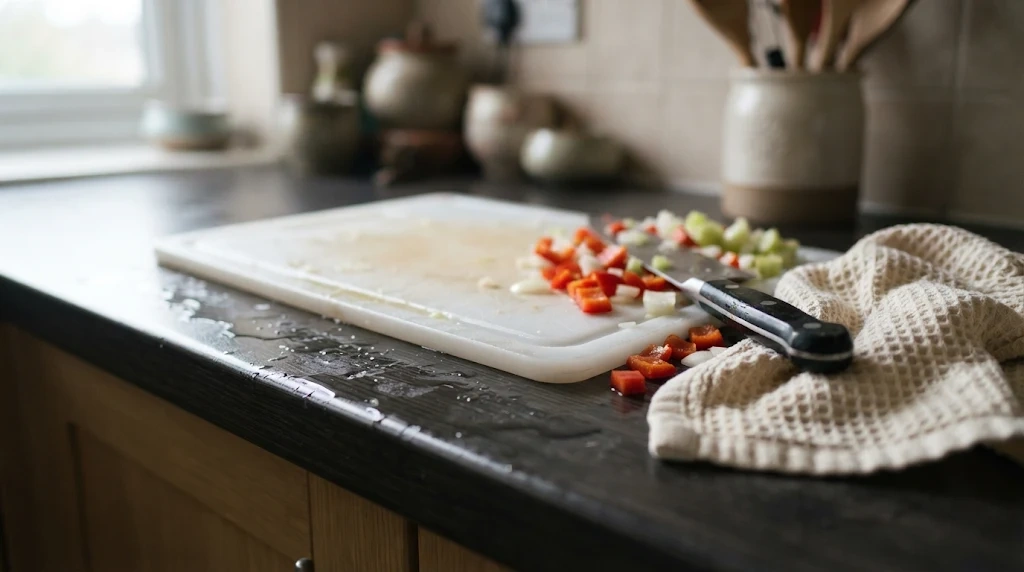
A few common habits turn a small slide into a real problem. Fix these, and even a plain board behaves better.
- Cutting on a wet counter: Water under a flat board acts like a lubricant, so wipe the counter dry first.
- Using a dry towel: A dry towel slides almost as freely as the board, so dampen it every time.
- Pushing down too hard: Heavy pressure drives the board forward, so let the knife do the work.
- Ignoring a warp: A rocking board needs flattening, not a thicker mat.
- Skipping the test push: Always check the board before the knife comes out.
Food safety ties into this too. A board that slides can send a knife off course.
The FoodSafety.gov guidance on safe food handling starts with a stable, clean prep surface.
The USDA Food Safety and Inspection Service and the CDC food safety pages make the same point in different words: steady hands start with a steady board. The NSF site is also worth a look if you want to check what certified food-safe boards and kitchen products actually meet.
My Top Picks for a Board That Stays Put
If you’re ready to upgrade, here’s what I’d actually recommend. Each of these solves sliding in a different way, so pick the one that fits your kitchen.
🏆 Best Overall
OXO Good Grips Utility Cutting Board
★★★★★
Non-slip rubber feet on both ends, a juice groove, and a dishwasher-safe build. This is the board I reach for most days because it simply does not move.
💰 Best Budget Fix
Con-Tact Brand Non-Adhesive Shelf Liner
★★★★☆
A roll of rubberized grip liner you cut to fit any board, drawer, or shelf. I keep a pre-cut sheet in my board drawer and it has outlasted two boards so far.
🥩 Best for Heavy Prep
Joseph Joseph Cut&Carve Plus Large
★★★★☆
A large board with non-slip feet, angled cutting surface, and deep juice grooves for meat. I pull this one out for roasts and big veggie prep sessions.
The OXO Good Grips cutting board is my default pick if you want one board that solves sliding on its own. Pair it with a sheet of shelf liner, and you’ll never chase a board again.
Frequently Asked Questions
How do I keep a cutting board from sliding without a towel?
Use a sheet of rubberized shelf liner or a silicone baking mat under the board. Both grip smooth counters well, cost only a few dollars, and can be cut to fit any board size.
Why does my cutting board slide on granite?
Polished granite offers almost no friction, so a flat board glides with each knife stroke. Water on the stone makes it worse, but a rubberized shelf liner grips polished stone far better and stays put all session.
Can I use a silicone mat under a cutting board?
Yes, a thin silicone baking mat works well under a cutting board, and it grips both the counter and the board even when damp. Make sure the mat lies flat with no curled edges, or the board may rock.
Do non-slip cutting boards really work?
Yes, boards with molded rubber feet stay put on most counters without any towel or mat. The trade-off is that you can only use one side, since the feet sit on the underside.
How do I stop a wooden cutting board from sliding?
Put a damp cloth towel or a sheet of shelf liner under the board, and check that the board isn’t warped first. Keep the board oiled and stored upright so it stays flat and holds its grip over time.
The Bottom Line
A damp towel fixes a sliding board in ten seconds. A sheet of shelf liner fixes it for good.
Pick one fix, test the board before every session, and enjoy chopping without the chase. Your knives, your fingers, and your dinner will all thank you.

