Are Epicurean Cutting Boards Non-Toxic? A Complete Safety Guide
Quick Answer
Yes, Epicurean cutting boards are generally considered non-toxic and safe for their intended food-preparation use. They’re made from paper fibers bonded with cured resin, and the company’s paper-composite cutting boards carry NSF food-contact certification. However, non-toxic doesn’t mean chemical-free. The material contains synthetic resin, so it’s important to understand the difference between food-contact safety and natural materials. You can review the manufacturer’s material and certification information before buying.
Key Safety Facts
- Food-contact certified: Epicurean identifies its paper-composite cutting boards as NSF certified.
- Composite construction: Paper fibers and thermosetting resin form a dense cutting surface.
- Dishwasher safe: Standard Epicurean paper-composite boards can be cleaned in a dishwasher.
- Low-maintenance surface: The boards resist moisture and don’t need regular oiling.
- Normal wear matters: Replace boards with excessive grooves, cracks, or damaged surfaces.
- Not chemical-free: Their cured resin is an engineered component, not natural solid wood.
My Recommendation
- Choose an authentic, food-contact-certified board and follow the manufacturer’s cleaning instructions.
- Use separate cutting surfaces for raw meat and ready-to-eat foods.
- If avoiding synthetic resin entirely is your priority, consider a solid hardwood cutting board instead.
When choosing a cutting board, I look beyond its appearance and price. The material touching my food matters just as much as its durability.
Epicurean boards look like wood, yet they’re made differently. That naturally raises questions about resin, chemicals, and long-term food safety.
In this guide, I’ll explain what they’re made from, what their certifications mean, and how they compare with other cutting surfaces.
What Are Epicurean Cutting Boards Made Of?
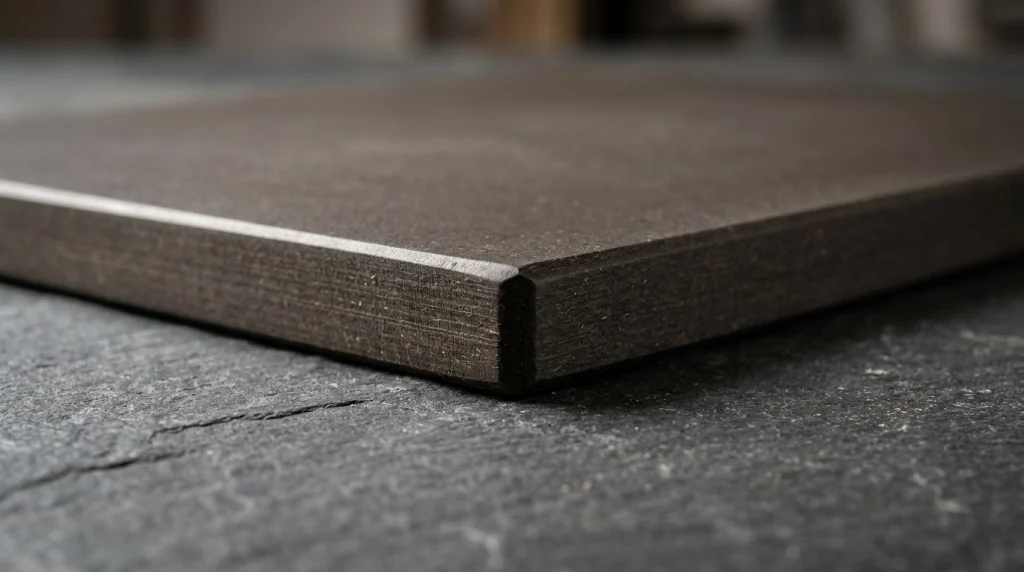
Epicurean cutting boards use a paper-composite material created by bonding layers of paper with thermosetting resin. Heat and pressure transform those layers into a dense, durable sheet.
The finished material resembles wood but behaves differently around moisture. It also requires less maintenance than many traditional wooden boards.
Understanding the Paper-Composite Material
 Save
A paper composite is an engineered material made from paper fibers and a bonding resin. Its strength comes from the way those components combine during manufacturing.
Epicurean describes a production process involving several stages:
- Paper preparation: Manufacturers prepare layers of high-quality paper fiber.
- Resin application: The paper receives a thermosetting resin treatment.
- Layer stacking: Sheets are arranged to create the desired strength and thickness.
- Heat pressing: Controlled heat and pressure bond the layers together.
- Curing: The resin hardens into a stable composite structure.
- Cutting and finishing: The material becomes kitchen boards in different shapes and sizes.
This construction explains why Epicurean boards can be thin without feeling like ordinary cardboard. The paper becomes part of a rigid composite.
Is Epicurean the Same as Solid Wood?
No. Epicurean boards contain wood-derived paper fibers, but they aren’t solid hardwood cutting boards.
A maple cutting board consists of wood pieces or a solid wooden surface. An Epicurean board combines processed paper and cured resin.
That distinction matters when evaluating ingredients, durability, and maintenance. Someone seeking an entirely wood-based cutting surface may prefer untreated solid hardwood.
Are Epicurean Cutting Boards Safe for Food Contact?
Yes, Epicurean’s certified paper-composite cutting boards are designed for direct food contact. The company identifies NSF certification as an important safety feature.
That certification provides more meaningful evidence than broad marketing terms such as natural or eco-friendly.
What Does NSF Certification Mean?
NSF evaluates products against applicable public-health and sanitation standards. For food equipment materials, NSF/ANSI 51 is particularly relevant.
The standard addresses materials intended for commercial food-equipment applications. Certification provides independent assurance within the product’s approved conditions of use.
It doesn’t mean that every ingredient is absent or that a board remains safe regardless of damage. Proper handling still matters.
When shopping, check the specific product’s certification markings and description. Don’t assume every accessory automatically shares the same certification.
Does GREENGUARD Certification Prove Food Safety?
Not by itself. GREENGUARD certification primarily concerns chemical emissions into indoor air, rather than direct food-contact suitability.
Epicurean also reports GREENGUARD certification for its paper-composite material. This offers a separate type of environmental health information.
- NSF certification: Relevant to specified food-equipment and sanitation requirements.
- GREENGUARD certification: Addresses emissions under defined testing conditions.
- FSC certification: Concerns responsible sourcing and forest-management standards.
These certifications address different questions. None should be interpreted as proof that the board contains no chemicals whatsoever.
Do Epicurean Cutting Boards Contain Formaldehyde or Harmful Chemicals?
Epicurean’s composite contains a cured resin, so it’s misleading to describe the material as completely chemical-free. The more useful question concerns exposure during normal use.
Some phenolic resins use formaldehyde chemistry during manufacture. However, the presence of such chemistry doesn’t establish that a finished board releases harmful amounts.
Understanding Phenolic Resin
Phenolic resin is a thermosetting polymer used in numerous durable composite materials. Once properly cured, it forms a crosslinked structure that differs from uncured ingredients.
Richlite, a paper-composite material associated with Epicurean products, describes its resin as fully cured during manufacturing. The manufacturer states that its finished material doesn’t off-gas formaldehyde.
That is a manufacturer claim rather than a guarantee that every chemical is completely absent. Product-specific emissions reports offer the best basis for evaluating particular concerns.
Does Resin Automatically Make a Cutting Board Toxic?
No. The fact that a material contains synthetic resin doesn’t automatically make it unsuitable for food contact.
Safety depends on the finished formulation, potential exposure, intended use, and relevant testing. This is why food-contact certification is more helpful than judging an ingredient by name alone.
I would also avoid claiming that any board has zero chemical migration without appropriate test evidence. A food-safe product isn’t necessarily a substance-free product.
Are Epicurean Cutting Boards BPA-Free?
Some retailers explicitly identify specific Epicurean boards as BPA-free. However, BPA-free labeling and broader chemical safety are separate issues.
BPA stands for bisphenol A, a chemical associated with certain plastics and resins. Its absence doesn’t establish the absence of every other synthetic compound.
For a particular model, verify the product description or ask Epicurean for material documentation. This provides more certainty than assuming all product lines have identical formulations.
Do Epicurean Cutting Boards Release Microplastics?
Richlite reports independent testing indicating that its composite doesn’t release microplastic particles during normal cutting and washing. The reported particles were cellulose fibers rather than synthetic microplastics.
This is encouraging, although the available manufacturer summary shouldn’t be treated as proof that every Epicurean model produces no particles under every condition.
What Happens When a Knife Scratches the Surface?
Knife marks are expected on cutting boards. Epicurean describes light scoring as normal because the surface accommodates contact with a blade.
The important distinction is between minor surface marks and extensive damage. Deep grooves can become difficult to clean regardless of the board material.
- Light scoring: Usually normal surface wear.
- Deep grooves: Can trap food particles and complicate cleaning.
- Loose fragments: A reason to stop using and inspect the board.
- Cracks or delamination: Signs that replacement may be necessary.
Don’t intentionally scrape or sand an Epicurean board to investigate particle release. Modifying the finished surface can create unnecessary debris.
Epicurean vs. Wood vs. Plastic Cutting Boards
 Save
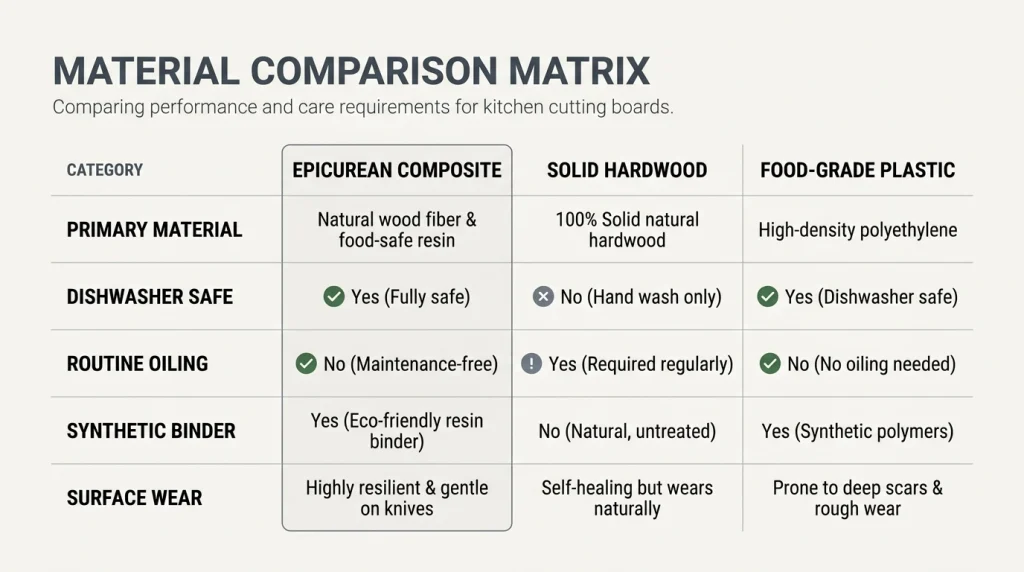
Epicurean boards occupy a useful middle ground between conventional wood and plastic. They offer a wood-like appearance with dishwasher compatibility.
However, no cutting board is automatically the safest choice in every kitchen. Cleaning habits and surface condition also influence hygiene.
| Feature | Epicurean Composite | Solid Hardwood | Plastic |
|---|---|---|---|
| Primary material | Paper fiber and cured resin | Natural wood | Usually polyethylene or polypropylene |
| Dishwasher compatibility | Yes, standard paper-composite models | Generally hand-wash recommended | Depends on product |
| Routine oiling | Not required | Often recommended | Not required |
| Synthetic binder | Yes | Not in a single-piece solid board | Made from synthetic polymer |
| Surface wear | Knife scoring | Knife grooves | Knife grooves |
| Best fit | Low-maintenance everyday preparation | Traditional cutting and natural materials | Affordable, dedicated food-preparation boards |
Which Material Would I Choose?
For daily vegetable preparation, I like the practical advantages of a lightweight, dishwasher-safe surface. Epicurean fits that requirement well.
For someone who wants to avoid resin-based materials entirely, I’d favor a single-piece hardwood board. That preference concerns material composition, not proof that wood is universally safer.
For raw poultry, a separate dishwasher-safe cutting board can simplify cleanup. The USDA recommends keeping raw animal products separate from ready-to-eat foods.
Are Epicurean Cutting Boards Antibacterial?
Epicurean advertises antimicrobial properties for its paper-composite material. However, antimicrobial claims shouldn’t replace normal washing and sanitizing.
A surface that resists moisture may be easier to clean than some alternatives. That doesn’t mean harmful microorganisms disappear automatically.
How Does Cross-Contamination Happen?
Cross-contamination occurs when harmful microorganisms transfer between food, equipment, or surfaces. Raw chicken juices contacting vegetables are a common example.
A certified cutting board can still become contaminated during preparation. Proper separation and cleaning remain essential.
- Use a dedicated board for raw meat, poultry, and seafood.
- Keep another board for fruits, vegetables, and bread.
- Wash knives after contact with raw animal products.
- Clean the cutting surface before switching food categories.
- Dry boards fully before storage.
The FoodSafety.gov four-step food-safety guide explains why cleaning and separation are central to preventing foodborne illness.
How Should You Clean an Epicurean Cutting Board?
Wash Epicurean paper-composite boards with hot, soapy water or use a dishwasher according to the manufacturer’s instructions. Regular cleaning removes food residue and helps maintain a hygienic surface.
Unlike many wooden boards, Epicurean boards don’t require routine mineral-oil treatments. That makes them convenient for busy kitchens.
Step-by-Step Cleaning Instructions
- Remove food scraps: Scrape away visible residue using a suitable kitchen utensil.
- Wash the surface: Use dish soap and warm or hot water with a soft sponge.
- Clean both sides: Pay attention to juice grooves, corners, and hanging holes.
- Rinse thoroughly: Remove detergent and loosened food particles.
- Sanitize when needed: Follow a suitable food-contact sanitizer’s label or official food-safety guidance.
- Dry completely: Allow water to drain before storing the board.
For additional food-safety information, see the USDA guidance on cutting board materials and sanitation.
Can Epicurean Boards Go in the Dishwasher?
Yes. Dishwasher compatibility is one of the main advantages of Epicurean’s paper-composite cutting boards.
Dishwashing can simplify cleaning after cutting meat or other messy ingredients. Check the instructions for your particular model before using high-temperature cycles.
Avoid assuming that every accessory sold under the same brand tolerates identical conditions. Different components may have different care requirements.
Should You Use Bleach or Strong Cleaners?
Routine washing usually requires only dish soap and water. When sanitizing is necessary, use an appropriate food-contact sanitizer at the recommended dilution.
The USDA describes a solution of one tablespoon of unscented liquid chlorine bleach per gallon of water for cutting-board sanitation. Follow current instructions carefully and never mix bleach with other cleaners.
For ordinary cleaning, avoid abrasive pads that unnecessarily wear the surface. A soft sponge works well for most food residue.
Why Does a New Epicurean Cutting Board Smell?
A newly manufactured Epicurean board may have a noticeable odor. The manufacturer’s care guidance describes an initial smell that generally diminishes after several washings.
However, smell alone can’t establish whether chemical exposure is safe or unsafe. It also doesn’t identify a specific substance.
What Should You Do About the Odor?
- Wash the board before its first use.
- Rinse it thoroughly and allow it to dry.
- Repeat normal washing if the manufacturing odor remains.
- Avoid unnecessary solvents, fragrance sprays, or harsh treatments.
- Contact the manufacturer if the odor remains unusually strong or worsens.
If a board produces a strong burning or chemical smell after exposure to heat, stop using it. Inspect the surface and contact Epicurean before further food preparation.
Are Epicurean Cutting Boards Heat Resistant?
Epicurean’s paper-composite material is heat resistant, with some products advertised for temperatures up to 350°F (about 177°C). However, heat resistance doesn’t make a cutting board a substitute for cookware.
The exact temperature limitation should be confirmed for the specific product. Extended or unusual exposure may differ from normal kitchen use.
Can You Put Hot Pans on an Epicurean Board?
Some Epicurean products can tolerate brief contact with hot cookware within their stated limits. Nevertheless, I prefer using a dedicated trivet for very hot pans.
Direct contact with flames, heating elements, or surfaces above the rated temperature is inappropriate. Protecting the board also helps preserve its appearance.
Don’t use a cutting board inside an oven unless the product instructions expressly authorize that use. Heat-resistant doesn’t automatically mean oven-safe.
How Long Do Epicurean Cutting Boards Last?
Epicurean boards are designed for extended use, but there’s no universal replacement schedule. Their lifespan depends on cutting frequency, cleaning, storage, and damage.
The company offers warranty coverage on certain products, but that shouldn’t be confused with a guarantee against ordinary wear.
Signs You Should Replace Your Cutting Board
 Save
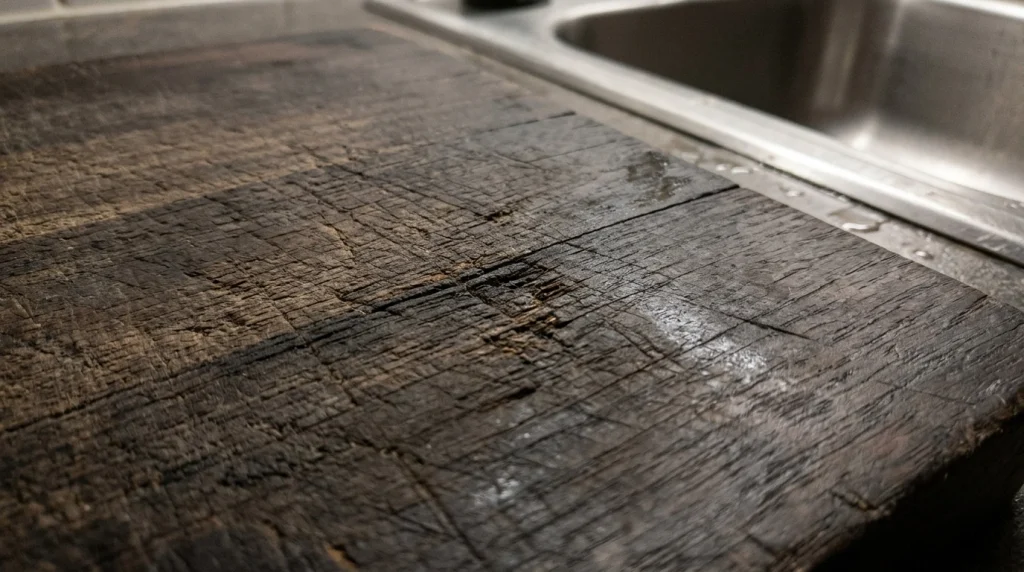
- Deep knife grooves: Scratches have become difficult to clean thoroughly.
- Visible cracks: The board has developed structural damage.
- Surface separation: Material layers appear to be lifting or separating.
- Loose particles: The surface sheds visible fragments during ordinary preparation.
- Persistent contamination: Food residue or odors remain despite appropriate cleaning.
According to the University of Minnesota Extension’s food-preparation guidance, worn boards with deep grooves should be replaced. That advice applies across cutting-board materials.
Can You Sand an Epicurean Cutting Board?
I wouldn’t sand or resurface an Epicurean board without explicit manufacturer instructions. Removing material may change the finished surface and create composite dust.
This differs from refinishing certain solid-wood boards. Severe composite damage is generally a stronger reason to consider replacement.
Are Epicurean Cutting Boards Environmentally Friendly?
Epicurean emphasizes responsible paper sourcing and durable construction. Its manufacturer information identifies FSC certification and domestic manufacturing as sustainability-related features.
However, environmentally friendly isn’t an absolute scientific category. A complete environmental comparison would require lifecycle information about materials, manufacturing, transportation, and disposal.
Paper Sourcing and Manufacturing
Epicurean uses paper-derived fibers in its composite material. The company also reports efforts to reuse manufacturing waste and reduce energy consumption.
Those practices are positive considerations, but they don’t mean the finished board is biodegradable. Resin-bonded composites shouldn’t be treated like ordinary paper.
Can You Recycle an Epicurean Board?
Don’t put a worn Epicurean board into paper recycling simply because it contains paper fibers. The cured composite is a different material.
Local recycling programs may not accept mixed paper-resin products. Ask your waste provider or the manufacturer about suitable disposal options.
What Should You Look for Before Buying an Epicurean Board?
Start with the exact model and its documented features. Authenticity, food-contact certification, dimensions, and cleaning instructions are more useful than vague safety labels.
For a practical purchase, I would check these details:
- Model identity: Confirm the product name and manufacturer.
- NSF status: Look for applicable food-contact certification.
- Dimensions: Choose enough working space for your ingredients.
- Surface stability: Consider non-slip feet or a secure work surface.
- Cleaning requirements: Confirm dishwasher compatibility.
- Condition: Reject damaged, cracked, or visibly defective products.
Which Epicurean Board Is Best for Everyday Cooking?
The Kitchen Series is a sensible starting point for general food preparation. Its thin profile and multiple sizes make it useful in kitchens with limited storage.
The All-in-One Series adds practical stability features, while the Gourmet Series offers a thicker surface. I would choose based on cooking tasks rather than assuming the most expensive version is safest.
Recommended Epicurean Cutting Boards
If you’re ready to choose one, these three established Epicurean series cover different kitchen needs. Their published features provide a useful starting point for comparison.
The star scores below reflect manufacturer-site customer-review averages observed during research, not my personal testing. Scores and review counts can change.
🏆 Best for Everyday Prep
Epicurean Kitchen Series Cutting Board
★★★★★ 4.9/5
This thin, lightweight composite board is dishwasher safe and available in several sizes. I’d choose it for everyday chopping when easy storage and minimal upkeep are priorities.
🍳 Best for Countertop Stability
Epicurean All-in-One Series Cutting Board
★★★★★ 4.9/5
The All-in-One features silicone feet and a juice groove, with both sides usable for preparation. I prefer this design when cutting juicy ingredients or working on a smooth countertop.
🔪 Best Thicker Board
Epicurean Gourmet Series Cutting Board
★★★★★ 4.9/5
The Gourmet Series has a 3/8-inch profile and a juice groove on one side. I’d consider it for cooks who prefer a more substantial cutting surface and larger preparation areas.
Affiliate disclosure: As an Amazon Associate, this website may earn from qualifying purchases. Product ratings come from published customer reviews and don’t represent independent laboratory testing.
Frequently Asked Questions
Are Epicurean cutting boards completely chemical-free?
No. Epicurean paper-composite cutting boards contain cured synthetic resin as well as paper-derived fibers. They’re designed for food contact, and applicable products carry NSF certification. Being suitable for food preparation doesn’t mean a product contains no synthetic chemicals or has zero potential for chemical migration.
Are Epicurean cutting boards safer than plastic?
Epicurean boards offer a different material composition and may appeal to people concerned about conventional plastic surfaces. However, there’s insufficient basis to say they’re universally safer than every food-grade plastic board. Both materials require proper cleaning, careful separation of foods, and replacement when excessively worn.
Can you cut raw chicken on an Epicurean cutting board?
Yes, an appropriate Epicurean cutting board can be used for raw chicken. Use a separate board for ready-to-eat foods, and thoroughly clean and sanitize the surface after poultry preparation. Follow the manufacturer’s dishwasher instructions and avoid using boards with deep, hard-to-clean grooves.
Do Epicurean cutting boards contain formaldehyde?
Phenolic resin manufacturing can involve formaldehyde chemistry, but that doesn’t establish harmful exposure from a finished product. Richlite states that its resin cures into a stable structure and doesn’t off-gas formaldehyde. For model-specific reassurance, request current emissions and material-testing documentation from the manufacturer.
When should you replace an Epicurean cutting board?
Replace your board when deep grooves, cracks, separation, or surface damage make proper cleaning difficult. Minor knife scoring alone doesn’t necessarily require replacement. The USDA recommends discarding cutting boards of any material when they become excessively worn or develop grooves that cannot be cleaned effectively.
Final Verdict: Are Epicurean Cutting Boards Worth Using?
Yes. Epicurean cutting boards are a reasonable food-safe choice for everyday cooking when used according to their instructions. Their food-contact certification, durable construction, and dishwasher compatibility are meaningful advantages.
Still, I wouldn’t describe them as entirely natural or chemical-free. They’re engineered composite boards containing cured resin, and that distinction deserves clear disclosure.
My recommendation is to prioritize verified food-contact suitability, proper cleaning, and the condition of the cutting surface. Those factors matter more than broad non-toxic marketing promises.
If you want a low-maintenance board with a wood-like appearance, Epicurean is worth considering. If avoiding synthetic binders is your main goal, choose an appropriate solid-hardwood alternative instead.
Choose a board that fits your cooking habits, maintain it carefully, and replace it when excessive wear makes cleaning difficult.

