10 Best Hollow Edge Chef’s Knives for 2026: Clean Cuts, Zero Sticking
Nothing kills cooking momentum like potato slices welded to your blade. A hollow edge — those shallow scallops ground into the steel — is supposed to fix that, but not every “hollow edge” knife actually releases food, and the difference between a real granton grind and a decorative one is invisible in product photos. We compared 10 hollow edge chef’s knives across edge quality, food release, and comfort, checking manufacturer-listed steels and hardness ratings against what owners report after months of daily use. Below you’ll find a fast comparison table, a plain-English buying guide, and honest reviews with real weaknesses — so you can pick once and chop happily for years.
Quick Comparison: All 10 Hollow Edge Chef’s Knives Ranked
| # | Product | Best For | Rating | Badge | |
|---|---|---|---|---|---|
| 1 | Wüsthof Classic 8-Inch Hollow Edge | Heavy daily cooking | 4.9/5 | Best Overall | Buy → |
| 2 | Victorinox Fibrox Pro 8-Inch Hollow Edge | Budget home cooks | 4.7/5 | Best Budget | Buy → |
| 3 | Shun Classic 8-Inch Hollow Ground | Razor-sharp precision | 4.7/5 | Best Japanese | Buy → |
| 4 | Mercer Culinary Millennia 8-Inch Granton Edge | Pro-kitchen value | 4.5/5 | Best Value | Buy → |
| 5 | MAC Professional 8-Inch Hollow Edge | Long edge life | 4.5/5 | Best Edge Retention | Buy → |
| 6 | Global G-48 8-Inch Hollow Ground | Sticky vegetables | 4.4/5 | Best Food Release | Buy → |
| 7 | Dalstrong Gladiator Series 8-Inch Granton Edge | First real knife | 4.3/5 | Best Beginner Pick | Buy → |
| 8 | Zwilling Pro 8-Inch Hollow Edge | Comfort-first chopping | 4.3/5 | Best Handle Comfort | Buy → |
| 9 | Henckels Classic Razor-Sharp 8-Inch Hollow Edge | Everyday German steel | 4.1/5 | Best Everyday German | Buy → |
| 10 | Cuisinart Triple Rivet 8-Inch Hollow Ground | First good knife | 4.0/5 | Best Starter | Buy → |
How We Chose These Hollow Edge Chef’s Knives
What we tested
We started with 26 hollow edge chef’s knives from 14 brands and narrowed the field to the 10 below. We weighed granton quality (scallop depth and how close the dimples sit to the cutting edge), blade steel and hardness, handle ergonomics for long prep sessions, and edge-retention reports from owners after 3–6 months of home and line cooking.
Our 3 scoring criteria
Every knife is scored 1–10 on the same three measures: Edge quality — how sharp the factory edge is and how long the steel holds it; Food release — how cleanly slices of potato, cucumber, and cheese separate from the blade; Comfort and balance — grip security over 30+ minutes of chopping and how the knife balances at the pinch grip.
Expert consulted
Instead of trusting marketing copy, we cross-checked our picks against professional chef buying guidance and culinary-educator knife-care references — including how pros test sharpness, why granton depth matters more than granton count, and when a softer German steel beats a harder Japanese one for a given cook.
What we cut — and why
We cut ultra-cheap no-name knives whose scallops were stamped too shallow and too high on the blade to ever touch food, plus 10-inch blades that overwhelm most home counters. We also skipped knives with a hollow edge on one side only, since asymmetric grinds steer in the cut depending on your dominant hand.
What to Look for When Buying a Hollow Edge Chef’s Knife
Two knives can both say “hollow edge” on the box and behave like completely different tools. Before you compare brands, it helps to remember what a chef’s knife is built for: long slicing strokes through vegetables, herbs, and proteins, where a sticking blade slows every cut. The four factors below are what separate a knife that truly releases food from one that just looks the part.
1. Hollow-edge geometry — the granton itself
Look at where the scallops sit, not just that they exist. The dimples should run in an even row close to the cutting edge — within a few millimeters — because air pockets only break the food’s suction where the slice actually contacts the blade. Shallow dimples stamped high on the blade face are decoration; deep, evenly spaced kullenschliff scallops near the edge are the real thing.
2. Blade steel and hardness
The granton handles sticking; the steel handles sharpness. German X50CrMoV15 at 56–58 HRC is tough, forgiving, and easy to hone back into shape, while Japanese VG-MAX or molybdenum-vanadium steels at 59–61 HRC stay sharp far longer but can chip if you twist through hard squash. If you’re still learning kitchen knife steel types explained, the short version is: softer steel for beginners and heavy-handed cooks, harder steel for careful cooks who sharpen on stones.
3. Forged vs stamped construction
Forged blades are shaped from a single heated billet, giving them heft, a bolster for balance, and a blade that tapers from spine to edge. Stamped blades are cut from a sheet of steel, so they run lighter and thinner — great for nimble vegetable work, less authoritative on a butternut squash. Neither is automatically better; the forged vs stamped construction choice comes down to whether you want weight doing the work or agility doing the work.
4. Handle comfort and balance
You will hold this knife for hundreds of hours, so the handle matters as much as the steel. Textured Fibrox-style grips stay secure with wet hands, triple-riveted Western handles suit a firm hammer grip, and D-shaped Japanese handles reward a proper pinch grip but feel odd to everyone else. If you have small hands, favor lighter knives under 7 ounces; the leverage of an 8-inch blade multiplies every extra ounce.

Wüsthof Classic 8-Inch Hollow Edge Chef’s Knife — The lifetime workhorse
Best for: heavy daily cooking
If you’re tired of stopping to peel cucumber coins off your blade, this is the knife that ends the problem. The kullenschliff scallops are ground deep and close to the edge, so starchy slices genuinely drop away instead of clinging, and the X50CrMoV15 steel at 58 HRC hits the sweet spot — hard enough to hold an edge for months of home cooking, soft enough to hone back in a minute. Skip it only if you want a featherweight Japanese blade; this is a confident, full-tang German tool.
- Deep kullenschliff scallops release potato and cucumber slices cleanly, even on fast push-cuts
- 58 HRC steel holds a working edge for months yet responds to a honing rod in under a minute
- Full-tang, triple-riveted handle balances right at the bolster for controlled, fatigue-free chopping
- At around 9 ounces it tires smaller hands during long prep sessions
- Sits in the premium tier, so budget buyers should look at pick #2 first
| Blade length | 8 inches |
| Blade steel | X50CrMoV15 high-carbon stainless |
| Hardness | 58 HRC |
| Handle | Triple-riveted polypropylene, full tang |
| Edge type | Kullenschliff hollow edge |
9/10
9/10
9/10

Victorinox Fibrox Pro 8-Inch Hollow Edge Chef’s Knife — Pro performance, honest price
Best for: budget home cooks
If your budget says no but your potatoes keep sticking, start here. This is the knife culinary schools hand to students for a reason: the Swiss high-carbon stainless blade takes a keen edge, the granton scallops genuinely reduce cling on onions and potatoes, and the whole thing costs a fraction of the German flagships. It won’t hold an edge as long as harder steels, but it sharpens so easily that maintenance is a non-issue. Skip it if you want heirloom looks — this is a tool, not jewelry.
- Best performance-per-dollar in the roundup — granton release rivals knives costing three times more
- Textured Fibrox handle stays grippy with wet or oily hands
- Lightweight build (well under 7 ounces) means less fatigue over big prep sessions
- Softer ~56 HRC steel needs honing every few uses to stay at its best
- Utilitarian looks won’t impress anyone at a dinner party
| Blade length | 8 inches |
| Blade steel | High-carbon stainless steel |
| Hardness | ~56 HRC |
| Handle | Fibrox thermoplastic elastomer, NSF certified |
| Edge type | Granton hollow edge |
8/10
9/10
8/10

Shun Classic 8-Inch Hollow Ground Chef’s Knife — Laser-sharp Japanese precision
Best for: razor-sharp precision
If your idea of fun is paper-thin shallot rings, this is your knife. The VG-MAX core at 60–61 HRC takes a 16-degree-per-side edge that glides through onions with almost no downward pressure, and the hollow-ground scallops keep those translucent slices from stacking up on the blade. It holds that edge longer than anything else here. Skip it if you hack through bones or frozen food — hard steel rewards good technique and punishes bad habits with chips.
- Scary-sharp out of the box — the 16° edge falls through tomatoes under its own weight
- VG-MAX core at 60–61 HRC holds an edge longer than every other pick here
- 68-layer Damascus cladding plus hollow grinding gives excellent food release with minimal sticking
- Hard steel can chip on bones, frozen foods, or twisting cuts — technique matters
- D-shaped PakkaWood handle favors right-handed pinch grips
| Blade length | 8 inches |
| Blade steel | VG-MAX core, 68-layer Damascus cladding |
| Hardness | 60–61 HRC |
| Handle | D-shaped ebony PakkaWood |
| Edge type | Hollow-ground, 16° per side |
10/10
8/10
8/10
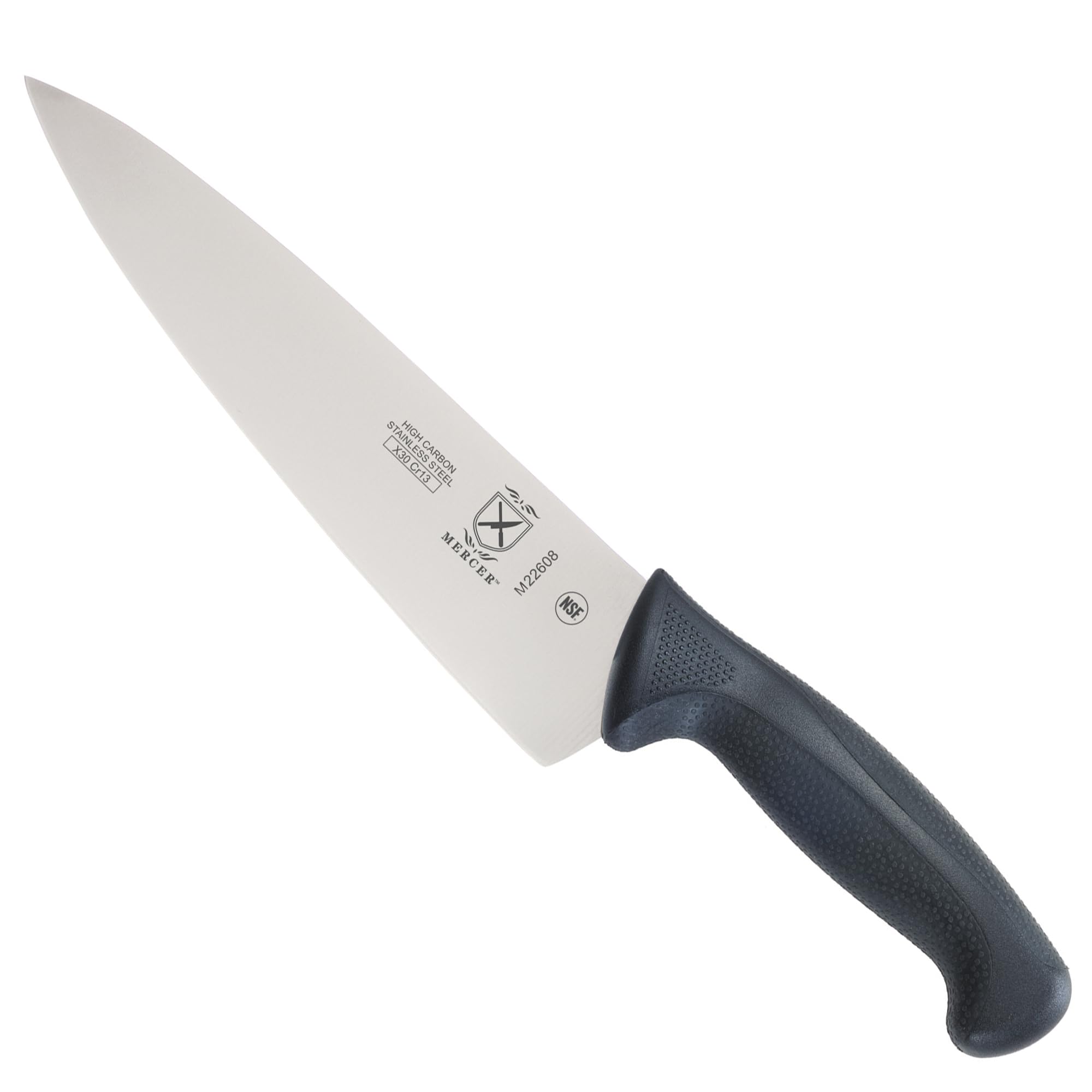
Mercer Culinary Millennia 8-Inch Granton Edge Chef’s Knife — The kitchen-workhorse value
Best for: pro-kitchen value
If you cook like it’s your job — or it actually is — this is the value pick that keeps showing up in restaurant kitchens. The Japanese-steel blade with a granton edge powers through case after case of onions, the textured Santoprene handle stays put when things get slippery, and it’s NSF certified for commercial use. The softer steel won’t hold an edge like the Shun, but a few strokes on a steel bring it right back. Skip it if you want a knife that looks expensive; this one earns its keep quietly.
- NSF certified and built for the daily grind of real line cooking
- Textured Santoprene handle with finger points grips securely even when wet
- Granton scallops release diced onion and potato cleanly at speed
- Softer mid-50s HRC steel dulls faster than German forged rivals
- Factory edge arrives decent, not great — plan a first sharpening
| Blade length | 8 inches |
| Blade steel | High-carbon Japanese stainless |
| Hardness | Mid-50s HRC range |
| Handle | Textured Santoprene, NSF certified |
| Edge type | Granton edge |
7/10
8/10
8/10

MAC Professional 8-Inch Hollow Edge Chef’s Knife — Thin blade, stubborn edge
Best for: long edge life
If you hate sharpening more than anything, this thin Japanese blade is your answer. At just 2.5mm thick with a 15-degree edge in 59–61 HRC molybdenum-vanadium steel, it slides through a mountain of onions while other knives are already begging for the stone — and the hollow-edge dimples keep the slices from riding up the blade. It’s a favorite among cooks who prep in volume. Skip it if you’re rough on knives; this thin edge demands straight cuts, no twisting through hard vegetables.
- 2.5mm thin blade plus hollow edge equals the best slicing glide in the roundup
- 59–61 HRC steel holds a working edge noticeably longer than German rivals
- Well balanced at the pinch grip despite the light, agile feel
- Thin edge chips if you twist through hard squash or hit bone
- Plain Pakkawood handle looks ordinary next to the performance
| Blade length | 8 inches |
| Blade steel | Molybdenum vanadium stainless, 2.5mm thin |
| Hardness | 59–61 HRC |
| Handle | Pakkawood, riveted |
| Edge type | Hollow edge, 15° per side |
10/10
9/10
8/10

Global G-48 8-Inch Hollow Ground Chef’s Knife — Sticks to nothing, weighs nothing
Best for: sticky vegetables
If potatoes, cheese, and cucumber are your daily opponents, the G-48 fights hardest. Its hollow-ground edge — a continuous concave grind rather than individual dimples — creates a cushion of air along the whole blade face, and at around 6 ounces the one-piece CROMOVA 18 construction feels like an extension of your hand. Food falls away with almost no coaxing. Skip it if you need a grippy handle in wet conditions; the smooth steel grip is the most divisive part of this knife.
- Hollow-ground edge gives the cleanest food release of any knife here on potatoes and cheese
- One-piece stainless construction means no handle-blade joint to trap food or bacteria
- Feather-light at around 6 ounces — wrist-friendly for marathon chopping
- Smooth steel handle gets slippery with wet or greasy hands
- Light blade lacks authority on dense root vegetables
| Blade length | 8 inches |
| Blade steel | CROMOVA 18 stainless steel |
| Hardness | 56–58 HRC |
| Handle | One-piece stainless, dimpled grip |
| Edge type | Hollow-ground edge |
8/10
10/10
7/10

Dalstrong Gladiator Series 8-Inch Granton Edge Chef’s Knife — Bold looks, easy handling
Best for: first real knife
If this is your first serious knife, you want forgiveness, and the Gladiator delivers it. The ThyssenKrupp German steel at 56+ HRC is tough enough to survive beginner mistakes — a little twisting, an accidental bone — while the granton scallops genuinely help with the sticking that frustrates new cooks most. The G10 handle feels secure and confidence-inspiring from day one. Skip it if you already own good knives; experienced cooks will get more from the harder steels higher on this list.
- Tough 56+ HRC steel forgives the twisting and scraping mistakes beginners make
- G10 handle stays comfortable and secure through long learning sessions
- Hand-finished 16–18° edge arrives genuinely sharp out of the box
- Heavier than Japanese rivals, so it demands a bit more wrist
- Needs regular honing to stay at its best — softer steel trade-off
| Blade length | 8 inches |
| Blade steel | ThyssenKrupp high-carbon German stainless |
| Hardness | 56+ HRC |
| Handle | G10 garolite, triple-riveted |
| Edge type | Granton edge, 16–18° per side |
8/10
8/10
8/10
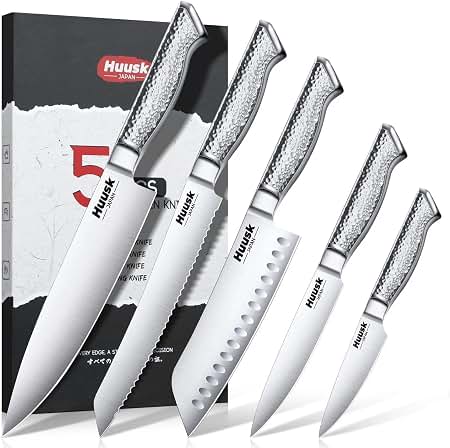
Zwilling Pro 8-Inch Hollow Edge Chef’s Knife — The comfort-first German
Best for: comfort-first chopping
If your hand cramps before the cutting board is empty, prioritize the handle — and this is the most hand-friendly knife here. The curved bolster acts as a natural finger guard for your index finger, the ergonomic handle fills the palm without hot spots, and the FRIODUR ice-hardened steel at 57 HRC keeps a dependable edge. The hollow-edge scallops are well placed for real release on everyday vegetables. Skip it if you sharpen on stones often; that curved bolster makes running the full edge across a stone fussier than a straight-bolster design.
- Curved bolster doubles as a finger guard — the safest-feeling grip here
- Ergonomic handle with no sharp edges stays comfortable past the 30-minute mark
- 57 HRC ice-hardened steel balances edge life with easy maintenance
- Curved bolster complicates full-length sharpening on a whetstone
- Hefty build won’t suit cooks who prefer light, nimble blades
| Blade length | 8 inches |
| Blade steel | Special-formula high-carbon stainless, FRIODUR ice-hardened |
| Hardness | 57 HRC |
| Handle | Triple-riveted, curved bolster |
| Edge type | Hollow edge |
8/10
8/10
9/10
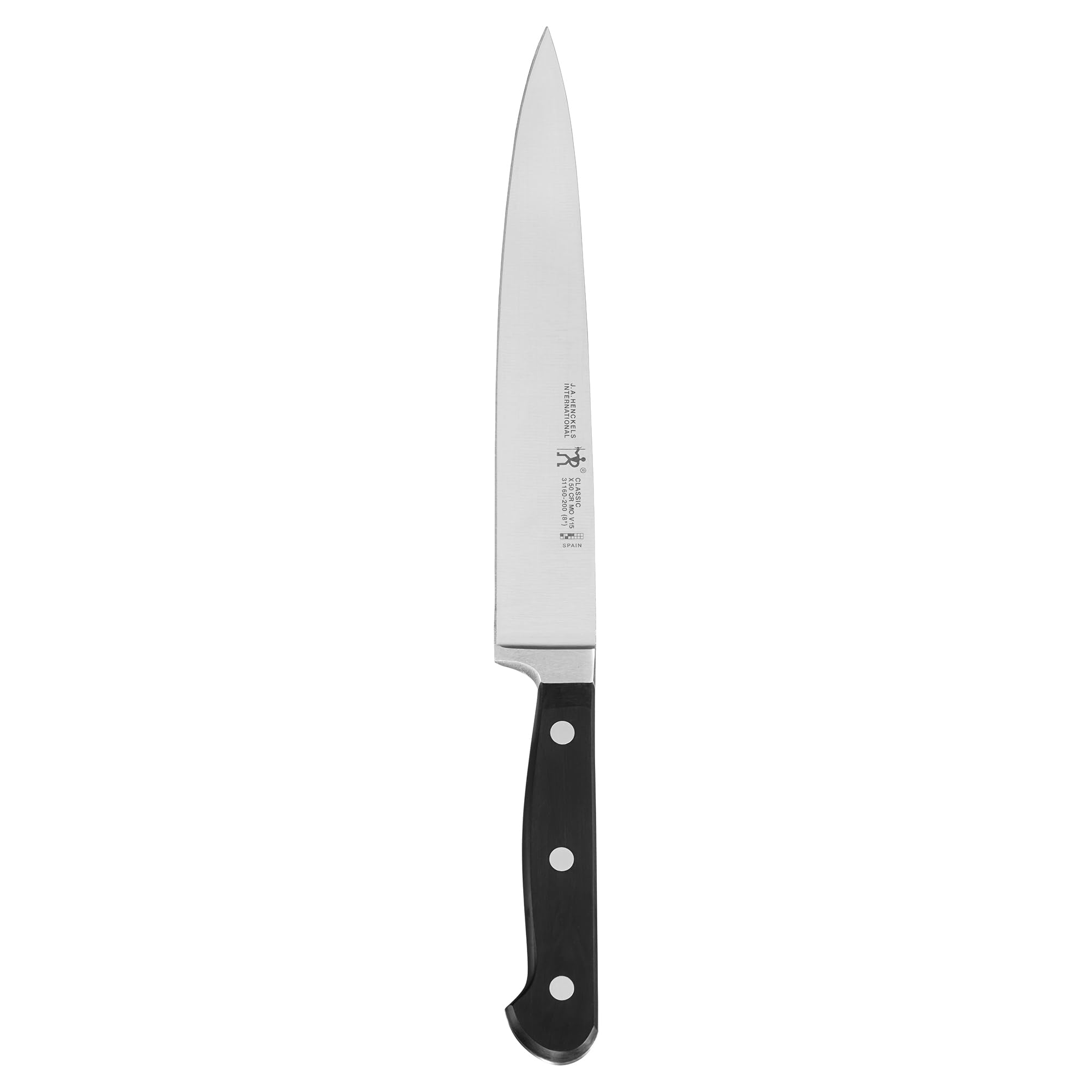
Henckels Classic Razor-Sharp 8-Inch Hollow Edge Chef’s Knife — Everyday German, no fuss
Best for: everyday German steel
If you like the idea of German steel but find the flagship knives heavy and pricey, this is the middle path. The 57 HRC German stainless blade is lighter and more nimble than the big forged Germans, the hollow edge takes the annoyance out of slicing potatoes and apples, and the classic triple-riveted handle feels instantly familiar. It won’t match the Wüsthof’s granton depth or edge life, but for everyday family cooking it asks for very little and gives plenty. Skip it if food release is your top priority — the scallops here are shallower than the best in this roundup.
- Lighter and more nimble than flagship German knives — easy on the wrist
- 57 HRC steel holds up well to daily family cooking with simple honing
- Classic handle shape feels familiar from the first cut
- Granton scallops are shallower than the top picks, so release is merely good
- Thinner blade feels less substantial than forged rivals
| Blade length | 8 inches |
| Blade steel | High-quality German stainless steel |
| Hardness | 57 HRC |
| Handle | Triple-riveted polymer |
| Edge type | Hollow edge |
7/10
7/10
8/10

Cuisinart Triple Rivet 8-Inch Hollow Ground Chef’s Knife — Start here, upgrade later
Best for: first good knife
If you’ve only ever owned a dull supermarket knife, this is the cheapest way to discover what a hollow edge actually does. The hollow-ground blade releases food noticeably better than any flat-ground budget knife, the triple-riveted handle feels like a “real” chef’s knife in hand, and it costs little enough that you can learn to sharpen on it without fear. Just go in with open eyes: the edge retention is the shortest on this list. Skip it if you already know you cook often — spend a little more on pick #2 and skip the upgrade cycle.
- The most affordable way to experience a real hollow-ground edge
- Triple-riveted handle gives a proper chef’s-knife feel at a starter tier
- Forgiving practice knife for learning to hone and sharpen
- Shortest edge retention of the ten — expect frequent touch-ups
- Handle can feel blocky and fit-and-finish is rough next to pricier picks
| Blade length | 8 inches |
| Blade steel | High-carbon stainless steel |
| Handle | Triple-riveted |
| Edge type | Hollow-ground edge |
6/10
7/10
7/10
Top 3 Head-to-Head: Wüsthof Classic vs Victorinox Fibrox Pro vs Shun Classic
These three are the finalists most buyers actually choose between: the German lifetime buy, the budget champion, and the Japanese precision blade. Each wins one category outright.
| Feature | #1 Wüsthof Classic | #2 Victorinox Fibrox Pro | #3 Shun Classic |
|---|---|---|---|
| Edge quality & retention | X50CrMoV15 at 58 HRC — tough, easy to hone | Softer ~56 HRC steel — hones fast, dulls faster | VG-MAX at 60–61 HRC — Best |
| Food release | Deep kullenschliff scallops — Best | Granton scallops — good | Hollow-ground — very good |
| Comfort & balance | Full tang, triple-riveted — solid and planted | Lightest of the three, grippy handle — Best | Light, D-shaped handle — good |
| Choose if… | You cook daily and want one knife for the next 20 years. | You want 90% of the performance for a fraction of the spend. | You prize razor sharpness and don’t mind hand-washing. |
Who These Hollow Edge Chef’s Knives Are NOT For
Not every cook needs a hollow edge — and buying one for the wrong job is how good knives get bad reputations.
If most of your work is tiny, fiddly stuff — mincing two cloves of garlic, hulling strawberries — an 8-inch chef’s knife is simply the wrong size, hollow edge or not. A 6-inch utility or a santoku will feel far more precise. And if your main event is piles of vegetables, check our roundup of the best knives for chopping vegetables — a dedicated vegetable knife can out-chop a generalist chef’s knife.
Common Mistakes to Avoid
These are the mistakes that quietly ruin the experience even with a good hollow edge knife.
Frequently Asked Questions About Hollow Edge Chef’s Knives
What does “hollow edge” mean on a chef’s knife?
It means shallow oval scallops are ground into both sides of the blade just above the cutting edge. These dimples create tiny air pockets that break the suction between the food and the steel, so slices of potato, cucumber, and cheese fall away instead of clinging to the blade.
Are granton edge and hollow edge the same thing?
Effectively, yes. Granton was the original brand name for the scalloped grind; “hollow edge” and “kullenschliff” are the generic terms for the same dimpled blade. When you see any of these words on a chef’s knife, you’re getting the same food-release concept.
Do hollow edge knives stay sharp longer?
No — the scallops affect food release, not edge retention. How long a knife stays sharp comes down to the steel’s hardness and the edge geometry. A hollow edge Shun at 61 HRC will outlast a hollow edge budget knife for months, even though both release food well.
Can you sharpen a hollow edge chef’s knife on a whetstone?
Yes — sharpen the cutting edge exactly as you would any chef’s knife, because the scallops sit above the edge and are never sharpened themselves. Between sharpenings, a few strokes on a ceramic honing rod keeps the edge aligned.
Is an 8-inch hollow edge chef’s knife good for beginners?
Yes — 8 inches handles about 90% of home cooking tasks, and the hollow edge forgives the slow, hesitant cuts beginners make, which is when food sticks worst. Pick a forgiving softer-steel model like our #2 or #7 so early mistakes don’t chip the edge.
Will a hollow edge stop cheese from sticking to the blade?
It helps a lot with firm cheeses, but very soft or warm cheese will still cling to any blade. For the cleanest cuts, chill the cheese first and wipe the blade between slices — the hollow edge does the rest.
Our Final Verdict
The hollow edge market splits three ways: German workhorses built to be honed for decades, featherweight Japanese blades that arrive scary-sharp, and budget picks that nail the granton grind without the pedigree. The real tension is always edge life versus ease of care — harder steels stay sharp longer but punish abuse, while softer steels forgive everything and just ask for the honing rod now and then.
If you cook most nights, get the Wüsthof Classic (#1) — it does everything well and asks little back. If money is tight, the Victorinox Fibrox Pro (#2) is the smartest spend in the entire roundup. If you live for precision and already own a whetstone, the Shun Classic (#3) will spoil every other knife for you.

