Can Ash Wood Be Used for a Cutting Board? Pros, Cons, and Safety
Quick Answer
Yes, ash wood can be used for a cutting board, but it isn’t the best choice for frequent food preparation. Ash is strong, durable, and reasonably knife-friendly. However, its open-grain structure can make food residue and moisture harder to remove. For everyday chopping, a close-grained hardwood such as maple is generally a better option, especially when following FDA food-handling guidance.
What You Should Know
- Hardness: White ash has a Janka hardness of approximately 1,320 lbf, making it resistant to ordinary dents.
- Grain structure: Its relatively large, open pores make cleaning more demanding than with hard maple.
- Food safety: Clean, untreated ash isn’t automatically unsafe, but surface condition and hygiene matter.
- Best application: Ash works particularly well for decorative serving boards and occasional light cutting.
- Maintenance: Hand-wash, dry promptly, and maintain a food-contact-safe finish.
Bottom Line
- My recommendation: Use ash for attractive serving boards, but choose hard maple for a primary cutting board.
Ash wood catches my attention because of its pale color, bold grain, and impressive strength. But beautiful wood doesn’t automatically make a practical cutting surface.
If you’re considering making or buying an ash cutting board, it’s worth understanding its limitations. I’ll explain how its grain, hardness, food safety, and maintenance compare with better-known cutting board materials.
What Is Ash Wood?
Ash is a hardwood from trees belonging to the Fraxinus genus. White ash and European ash are two familiar species used in furniture, flooring, tool handles, and woodworking.
Its strength and flexibility make it useful for products that experience repeated impact. Cutting boards, however, demand more than mechanical strength.
Important Characteristics of Ash Wood
- Color: Creamy white, pale beige, or light brown, depending on the species and individual board.
- Grain: Usually straight, bold, and visibly open.
- Texture: Medium to coarse compared with many traditional cutting board woods.
- Hardness: White ash measures approximately 1,320 pounds-force on the Janka scale.
- Workability: Ash generally machines, shapes, and sands well.
- Moisture behavior: Like other solid hardwoods, ash expands and contracts as its moisture content changes.
The Janka test measures how strongly wood resists indentation. It doesn’t directly measure knife wear, sanitation, or resistance to water damage.
According to The Wood Database’s white ash reference, the wood has a medium-to-coarse texture and a hardness of 1,320 lbf.
Is Ash Wood Safe for Cutting Boards?
A clean ash board made from suitable untreated timber can be used for limited food preparation. However, ash’s open pores make it less desirable than close-grained hardwoods for intensive chopping.
The distinction matters because a board can be made from a generally suitable wood yet still have a poorly maintained food-contact surface.
Why Does Open Grain Matter?
 Save
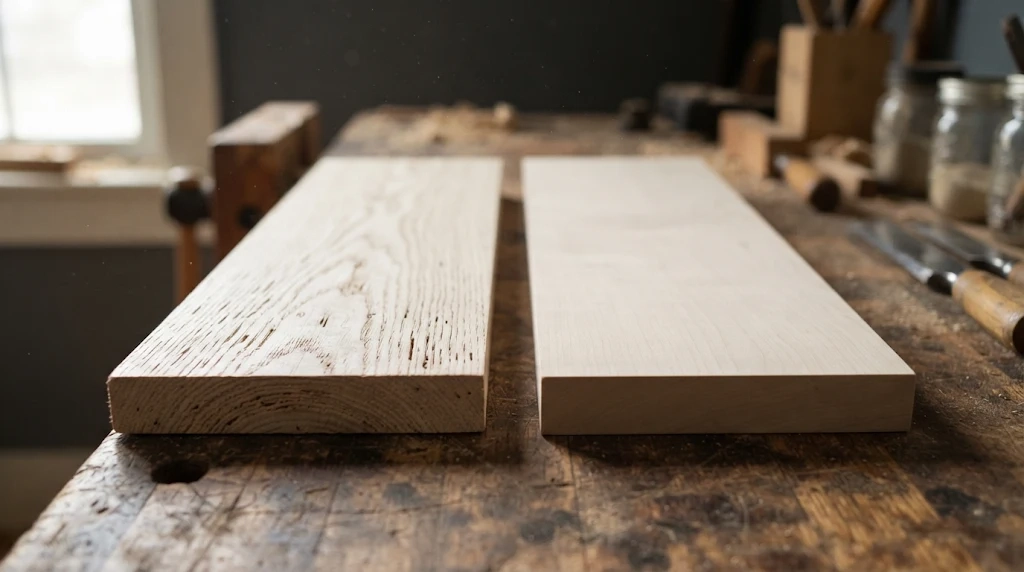
Ash is a ring-porous hardwood. This means relatively large vessels form during part of the tree’s growing season.
Those vessels create noticeable openings in the wood’s structure. On a working cutting surface, these openings can make trapped residue more difficult to remove.
Consider a smooth maple board beside a coarse-grained ash board. Both need cleaning, but the maple surface generally offers fewer large surface openings.
Does Ash Wood Naturally Harbor Bacteria?
Open grain does not mean every ash cutting board contains harmful bacteria. The real concern is whether its surface can be cleaned thoroughly after contact with food.
Bacteria can persist on poorly cleaned cutting boards of different materials. Knife grooves, moisture, food residue, and cross-contamination all deserve attention.
The FDA recognizes hard maple and equivalently hard, close-grained woods for cutting boards in its Food Code. Ash has adequate hardness, but its open-grain structure is a disadvantage.
Can You Cut Raw Meat on Ash Wood?
I wouldn’t choose ash as a dedicated raw-meat cutting board. A smooth, easily sanitized alternative is more practical for that task.
Raw meat, poultry, and seafood create opportunities for cross-contamination. Keeping their preparation surfaces separate from ready-to-eat foods helps reduce that risk.
The USDA’s cross-contamination guidance recommends separate boards for produce and raw animal products whenever possible.
What Are the Advantages of Ash Wood Cutting Boards?
Ash does have useful qualities for kitchen projects. Its main strengths are durability, appearance, and workability.
1. Good Resistance to Dents
White ash’s 1,320 lbf Janka hardness places it within a practical range for many wooden kitchen accessories. It is tougher than several softer domestic hardwoods.
This resistance is helpful when preparing sandwiches, slicing bread, or arranging foods. However, hardness alone doesn’t overcome its sanitation drawbacks.
2. Attractive Natural Grain
Ash has a pronounced grain pattern that creates visual interest. Its pale color also complements modern, Scandinavian, and farmhouse-style kitchens.
A serving board made from carefully selected ash can look striking without colored stains. Food-contact-safe oil may deepen its natural tones.
3. Comfortable Woodworking Properties
Ash is relatively straightforward to cut, shape, and sand with suitable tools. That makes it appealing for woodworkers developing custom serving boards.
Its visible grain also provides a useful reference when planning cuts. Always control sanding dust with appropriate extraction and respiratory protection.
4. Suitable for Light Kitchen Tasks
Occasional bread slicing and presentation are reasonable uses for a properly made ash board. These tasks generally involve less moisture and contamination than preparing raw poultry.
A decorative ash board can also work as a serving platter. Just make sure its finish and any adhesives are suitable for the intended food contact.
What Are the Disadvantages of Ash Cutting Boards?
The biggest drawback is ash’s grain structure, not its strength. Moisture management and surface cleanliness require more attention.
- Open pores: Food particles and liquids can become harder to remove from textured areas.
- Extra cleaning: A heavily used surface may demand more careful inspection.
- Moisture sensitivity: Repeated wetting and drying can contribute to warping or cracking.
- Surface wear: Deep knife cuts can create additional difficult-to-clean areas.
- Limited suitability: Ash is not my first choice for heavy daily chopping or commercial food preparation.
A finish can help reduce moisture absorption, but ordinary oil does not seal every pore permanently. Regular maintenance remains necessary.
Ash vs. Maple vs. Walnut vs. Cherry: Which Is Better?
 Save
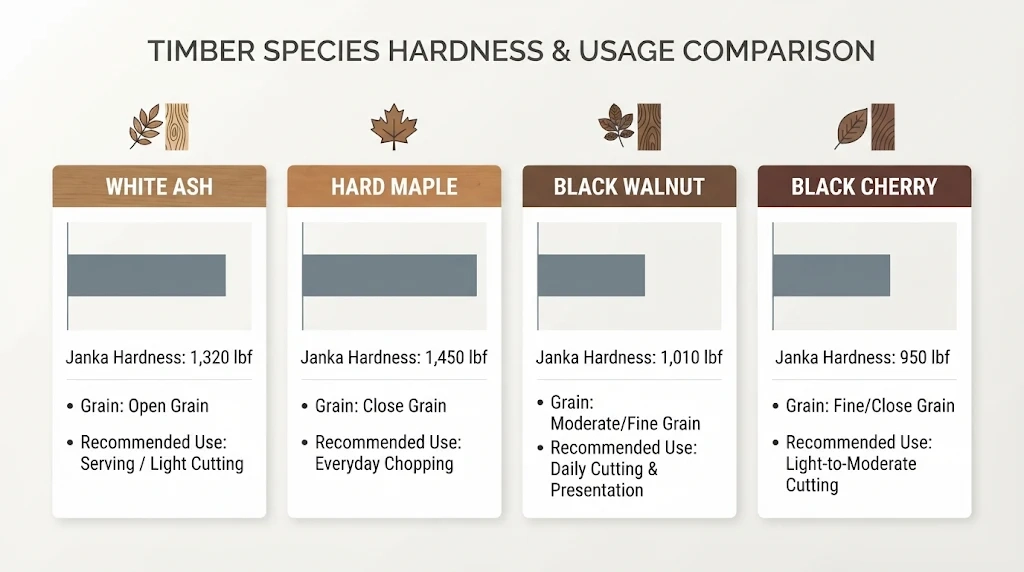
Hard maple is generally the stronger everyday choice because it combines suitable hardness with a tighter grain. Walnut and cherry also offer useful alternatives, depending on your priorities.
The following comparison uses approximate Janka hardness values for representative North American species. Actual wood characteristics vary by species, board construction, and individual timber.
| Wood | Janka Hardness | Grain | My Preferred Use |
|---|---|---|---|
| White ash | 1,320 lbf | Open | Serving, light cutting |
| Hard maple | 1,450 lbf | Close | Everyday chopping |
| Black walnut | 1,010 lbf | Moderately open to fine | Daily cutting and presentation |
| Black cherry | 950 lbf | Fine, close | Light-to-moderate cutting |
Important: Hardness does not equal food safety. Surface smoothness, finish, construction, cleaning, and drying are equally important.
Ash vs. Maple Cutting Boards
Maple wins for everyday kitchen preparation. Its relatively fine, close grain makes it an established material for butcher blocks and cutting boards.
Ash remains an appealing decorative option, particularly when its bold grain is part of the design. I would use maple for repeated knife work and ash for occasional serving.
Ash vs. Walnut Cutting Boards
Black walnut is softer than white ash, but its grain characteristics make it popular for premium cutting boards. Walnut’s dark color also offers a different appearance.
Both woods require suitable care. Walnut can show knife marks, while ash demands more attention to its open grain.
Ash vs. Cherry Cutting Boards
Black cherry is softer than ash and may develop visible cutting marks sooner. However, its fine texture makes it attractive for food preparation.
Cherry also develops a richer color as it ages. For moderate chopping, I generally prefer cherry over ash.
Can You Make a Cutting Board From Ash Wood?
Yes, you can make one, provided you understand its limitations. I would design an ash board primarily for serving and occasional dry-food preparation.
For heavy chopping, maple remains the more practical woodworking project. If you already own suitable ash lumber, a serving board can put it to good use.
Materials and Tools
- Clean, properly dried, untreated ash hardwood
- Table saw or another appropriate cutting tool
- Planer or suitable flattening tools
- Clamps and a food-contact-suitable waterproof wood glue, if joining pieces
- Sandpaper in progressively finer grits
- Food-grade mineral oil or a suitable board finish
- Measuring tools, eye protection, and dust control equipment
Step-by-Step: Making an Ash Serving Board
- Inspect the wood: Reject timber with decay, questionable chemical treatments, loose knots, or serious cracks.
- Plan the dimensions: Choose a size that fits your workspace and intended serving use.
- Cut the blank: Trim the wood accurately while following safe woodworking procedures.
- Flatten the surfaces: Remove uneven areas so the board rests securely.
- Shape the edges: Round sharp corners and eliminate splinter-prone surfaces.
- Sand progressively: Work through appropriate grits until the surface feels smooth.
- Inspect the grain: Check for rough fibers, cracks, and open areas that could trap debris.
- Apply a suitable finish: Follow the manufacturer’s food-contact and curing instructions.
- Check before use: Confirm the board is smooth, clean, completely finished, and dry.
For a simple home project, a single-piece board avoids glue joints. However, properly constructed glued boards can also be suitable when their materials meet the intended requirements.
Never assume that a finish turns damaged, contaminated, or chemically treated lumber into a safe food surface.
What Is the Best Finish for an Ash Wood Cutting Board?
Food-grade mineral oil is a common choice for wooden cutting boards. It helps condition the surface, although it doesn’t create a completely waterproof barrier.
Other products, including board waxes, may provide additional surface protection. Select products specifically intended for food-contact wooden boards.
Common Finish Options
- Food-grade mineral oil: Easy to apply and renew.
- Board conditioner: Often combines mineral oil with wax for additional water resistance.
- Food-contact-rated curing finish: Potentially suitable when used exactly as the manufacturer directs.
- Unknown furniture finish: Avoid unless its suitability for cutting surfaces is clearly established.
Do not use ordinary furniture polish, unidentified stains, or industrial wood treatments on a food-preparation board. The finish should match the board’s actual use.
How Do You Clean and Maintain an Ash Cutting Board?
 Save
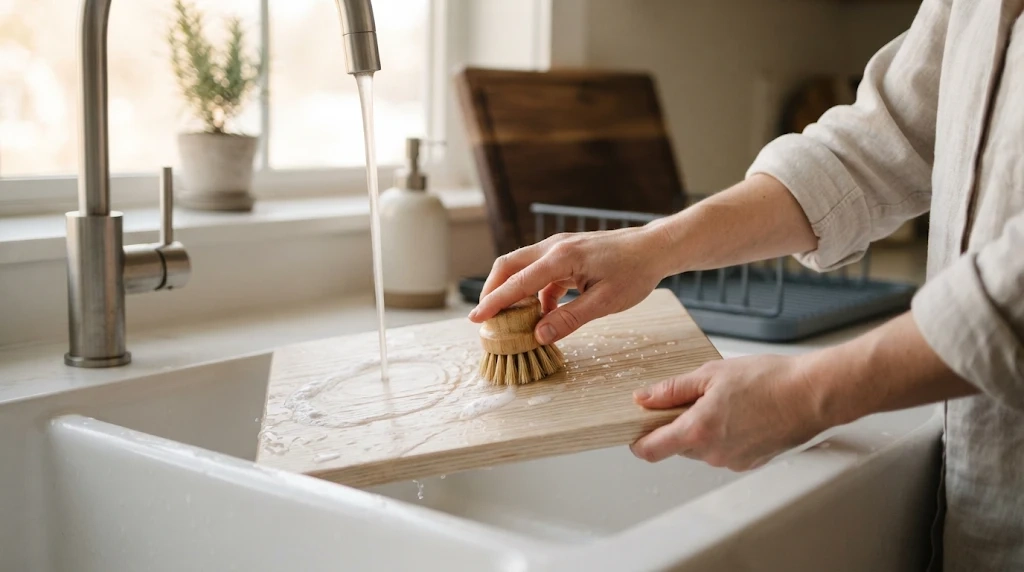
Hand-washing and prompt drying are the simplest ways to maintain ash. Avoid soaking the board or leaving it wet against a countertop.
After Every Use
- Remove food scraps from the surface.
- Wash with warm water and dish soap.
- Use a soft brush where residue is difficult to remove.
- Rinse thoroughly with clean water.
- Dry with a clean towel.
- Stand the board upright where air can circulate around both sides.
The USDA’s cutting board guidance recommends thorough cleaning and replacing boards with excessively worn, difficult-to-clean surfaces.
Can You Sanitize an Ash Cutting Board?
Yes, a suitable wooden board can be sanitized when necessary. USDA guidance describes a solution of one tablespoon of unscented liquid chlorine bleach per gallon of water.
Follow the recommended contact time, rinse appropriately, and dry the board thoroughly. Never mix bleach with vinegar, ammonia, or other cleaners.
How Often Should You Oil Ash Wood?
Condition the board when the surface looks dry or begins absorbing water unusually quickly. There is no universal oiling schedule that suits every board.
Frequent washing, kitchen humidity, and the selected finish affect maintenance needs. Always follow the care instructions for your particular finish.
Can Ash Cutting Boards Go in the Dishwasher?
I recommend keeping solid ash boards out of the dishwasher. Extended exposure to hot water and repeated drying cycles can encourage movement, cracking, and finish deterioration.
Some solid wood products may tolerate certain dishwasher procedures, but that doesn’t make dishwashing a good routine for a handcrafted ash board. Hand-washing offers more control.
When Should You Replace an Ash Cutting Board?
Replace an ash board when it can no longer be cleaned and maintained effectively. Deep grooves, structural cracks, and persistent residue are reasons to stop using it for food preparation.
Signs That a Board Needs Attention
- Deep knife grooves that are difficult to clean
- Splinters or loose wooden fibers
- Cracks extending into the working surface
- Separation between glued pieces
- Persistent unpleasant odors after cleaning
- Visible mold or unexplained discoloration
- Severe warping that makes cutting unstable
Minor surface wear may be repairable on an otherwise sound board. Structural damage or suspected contamination requires a more cautious approach.
When you cannot restore a smooth, cleanable food-contact surface, replacing the board is the safer decision.
What Are the Best Alternatives to an Ash Cutting Board?
If you’re buying your first main cutting board, I recommend starting with a close-grained hardwood or an easy-clean nonporous alternative. The right choice depends on your cooking habits.
Hard Maple
Hard maple offers an excellent balance of durability, grain structure, and traditional cutting-board performance. It’s my preferred wooden option for general kitchen preparation.
Black Walnut
Walnut offers a rich, dark appearance and a comfortable cutting surface. It suits cooks who want a board that can double as a serving piece.
Black Cherry
Cherry provides a fine-textured surface and warm appearance. It may show knife marks sooner than maple, but that’s a reasonable tradeoff for some home kitchens.
Nonporous Plastic
A quality plastic board is convenient for handling raw ingredients. Many models are dishwasher-safe, though the manufacturer’s care instructions should always take priority.
Plastic still develops scratches over time. Replace it when grooves become too difficult to clean.
Recommended Cutting Boards for Everyday Kitchen Use
If you’re comparing ash against ready-made alternatives, these three established products are worth considering. They address different priorities: wood construction, cleaning convenience, and lightweight storage.
The suitability scores below are editorial assessments based on materials and product features, not personal testing or customer-review averages.
🏆 Best Wood Option
John Boos Chop-N-Slice Maple Cutting Board
★★★★☆ 4.8/5
This traditional cutting board uses Northern hard rock maple and edge-grain construction. The reversible design makes it useful for chopping, slicing, and everyday food preparation.
I favor its close-grained maple construction over ash for frequent cutting. It still requires hand-washing and regular care.
💰 Best Easy-Clean Option
OXO Good Grips Utility Cutting Board
★★★★☆ 4.6/5
The OXO Utility Cutting Board has a nonporous, double-sided design with non-slip feet. It is dishwasher-safe and includes features for managing liquids.
I would favor this option when convenient cleaning matters more than the traditional appearance of wood.
⭐ Best Lightweight Alternative
Epicurean Kitchen Series Cutting Board
★★★★☆ 4.7/5
Epicurean’s Kitchen Series uses a paper-composite material rather than solid wood. Its boards are thin, reversible, dishwasher-safe, and available in several sizes.
I would consider it for a smaller kitchen where easy storage and low-maintenance cleaning are important.
Frequently Asked Questions
Is ash wood toxic for food preparation?
Ash wood is not generally treated as an inherently toxic cutting-board material. However, suitability depends on the species, chemical treatments, finish, surface condition, and cleanliness.
Use properly identified, untreated wood with a suitable food-contact finish. Avoid reclaimed or chemically treated lumber when its history is uncertain.
Is ash wood better than oak for cutting boards?
Ash and many oak species have pronounced, open-grain structures that complicate cleaning. Neither is my first recommendation for a heavily used kitchen cutting board.
Hard maple is generally a better choice because it combines good hardness with a closer grain. Individual oak species also differ considerably in pore structure.
Can you use ash wood for a charcuterie board?
Yes, ash is a reasonable option for a properly finished charcuterie or serving board. Its pale color and bold grain can create an attractive presentation surface.
Use clean, suitable materials and avoid leaving wet foods on the board for extended periods. Wash and dry it after serving.
Does ash wood dull kitchen knives?
Ash’s hardness is within a range commonly associated with workable cutting surfaces. However, hardness alone cannot predict how quickly a particular board will dull knives.
Grain orientation, surface condition, mineral content, and cutting technique all influence blade wear. Ash’s main drawback remains its open-grain structure.
What is the best wood for a homemade cutting board?
Hard maple is an excellent starting choice for a homemade everyday cutting board. Its hardness, close grain, and long history in cutting-board construction make it practical.
Walnut and cherry are also useful alternatives. Whatever wood you choose, prioritize appropriate lumber, sound construction, safe finishing, and regular cleaning.
Final Verdict: Should You Use Ash Wood for a Cutting Board?
Yes, ash can be used for a cutting board, but I wouldn’t make it my primary chopping surface. Its strength and appearance are appealing, while its open pores introduce unnecessary cleaning challenges.
For serving bread, cheese, or snacks, a properly finished ash board can be an attractive option. For repeated chopping and everyday meal preparation, I recommend hard maple.
My final advice: Choose wood according to how you will use the board, not appearance alone. A smooth, cleanable surface and good maintenance habits matter more than an impressive hardness rating.
If you’re selecting your next cutting board, compare maple, walnut, cherry, and easy-clean alternatives before deciding. The best board is the one that fits your cooking routine and that you can maintain safely.

