Are Plastic Cutting Boards Safe? Health Risks, Cleaning, and Alternatives
Quick Answer
Yes, plastic cutting boards are generally safe for food preparation when they are made from food-contact-appropriate materials, cleaned properly, and replaced when damaged. Their nonporous surfaces are easy to wash, but deep knife grooves can trap bacteria. Plastic boards may also release tiny particles during cutting, although the health implications of dietary microplastic exposure remain uncertain. The FDA’s guidance on microplastics explains the current scientific evidence.
What Makes a Plastic Cutting Board Safe?
- Food-safe material: Choose a cutting board specifically designed for direct food contact.
- Smooth surface: Avoid boards with deep scratches, cracks, or peeling plastic.
- Regular washing: Clean thoroughly with hot, soapy water after preparing food.
- Separate food preparation: Keep raw meat away from vegetables and ready-to-eat foods.
- Timely replacement: Discard heavily worn boards that are difficult to clean.
Bottom Line
- Best practical approach: Use a clean plastic board for raw meat and a separate cutting board for produce and ready-to-eat food.
Are plastic cutting boards safe enough for everyday cooking? It’s a reasonable question, especially when an older board starts showing knife marks.
I prefer looking at three things: food hygiene, material safety, and long-term wear. Each matters when choosing a cutting surface.
In this guide, I’ll explain the actual risks, compare common materials, and share practical ways to keep your kitchen safer.
What Are Plastic Cutting Boards Made Of?
A plastic cutting board is a food preparation surface manufactured from plastic polymers. Unlike wood, most plastic boards have a nonporous surface that doesn’t readily absorb water.
Manufacturers commonly use polyethylene and polypropylene. Both appear in many food-contact products when manufactured for their intended use.
High-Density Polyethylene (HDPE)
HDPE is a common material for kitchen cutting boards. It offers good moisture resistance and can withstand routine chopping and washing.
- Material: High-density polyethylene.
- Common uses: Household and commercial cutting boards.
- Main advantage: Nonporous and relatively easy to clean.
- Main drawback: Knife cuts gradually damage the surface.
Polypropylene (PP)
Polypropylene is another widely used food-contact plastic. Manufacturers use it for lightweight cutting boards, kitchen containers, and flexible kitchen accessories.
- Material: Polypropylene.
- Common uses: Lightweight boards and kitchenware.
- Main advantage: Moisture resistance and easy handling.
- Main drawback: Surface scratching and possible heat-related distortion.
Neither material is automatically safe under every condition. Product construction, additives, temperature limits, and proper use still matter.
Are Plastic Cutting Boards Safe for Food Preparation?
Yes. Properly manufactured and maintained plastic cutting boards are suitable for everyday food preparation.
The bigger immediate concern is usually cross-contamination rather than the plastic material itself. Harmful microorganisms can transfer from raw foods to ready-to-eat ingredients.
For example, cutting raw chicken and then slicing tomatoes on the same unwashed board creates an avoidable food-safety risk.
Why Plastic Boards Can Be Hygienic
Plastic cutting boards offer several practical advantages when their surfaces remain in good condition.
- Low moisture absorption: Plastic doesn’t readily absorb liquids.
- Easy cleaning: Smooth surfaces are convenient to scrub.
- Dishwasher compatibility: Many models support dishwasher cleaning.
- Color coding: Different board colors help separate food categories.
- Easy replacement: Affordable options make replacing worn boards practical.
However, a nonporous surface doesn’t make a cutting board germ-proof. Food residue and bacteria can remain in damaged areas.
The USDA recommends replacing boards with excessive wear or hard-to-clean grooves. This advice applies to both plastic and wood.
Do Plastic Cutting Boards Release Microplastics?
Yes, cutting and abrasion can release small plastic particles from some cutting boards. The amount varies with the board, knife, pressure, and cutting technique.
This is one reason plastic cutting boards have attracted increasing attention. Researchers are investigating how plastic particles enter food during preparation.
What Are Microplastics?
Microplastics are tiny plastic particles generally measuring less than five millimeters in at least one dimension. Smaller particles are often described as nanoplastics.
Plastic particles can originate from environmental pollution, packaging, textiles, and everyday products. Cutting-board abrasion is another potential source.
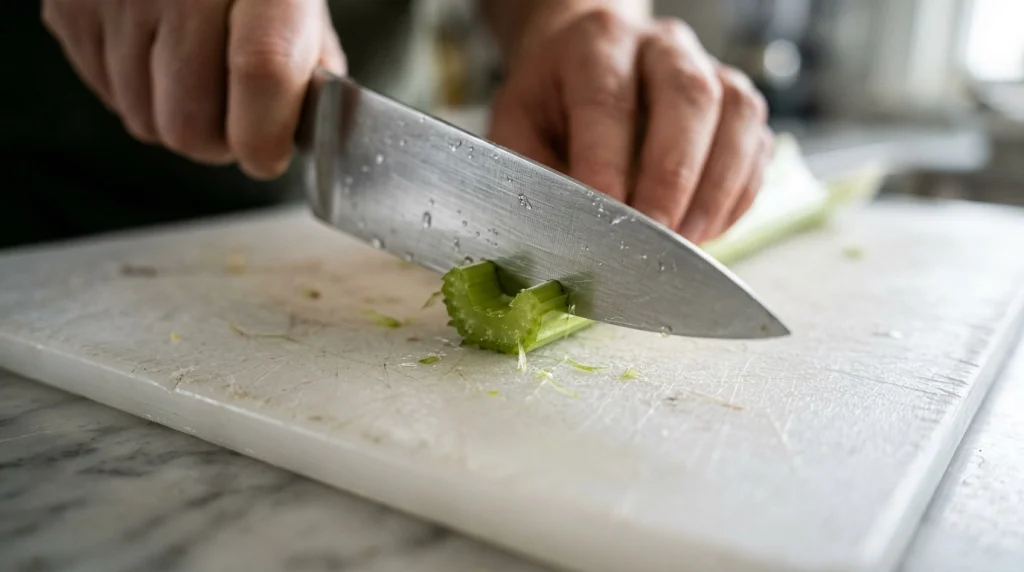
Does Cutting Food on Plastic Increase Exposure?
 Save
Repeated knife contact can scrape microscopic fragments from a plastic surface. Those fragments may transfer to ingredients being prepared.
The amount depends on several factors:
- Knife sharpness: Different blade conditions change surface abrasion.
- Cutting pressure: Forceful chopping can increase board wear.
- Material composition: Plastic formulations behave differently.
- Surface condition: Damaged boards can deteriorate further.
- Usage frequency: Frequent cutting creates more opportunities for wear.
Visible plastic shavings are a clear reason to replace a board. Smaller particles are much harder to detect without specialized equipment.
Are Microplastics From Cutting Boards Harmful?
The health consequences of microplastic exposure are still being investigated. Researchers have identified important questions about long-term exposure and biological effects.
As of 2026, scientific evidence doesn’t establish that typical dietary microplastic levels cause specific human health outcomes. That uncertainty shouldn’t be mistaken for proof of complete safety.
The U.S. Food and Drug Administration continues to review emerging research and food-contact material safety.
My practical preference is to reduce unnecessary plastic wear rather than panic about every scratch. Replacing damaged boards is a reasonable precaution.
Are Plastic Cutting Boards Toxic or BPA-Free?
Most modern polyethylene and polypropylene cutting boards don’t require bisphenol A (BPA) as part of their basic polymer composition. However, that doesn’t make every plastic product identical.
BPA is associated mainly with certain polycarbonate plastics and epoxy resins. It isn’t a standard ingredient in HDPE or polypropylene.
How to Choose Safer Plastic Materials
- Buy boards specifically marketed for food preparation.
- Look for a clearly identified material, such as HDPE or polypropylene.
- Choose manufacturers that provide material and care information.
- Avoid unknown industrial plastic sheets repurposed as cutting boards.
- Follow the manufacturer’s temperature and dishwasher instructions.
Labels such as “BPA-free” can provide useful information, but they aren’t complete safety certifications. Food-contact suitability matters more than one marketing claim.
For regulatory background, consult the FDA’s food safety resources.
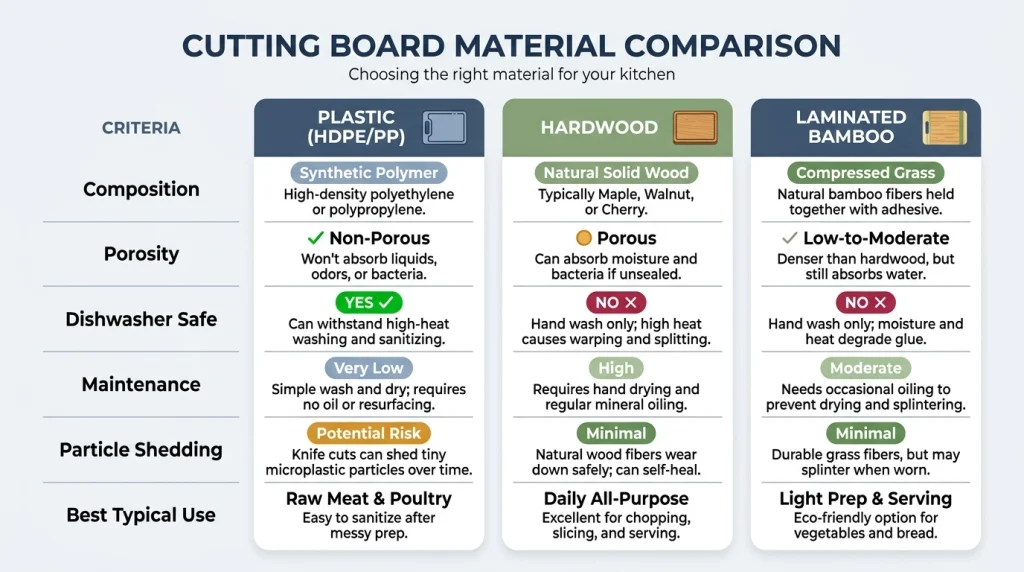
Plastic vs. Wood vs. Bamboo Cutting Boards: Which Is Safer?
 Save
Plastic, wood, and bamboo can all be appropriate cutting-board materials. Their cleaning requirements, surface durability, and maintenance needs differ.
I wouldn’t choose based on material alone. The condition of the board and how it’s cleaned matter just as much.
| Feature | Plastic | Wood | Bamboo |
|---|---|---|---|
| Common composition | HDPE or PP | Hardwood | Laminated bamboo |
| Porosity | Low | Varies by species and grain | Generally low moisture absorption |
| Dishwasher suitability | Often, if labeled safe | Usually hand-wash recommended | Usually hand-wash recommended |
| Maintenance | Wash and replace when worn | Wash, dry, and condition | Wash, dry, and condition as directed |
| Microplastic shedding | Possible during cutting | No plastic polymer in untreated solid wood | Depends partly on construction and coatings |
| Typical use preference | Raw meat preparation | Vegetables and general chopping | Produce and light chopping |
These comparisons describe typical products, not guarantees for every board. Cleaning and maintenance instructions can vary by manufacturer.
Are Wooden Cutting Boards Safer Than Plastic?
Wooden boards are a reasonable alternative for cooks who want to avoid cutting directly on plastic. Good-quality hardwood can provide a durable cutting surface.
Wood still requires careful cleaning and drying. Cracks, poorly maintained seams, and trapped food residue can create hygiene problems.
Solid wood may also be resurfaced when appropriate. Plastic boards with excessive damage are generally better replaced.
Are Bamboo Cutting Boards Better Than Plastic?
Bamboo boards offer a firm cutting surface and generally absorb little moisture. They can work well for vegetables and everyday food preparation.
However, bamboo boards often contain adhesives because they are constructed from joined pieces. Choose products intended for food contact.
Bamboo can also be harder on knife edges than some softer cutting surfaces. I would consider knife care before choosing it for heavy daily chopping.
Can Bacteria Grow on Plastic Cutting Boards?
Yes. Bacteria can remain on plastic cutting boards, especially when food residue collects in scratches and grooves.
A smooth surface is easier to clean than a heavily damaged one. Nonporous plastic doesn’t automatically prevent bacterial contamination.
How Cross-Contamination Happens
Cross-contamination occurs when microorganisms transfer from one food or surface to another. Raw poultry, meat, and seafood require particular attention.
Consider this common kitchen sequence:
- Raw chicken is placed on a cutting board.
- Chicken juices contaminate the cutting surface.
- The board isn’t washed before preparing salad ingredients.
- Bacteria may transfer to food that won’t be cooked.
Using separate boards reduces this risk. Proper washing between food preparation tasks is equally important.
The USDA Food Safety and Inspection Service recommends separating raw animal products from ready-to-eat foods.
How Do You Clean and Sanitize a Plastic Cutting Board?
Wash plastic cutting boards with hot, soapy water after every use. Sanitize when appropriate, especially after preparing raw meat or poultry.
Step 1: Remove Food Scraps
Scrape away food residue with a suitable utensil. Avoid dragging a sharp knife edge across the board unnecessarily.
Step 2: Wash With Soap and Water
Use hot, soapy water and a clean sponge or brush. Pay particular attention to knife marks and board edges.
Step 3: Rinse Thoroughly
Rinse away soap and loosened food debris with clean water. Check the surface for remaining residue.
Step 4: Sanitize When Needed
For compatible boards, the USDA describes a sanitizing solution containing one tablespoon of unscented liquid chlorine bleach per gallon of water.
- Prepare the diluted solution using the appropriate bleach product.
- Apply it to the cleaned cutting surface.
- Let it remain for several minutes.
- Rinse thoroughly with clean water.
- Allow the board to dry completely.
Follow the bleach label and manufacturer guidance. Never mix bleach with vinegar, ammonia, or other cleaners.
Step 5: Dry Before Storage
Place the clean board upright or on a drying rack. Avoid stacking damp boards where moisture can remain trapped.
For additional cleaning recommendations, see the University of Maine’s cutting-board safety guidance.
Can Plastic Cutting Boards Go in the Dishwasher?
Many plastic cutting boards are dishwasher-safe, but not all. Check the manufacturer’s instructions before exposing a board to dishwasher heat.
Some thin or flexible boards may warp at high temperatures. Repeated heat exposure can also affect certain plastic products.
Dishwasher Cleaning Checklist
- Confirm that the board carries a dishwasher-safe designation.
- Position it securely so it cannot interfere with spray arms.
- Use the recommended dishwasher cycle.
- Inspect for warping after washing.
- Allow the board to dry fully before storage.
A warped board can shift while chopping. Replace it if the distortion makes food preparation unstable.
When Should You Replace a Plastic Cutting Board?
Replace a plastic cutting board when it develops excessive wear or damage that prevents effective cleaning. There isn’t a universal replacement schedule.
A board used daily for heavy chopping may wear faster than one used occasionally. Surface condition matters more than age alone.
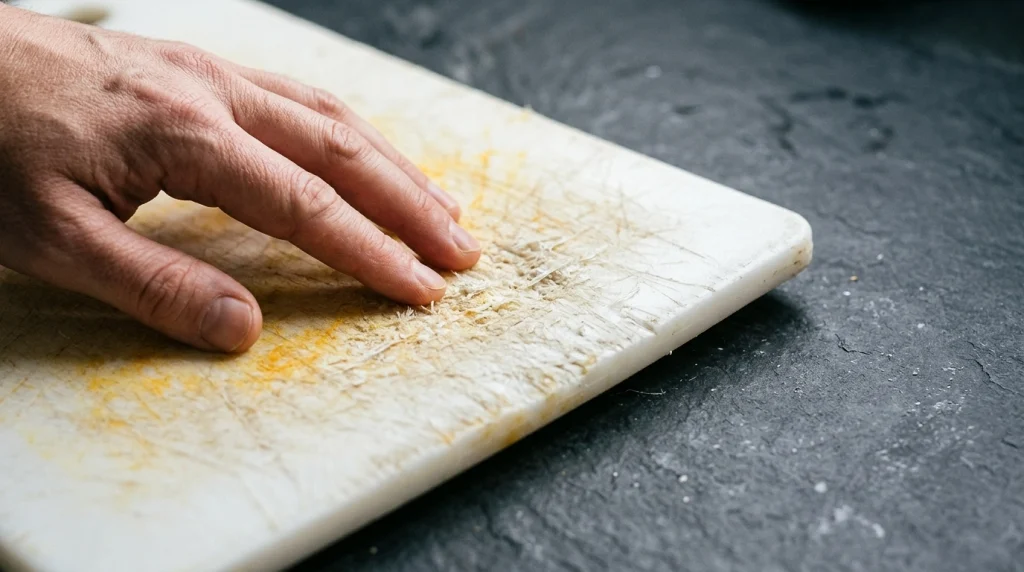
Signs Your Cutting Board Needs Replacing
 Save
- Deep grooves: Knife cuts collect food residue and resist cleaning.
- Visible peeling: Plastic fragments are detaching from the surface.
- Cracks: Openings create difficult-to-clean areas.
- Persistent odors: Smells remain after proper washing.
- Permanent warping: The board no longer sits securely.
- Excessive discoloration: Staining accompanies other signs of deterioration.
Light staining alone doesn’t always mean a board is unsafe. Deep damage and cleaning difficulty are stronger reasons for replacement.
I recommend inspecting your board under good lighting. Run a clean finger gently across the surface to identify rough, damaged sections.
How Can You Reduce Microplastic Exposure While Cutting Food?
Reducing unnecessary plastic abrasion is a sensible precaution. You don’t need to abandon every plastic kitchen tool immediately.
Instead, focus on the condition of your cutting boards and your cutting habits.
Practical Ways to Limit Wear
- Replace boards with peeling or deeply damaged surfaces.
- Use controlled knife movements instead of excessive chopping force.
- Avoid scraping food with the sharpened knife edge.
- Choose durable cutting boards designed for regular use.
- Consider a solid wooden board for routine vegetable preparation.
- Inspect plastic boards regularly for new damage.
These steps may reduce unnecessary surface damage. They don’t guarantee zero microplastic exposure.
Are Plastic Cutting Boards Safe for Raw Meat?
Yes, plastic cutting boards are practical for preparing raw meat when cleaned and sanitized properly. A dedicated board helps reduce cross-contamination.
I prefer reserving one clearly marked plastic board for raw chicken, beef, and seafood. Another surface handles vegetables, bread, and cooked food.
Safe Raw Meat Preparation Tips
- Use a dedicated board for raw animal products.
- Keep clean utensils separate from contaminated utensils.
- Wash the board immediately after use.
- Sanitize according to food-safety recommendations.
- Wash your hands after handling raw meat.
- Keep prepared food away from raw meat juices.
Color-coded boards can make separation easier. However, colors alone don’t prevent contamination without proper handling.
What Should You Look for When Buying a Plastic Cutting Board?
The best plastic cutting board isn’t necessarily the thickest or most expensive. A stable surface, suitable material, and easy cleaning matter more.
Important Buying Features
- Food-contact suitability: Choose a product manufactured for kitchen preparation.
- Stable construction: A board should stay securely positioned during chopping.
- Appropriate thickness: Consider durability and storage space.
- Easy cleaning: Smooth construction simplifies maintenance.
- Practical dimensions: Select enough room for your typical ingredients.
- Clear care instructions: Confirm temperature and dishwasher limits.
For most home kitchens, I would prioritize a practical medium-sized board over an oversized specialty model. The right choice depends on counter space and cooking habits.
Recommended Plastic Cutting Boards for Everyday Kitchens
If you’re choosing a new cutting board, these recognizable models are worth comparing. Each suits a different kitchen priority.
These are editorial recommendations based on product design and intended use, not personal laboratory tests or verified customer-rating averages.
Disclosure: Some links below are affiliate links. I may earn a commission from qualifying purchases at no additional cost to you.
🏆 Best Everyday Choice
OXO Good Grips Utility Cutting Board
★★★★☆
This utility cutting board offers a nonporous cutting surface, convenient handles, and practical everyday dimensions. I favor this style for kitchens needing one straightforward board for routine meal preparation.
🎨 Best for Food Separation
Joseph Joseph Index Cutting Board Set
★★★★☆
The Index system uses multiple labeled or color-coded boards with a storage case. I like the concept for keeping raw ingredients separate from foods that are ready to eat.
💰 Best Value Set
Gorilla Grip Reversible Cutting Board Set
★★★☆☆
This style of reversible plastic board offers multiple cutting surfaces and practical juice-groove designs. I would consider a set for households wanting separate boards without spending heavily.
Before purchasing, confirm the exact model, material, dimensions, and care instructions. Product variants can differ even when sold under similar names.
Frequently Asked Questions About Plastic Cutting Board Safety
Are Plastic Cutting Boards Safe for Daily Use?
Yes, plastic cutting boards are generally suitable for daily food preparation when made for food contact and maintained properly. Wash them after every use, separate raw meat from ready-to-eat foods, and replace boards with excessive grooves or damage that makes cleaning difficult.
Do Plastic Cutting Boards Contain Harmful Chemicals?
Food-contact plastic cutting boards are manufactured using materials intended for kitchen applications. However, composition varies by product. Choose reputable manufacturers, review material information, and avoid repurposing unknown plastics for food preparation. A BPA-free label alone doesn’t establish complete product safety.
Are Plastic Cutting Boards More Sanitary Than Wood?
Plastic surfaces are generally easier to wash because they are nonporous. However, wood can also be used safely when properly maintained. Both materials may retain contamination in deep grooves or cracks, so thorough cleaning and timely replacement remain essential.
How Often Should I Replace a Plastic Cutting Board?
There’s no fixed replacement interval that applies to every plastic cutting board. Inspect the surface regularly and replace it when deep knife marks, cracks, peeling, or warping make cleaning difficult or food preparation unsafe. Heavy use may require more frequent replacement.
What Is the Safest Cutting Board Material?
No single cutting-board material is universally safest for every task. Food-grade plastic is convenient for raw meat preparation, while well-maintained hardwood is another practical option. Cleanliness, food separation, proper drying, and surface condition are more important than choosing one material alone.
Final Verdict: Should You Keep Using Plastic Cutting Boards?
Plastic cutting boards are generally safe for everyday cooking when used correctly. Their easy-clean surfaces make them particularly convenient for preparing raw meat and seafood.
Still, they aren’t maintenance-free. Deep scratches, plastic shedding, and poor cleaning practices deserve attention.
My preferred kitchen setup is simple:
- Keep a dedicated plastic cutting board for raw meat.
- Use another clean board for produce and ready-to-eat foods.
- Wash and sanitize surfaces when needed.
- Replace plastic boards with excessive damage.
- Consider hardwood if reducing plastic cutting surfaces matters to you.
The most important lesson is that cutting-board safety depends on everyday habits. Choosing a suitable material is only the beginning.
Check your cutting board today. If it has deep grooves, peeling plastic, or cracks, consider replacing it before your next meal preparation.

