Bamboo vs. Wood Cutting Boards: Which Is Better for Your Knives?
Quick Answer
For most home cooks, a quality hardwood cutting board is better than bamboo for protecting chef knife edges. Maple, walnut, and cherry offer forgiving cutting surfaces, while bamboo is generally harder, lighter, and more moisture-resistant. Both can be safe with proper cleaning, but hardwood is my preferred choice for anyone focused on keeping kitchen knives sharp.
Key Differences
- Knife protection: Quality hardwood generally provides a more forgiving surface than bamboo.
- Durability: Both can last for years, depending on construction, use, and maintenance.
- Food safety: Neither material replaces proper washing, drying, and sanitation.
- Maintenance: Both benefit from hand-washing and occasional food-safe mineral oil.
- Cost: Basic bamboo boards are often less expensive than premium hardwood boards.
- Sustainability: Bamboo grows rapidly, while responsibly sourced hardwood can provide exceptional service life.
My Recommendation
- Choose hardwood: For frequent chopping, expensive knives, and long-term kitchen use.
- Choose bamboo: For affordable, lightweight boards used mainly for lighter preparation.
Choosing between bamboo and wood cutting boards sounds simple until you consider your knives, food safety, and daily cleaning routine. I’ve found that the most useful way to compare them is to focus on what happens during ordinary food preparation.
A cutting board isn’t just a surface for chopping vegetables. It affects how comfortably your knife moves, how you clean your workspace, and how much maintenance you’ll need.
In this guide, I’ll explain the practical differences and help you decide which board belongs in your kitchen.
What Is the Difference Between Bamboo and Wood Cutting Boards?
The biggest difference is their material structure. Bamboo is a fast-growing grass, while traditional wooden cutting boards come from trees such as maple, walnut, cherry, and beech.
Both materials are commonly manufactured into boards using joined strips or blocks. Their cutting performance depends on material hardness, grain orientation, surface finish, and construction quality.
What Is a Bamboo Cutting Board?
A bamboo cutting board is a food-preparation surface made from processed bamboo strips or sections. Manufacturers commonly join these pieces with adhesive to create a flat cutting surface.
Bamboo tends to resist moisture absorption better than many traditional hardwoods. Its relatively hard surface also helps it resist visible knife marks.
- Made from rapidly growing bamboo.
- Often lightweight and relatively affordable.
- Usually constructed from laminated strips.
- Generally requires hand-washing.
- Can be harder on delicate knife edges.
What Is a Wooden Cutting Board?
A wooden cutting board uses natural timber to create a stable food-preparation surface. Common materials include hard maple, walnut, cherry, and beech.
Wooden boards come in edge-grain and end-grain constructions. Both can work well, although their performance and maintenance requirements differ.
- Edge-grain wood: Uses long wood fibers running across the cutting surface.
- End-grain wood: Exposes the ends of wood fibers to the knife.
- Hard maple: Offers a useful balance of durability and knife friendliness.
- Walnut: Provides a slightly softer cutting surface with a darker appearance.
- Cherry: Offers a relatively forgiving surface and warm coloration.
For an everyday chef knife, I generally favor a well-made maple or walnut board over a similarly sized bamboo board.
Bamboo vs. Wood Cutting Boards: Side-by-Side Comparison
 Save
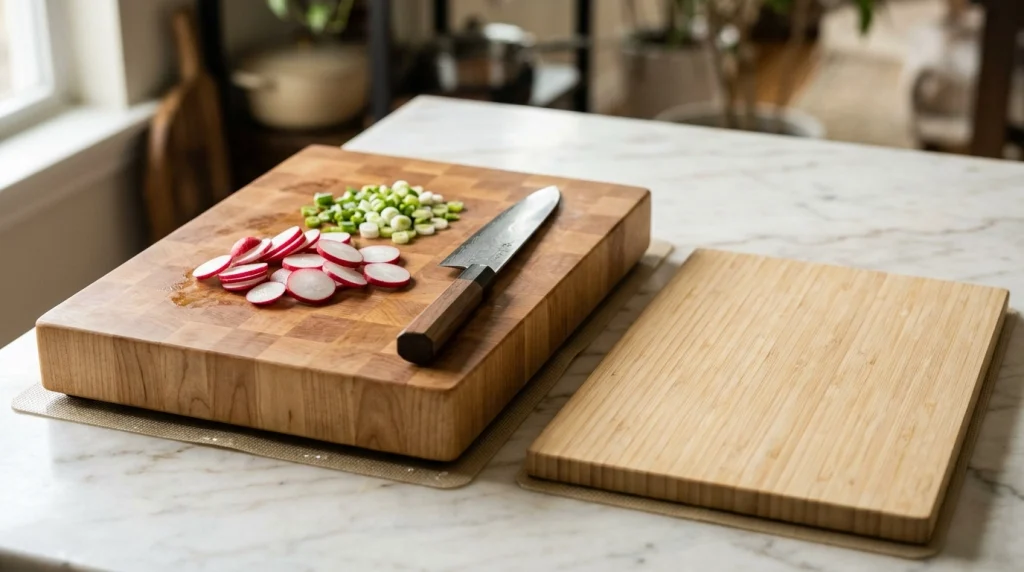
Neither material wins in every category. Your preferred cutting board should match your cooking habits and the knives you use most frequently.
| Feature | Bamboo | Hardwood |
|---|---|---|
| Material | Grass-based laminate | Tree-derived timber |
| Knife friendliness | Generally less forgiving | Generally more forgiving |
| Surface hardness | Usually relatively hard | Varies by wood species |
| Moisture absorption | Typically low | Varies by species and finish |
| Weight | Often lighter | Often heavier, depending on size |
| Maintenance | Hand-wash and oil as needed | Hand-wash and oil as needed |
| Typical cost | Budget to midrange | Budget to premium |
| Best use | Light preparation and serving | Frequent everyday chopping |
The main takeaway is straightforward. Choose a quality hardwood board when knife longevity matters most, but don’t dismiss bamboo for lighter kitchen tasks.
Which Cutting Board Is Better for Keeping Knives Sharp?
 Save
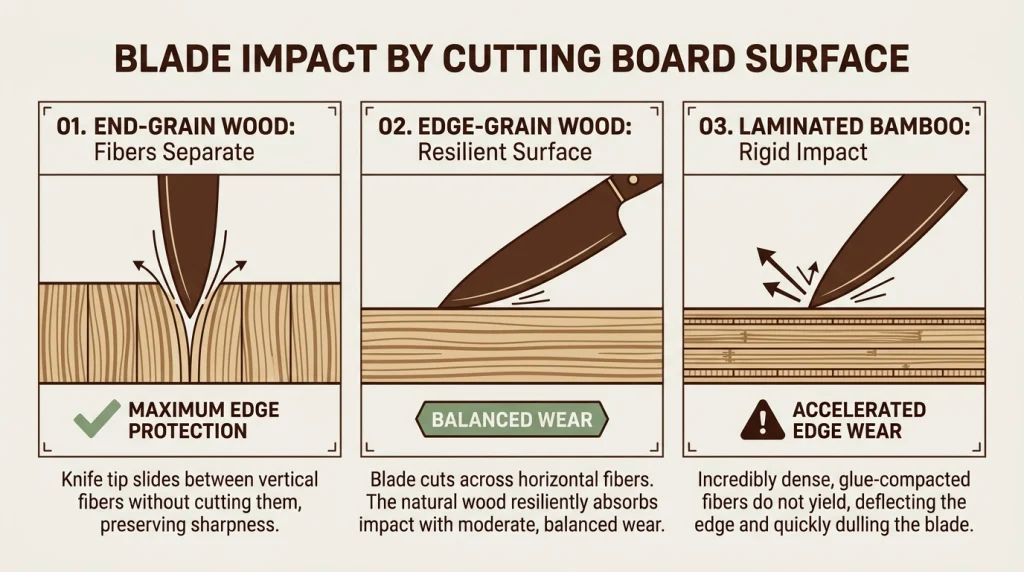
Wood is generally better for maintaining a chef knife’s cutting edge. A suitable hardwood surface offers some give during chopping, reducing the harsh impact associated with rigid cutting materials.
Bamboo is typically harder and less forgiving. Repeated chopping on a hard bamboo surface may contribute to faster edge wear, especially with thin blades.
Why Does Cutting Board Hardness Matter?
Each time you chop, your knife’s cutting edge contacts the board. The board’s resistance influences the stress placed on that thin metal edge.
A forgiving cutting surface can reduce unnecessary impact. That matters when you’re chopping onions, preparing vegetables, or mincing herbs repeatedly.
However, material hardness isn’t the only factor. Surface texture, construction, technique, and knife steel also influence edge retention.
Is Bamboo Too Hard for Japanese Chef Knives?
Bamboo isn’t automatically unsafe for Japanese knives, but hardwood is often a better match. Thin, high-hardness blades can be less tolerant of twisting, side pressure, and rigid cutting surfaces.
For delicate edges, I would choose a smooth maple or walnut board. I’d also avoid twisting the blade while its edge remains against the surface.
- Use controlled slicing motions instead of forceful chopping.
- Avoid twisting a blade while cutting.
- Never scrape food sideways with the sharp edge.
- Keep the board stable using a nonslip mat.
- Inspect the board for rough areas or damage.
If your knife loses its edge unexpectedly, read my guide explaining why a chef knife becomes dull.
Does End-Grain Wood Protect Knives Better Than Edge-Grain?
End-grain hardwood is often considered especially forgiving because of its fiber orientation. The blade meets the exposed ends of the wood fibers rather than primarily cutting across their sides.
Edge-grain hardwood remains an excellent everyday alternative. It usually offers simpler construction and a lower price than comparable premium end-grain boards.
- End-grain: Excellent option for frequent chopping and premium knife care.
- Edge-grain: Practical balance of performance, durability, and cost.
- Bamboo: Suitable for everyday food preparation, although typically harder on fine edges.
For more options, explore my guide to the best cutting boards for keeping knives sharp.
Are Bamboo Cutting Boards More Hygienic Than Wood?
Bamboo isn’t automatically more hygienic than hardwood. Both materials can support safe food preparation when you wash, sanitize when appropriate, and dry them correctly.
Bamboo absorbs relatively little moisture, which is useful. However, moisture resistance alone doesn’t guarantee that a board is free from harmful microorganisms.
What Do Food Safety Experts Recommend?
The USDA Food Safety and Inspection Service emphasizes proper cutting board cleaning and replacement when surfaces become excessively worn.
The University of Maine Cooperative Extension also explains how board materials, maintenance, and cleaning practices affect food safety.
Regardless of board material, raw meat juices can contaminate foods that won’t receive further cooking. Separate preparation surfaces help reduce that risk.
Should You Cut Raw Chicken on Bamboo or Wood?
You can use either material for raw poultry if you clean and sanitize it properly afterward. However, I prefer a dedicated dishwasher-safe plastic board for raw meat and poultry.
That arrangement makes separation between raw and ready-to-eat foods easier. It also keeps my primary hardwood board available for vegetables, fruits, and bread.
- Use separate boards for raw meat and ready-to-eat food.
- Wash cutting surfaces after every food-preparation session.
- Sanitize boards after raw poultry or meat contact.
- Allow boards to dry completely before storing.
- Replace boards with deep, hard-to-clean grooves.
The University of Illinois Extension cutting board guidance provides additional recommendations for preventing cross-contamination.
Which Lasts Longer: Bamboo or Wooden Cutting Boards?
A well-maintained hardwood board can provide many years of service. Bamboo can also last a long time, although construction quality and moisture exposure strongly influence its lifespan.
Neither material has a guaranteed advantage in every kitchen. A poorly maintained premium board may fail sooner than a carefully maintained inexpensive one.
Common Problems With Bamboo Boards
- Splitting: Moisture changes may stress joined sections.
- Delamination: Adhesive joints may separate if the board absorbs excessive water.
- Rough surfaces: Heavy use can expose raised fibers or damaged areas.
- Warping: Uneven moisture exposure can affect board flatness.
Common Problems With Wooden Boards
- Dryness: Neglected surfaces may develop roughness or cracks.
- Warping: Uneven exposure to water and heat can change the board’s shape.
- Knife marks: Repeated chopping gradually scores the surface.
- Joint damage: Poorly constructed laminated boards may separate.
One advantage of many solid hardwood boards is that minor surface damage can sometimes be repaired by appropriate resurfacing. Deep cracks, separated glue joints, or unsanitary grooves require more careful evaluation.
A board that cannot be cleaned properly should leave food-preparation service.
How Do You Clean Bamboo and Wood Cutting Boards?
 Save
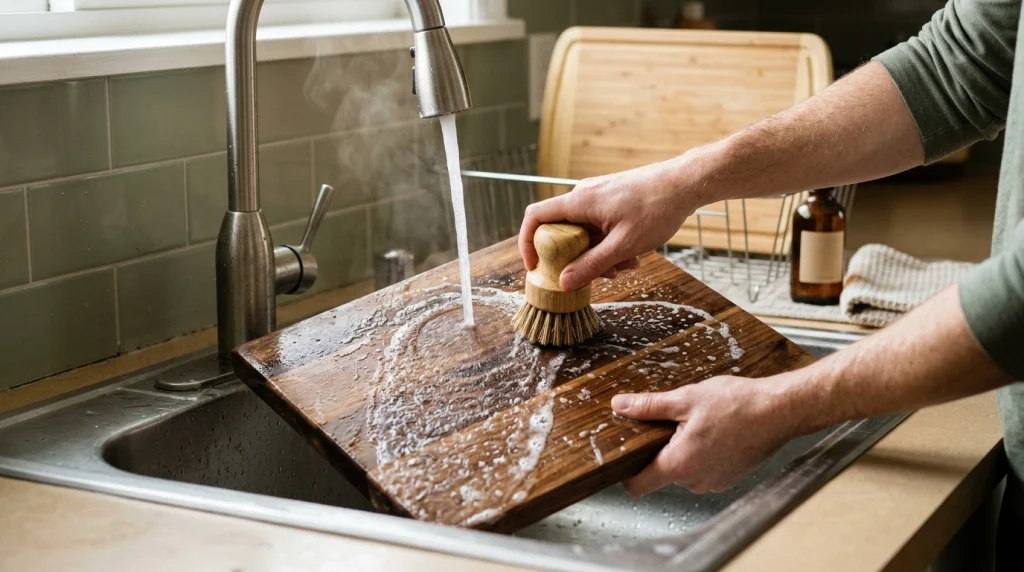
Clean both types promptly using dish soap and warm water. Avoid prolonged soaking, and follow the manufacturer’s instructions before applying any sanitizer.
My preferred cleaning routine is simple because consistency matters more than complicated treatments.
Everyday Cleaning Steps
- Remove scraps: Clear food particles using a scraper or paper towel.
- Wash: Scrub both sides with dish soap and warm water.
- Rinse: Remove soap and loosened food residue.
- Sanitize when needed: Use a food-contact-safe method according to its directions.
- Dry: Wipe away excess water with a clean towel.
- Air-dry: Stand the board where air can circulate around its surfaces.
For additional care guidance, see safe cutting board cleaning recommendations from the University of Maine.
Can You Put Bamboo or Wood in the Dishwasher?
Most bamboo and laminated hardwood cutting boards should not go in the dishwasher. Prolonged heat, water exposure, and drying cycles can cause cracks, warping, and separated joints.
Some solid wooden products have different care instructions. Always follow the manufacturer’s recommendations for your specific board.
How Often Should You Oil a Cutting Board?
Oil bamboo and hardwood boards when the surface looks dry or feels rough, following the manufacturer’s care advice. There isn’t one maintenance schedule that fits every kitchen.
Food-grade mineral oil is a common choice because it doesn’t become rancid like some cooking oils can. Apply a thin, even layer and remove excess oil after absorption.
- Start with a clean, completely dry board.
- Apply food-grade mineral oil across the surface.
- Include the board’s edges when appropriate.
- Allow the oil to absorb according to product instructions.
- Wipe away remaining oil before use.
Don’t use oil to conceal cracks or unsanitary damage. Oil is a maintenance treatment, not a substitute for cleaning or repairs.
Is Bamboo More Environmentally Friendly Than Hardwood?
Bamboo can be a strong sustainability option because it grows rapidly and can be harvested without cutting down a tree. However, growth rate alone doesn’t establish a product’s overall environmental impact.
Manufacturing, adhesive selection, shipping distance, durability, and disposal also matter. The same considerations apply when evaluating hardwood products.
What Makes a Cutting Board More Sustainable?
- Responsible sourcing: Look for credible information about forest or bamboo management.
- Product lifespan: A durable board may avoid repeated replacements.
- Manufacturing quality: Strong construction can reduce premature failure.
- Transport: Shipping distance and product weight contribute to environmental impact.
- Repairability: Some hardwood boards can be resurfaced instead of replaced.
I would choose a durable, responsibly sourced hardwood board over a low-quality bamboo board that needs frequent replacement. A well-made bamboo board may still be an excellent environmental choice.
Which Cutting Board Should You Buy for Your Kitchen?
Choose based on your most frequent food-preparation tasks. A cutting board used daily with a premium chef knife has different priorities from one used occasionally for fruit.
Choose Bamboo If You:
- Want a relatively affordable cutting surface.
- Prefer a lightweight board.
- Mostly slice fruits, vegetables, or bread.
- Need a convenient board for occasional food preparation.
- Value bamboo’s rapid growth as a renewable material.
Choose Hardwood If You:
- Use a chef knife frequently.
- Want a more forgiving cutting surface.
- Own thin-edged or premium kitchen knives.
- Prefer a substantial, stable chopping board.
- Want a board that may support long-term resurfacing and maintenance.
What Size Cutting Board Is Best for Everyday Cooking?
For many home kitchens, a board around 18 by 12 inches offers useful preparation space. A larger 20 by 15-inch board can feel more comfortable when handling multiple ingredients.
Consider your counter space and sink dimensions before choosing. A large board isn’t convenient if you cannot wash and store it properly.
Thickness also affects weight and stability. Use a nonslip mat underneath any board that moves during cutting.
Three Cutting Boards Worth Considering in 2026
If you’re choosing between bamboo and wood, these three established product lines offer different approaches. My recommendations reflect their materials, construction, and intended uses rather than a claim of personal laboratory testing.
Affiliate disclosure: As an Amazon Associate, CookingFlavour may earn from qualifying purchases. Product availability and prices can change.
🏆 Best for Everyday Chef Knives
John Boos Chop-N-Slice Maple Cutting Board
★★★★★ 4.8/5 editorial fit
This hard-maple cutting board provides a substantial work surface for regular chopping. It’s my preferred style for an everyday chef knife because maple offers a practical balance of resilience and durability. Check the selected model’s dimensions and grain construction before buying.
💰 Best Lightweight Bamboo Option
Totally Bamboo Kauai Cutting Board
★★★★☆ 4.3/5 editorial fit
The Kauai is a compact bamboo board intended for straightforward kitchen preparation. I like this style for fruit, bread, and smaller tasks when a heavy chopping block would be unnecessary. Its harder surface is less appealing for repeated work with delicate knives.
🔪 Best Large Wood Work Surface
Teakhaus Reversible Teak Cutting Board
★★★★☆ 4.5/5 editorial fit
Teakhaus offers substantial teak boards with reversible cutting surfaces in selected models. I’d consider one when generous preparation space and moisture-resistant wood are priorities. Teak can contain abrasive mineral compounds, so maple or walnut remains my first choice for especially delicate knife edges.
Frequently Asked Questions
Is bamboo better than wood for cutting boards?
Bamboo is a practical choice when low weight, affordability, and moisture resistance are important. However, hardwoods such as maple and walnut generally provide a more forgiving cutting surface. For frequent chopping with quality chef knives, I recommend hardwood over bamboo.
Do bamboo cutting boards dull knives faster?
Bamboo can contribute to faster knife-edge wear because it is generally harder than many traditional cutting-board woods. The effect depends on the bamboo’s construction, knife steel, and chopping technique. A smooth hardwood board is often preferable for thin or delicate blades.
Are wooden cutting boards safe for raw meat?
Wooden cutting boards can be used for raw meat when properly cleaned and sanitized. However, using a dedicated board for raw meat helps reduce cross-contamination. I prefer dishwasher-safe plastic for this task and keep hardwood for vegetables and other everyday preparation.
Is bamboo or maple better for a chef knife?
Maple is generally the better choice for regular chef knife use. Its resilient hardwood surface offers a balance of knife friendliness and resistance to wear. Bamboo remains useful for lighter food-preparation tasks, particularly when a compact, lightweight board is more convenient.
How long do bamboo and wood cutting boards last?
Both materials can provide years of service when properly maintained. Lifespan depends on construction, cleaning habits, moisture exposure, and cutting frequency. Replace either board when deep grooves, cracks, warping, or separated joints make proper cleaning difficult.
Final Verdict: Is Bamboo or Wood the Better Cutting Board?
For most cooks who rely on a chef knife every day, I recommend a quality hardwood cutting board. Maple and walnut offer a useful combination of cutting comfort, durability, and knife-edge protection.
Bamboo is still worth considering. It’s often affordable, lightweight, and convenient for small preparation tasks.
The smartest setup may include more than one board:
- Hardwood: Your primary surface for everyday chopping.
- Bamboo: A secondary board for lighter preparation or serving.
- Dishwasher-safe plastic: A dedicated surface for raw meat and poultry.
Whichever material you choose, keep it clean, dry, stable, and well maintained. A suitable board and good cutting technique work together to protect your knives.
For a complete routine, read my guide to cleaning, sharpening, and maintaining kitchen knives before your next food-preparation session.

