Are Bamboo Cutting Boards Safe? Benefits, Risks, and Food Safety Tips
Quick Answer
Yes, bamboo cutting boards are generally safe for food preparation when they’re made with food-contact-safe materials and maintained properly. Bamboo absorbs relatively little moisture and offers a durable cutting surface. However, poorly manufactured boards, damaged glue joints, and improper cleaning can create problems. Follow established USDA food safety guidance to minimize contamination risks.
What makes a bamboo cutting board safe?
- Food-safe construction: Choose boards made with suitable adhesives and finishes.
- Proper cleaning: Wash with hot, soapy water after preparing each food item.
- Complete drying: Store the board only after its surfaces have dried thoroughly.
- Separate preparation: Use different boards for raw animal products and ready-to-eat foods.
- Regular inspection: Replace boards with deep grooves, cracks, or separating layers.
Bottom line
- Best everyday use: Vegetables, fruits, bread, herbs, and general food preparation.
- Important precaution: Bamboo is not automatically antibacterial, chemical-free, or safer than every other cutting board material.
Bamboo cutting boards have become popular in home kitchens, but their safety deserves a closer look. Their attractive appearance and durable surface don’t tell the whole story.
I believe choosing a cutting board should start with food safety, not appearance. This guide explains bamboo’s benefits, potential chemical concerns, cleaning methods, and comparisons with wood and plastic.
What Is a Bamboo Cutting Board?
A bamboo cutting board is a food preparation surface made from processed bamboo, a fast-growing type of grass. Manufacturers typically join bamboo strips to create a flat, durable board.
Unlike a solid piece of hardwood, most bamboo boards contain bonded sections. Their construction quality matters just as much as the bamboo itself.
How Are Bamboo Cutting Boards Made?
 Save
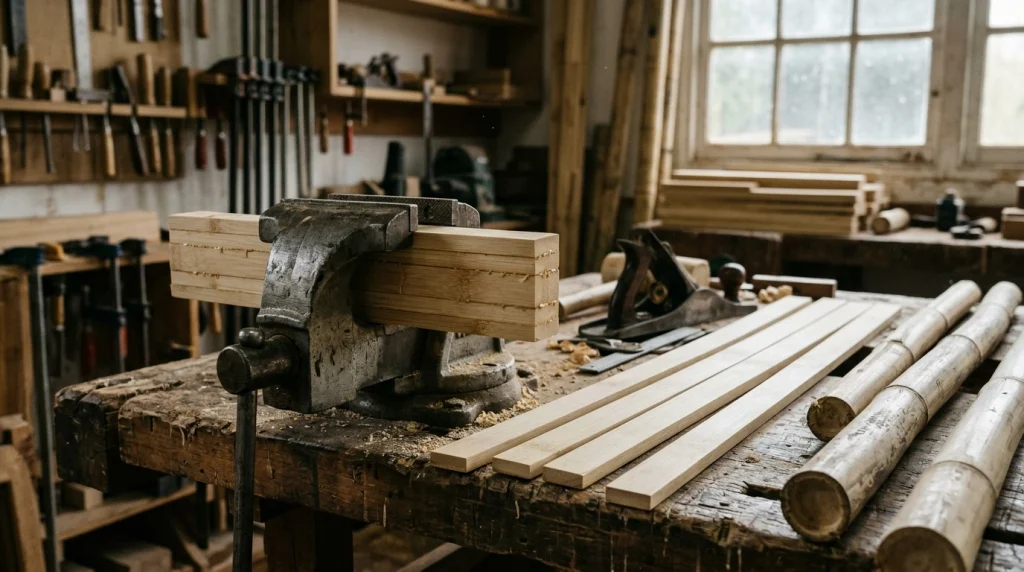
Manufacturers process harvested bamboo into strips and prepare them for bonding. The strips are then assembled into boards using adhesives, pressure, and finishing processes.
Common manufacturing steps include:
- Harvesting: Mature bamboo stems are collected and cut into usable sections.
- Processing: The bamboo is split, cleaned, and shaped into strips.
- Drying: Moisture is reduced to help stabilize the material.
- Bonding: The strips are joined with adhesive to form a board.
- Finishing: The surface is sanded and may receive a food-contact-safe finish.
Some boards have a darker caramelized appearance created through heat treatment. Color alone doesn’t establish whether a particular board is safe.
Is Bamboo Naturally Safe for Food Contact?
Bamboo itself can be suitable for food-contact products when manufactured and maintained hygienically. The important distinction is between natural bamboo and the complete finished product.
A finished board may contain adhesives, coatings, and other materials. Buyers should evaluate those components rather than assuming every bamboo product is identical.
Are Bamboo Cutting Boards Safe for Everyday Food Preparation?
Yes, a well-made bamboo cutting board is generally suitable for everyday chopping and slicing. Safe use depends on cleaning, preventing cross-contamination, and replacing damaged boards.
Bamboo’s relatively low moisture absorption can be useful in the kitchen. However, it doesn’t eliminate the possibility of bacteria surviving on a dirty surface.
Can Bacteria Grow on Bamboo Cutting Boards?
Yes, bacteria can survive on bamboo cutting boards, especially when food residue and moisture remain. No cutting board material can replace thorough cleaning.
Raw meat, poultry, and seafood can introduce harmful microorganisms. These include Salmonella, Campylobacter, and certain strains of E. coli.
The CDC’s food poisoning prevention guidance emphasizes cleaning surfaces and separating raw foods from ready-to-eat ingredients.
Pay particular attention to these contamination risks:
- Raw meat juices: They may transfer microorganisms to other foods.
- Deep knife grooves: They can become difficult to clean thoroughly.
- Standing moisture: Damp storage conditions can encourage microbial growth.
- Cross-contamination: Using one dirty board for meat and salad ingredients can spread germs.
For example, slicing chicken and then chopping lettuce without cleaning the board creates an avoidable risk. The problem isn’t limited to bamboo.
Are Bamboo Cutting Boards Antibacterial?
Bamboo cutting boards should not be treated as self-sanitizing surfaces. Claims about natural antibacterial properties don’t justify skipping normal food safety procedures.
Bamboo’s relatively dense structure can help limit moisture absorption. That is different from proving the surface reliably kills harmful microorganisms.
My practical recommendation is simple: treat bamboo like any other food-contact surface. Clean it after every use and sanitize when appropriate.
Do Bamboo Cutting Boards Contain Harmful Chemicals?
Some bamboo cutting boards contain adhesives and finishes, but their presence doesn’t automatically make a board unsafe. The concern is whether those materials are suitable for food contact.
Products from manufacturers that disclose construction and food-contact suitability are easier to evaluate. Unclear labeling should encourage additional questions before buying.
Is the Glue in Bamboo Cutting Boards Safe?
Glue can be safe in bamboo cutting boards when manufacturers use adhesives appropriate for their intended food-contact applications. However, adhesive chemistry and manufacturing quality vary.
The critical questions are:
- Does the manufacturer identify the adhesive as suitable for food-contact use?
- Can the manufacturer provide credible compliance or testing documentation?
- Is the board designed for repeated chopping and washing?
- Are the bonded layers intact, without visible gaps or separation?
- Are the cleaning instructions consistent with the product’s construction?
Labels such as “natural” and “eco-friendly” don’t prove adhesive safety. Specific manufacturer information is more useful than broad marketing claims.
Do Bamboo Cutting Boards Contain Formaldehyde?
Some adhesive systems can involve formaldehyde-based resins, but this doesn’t mean every bamboo cutting board contains unsafe formaldehyde levels. The actual materials and potential exposure must be evaluated.
There is also an important distinction between solid bamboo boards and plastic products containing bamboo powder or fibers.
The European Commission’s bamboo food-contact guidance identifies concerns involving certain bamboo-filled plastic food-contact materials.
Some products in that category have released melamine and formaldehyde into food, particularly under heated conditions. Those findings should not automatically be applied to every solid bamboo cutting board.
When shopping, look for:
- Clear material descriptions: Distinguish solid bamboo construction from bamboo-plastic composites.
- Food-contact information: Look for meaningful manufacturer documentation.
- Transparent finishes: Confirm the surface treatment suits food preparation.
- Reliable construction: Avoid peeling coatings and separating laminated sections.
Are Bamboo Cutting Boards Non-Toxic?
A properly manufactured bamboo cutting board can be a safe food-contact product. However, “non-toxic” is a broad marketing term rather than proof of specific testing.
I would prioritize clear food-contact documentation over an attractive package or sustainability slogan. It gives buyers a stronger basis for making an informed decision.
Are Bamboo Cutting Boards Safer Than Wood or Plastic?
Bamboo, hardwood, and food-grade plastic can all serve as safe cutting surfaces when properly maintained. None is the safest choice under every circumstance.
The better choice depends on cleaning needs, knife care, maintenance preferences, and how the board will be used.
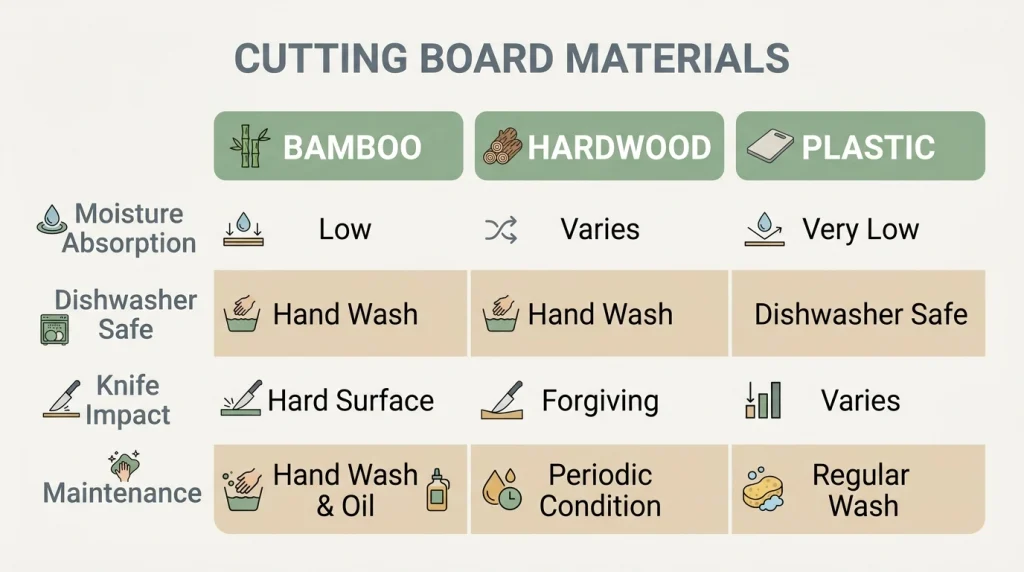
Bamboo vs. Wood vs. Plastic: Safety Comparison
 Save
| Feature | Bamboo | Hardwood | Plastic |
|---|---|---|---|
| Food safety | Safe with proper care | Safe with proper care | Safe with proper care |
| Moisture absorption | Generally low | Varies by wood species | Very low |
| Dishwasher compatibility | Usually hand-wash only | Usually hand-wash preferred | Often dishwasher-safe |
| Knife friendliness | Harder surface | Often more forgiving | Varies with plastic type |
| Routine maintenance | Hand washing and occasional oiling | Hand washing and periodic conditioning | Washing and surface inspection |
| Best suited for | General preparation | Frequent chopping | Easy-clean food preparation |
These comparisons describe common material characteristics, not guaranteed performance for every product. Construction quality and manufacturer instructions can change the practical result.
Is Bamboo Better Than Wood for Cutting Boards?
Bamboo generally absorbs less moisture than many hardwoods, while hardwood can offer a more forgiving cutting surface. Both materials require proper cleaning.
For someone using sharp chef knives throughout the day, I would consider a quality maple board. For lighter everyday chopping, bamboo remains a practical alternative.
Is Bamboo Better Than Plastic for Food Safety?
Not necessarily. Plastic often offers easier dishwasher cleaning, while bamboo provides a rigid surface that requires hand washing.
The USDA recommends separate boards for raw animal foods and ready-to-eat ingredients. This prevents cross-contamination regardless of material.
See the USDA’s cutting board cross-contamination advice for more information.
Can You Cut Raw Meat on a Bamboo Cutting Board?
Yes, raw meat can be prepared on an intact bamboo board if the board is cleaned and sanitized correctly afterward. However, a separate, easily sanitized board is often more convenient.
Raw poultry deserves particular attention because contaminated juices can spread across countertops, utensils, and nearby ingredients.
How to Handle Raw Meat Safely
- Use a dedicated board: Keep a separate board for meat, poultry, and seafood.
- Contain juices: Select a suitably sized board, preferably with a juice groove when needed.
- Clean immediately: Wash with hot, soapy water after food preparation.
- Sanitize appropriately: Follow suitable food-contact sanitizer instructions.
- Rinse and dry: Follow the sanitizer directions and allow the board to dry completely.
For convenience, a dishwasher-safe plastic board is often my preferred recommendation for raw chicken preparation. It reduces the difficulty of maintaining separate, easily cleaned surfaces.
How Do You Clean a Bamboo Cutting Board Safely?
Clean a bamboo cutting board with dish soap and warm or hot water after each use. Rinse it thoroughly, remove excess moisture, and allow it to air-dry.
Regular cleaning matters more than any claim that bamboo naturally resists bacteria.
Step-by-Step Bamboo Cutting Board Cleaning
- Remove food: Scrape off remaining ingredients and loose debris.
- Wash: Scrub both sides with dish soap and warm or hot water.
- Check grooves: Pay attention to knife marks and edges.
- Rinse: Remove soap and loosened food particles with clean water.
- Dry: Wipe away excess water with a clean paper towel.
- Store upright: Allow airflow around both sides until completely dry.
Don’t leave bamboo submerged in a sink. Prolonged moisture exposure can contribute to warping, cracking, and weakening of bonded joints.
How Do You Sanitize a Bamboo Cutting Board?
Sanitizing can provide added protection after handling raw animal foods. First wash away visible debris, because sanitizers work best on clean surfaces.
University of Maine Cooperative Extension recommends a diluted unscented household bleach solution for bamboo cutting boards. Its guidance describes using one-half teaspoon of bleach per quart of water, followed by appropriate contact time, rinsing, and drying.
Follow the University of Maine’s cutting board cleaning guidance and the sanitizer manufacturer’s directions.
- Use only products appropriate for food-contact surfaces.
- Never combine bleach with vinegar, ammonia, or other cleaners.
- Measure sanitizer dilution carefully.
- Follow the required contact time and rinsing instructions.
- Allow the board to dry completely before storage.
Vinegar may help with ordinary cleaning, but it isn’t a reliable substitute for an appropriately labeled sanitizer. Don’t depend on lemon juice or salt as your only sanitizing method.
Can Bamboo Cutting Boards Go in the Dishwasher?
Most bamboo cutting boards should not go in the dishwasher. High heat, prolonged moisture, and detergent exposure can damage the board.
Even when a board looks intact, repeated dishwasher cycles may weaken bonded sections. Follow the manufacturer’s care instructions rather than assuming bamboo tolerates machine washing.
Do Bamboo Cutting Boards Damage Knives?
Bamboo cutting boards can be harder on knife edges than some softer hardwood boards. However, the actual effect depends on blade steel, cutting technique, board construction, and use frequency.
Bamboo’s rigid surface provides stability for chopping. The tradeoff is that frequent heavy chopping may require more attention to knife maintenance.
Are Bamboo Boards Good for Chef Knives?
They can be suitable for routine slicing and vegetable preparation. However, people who prioritize edge retention may prefer a quality maple or similar hardwood cutting board.
For expensive chef knives, I would compare the cutting feel before committing to bamboo as the only kitchen board.
To help protect knife edges:
- Use smooth, controlled slicing movements.
- Avoid striking the board unnecessarily hard.
- Don’t twist a delicate knife edge against the surface.
- Keep the board stable with a suitable non-slip mat.
- Sharpen knives when cutting performance declines.
What Are the Advantages and Disadvantages of Bamboo Cutting Boards?
Bamboo provides an attractive, relatively moisture-resistant cutting surface, but it also has limitations. The main tradeoffs involve hardness, maintenance, and manufacturing transparency.
Advantages of Bamboo Cutting Boards
- Low moisture absorption: Bamboo generally absorbs relatively little water compared with many hardwoods.
- Durable construction: A properly made board can withstand regular chopping.
- Attractive appearance: Natural grain patterns suit many kitchen styles.
- Renewable raw material: Bamboo grows relatively quickly and can regenerate after harvesting.
- Manageable weight: Many bamboo boards are convenient to move and store.
- Multiple uses: Suitable designs can serve as both cutting and food presentation boards.
Disadvantages of Bamboo Cutting Boards
- Knife-edge wear: Bamboo may feel harder than certain hardwood cutting surfaces.
- Adhesive dependence: Many boards rely on glue to hold the strips together.
- Dishwasher limitations: Most require hand washing.
- Moisture damage: Improper drying can contribute to warping and splitting.
- Variable quality: Manufacturing standards and finishes differ among products.
- Maintenance needs: Periodic conditioning may help preserve the surface.
Bamboo’s rapid growth is an environmental advantage, but the full sustainability picture also depends on transportation, adhesives, manufacturing, and product lifespan.
How Often Should You Oil a Bamboo Cutting Board?
Oil a bamboo cutting board according to the manufacturer’s instructions and the condition of its surface. Many manufacturers suggest roughly monthly conditioning, although frequency varies.
Food-grade mineral oil is a common choice because it resists rancidity. Apply it only to a clean, completely dry board.
How to Oil Bamboo Properly
- Wash the cutting board and allow it to dry thoroughly.
- Apply a small amount of food-grade mineral oil.
- Spread the oil evenly over the cutting surface, sides, and edges.
- Allow the oil to absorb according to the product directions.
- Wipe away remaining excess oil before using the board.
Avoid using ordinary vegetable oil or olive oil for conditioning. These oils can oxidize, become sticky, and develop unpleasant odors.
Oiling helps protect the surface, but it doesn’t disinfect the board. A damaged or contaminated board still needs proper cleaning or replacement.
When Should You Replace a Bamboo Cutting Board?
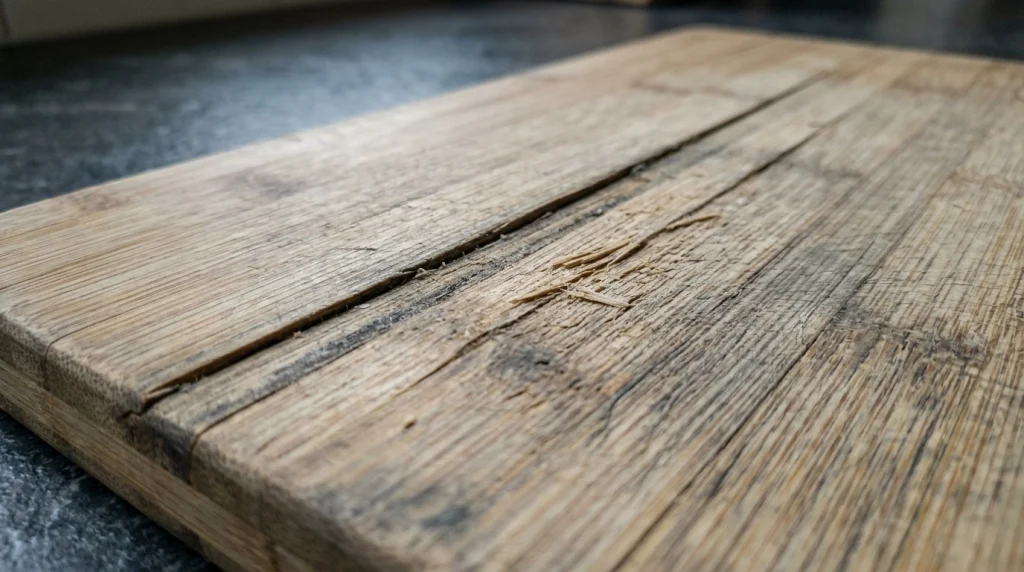
Replace a bamboo cutting board when damage makes thorough cleaning difficult. Deep grooves, spreading cracks, and loose laminated sections are important warning signs.
There is no universal replacement schedule. A frequently used board may wear faster than one used occasionally for bread and vegetables.
Signs Your Bamboo Board Is No Longer Safe
 Save
- Deep knife grooves: Cuts have become difficult to scrub clean.
- Separating layers: Glued bamboo strips are coming apart.
- Visible mold: Mold appears in cracks or hard-to-reach areas.
- Splintering: The cutting surface is shedding small fragments.
- Persistent damage: Cracks or warping interfere with safe food preparation.
- Peeling finish: A coating is breaking away from the working surface.
If a surface becomes rough or develops minor cosmetic scratches, manufacturer-approved refinishing may be possible. However, don’t attempt to rescue a board with deep structural damage or separating glue joints.
How Do You Choose a Safe Bamboo Cutting Board?
Choose a bamboo board with clear material information, durable construction, and straightforward cleaning instructions. Reputable product documentation matters more than attractive advertising.
As of 2026, I would use this checklist when comparing boards:
- Material: Prefer clearly identified bamboo construction rather than vaguely described composites.
- Adhesive: Look for explicit food-contact suitability information.
- Finish: Confirm that surface treatments are appropriate for food preparation.
- Dimensions: Choose enough surface area for safe, comfortable cutting.
- Thickness: Look for construction that resists unwanted movement and bending.
- Stability: Use non-slip feet or a suitable non-slip mat.
- Cleaning: Check whether the manufacturer specifies hand washing and conditioning.
- Warranty: Consider products backed by clear manufacturer support.
Don’t assume that a label saying “organic bamboo” proves food-contact safety. Request supporting information if the product description is unclear.
Recommended Cutting Boards for Different Kitchen Needs
If you’re choosing a board, I would focus on food-safe construction, manageable care, and the foods you prepare most often. These options illustrate different practical priorities.
Shopping note: The recommendations below are based on published product specifications and intended uses, not personal hands-on testing. Check current ratings, availability, and manufacturer information before purchasing.
🏆 Best for everyday bamboo prep
Totally Bamboo Kauai Cutting Board
★★★★☆ 4.9/5 manufacturer-listed customer rating
This reversible Moso bamboo board measures 14.5 by 11.5 inches and is 5/8 inch thick. Its practical dimensions and documented care instructions make it worth considering for everyday produce preparation. Hand washing is required.
🥩 Best easy-clean alternative
OXO Good Grips Carving and Cutting Board
Customer rating not independently verified
This polypropylene board measures 21.1 by 14.5 inches and includes a grooved side, non-slip feet, and dishwasher-safe construction. I recommend considering it when easy cleanup after meat preparation is a priority.
🌿 Best for compact bamboo prep
Totally Bamboo Hana Cutting Board
Customer rating not independently verified
This smaller bamboo board measures approximately 10 by 7.125 inches and is 5/8 inch thick. Its size suits simple tasks such as slicing lemons or chopping small amounts of herbs, although it isn’t ideal for preparing large meals.
Affiliate disclosure: As an Amazon Associate, this website may earn from qualifying purchases if enrolled in the Amazon Associates program. Product prices and availability can change. Ratings shown are identified by source where available.
Frequently Asked Questions About Bamboo Cutting Board Safety
Are bamboo cutting boards safe for babies and toddlers?
A properly manufactured, clean bamboo cutting board can be used to prepare food for children. Use suitable food-contact materials, keep raw foods separate, and sanitize surfaces as needed. Avoid damaged boards and bamboo-plastic composites with uncertain food-contact safety.
Can bamboo cutting boards develop mold?
Yes, bamboo cutting boards can develop mold when moisture remains trapped, particularly in cracks or storage areas with poor airflow. Wash and dry the board thoroughly after use. Replace boards with embedded mold or damage that prevents effective cleaning.
Are bamboo cutting boards safer than plastic cutting boards?
Neither material is automatically safer in every situation. Bamboo absorbs relatively little moisture, while many plastic boards can be cleaned in a dishwasher. The best choice depends on separating raw foods, washing correctly, and replacing boards that develop hard-to-clean damage.
Can I use vinegar to disinfect a bamboo cutting board?
Vinegar can help with routine cleaning and odor removal, but it shouldn’t replace a suitable sanitizer when proper sanitizing is needed. Wash the board first, then follow food-contact sanitizer instructions. Never mix vinegar with chlorine bleach.
How long does a bamboo cutting board last?
A bamboo cutting board’s lifespan depends on construction quality, frequency of use, cleaning, and storage. There isn’t a universal number of years. Replace it when cracks, separating joints, heavy knife grooves, or other damage make hygienic preparation difficult.
Final Verdict: Should You Use a Bamboo Cutting Board?
Yes, bamboo cutting boards can be a safe and practical choice for everyday cooking. Their durability and relatively low moisture absorption make them appealing for many kitchens.
However, the best results depend on choosing quality construction and following good food hygiene practices. Bamboo should never be treated as automatically antibacterial or maintenance-free.
My recommendation is to use a quality bamboo board for vegetables, fruit, bread, and general food preparation. Keep a separate, easily sanitized board available for raw meat and poultry.
Before your next meal, inspect your cutting board for damage, wash it thoroughly, and confirm it’s completely dry. Those simple habits matter more than the material alone.

