Chef Knife HRC Explained: Hardness Ratings and Tradeoffs
Quick Answer
Chef knife HRC refers to the blade’s hardness on the Rockwell C scale. Most chef knives fall between 54 and 62 HRC. Lower values (54–56) mean a tougher, easier-to-sharpen blade that dulls faster. Higher values (60–62) mean better edge retention but a more brittle edge that can chip and is harder to sharpen. There is no single “best” HRC—the right number depends on how you cut, what you cut on, and how much maintenance you accept.
What HRC Actually Measures on a Chef Knife
 Save
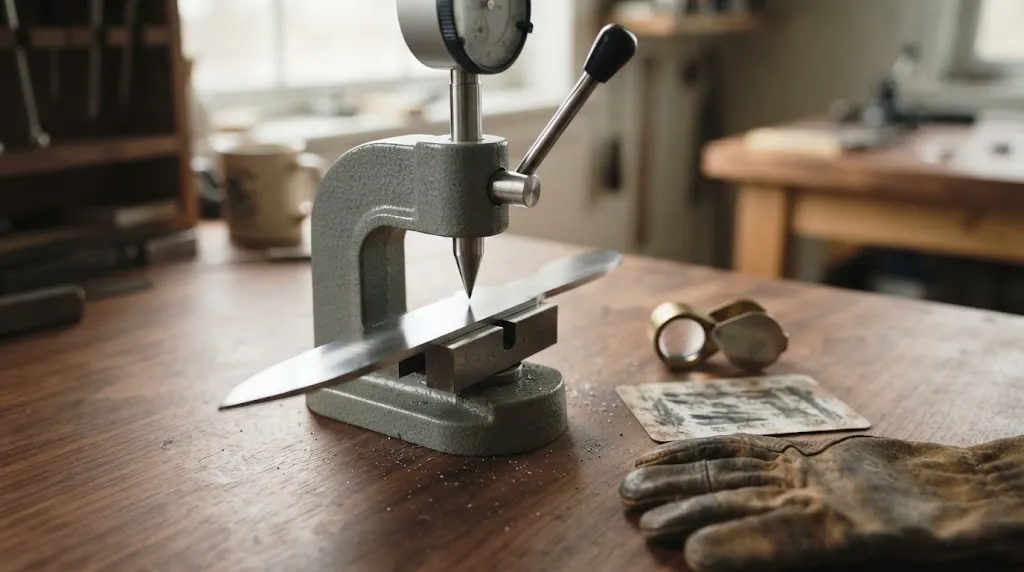
HRC stands for Hardness Rockwell C. It is a measurement of how resistant the blade steel is to indentation and permanent deformation. The test presses a diamond indenter into the steel under a specific load and measures the depth of the mark. A higher number means the steel resisted the indentation more.
On a chef knife, this single number is often printed on the box or product page as a shorthand for performance. But it is only one specification among several that determine how a knife behaves in a kitchen. Steel composition, heat treatment, blade geometry, and edge angle all interact with hardness to produce the final cutting experience.
The practical translation is straightforward: harder steel can support a thinner, more acute edge that resists rolling and wear. Softer steel is more forgiving, bends rather than breaks under lateral stress, and responds quickly to a honing rod or sharpening stone. Neither is inherently superior. They solve different problems.
The Common HRC Ranges for Chef Knives
Chef knives generally occupy three broad bands on the Rockwell C scale. These ranges are not rigid rules, and manufacturers sometimes push slightly beyond them, but they describe the mainstream market accurately.
| HRC Range | Typical Style | Key Tradeoff |
|---|---|---|
| 52–56 | German-style workhorse | Tough, easy to sharpen, dulls faster |
| 56–60 | Balanced / hybrid | Compromise between retention and durability |
| 60–62+ | Japanese-style / high-performance | Long edge life, chipping risk, harder to sharpen |
German manufacturers like Zwilling commonly list chef knives in the mid-to-high 50s HRC range. The Zwilling Signature 8-inch chef’s knife, for example, specifies 55–58 HRC. The Twin Master line lists 50–54 HRC. Japanese knives using steels like VG-10 or SG2 frequently reach 60–62 HRC or slightly above.
These are not quality rankings. A 55 HRC German chef knife and a 62 HRC Japanese gyuto are built for different expectations. The German knife is designed to tolerate a busy professional kitchen’s rough handling, occasional dishwasher exposure, and rapid honing between tasks. The Japanese knife is designed for controlled cutting on soft boards, with the understanding that the user will respect its limits.
Why Higher HRC Isn’t Automatically Better
The most persistent misconception about chef knife HRC is that the number functions as a score. It does not. A 62 HRC knife is not “better” than a 59 HRC knife in any universal sense.
Hardness and toughness exist in tension. As steel hardness increases, the blade becomes more resistant to wear and deformation at the edge, but it also becomes less able to absorb impact without cracking or chipping. A very hard edge that encounters a frozen bone or a granite countertop may fail catastrophically. A softer edge in the same situation will likely roll or indent instead, which is annoying but repairable with a honing rod.
Key Insight
Two knives at the same HRC can behave differently if their steels have different alloy compositions or heat treatments. A simple carbon steel at 60 HRC and a high-alloy stainless steel at 60 HRC are not equivalent in toughness or wear resistance. HRC tells you hardness, not the full metallurgical story.
Steel type matters alongside the number. A simple high-carbon steel like 1095 at 60 HRC will have different toughness characteristics than a particle-metallurgy stainless steel at the same hardness. The alloying elements—chromium, vanadium, molybdenum—change how the steel responds to hardening and how it performs at the edge. This is why shopping by HRC alone can lead to disappointment.
How HRC Affects Sharpening and Maintenance
Hardness directly determines how the blade responds to sharpening stones and honing rods.
Softer blades in the 52–56 HRC range abrade quickly on standard stones. A few passes on a medium-grit stone can restore a working edge. Honing rods realign a rolled edge effectively because the steel is ductile enough to move without fracturing. For a cook who wants minimal maintenance and doesn’t mind touching up the edge frequently, a softer blade is the practical choice.
Harder blades above 60 HRC resist abrasion. Sharpening takes longer and demands more consistent angle control. The reward is that the edge lasts significantly longer under normal cutting. A home cook who sharpens once a month with a softer knife might sharpen once every two or three months with a harder one, provided the knife is used appropriately.
The honing rod becomes less useful at high hardness. A 62 HRC edge is unlikely to roll in normal use; it is more likely to wear or micro-chip. Honing a very hard blade aggressively can do more harm than good. These knives benefit from occasional light stropping on leather or a fine stone rather than daily rod work.
Warning
Never use a hard-steel Japanese knife on frozen food, bones, or hard cutting boards. The edge can chip, and repairing a chip on a 62 HRC blade requires removing a significant amount of steel. Match the knife to the task.
Matching HRC to Your Cutting Habits
The right HRC for a chef knife depends on three practical questions: what you cut, what you cut on, and how you maintain your tools.
If you chop through bones, frozen ingredients, or dense squash regularly: a softer blade in the 54–57 HRC range is the safer choice. It will tolerate impact and lateral stress without catastrophic failure. German-style knives built in this range are designed precisely for this kind of work.
If you do mostly vegetable prep, slicing, and controlled cutting on wood or soft plastic boards: a 58–61 HRC blade offers a useful balance. It holds an edge noticeably longer than a softer knife while remaining practical to sharpen at home. This is the range many hybrid and mid-range Japanese knives occupy.
If you are willing to treat the knife carefully, use appropriate boards, and learn to sharpen on stones: a 62+ HRC blade can deliver exceptional edge retention and a keenness that softer steel cannot sustain. The tradeoff is that the knife demands respect. It is not a tool for hurried or careless work.
A common mistake is buying the highest HRC available as a beginner, then damaging the edge through normal kitchen habits. A 55 HRC knife that you use comfortably and maintain consistently will outperform a 62 HRC knife that you are afraid to use or cannot sharpen effectively.
What HRC Does Not Tell You
 Save
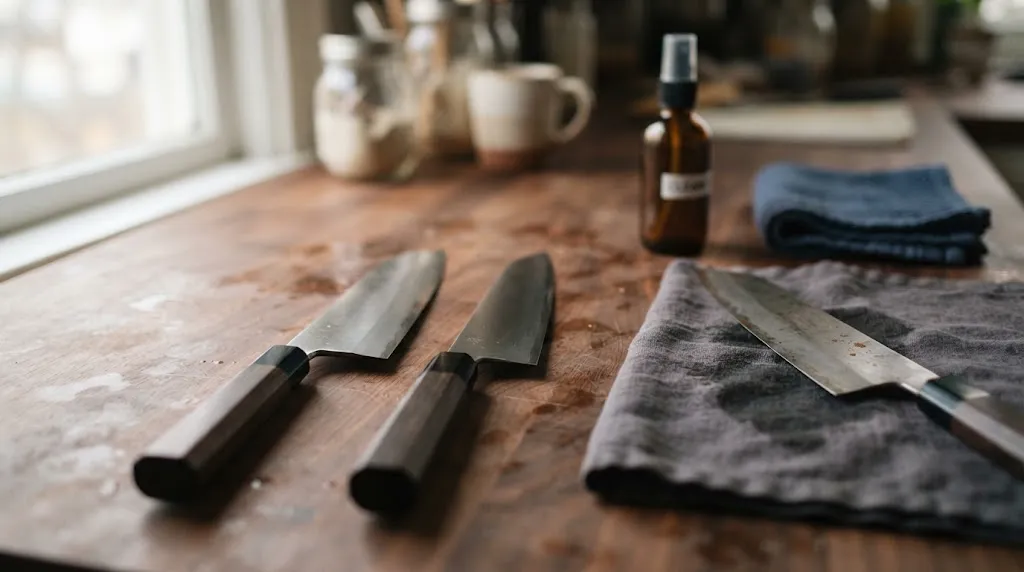
HRC is silent on several properties that matter just as much as hardness.
It does not measure sharpness. A soft knife can be sharpened to a fine edge; a hard knife can be left dull. Sharpness is a function of edge geometry and the sharpener’s skill.
It does not predict corrosion resistance. A high-carbon steel at 60 HRC may rust if left wet. A stainless steel at 55 HRC may resist corrosion far better. The chromium content, not the hardness, determines rust resistance.
It does not account for edge geometry. A thick, convex edge at 58 HRC and a thin, acute edge at 58 HRC will cut very differently. Geometry often matters more than hardness for day-to-day cutting feel.
When evaluating a chef knife, treat HRC as one data point. Combine it with the steel type, the manufacturer’s reputation for heat treatment, the blade grind, and your own maintenance habits. A knife is a system, not a single number.
Frequently Asked Questions
Is a higher HRC chef knife always sharper?
No. Sharpness depends on edge geometry and how the edge was ground and maintained. A 55 HRC knife can be sharper than a 62 HRC knife if it has a better edge. Hardness affects how long that sharpness lasts, not whether it can be achieved.
What HRC is best for a home cook?
For most home cooks, 56–60 HRC offers a practical balance. It holds an edge reasonably well, tolerates normal kitchen use without excessive chipping risk, and can be sharpened with standard equipment. Very high hardness knives are better suited to users who understand their limitations.
Can I sharpen a 62 HRC chef knife at home?
Yes, but it requires appropriate stones. Hard steels respond slowly to soft stones. Diamond plates or hard ceramic water stones in the 1000–3000 grit range work well. Expect the process to take longer than sharpening a softer German-style knife.
Why do German knives have lower HRC than Japanese knives?
German manufacturers prioritize toughness, ease of maintenance, and tolerance for rough handling in professional kitchens. Japanese makers prioritize edge retention and cutting precision. The different HRC targets reflect these different design philosophies, not a difference in quality.
Does HRC affect how often I need to hone my knife?
Yes. Softer blades benefit from regular honing because the edge rolls more readily. Harder blades above 60 HRC rarely need honing; they wear or micro-chip instead, and honing can accelerate edge degradation if done aggressively.
Is 58 HRC good for a chef knife?
58 HRC is a solid middle-ground specification. It sits in the balanced range where edge retention is noticeably better than entry-level German knives but the blade remains tough enough for everyday use and practical to sharpen. Many well-regarded hybrid knives target this range.
Conclusion
Chef knife HRC is a useful specification, but it is not a ranking. The number describes how hard the steel is, which in turn shapes how the edge behaves: how long it stays sharp, how it responds to impact, and how much effort sharpening requires.
For most cooks, the practical path is to choose an HRC range that matches your habits rather than chasing the highest number. If you want a knife you can use without worry and sharpen easily, look in the mid-50s. If you want longer edge life and are willing to cut carefully, look in the high 50s or low 60s. The best HRC is the one that fits how you actually cook.

