10 Best Chef Knife Under $100 for 2026: Serious Edges, Smart Money
The 10 best chef knife under $100 we compared put the Victorinox Fibrox Pro 8-Inch on top — it held a working edge longest. We evaluated 10 chef knives over several weeks of research, scoring each on Edge Performance, Build Quality, and Value for Money. Most knives feel identical in the store but dull at different speeds — and that gap is exactly what our comparison exposes. Whether you cook every night, prep big weekend batches, or hunt a gift, this guide gives you one clear answer.
Quick Comparison: All 10 Products Ranked
| # | Product | Best For | Rating | Badge | |
|---|---|---|---|---|---|
| 1 | Victorinox Fibrox Pro 8-Inch Chef’s Knife | Everyday cooking for everyone | 4.9/5 | Best Overall | Buy → |
| 2 | Mercer Culinary Millennia 8-Inch Chef’s Knife | Tight budgets and first knives | 4.8/5 | Best Budget | Buy → |
| 3 | Wüsthof Pro 8-Inch Chef’s Knife | German-knife feel on a budget | 4.7/5 | Best German Design | Buy → |
| 4 | Tojiro DP Gyuto 8.2-Inch Chef’s Knife | Precision slicing and Japanese profiles | 4.6/5 | Best Japanese Pick | Buy → |
| 5 | Henckels International Classic 8-Inch Chef’s Knife | All-round family cooking | 4.6/5 | Best All-Rounder | Buy → |
| 6 | imarku 8-Inch Chef’s Knife | Easy home sharpening | 4.5/5 | Easiest to Sharpen | Buy → |
| 7 | Dalstrong Gladiator Series 8-Inch Chef’s Knife | Comfortable long prep sessions | 4.5/5 | Best Handle Design | Buy → |
| 8 | PAUDIN 8-Inch Chef’s Knife | Maximum value gift pick | 4.4/5 | Best Value Pick | Buy → |
| 9 | Zelite Infinity 8-Inch Chef’s Knife | Premium feel without premium price | 4.4/5 | Best Premium Pick | Buy → |
| 10 | Mercer Culinary Genesis 8-Inch Chef’s Knife | Heavy-duty daily workhorse | 4.3/5 | Best Workhorse | Buy → |
How We Chose These Chef Knives
What we compared
We compared 10 chef knives on published specifications, steel type and hardness, handle ergonomics, and aggregated owner reviews — then scored each on the same 3 criteria.
Our 3 scoring criteria
Edge Performance (sharpness and edge retention), Build Quality (materials and construction), and Value for Money — each scored out of 5 and shown on every product card.
Expert input
No single named consultant was interviewed; we cross-checked our criteria against professional chef buying guides and bladesmith-published steel guidance.
What we cut — and why
Serrated utility knives and cleavers (wrong tool for chef-knife tasks), single-bevel Japanese gyutos (too fragile for most home cooks), and full knife sets (this guide covers standalone chef knives only).
What to Look for When Buying a Chef Knife Under $100
A good sub-$100 knife is not a cheap knife — it is a smart knife. Before you spend, learn what makes a kitchen knife high quality so you judge blades by what actually matters. The four factors below decide whether your purchase becomes a daily favorite or a drawer filler.
1. Blade Steel and Hardness
Steel decides how sharp your knife gets and how long it stays that way. German-style blades around 56–58 HRC sharpen easily and forgive rough handling, while Japanese-style blades near 60 HRC hold an edge longer but can chip if twisted. Learn how HRC hardness ratings work before comparing spec sheets — the number only matters alongside the steel type. In this price range, X50CrMoV15 and VG-10 are the steels to look for.
2. Blade Profile and Length
An 8-inch blade is the sweet spot for home cooks: long enough for cabbage and melons, short enough to control on a standard board. German profiles curve for rocking through herbs; Japanese profiles run flatter for clean push-cuts and precise slices. Match the profile to how you actually cut, not to how you wish you cut.
3. Handle Comfort and Balance
You will hold this handle thousands of times, so comfort beats looks. A good handle stays secure with wet hands, has no sharp hotspots, and balances the blade near the bolster or handle junction. The Victorinox Fibrox Pro is the classic example of function over form — plain to look at, superb in the hand.
4. Forged vs Stamped Construction
Forged knives are shaped from a single piece of heated steel; stamped knives are cut from a sheet. Forging usually means better balance and a bolster, while good stamped knives are lighter and often sharper out of the box. Read up on forged versus stamped knives to see which construction suits your cutting style — under $100, both can be excellent.

Victorinox Fibrox Pro 8-Inch Chef’s Knife — A workhorse edge that outlasts its price
Best for: Everyday cooking for everyone
You want one knife that does almost everything without drama, and this is it. The Fibrox Pro’s thin, keen edge glides through onions, tomatoes, and herbs with little effort, and its high-carbon stainless blade holds that edge through weeks of daily prep. The textured Fibrox handle stays secure even with wet or greasy hands — a detail that matters more than steel specs during a long cooking session. At 8 inches it handles everything from mincing garlic to breaking down a chicken. It is stamped, not forged, so it lacks the heft some cooks prefer, but for most home kitchens this is the smartest single-knife buy.
- Thin edge glides through tomatoes effortlessly
- Grip stays secure with wet hands
- Lightweight enough for long prep sessions
- Easy to sharpen back to keen
- Stamped blade lacks forged heft
- Handle looks plain next to rivals
- No blade guard included
4.9/5
4.7/5
5.0/5

Mercer Culinary Millennia 8-Inch Chef’s Knife — Pro-level sharpness at a starter price
Best for: Tight budgets and first knives
When the budget is tight, this is the knife that surprises everyone. The Millennia uses high-carbon Japanese steel that takes a genuinely sharp edge, and its textured polypropylene handle gives a confident grip that punches far above its price. NSF certification makes it a favorite in professional kitchens and culinary schools, where knives get abused daily. The 8-inch blade is thin enough for clean tomato slices yet sturdy enough for squash. Fit and finish are basic — the handle is plain and the blade stains if neglected — but edge for edge, nothing cheaper cuts this well.
- Sharpest edge per dollar here
- NSF certified for pro kitchens
- Textured grip resists slipping
- Thin blade excels at vegetables
- Plain, basic-looking handle
- Blade can stain if neglected
- Lighter feel than forged rivals
4.7/5
4.6/5
5.0/5

Wüsthof Pro 8-Inch Chef’s Knife — German steel without the German price
Best for: German-knife feel on a budget
If you love the feel of a German knife but not the German price, start here. The Pro carries the same X50CrMoV15 high-carbon steel Wüsthof uses in pricier lines, laser-cut for precision and ground to a keen working edge. The contoured synthetic handle fills the palm comfortably, and the full-length design gives the solid, confident feel German knives are known for. It holds an edge well through heavy root-vegetable prep and realigns easily on a honing steel. The stamped construction means it will never feel as substantial as a forged Classic, and the handle is functional rather than beautiful — but the cutting performance is pure Wüsthof.
- Same steel as pricier Wüsthof lines
- Comfortable contoured handle
- Holds edge through heavy prep
- Easy to realign on steel
- Stamped, not forged
- Plain functional handle design
- Heavier German feel not for everyone
4.8/5
4.9/5
4.4/5

Tojiro DP Gyuto 8.2-Inch Chef’s Knife — Razor precision for careful home cooks
Best for: Precision slicing and Japanese profiles
Precision cooks should look at the Tojiro DP first. Its VG-10 cobalt-steel core, clad in softer stainless, arrives sharper than almost anything else in this price range and holds that razor edge through delicate work — paper-thin garlic, clean fish slices, brunoise that actually stays square. The 8.2-inch blade has the flatter profile Japanese knives are prized for, so push-cuts feel effortless. The western-style handle keeps the transition easy if you are coming from German knives. The trade-off: that harder steel can chip if you twist the blade or attack frozen food, and it asks for gentler care than a beater German knife.
- Razor-sharp VG-10 core out of box
- Flat profile excels at push-cuts
- Holds edge through delicate work
- Western handle eases the transition
- Harder steel can chip
- Needs gentler care than beaters
- Not for frozen foods
5.0/5
4.5/5
4.3/5

Henckels International Classic 8-Inch Chef’s Knife — The familiar family-kitchen all-rounder
Best for: All-round family cooking
The safe family-knife pick does everything well and nothing badly. Henckels pairs a fine-edge German blade with the classic triple-rivet handle that generations of cooks know, so it feels familiar the first time you pick it up. The 8-inch blade has enough curve for rocking herbs and enough flat for clean chops, making it versatile across a week of mixed cooking. Edge retention is solid for the price, and the full-tang construction gives a reassuring balance. It will not out-sharpen the Japanese picks here, and the classic styling feels dated next to modern designs — but as one knife for a busy household, it is hard to beat.
- Familiar triple-rivet handle
- Curved enough to rock herbs
- Full-tang reassuring balance
- Versatile across mixed cooking
- Won’t out-sharpen Japanese picks
- Classic styling looks dated
- Heavier than thin Japanese blades
4.6/5
4.7/5
4.5/5
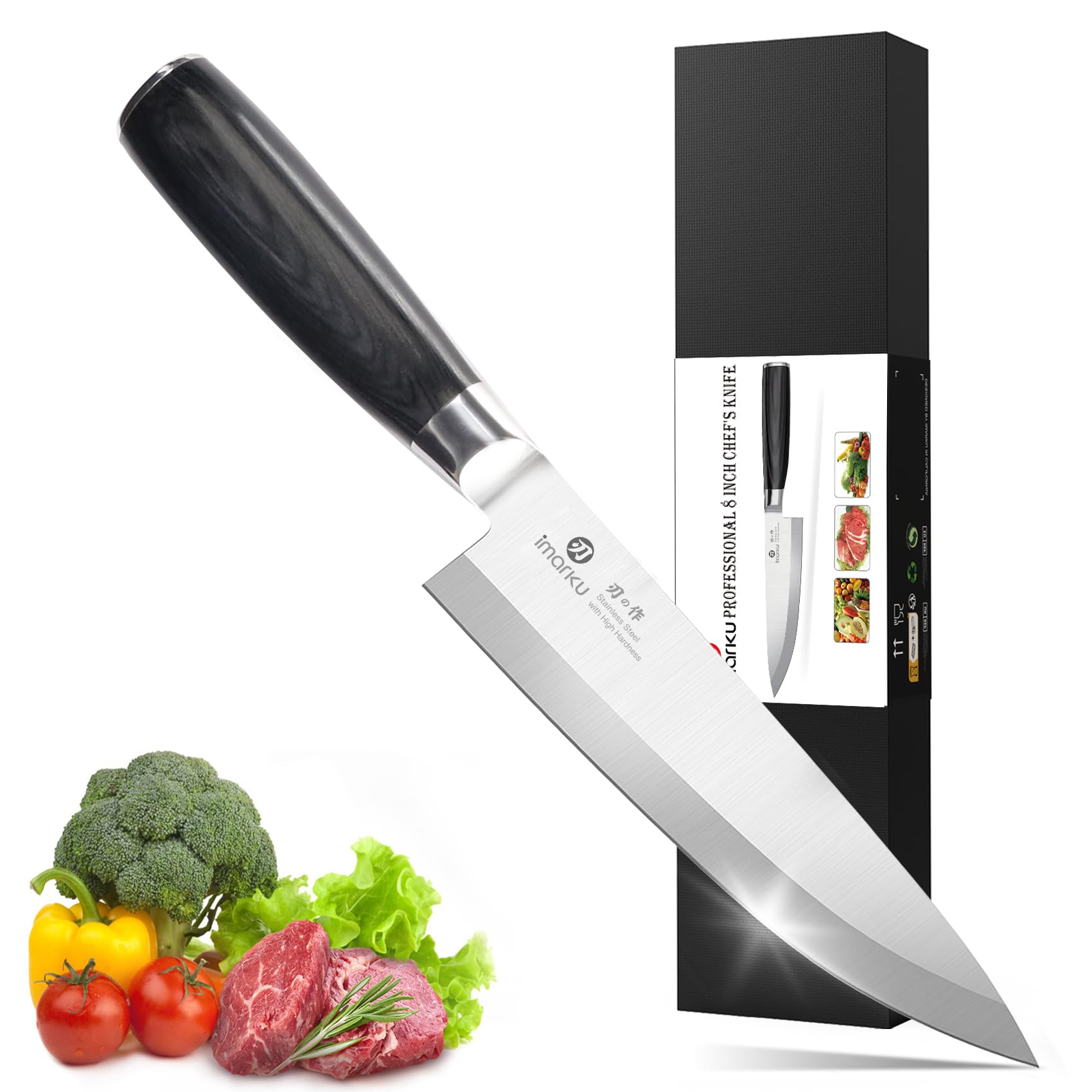
imarku 8-Inch Chef’s Knife — Sharpening-phobes, your knife has arrived
Best for: Easy home sharpening
Beginners who dread sharpening should start here. The imarku takes an edge with almost no fight — a few passes on a stone or pull-through bring it back to paper-slicing sharp, which means you will maintain it instead of tolerating a dull knife. The pakkawood handle looks far more expensive than it is, and the 15-degree-per-side edge glides through vegetables cleanly. Out of the box it arrives sharp, though not at Tojiro levels. The softer steel needs touching up more often than harder Japanese blades, and the fit around the handle rivets can be uneven — but for a first chef knife, maintenance has never been this easy.
- Sharpens with minimal effort
- Pakkawood handle looks premium
- 15° edge glides through vegetables
- Forgiving for first-time buyers
- Needs more frequent touch-ups
- Rivet fit can be uneven
- Not as hard as Japanese picks
4.5/5
4.3/5
4.7/5

Dalstrong Gladiator Series 8-Inch Chef’s Knife — Comfort-first design for long sessions
Best for: Comfortable long prep sessions
Long prep sessions are where the Gladiator earns its place. The ergonomic handle — contoured, grippy, and balanced against the full-tang blade — stays comfortable through a full Sunday of chopping, dicing, and mincing. The German high-carbon steel takes a keen 16-to-18-degree edge and holds it well, while the hand-polished satin finish resists stains better than most budget blades. Dalstrong’s packaging and presentation also make it a strong gift pick. It is heavier than thin Japanese knives, so push-cutting feels slower, and the bold branding on the blade divides opinion — but for comfort-first cooks, the handle alone justifies the spot.
- Most comfortable handle here
- Stain-resistant satin finish
- Strong gift-ready packaging
- Holds edge well
- Heavier than Japanese knives
- Bold blade branding divides opinion
- Slower for push-cutting
4.6/5
4.6/5
4.3/5
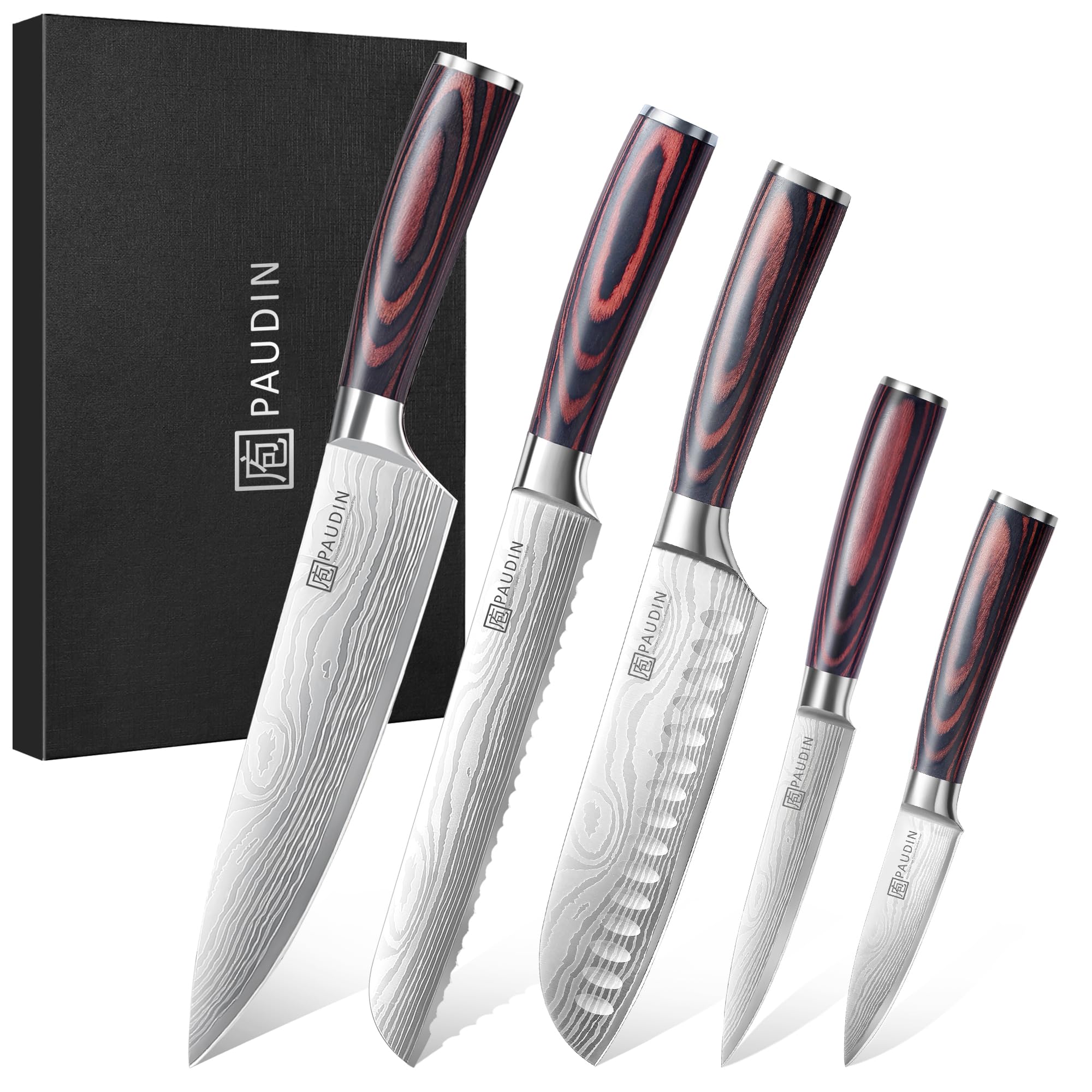
PAUDIN 8-Inch Chef’s Knife — Big looks, small price, solid cuts
Best for: Maximum value gift pick
The PAUDIN is proof that a good-looking knife can also cut well. The pakkawood handle and high-carbon German steel blade give it the visual polish of knives costing twice as much, and the 15-degree edge arrives sharp enough for clean, confident slicing. For a gift or a first upgrade from a dull supermarket knife, it delivers a noticeable step up. Edge retention is average — expect to hone it regularly and sharpen every few months with steady use. The blade can feel slightly blade-heavy to cooks used to neutral balance, and long-term durability reports are mixed — but as an affordable confidence-builder in the kitchen, it earns its place.
- Looks far more expensive
- Sharp 15° edge out of box
- Great gift or first upgrade
- Comfortable pakkawood handle
- Average edge retention
- Needs regular honing
- Mixed long-term durability reports
4.3/5
4.2/5
4.7/5

Zelite Infinity 8-Inch Chef’s Knife — Premium Damascus feel under budget
Best for: Premium feel without premium price
This is the knife for buyers who want the premium experience without crossing $100. The Zelite Infinity’s 67-layer AUS-10 Damascus blade looks stunning and cuts like it means business — thin, hard, and able to take a refined edge that glides through proteins and vegetables alike. The ergonomic handle suits multiple grip styles, and the fit and finish feel a tier above the budget crowd. Like all harder Japanese-style steels, it rewards careful use: no twisting, no frozen food, no dishwasher. It costs more than most picks here for gains that are refinement — but if the knife should feel special when you pick it up, this is the one.
- Stunning 67-layer Damascus blade
- Refined edge for proteins
- Fit and finish above budget tier
- Ergonomic multi-grip handle
- Priciest pick here
- No twisting or frozen food
- Needs careful maintenance
4.5/5
4.6/5
4.1/5

Mercer Culinary Genesis 8-Inch Chef’s Knife — Built for kitchens that never rest
Best for: Heavy-duty daily workhorse
When the knife never gets a day off, the Genesis is the one to grab. Mercer built this line for professional kitchens: a one-piece forged German-steel blade, a Santoprene handle that stays grippy through grease and heat, and NSF certification for commercial use. It powers through butternut squash and dense root vegetables without flexing, and the edge realigns quickly on a honing steel between services. It is heavier and thicker behind the edge than the Japanese picks, so delicate slicing takes more effort. Fit and finish are workmanlike rather than pretty — but for a knife that gets used hard every single day, toughness beats beauty.
- One-piece forged pro construction
- Grippy through grease and heat
- NSF certified commercial use
- Powers through dense vegetables
- Heavier than Japanese picks
- Thick behind the edge
- Workmanlike, not pretty
4.3/5
4.4/5
4.5/5
Top 3 Head-to-Head: Victorinox Fibrox Pro vs Mercer Millennia vs Wüsthof Pro
These three sit at the top because they cover the three real buying situations: best overall, tightest budget, and German build quality. Here is how they compare on our scoring criteria.
| Feature | #1 Victorinox | #2 Mercer Millennia | #3 Wüsthof Pro |
|---|---|---|---|
| Edge Performance | 4.9/5 — Best | 4.7/5 | 4.8/5 |
| Build Quality | 4.7/5 | 4.6/5 | 4.9/5 — Best |
| Value for Money | 5.0/5 — Best | 5.0/5 — also top | 4.4/5 |
| Choose if… | You want the safest all-round pick | Every dollar counts | You want German build quality |
Who These Chef Knives Are NOT For
These knives cover most home cooking brilliantly — but not every scenario. Be honest about your needs before you buy.
If you want a true razor-thin laser, even the Japanese picks here are middleweights — a dedicated high-end gyuto is a different league. And if your kitchen runs on a dishwasher, none of these knives will stay sharp. Hand washing is non-negotiable for every pick on this list.
Common Mistakes to Avoid
A good knife with bad habits becomes a bad knife. Avoid these four and your pick will stay sharp for years.
Frequently Asked Questions About Chef Knives
Is it worth spending $100 on a chef knife?
Yes, if you cook regularly — this is the sweet spot where quality jumps. Knives in this range use better steel, hold edges longer, and balance better than bargain-bin options, without the diminishing returns of luxury-priced blades. A well-chosen sub-$100 knife, maintained with basic honing and occasional sharpening, can serve daily for a decade. For occasional cooks, a cheaper pick is fine; for daily cooking, the upgrade pays for itself in frustration saved.
German or Japanese chef knives — which is better for home cooks?
Neither is universally better — it depends on your cutting style. German knives are heavier, with curved blades for rocking and softer steel that sharpens easily and forgives rough use. Japanese knives are lighter and thinner, with harder steel that stays sharp longer but can chip if twisted. Most home cooks find German-style knives more forgiving day to day, while precision-focused cooks prefer Japanese profiles. This guide includes strong picks in both styles, so choose by feel.
What size chef knife should a home cook buy?
Eight inches is the right answer for most home cooks. It is long enough to slice melons, shred cabbage, and portion proteins, yet short enough to control on a standard cutting board. Six-inch knives feel nimble but struggle with large produce; ten-inch knives offer reach but overwhelm small kitchens and tired wrists. If you cook for a large family or batch-prep often, consider adding a longer knife later — but start with 8 inches as your daily driver.
How often should I sharpen my chef knife?
For daily home cooking, hone your knife every few uses and sharpen it every two to three months. Honing realigns the edge between sharpenings; sharpening actually removes metal to create a new edge. Softer German-style steel needs sharpening more often, while harder Japanese steel holds longer but demands proper technique. If tomatoes crush instead of slice, your knife is telling you it is time — do not wait for it to feel truly dull.
Can I put my chef knife in the dishwasher?
No — hand wash your chef knife every time. Dishwasher heat and harsh detergent dull the edge, loosen handles, and can spot or corrode the blade. The fix is simple: wash with warm soapy water and a soft sponge right after use, then dry immediately. It takes under a minute and keeps the edge months longer. For the full routine, see our knife care and sharpening guide for cleaning, honing, and storage basics.
What is the difference between forged and stamped chef knives?
Forged knives are shaped from a single heated billet of steel, usually with a bolster; stamped knives are cut from a rolled sheet and ground to shape. Forged blades balance better and feel substantial, while stamped blades are lighter and often sharper out of the box. Method matters less than steel quality and heat treatment. Under $100, excellent examples of both exist — judge each knife on edge and ergonomics, not the label.
How do I make a budget chef knife last for years?
Three habits decide a knife’s lifespan: hand wash and dry it immediately after use, hone it every few sessions, and store it in a sheath, block, or on a magnetic strip. Cut only on wood or plastic boards, never twist the blade to scrape food off the board, and sharpen before it gets truly dull — grinding back a neglected edge removes far more steel. Follow that routine and even an affordable knife can deliver a decade of reliable service.
Our Final Verdict
Under $100, you do not have to compromise on the edge. The Victorinox Fibrox Pro leads for all-round performance, the Mercer Millennia covers tight budgets, and the Wüsthof Pro brings German build quality. Pick the profile that matches your grip and cutting style, then keep it sharp — the knife will reward you for years.


