
Does Eucalyptus Make a Good Cutting Board? Full Guide
Quick Answer
Yes, eucalyptus can make a good cutting board when the wood comes from a suitable species, has been properly dried, and features a food-safe finish. It offers attractive grain patterns and reasonable durability, although hardness varies considerably between species. Proper maintenance and safe food handling practices are essential.
What makes eucalyptus suitable for cutting boards?
- Good durability: Suitable eucalyptus species can withstand regular kitchen preparation.
- Moderate hardness: Some varieties offer a reasonable balance between durability and knife protection.
- Attractive appearance: Natural grain patterns complement modern and traditional kitchens.
- Renewable resource: Responsibly managed eucalyptus plantations can provide renewable hardwood.
- Regular maintenance: Handwashing, thorough drying, and periodic oiling help prevent damage.
- Species selection: Not every eucalyptus species is equally suitable for direct food contact.
My recommendation
- Choose carefully: Purchase eucalyptus boards specifically manufactured for food preparation rather than using unidentified eucalyptus lumber.
Eucalyptus might not be the first wood that comes to mind when shopping for a cutting board. However, its attractive appearance and useful hardwood properties make it an interesting alternative to maple, walnut, and acacia.
I prefer evaluating cutting board materials according to their practical performance rather than appearance alone. This guide explains eucalyptus hardness, food safety, knife compatibility, moisture resistance, and long-term maintenance.
What Is a Eucalyptus Cutting Board?
A eucalyptus cutting board is a food preparation surface manufactured from the timber of a eucalyptus tree. Depending on its construction, it may contain solid wood or several wooden strips joined together.
Eucalyptus refers to a large group of tree species rather than one specific type of timber. Their density, hardness, grain structure, and drying characteristics can differ significantly.
Common characteristics of eucalyptus wood
- Wood classification: Hardwood.
- Natural color: Pale brown, pinkish brown, or reddish brown, depending on the species.
- Grain pattern: Straight, interlocked, or irregular grain.
- Density: Moderate to high, depending on the species.
- Surface texture: Fine to moderately coarse.
- Common applications: Furniture, flooring, serving boards, kitchenware, and general woodworking.
These differences explain why two eucalyptus cutting boards may perform differently despite sharing the same material name.
Is Eucalyptus Wood Hard Enough for a Cutting Board?
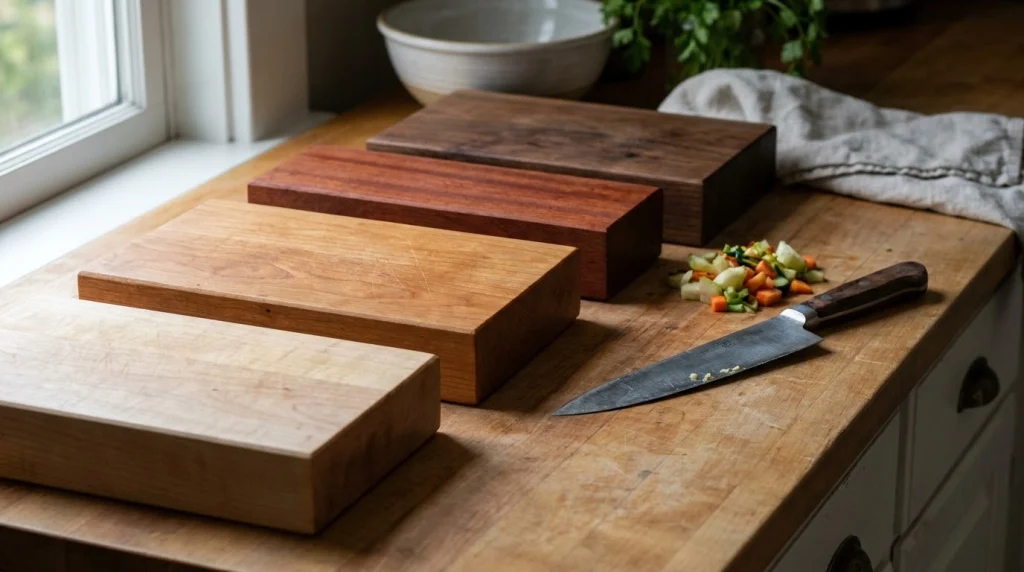
Certain eucalyptus species have suitable hardness for everyday cutting and chopping. However, exceptionally dense varieties may cause more knife wear than traditional cutting board hardwoods.
Wood hardness commonly uses the Janka hardness scale. This measurement describes how much force wood requires to resist indentation from a standardized steel ball.
Eucalyptus wood hardness
According to The Wood Database, rose gum, also known as Eucalyptus grandis, has a Janka hardness of approximately 1,260 pounds-force.
That places this particular species between black walnut and hard maple. However, these figures cannot represent every eucalyptus variety.
| Wood species | Janka hardness | Relative hardness | Typical kitchen application |
|---|---|---|---|
| Eucalyptus grandis | 1,260 lbf | Moderately hard | General preparation |
| Hard maple | 1,450 lbf | Hard | Daily chopping |
| Black walnut | 1,010 lbf | Moderate | Knife-friendly preparation |
| American cherry | 950 lbf | Moderately soft | Light chopping |
| Teak | 1,070 lbf | Moderate | General preparation |
Hardness values represent approximate species averages. Cutting board construction, moisture content, grain orientation, and mineral content also influence performance.
For everyday cooking, I would prioritize a moderately hard eucalyptus board over an unusually dense variety. Hardness alone does not determine overall cutting board quality.
Is Eucalyptus Wood Safe for Cutting Boards?
Eucalyptus wood can be suitable for cutting boards when manufacturers select appropriate timber and finish it for direct food contact. The name eucalyptus alone does not guarantee food safety.
The finished product matters as much as the wood species. Buyers should consider the adhesives, surface treatments, and manufacturing conditions.
What makes a eucalyptus board food-safe?
- Manufacturers identify the wood as suitable for kitchenware.
- The surface contains no harmful chemical treatments.
- Any adhesive is appropriate for its intended food-contact application.
- The finish is suitable for cutting boards.
- The wood has no mold, decay, or serious structural damage.
- The manufacturer specifically recommends the board for food preparation.
Are natural eucalyptus oils a concern?
Eucalyptus trees contain aromatic compounds, particularly in their leaves. Concentrated eucalyptus essential oil should not be confused with a properly manufactured wooden kitchen product.
Do not apply eucalyptus essential oil to a cutting board as a protective finish. Choose a conditioner specifically formulated for food-contact wooden surfaces instead.
A strong chemical odor, unexplained surface residue, or unidentified finish would make me avoid using a board for food preparation.
Benefits of Using a Eucalyptus Cutting Board
Eucalyptus offers several practical benefits when manufacturers select the right species and construction method. Its combination of appearance and durability makes it appealing for household kitchens.
1. Good durability
Suitable eucalyptus hardwood can tolerate the pressure associated with routine vegetable chopping and fruit preparation. Its resistance to indentation helps limit excessive surface damage.
A properly maintained board may provide years of service. Actual longevity depends on construction quality, usage, and moisture exposure.
2. Attractive natural appearance
Eucalyptus can feature warm reddish-brown tones and interesting grain patterns. These characteristics work well in both food preparation and presentation.
A food-safe eucalyptus board can serve several purposes:
- Chopping vegetables.
- Slicing fresh fruit.
- Preparing sandwiches.
- Serving cheese.
- Presenting bread and appetizers.
3. Potential environmental benefits
Many eucalyptus species grow relatively quickly under appropriate conditions. Responsible forestry practices can make plantation-grown eucalyptus a renewable source of timber.
However, rapid growth does not automatically make every eucalyptus product sustainable. Land management, biodiversity, transportation, and manufacturing also influence environmental impact.
When sustainability matters, look for independently certified sourcing rather than relying solely on marketing claims.
4. Reasonable resistance to everyday wear
Moderately hard eucalyptus can handle routine contact with kitchen knives. It generally offers better resistance to indentation than many softwoods.
Visible scratches remain normal on wooden cutting boards. They do not necessarily indicate that the material is defective.
5. Versatile kitchen applications
A well-designed eucalyptus board can work as both a preparation surface and a serving accessory. This versatility is useful in kitchens with limited storage space.
I would particularly consider one for produce preparation and serving bread or cheese.
What Are the Disadvantages of Eucalyptus Cutting Boards?
The main disadvantages include inconsistent species characteristics, potential moisture-related movement, and limited information about unfamiliar products. Some eucalyptus varieties may also be too hard for comfortable daily knife work.
Common disadvantages
- Variable hardness: Different species can have substantially different densities and resistance to indentation.
- Warping potential: Uneven moisture exposure may cause the board to curve or twist.
- Cracking risk: Poor drying and repeated moisture changes can contribute to splits.
- Maintenance requirements: Wooden boards generally require handwashing and occasional conditioning.
- Limited identification: Some manufacturers do not disclose the exact eucalyptus species.
- Knife wear: Particularly hard or abrasive varieties may accelerate blade dulling.
These disadvantages are not unique to eucalyptus. Many wooden cutting boards develop similar problems when manufacturing quality or maintenance is inadequate.
Does Eucalyptus Wood Dull Kitchen Knives?
Eucalyptus may dull kitchen knives faster than softer hardwoods, depending on the species and grain orientation. Moderately hard varieties can offer a reasonable cutting surface for ordinary kitchen knives.
Several factors determine how a board affects your knife edge:
- The hardness of the wood species.
- The direction of the wood grain.
- The presence of abrasive mineral particles.
- The pressure applied during chopping.
- The condition and sharpness of the knife.
- The cutting board’s surface finish.
End grain vs. edge grain eucalyptus boards
End-grain boards expose the ends of the wood fibers on the cutting surface. Edge-grain boards expose the long sides of those fibers.
A well-made end-grain board may reduce some cutting resistance because its fibers can separate slightly under a knife. Edge-grain construction is generally simpler and can offer excellent performance at a more accessible price.
Neither construction eliminates knife wear. A sharp knife and controlled cutting technique remain important.
Is Eucalyptus Wood Water-Resistant?
Some eucalyptus species offer useful natural moisture resistance, but eucalyptus cutting boards are not waterproof. They can absorb moisture and change shape during repeated wetting and drying.
Wood expands and contracts as its moisture content changes. Uneven exposure can create internal stress and eventually damage the board.
How moisture damages wooden boards
- Water enters exposed wood fibers.
- The affected areas expand.
- Uneven drying creates internal tension.
- Repeated cycles may produce cracks or warping.
- Gaps can develop around glued joints.
Never leave a eucalyptus cutting board submerged in a sink. Promptly remove excess water after washing and allow both sides to dry evenly.
Eucalyptus vs. Maple vs. Walnut vs. Acacia Cutting Boards
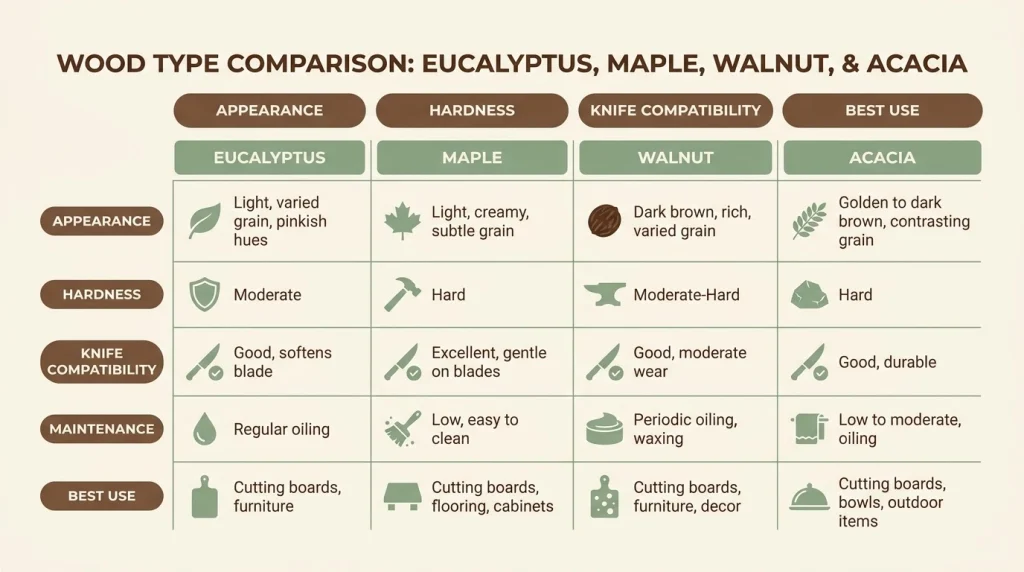
Eucalyptus can be a practical alternative to traditional hardwoods, but maple remains a dependable choice for frequent chopping. Walnut offers a softer cutting surface, while acacia provides a wide variety of attractive grain patterns.
| Feature | Eucalyptus | Maple | Walnut | Acacia |
|---|---|---|---|---|
| Hardness | Species-dependent | High | Moderate | Species-dependent |
| Knife compatibility | Variable | Good | Good | Variable |
| Appearance | Warm reddish tones | Light cream | Dark brown | Mixed brown tones |
| Maintenance | Regular | Regular | Regular | Regular |
| Best use | Prep and serving | Daily chopping | Precision slicing | General use |
Which cutting board wood should you choose?
- Choose eucalyptus: When you want an attractive hardwood board with clearly documented food-contact suitability.
- Choose maple: When frequent food preparation and predictable material properties are priorities.
- Choose walnut: When you prefer darker wood and a relatively forgiving cutting surface.
- Choose acacia: When decorative grain patterns and versatility matter.
For someone buying their first premium wooden cutting board in 2026, hard maple remains my conservative recommendation. Eucalyptus is worth considering when the manufacturer provides adequate material information.
Can You Cut Raw Meat on a Eucalyptus Cutting Board?
You can prepare raw meat on a eucalyptus board specifically designed for food preparation, provided you clean and sanitize it correctly. However, keeping a separate board for raw animal products simplifies kitchen hygiene.
The USDA’s cutting board guidance recommends separating raw meat preparation from fresh produce whenever possible.
Recommended cutting board arrangement
- Eucalyptus board: Vegetables, fruit, bread, and ready-to-eat foods.
- Separate nonporous board: Raw poultry, meat, and seafood.
- Serving board: Cooked foods, cheese, and appetizers.
For example, when preparing chicken and salad for dinner, I would reserve the wooden board for the salad ingredients. A separate dishwasher-safe board would handle the raw chicken.
How to Clean a Eucalyptus Cutting Board
Clean a eucalyptus cutting board using dish soap, warm to hot water, and a soft brush or sponge. Avoid prolonged soaking and excessive heat.
- Remove food particles: Scrape away leftover ingredients without damaging the wood.
- Wash the surface: Apply dish soap and scrub away visible residue.
- Clean both sides: Briefly wash all exposed surfaces to limit uneven moisture exposure.
- Rinse thoroughly: Remove all remaining soap and food particles.
- Sanitize when necessary: Use an appropriate food-contact sanitizer according to its directions and the board’s care instructions.
- Remove excess water: Wipe the board with a clean towel.
- Air-dry upright: Position the board so air can circulate around both faces.
For additional hygiene guidance, the University of Illinois Extension cutting board guide explains appropriate cleaning and sanitizing practices.
Cleaning methods to avoid
- Putting the board in a dishwasher unless the manufacturer explicitly permits it.
- Leaving the board submerged overnight.
- Using abrasive metal scouring pads.
- Applying undiluted household bleach.
- Drying the board directly over a stove.
- Storing the board while it is still damp.
How to Oil a Eucalyptus Cutting Board
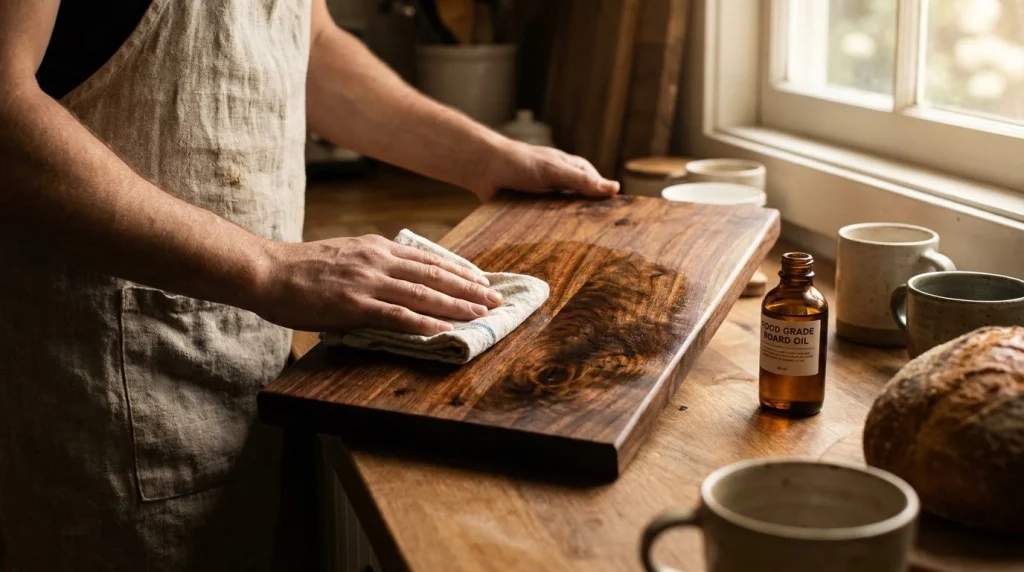
Food-grade mineral oil is a common conditioner for unfinished wooden cutting boards. It helps limit moisture absorption and prevents the surface from becoming excessively dry.
Always check the manufacturer’s finishing instructions before applying oil, especially if the board already has a specialized coating.
Step-by-step oiling instructions
- Clean the cutting board thoroughly.
- Allow every surface to dry completely.
- Apply a thin layer of food-grade cutting board oil.
- Spread the oil evenly across the faces and edges.
- Allow the oil to penetrate according to the product instructions.
- Wipe away the remaining surface oil.
- Repeat when the wood begins looking dry.
How often should you oil eucalyptus wood?
Inspect the cutting board approximately once a month as a starting point. Heavy use and frequent washing may increase its conditioning requirements.
Common signs that an oil-finished board needs attention include:
- A pale or faded appearance.
- Unusually rough surface fibers.
- Dry-looking edges.
- Uneven surface color.
- Rapid absorption of water droplets.
Ordinary vegetable oils, olive oil, and butter are not my preferred conditioners. Many cooking fats can develop unpleasant odors as they deteriorate.
How Long Does a Eucalyptus Cutting Board Last?
A quality eucalyptus cutting board may last several years with suitable care. There is no reliable universal lifespan because species, construction, usage, and environmental conditions differ.
Look for structural damage rather than replacing a board according to an arbitrary schedule.
Signs your eucalyptus board needs replacing
- Deep cracks that cannot be cleaned properly.
- Separation between glued wooden strips.
- Persistent mold growth.
- Severe warping that makes chopping unstable.
- Splintering or loose wooden fragments.
- Deep grooves that prevent effective cleaning.
Minor cosmetic scratches may not require replacement. Serious structural damage deserves immediate attention because it can affect hygiene and stability.
What to Look for When Buying a Eucalyptus Cutting Board
Choose a eucalyptus board with clearly documented food-contact suitability, stable construction, and a smooth cutting surface. Avoid buying solely according to appearance or price.
Buying checklist
- Wood identification: Prefer manufacturers that disclose the eucalyptus species.
- Food-contact suitability: Confirm that the product is intended for chopping food.
- Board dimensions: An 18-by-12-inch board offers a useful starting size for general kitchen preparation.
- Thickness: Consider approximately 1 to 1.5 inches for a substantial everyday wooden board.
- Surface quality: Check for cracks, rough patches, and exposed adhesive.
- Stability: Choose a flat board that does not rock during cutting.
- Care instructions: Look for clear washing and conditioning recommendations.
- Responsible sourcing: Consider independently certified timber when available.
Remember that some decorative eucalyptus serving boards are not designed for repeated knife contact. Check the intended application before purchasing.
Recommended Products for Wooden Cutting Boards
If you are comparing eucalyptus with conventional hardwoods or need a suitable maintenance product, these two options are worth considering.
As an Amazon Associate, I earn from qualifying purchases. Recommendations are based on published product specifications and practical suitability rather than hands-on testing.
🏆 Best hardwood alternative
John Boos Chop-N-Slice Maple Cutting Board
Recommended for everyday chopping
This reversible hard maple cutting board is available in an 18-by-12-inch size with a 1.25-inch thickness. I would choose it when consistent hardwood properties and daily chopping performance matter most.
🛡️ Best for wood maintenance
Howard Cutting Board Oil BBB012
Recommended for compatible oil-finished boards
This 12-ounce cutting board conditioner contains food-grade mineral oil. I recommend it for compatible wooden kitchen surfaces that require regular moisture conditioning.
Frequently Asked Questions
Is eucalyptus better than bamboo for cutting boards?
Eucalyptus may offer a more forgiving cutting surface than some bamboo boards, depending on the species and construction. Bamboo can provide good resistance to everyday wear, but its hardness and adhesive construction vary considerably, making product quality more important than the material name alone.
Is eucalyptus wood naturally antibacterial?
Some eucalyptus extracts demonstrate antimicrobial properties under specific laboratory conditions, but that does not establish that finished eucalyptus cutting boards reliably kill harmful bacteria. You should always wash and appropriately sanitize your board instead of relying on presumed natural antibacterial properties.
Can you put a eucalyptus cutting board in the dishwasher?
Most eucalyptus cutting boards should not go in the dishwasher because prolonged water exposure and high temperatures can damage wood and adhesives. Handwash your board with dish soap, remove excess moisture, and allow it to air-dry completely unless the manufacturer specifies otherwise.
What is the best oil for a eucalyptus cutting board?
Food-grade mineral oil is a common choice for compatible eucalyptus cutting boards because it resists rancidity and helps condition exposed wood fibers. A food-contact board conditioner containing mineral oil and suitable waxes may also work, provided the manufacturer recommends that type of treatment.
Can you make a cutting board from a eucalyptus tree?
You can make a cutting board from suitable eucalyptus timber, but you must identify the species, establish its suitability for food contact, dry it properly, and use appropriate adhesives and finishes. Avoid unidentified, chemically treated, decayed, or freshly harvested timber for direct food preparation.
Final Verdict: Is Eucalyptus a Good Cutting Board Material?
Eucalyptus can make a good cutting board when manufacturers use suitable hardwood and food-contact materials. It offers attractive grain patterns, useful durability, and versatile kitchen applications.
Its biggest limitation is the variation between species. Without reliable material information, predicting knife compatibility and long-term performance becomes difficult.
Here is what I recommend:
- Choose eucalyptus for everyday produce preparation and attractive food presentation.
- Choose hard maple if you want a more established hardwood for frequent chopping.
- Confirm that the manufacturer approves the finished product for food preparation.
- Handwash, dry thoroughly, and condition the board according to its care instructions.
Ultimately, a quality eucalyptus cutting board can be a worthwhile addition to your kitchen. Prioritize food-contact suitability, stable construction, and proper maintenance over decorative appearance alone.

