Chef Knife Toughness: Why Hardness Isn’t Everything
Quick Answer
Chef knife toughness refers to a blade’s ability to absorb impact and resist chipping, cracking, or snapping under stress. It is not the same as hardness. A tougher blade is more forgiving when it hits a bone, a hard pit, or a cutting board at an angle, but it usually trades some edge retention for that durability. The right balance depends on how you use the knife, not on chasing the highest possible hardness rating.
What Chef Knife Toughness Actually Means
Toughness describes how a steel behaves when force is applied. A tough blade bends, deforms, or absorbs energy without fracturing. A brittle blade may hold a very fine edge, but it is more likely to chip or break when it meets something hard or receives a sideways load.
This distinction matters because many buyers assume harder always means better. Hardness, measured on the Rockwell C scale (HRC), tells you how resistant the steel is to indentation and wear. It is closely linked to edge retention. But hardness and toughness pull in opposite directions in most knife steels. As hardness rises, toughness typically falls.
A chef knife with excellent toughness can survive the messy realities of a kitchen: a slight twist while dicing a butternut squash, contact with a chicken joint, or an uneven strike against a plastic board. A knife with poor toughness may perform beautifully on soft vegetables and then chip the first time it meets resistance.
Why Hardness Alone Is a Misleading Number
Rockwell hardness is one of the most visible specifications on a knife listing. A blade rated at 62 HRC sounds more advanced than one at 56 HRC. In practice, that higher number tells you the steel can take a thinner, more acute edge and hold it longer. It does not tell you whether the blade will survive a careless moment.
The common oversimplification is that harder steel equals better steel. The more accurate statement is that harder steel equals a different set of tradeoffs. Very hard steels can be sharpened to aggressive angles and keep that edge through extended slicing. They also demand more care. Lateral pressure, hard impacts, and frozen foods become genuine risks.
Key Insight
A chef knife’s toughness is determined by far more than its HRC rating. Steel composition, heat treatment, blade geometry, and grinding all influence whether a blade chips or holds together. Two knives at the same hardness can behave very differently in the kitchen.
How Steel Type Shapes Toughness
 Save
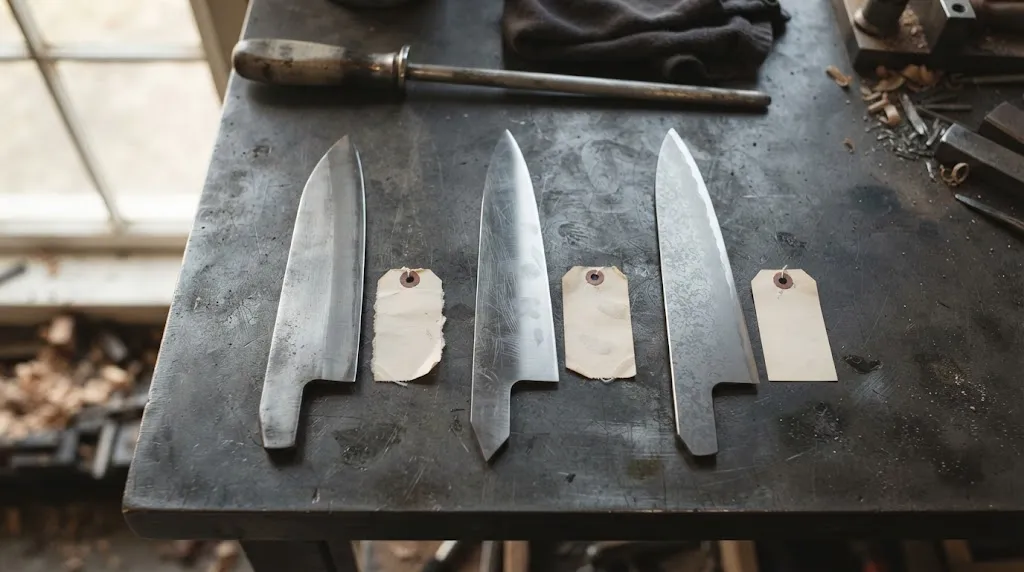
Different families of knife steel occupy different positions on the hardness-toughness spectrum.
German-style stainless steels, such as X50CrMoV15, are commonly heat-treated to roughly 54–56 HRC. At that hardness, the steel remains ductile enough to roll rather than chip under stress. The edge may need more frequent honing, but it is forgiving in heavy-use environments. A rolled edge can often be realigned with a honing rod in seconds. A chipped edge requires grinding.
Japanese-style steels often run harder. VG-10, a widely used stainless steel in Japanese knives, is frequently treated to around 60 HRC. It offers strong edge retention and takes a keen edge, but it is less tolerant of abuse than a softer German steel. AUS-8 sits in a similar middle ground, balancing reasonable hardness with practical toughness.
Powder-metallurgy steels such as CPM-MagnaCut represent a more recent attempt to break the old tradeoff. MagnaCut is designed to combine high edge retention, good toughness, and stainless corrosion resistance in one alloy, a combination that was difficult to achieve with conventional steels. These steels are not magic, but they narrow the gap between hardness and durability.
| Steel Family | Typical HRC | Toughness Tendency | Practical Behavior |
|---|---|---|---|
| German stainless (X50CrMoV15) | 54–56 | High | Rolls rather than chips; easy to maintain |
| Japanese stainless (VG-10, AUS-8) | 58–61 | Moderate | Sharp edge, less forgiving of lateral stress |
| Powder metallurgy (MagnaCut, CPM-154) | 58–63 | Moderate to high | Balanced performance; depends on heat treat |
The table above is a simplification. Heat treatment can shift a steel’s behavior significantly, and two knives made from the same alloy by different manufacturers may perform differently at the same stated hardness.
The Role of Heat Treatment and Geometry
Steel composition sets the boundaries, but heat treatment determines where within those boundaries a blade actually lands. A poorly heat-treated VG-10 blade can be brittle or soft. A carefully treated German steel can deliver better-than-expected edge retention.
Geometry matters just as much. A very thin blade behind the edge cuts with less resistance, but it has less material to absorb impact. A thicker grind is more durable but sacrifices some slicing ease. The edge angle follows the same logic: a 12-degree edge is sharper but more fragile than a 15- or 17-degree edge.
This is why toughness cannot be judged from a steel name alone. A knife maker who understands the intended use will adjust hardness, grind, and edge angle together. A laser-thin gyuto and a workhorse chef knife may both be called “chef knives,” but they are built for different levels of stress.
When Toughness Matters Most in the Kitchen
Toughness becomes a practical concern in specific situations:
- Breaking down poultry or fish: Contact with joints and small bones creates localized impact. A brittle edge may chip.
- Cutting hard produce: Squash, pumpkin, and dense root vegetables can require force and occasional lateral pressure.
- Rocking cuts: A rocking motion concentrates stress near the belly of the blade. Hard, thin edges are more vulnerable.
- Shared kitchens: When a knife is used by multiple people with different habits, a tougher blade tolerates more inconsistency.
- Frozen or semi-frozen food: Even a tough knife should not be used on fully frozen blocks, but a brittle blade is at greater risk from cold, hard food.
For delicate precision work on soft ingredients, a harder, thinner blade is often the better tool. For a single knife that must handle everything with minimal fuss, toughness deserves more weight.
What Actually Damages a Chef Knife Edge
Chips and cracks rarely come from normal cutting. They usually result from forces the edge was not designed to handle.
Lateral torque is a common culprit. Twisting the blade while it is inside a dense ingredient concentrates stress sideways across the edge. A hard steel may chip; a tougher steel may roll or indent.
Impact is another. Hitting a bone, a pit, or the edge of a cutting board sends a shock through the blade. Thinner edges are more vulnerable because there is less steel supporting the cutting apex.
Improper storage causes damage that is easy to overlook. A knife rattling in a drawer or knocking against another tool can sustain micro-chips along the edge. A blade guard or magnetic strip removes that risk.
Warning
Do not use any chef knife, regardless of toughness, to cut fully frozen food or bones. Even tough steels can be damaged by tasks beyond their design limits. If a job requires chopping through bone, use a cleaver intended for that purpose.
How to Choose a Chef Knife With the Right Balance
 Save
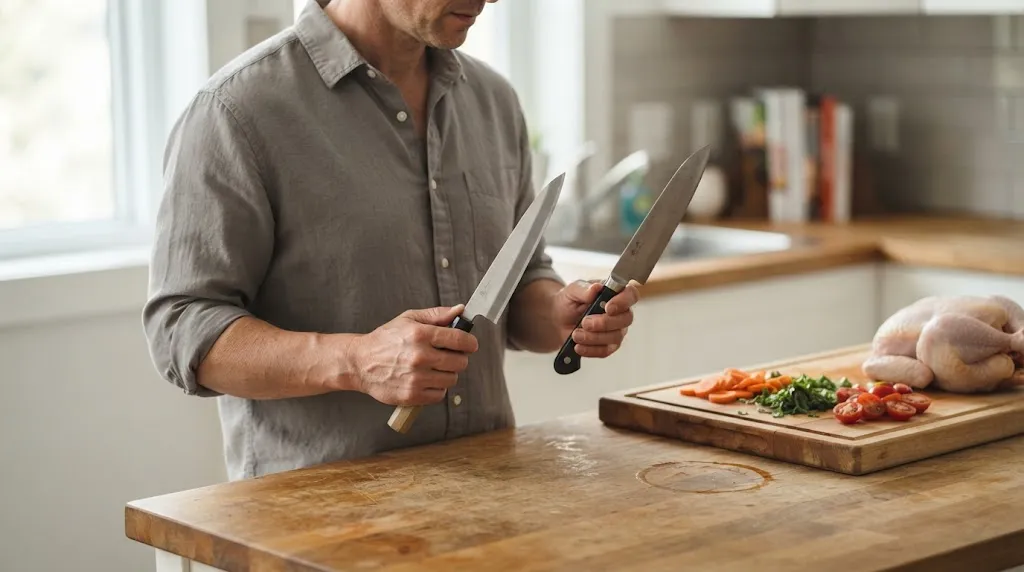
Start with how you actually cook. If you prepare mostly vegetables, herbs, and boneless proteins with controlled cuts, a harder Japanese-style blade at 60 HRC or above can deliver excellent sharpness and edge life. You will need to accept that the edge is less tolerant of careless contact.
If you break down whole chickens, work with dense produce, or share your kitchen with other cooks, a tougher blade in the 56–58 HRC range is often the more practical choice. You may hone it more often, but you are less likely to face a repair job.
If you want one knife that covers a wide middle ground, look for a steel and heat treatment that prioritize balance rather than a headline hardness number. Powder-metallurgy steels and well-treated mid-hardness stainless steels can serve this role well.
For readers who want to go deeper into the broader category, our guide to choosing and using a chef knife covers blade shapes, sizes, and handling. If you are specifically concerned about keeping an edge in good condition, the article on knife sharpening fundamentals explains how to maintain different edge types without removing unnecessary steel.
Toughness and Sharpening: A Practical Relationship
A tougher steel is generally easier to sharpen and maintain. It responds well to honing rods because the edge can realign rather than fracture. A very hard steel may hold an edge longer but can require more careful sharpening to avoid removing excess material or worsening existing micro-chips.
This does not mean hard steels are impractical. It means the maintenance routine should match the blade. A 62 HRC knife benefits from a light touch and periodic whetstone sharpening. A 55 HRC knife can be kept serviceable with regular honing and less frequent sharpening sessions.
The best approach is to avoid treating hardness as a quality score. Treat it as one specification among several, and match it to the way the knife will actually be used.
Related Product
Honing rod for edge maintenance
A honing rod helps realign the edge on tougher steels between sharpenings, keeping a chef knife working longer with less steel removal.
As an Amazon Associate, we earn from qualifying purchases.
Frequently Asked Questions
Is a tougher chef knife always better?
No. Toughness is a tradeoff. A tougher blade usually gives up some edge retention or ultimate sharpness. The right choice depends on whether you prioritize durability under hard use or maximum cutting performance on soft ingredients.
What HRC is considered tough for a chef knife?
There is no single cutoff, but chef knives in the 54–57 HRC range are generally considered tough and forgiving. Blades at 60 HRC and above tend to prioritize hardness and edge retention, with less tolerance for impact and lateral stress.
Can a hard chef knife still be tough?
It can be tougher than expected, depending on steel composition and heat treatment. Powder-metallurgy steels such as CPM-MagnaCut are designed to deliver a combination of hardness, toughness, and corrosion resistance that conventional steels struggle to match.
Does toughness affect how often I need to sharpen?
Indirectly. A tougher, softer steel may dull faster in normal cutting but is less likely to chip. A harder steel holds its edge longer but may need more careful repair if damaged. Sharpening frequency depends on both edge retention and how well the knife is treated.
Can I make a brittle knife tougher by sharpening it differently?
You can reduce chip risk by using a slightly wider edge angle and avoiding thin, acute grinds on a hard blade. But sharpening cannot change the steel’s fundamental toughness. Geometry can only compensate so much.
Is German steel tougher than Japanese steel?
Generally, yes, in the context of typical kitchen knife heat treatments. German-style steels are usually run softer, which makes them more resistant to chipping and rolling. Japanese steels are often harder, which improves sharpness and edge retention at the cost of some durability. There are exceptions on both sides.
Conclusion
Chef knife toughness is not a spec to maximize blindly. It is a property that determines how a blade behaves when the work gets imperfect. A tough knife forgives a slight twist, a moment of carelessness, or an unexpected bone. A hard knife rewards precision with longer edge life and a keener cut.
The most useful approach is to match the knife to the kitchen. If you need one tool that handles mixed tasks with minimal risk, prioritize a balanced steel in the mid-to-high 50s HRC range. If you cut with control and want the sharpest edge for the longest time, a harder blade can serve you well, provided you respect its limits.

