Chef Knife vs Kitchen Knife: What’s the Difference?
Quick Answer
A chef’s knife is a specific type of kitchen knife, while “kitchen knife” is a broad term for knives used to prepare food. That means a chef’s knife is a kitchen knife, but a kitchen knife can also be a paring, bread, utility, boning, carving, or other specialized knife. If you want one versatile blade for chopping, slicing, dicing, and mincing, a chef’s knife is usually the more relevant choice.
Why the Terms Cause Confusion
The confusion comes from everyday language. A retailer or cook may call an ordinary chef’s knife simply a “kitchen knife,” especially when comparing it with specialty blades. Technically, the terms describe different levels of the same category: kitchen knife is the family; chef’s knife is one member of that family.
A useful way to think about it is “vehicle” versus “sedan.” A sedan is a vehicle, but not every vehicle is a sedan. Likewise, a chef’s knife belongs to the kitchen-knife category, but the category includes many other designs.
This distinction matters when you are shopping or replacing a knife. If a listing says “kitchen knife,” do not assume you are getting a chef’s knife. Look at the blade shape and intended use.
Chef’s Knife: What It Is and What It Does
A chef’s knife is an all-purpose food-preparation knife designed to handle many board tasks with one blade. Typical Western chef’s knives have a broad blade, a pointed tip, and a curved cutting edge that supports rocking or slicing motions. Eight inches is a common size, although chef’s knives are available shorter and longer.
The broad heel gives you a substantial cutting area for onions, carrots, potatoes, herbs, and other ingredients. The tip is useful for more controlled cuts, while the long edge can make it easier to slice through larger ingredients in fewer strokes.
A chef’s knife is particularly useful for chopping vegetables, dicing, slicing boneless meat, mincing herbs, and crushing garlic with the side of the blade. It is a generalist: it handles many jobs reasonably well rather than being optimized for one narrow task.
That versatility is why an ordinary home cook can often do most day-to-day prep with a chef’s knife plus one or two specialty knives.
For example, how to dice an onion properly is exactly the sort of board work a chef’s knife is designed to handle.
Kitchen Knife: What the Term Actually Means
 Save
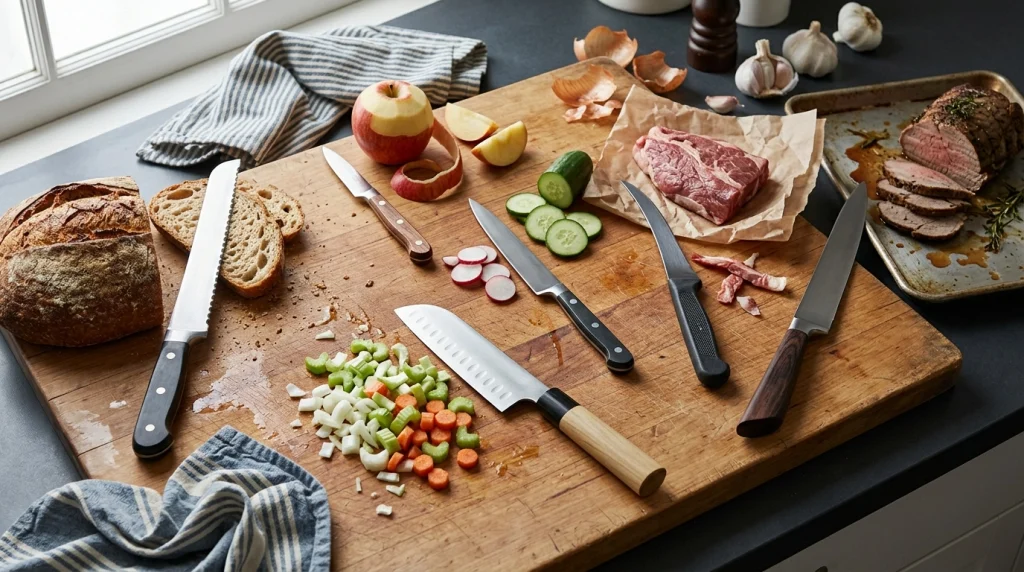
Save“Kitchen knife” is a category rather than one fixed blade design. It can refer to almost any knife intended for food preparation, so its size, edge, thickness, flexibility, and shape depend on the particular type.
Examples include:
- Paring knives for small, precise work such as peeling and trimming.
- Bread knives with serrated edges for cutting through crusty loaves.
- Utility knives for smaller slicing jobs that sit between a paring knife and a full-size chef’s knife.
- Boning knives for separating meat or poultry from bones.
- Carving or slicing knives for cutting cooked roasts into even slices.
- Santoku knives, another general-purpose style with a different blade profile and cutting feel.
So there is no meaningful “standard kitchen knife” specification. If someone says “kitchen knife,” you need the specific knife type before you can predict how it will perform.
That broader meaning is consistent with the way knife terminology is used by manufacturers and culinary references: a chef’s knife is a particular all-purpose design, while kitchen knives encompass multiple specialized forms. WÜSTHOF’s chef’s knife guide, for example, describes its chef’s knives as all-purpose kitchen tools.
Chef Knife vs Kitchen Knife: The Practical Differences
| Feature | Kitchen Knife | Chef’s Knife |
|---|---|---|
| Definition | Broad category of food-preparation knives | Specific all-purpose knife type |
| Shape | Varies by knife type | Typically broad, pointed, and curved |
| Main role | Specialized or general-purpose | General everyday food preparation |
| Typical tasks | Depends on the specific knife | Chopping, slicing, dicing, and mincing |
| Size | No single standard | Often around 8 inches, with other sizes available |
The important point is that these are not two competing knife categories. The chef’s knife sits inside the larger kitchen-knife category. Comparing them as though you must choose between two completely different knife types can therefore be misleading.
Does a Chef’s Knife Replace Other Kitchen Knives?
Not completely. A chef’s knife can cover a large share of everyday prep, but specialized knives exist because some tasks are easier or better controlled with a different blade.
A paring knife is more comfortable for small in-hand work. A serrated bread knife is better suited to crusty bread and other foods where a serrated edge has an advantage. A boning knife is designed to work around bones, where a chef’s knife is too broad and rigid for precise separation.
If you regularly work with poultry or meat, a boning knife guide can help explain why its narrow blade serves a different purpose from a chef’s knife.
The same principle applies to delicate or specialized cutting. A long slicing knife can make clean, even passes through a roast, while a chef’s knife is better suited to general preparation before cooking.
The practical takeaway is not that you need a large knife collection. It is that the chef’s knife and specialty knives solve different problems. Start with the tasks you actually perform.
Which One Should You Choose?
If you are deciding between a chef’s knife and something described only as a “kitchen knife,” first identify what the latter actually is.
Choose a chef’s knife when you want one main knife for routine preparation, especially chopping vegetables, slicing boneless proteins, mincing herbs, and handling larger ingredients.
Choose a different kitchen knife when the job has a specific requirement:
- Small, detailed work: choose a paring knife.
- Crusty bread: choose a serrated bread knife.
- Working around bones: choose a boning knife.
- Smaller medium-duty slicing: a utility knife can be more convenient.
- Cooked roasts: use a slicing or carving knife.
- A flatter chopping style: a santoku or similar blade may suit you better.
Comfort matters too. Blade length, weight, balance, handle shape, and cutting style all affect whether a knife feels controlled in your hand. A nominally “better” knife is not automatically better for every cook.
If you are buying online, read the actual blade length and description rather than relying on the word “kitchen.” If you can handle knives in person, pay attention to whether the handle fits your hand, whether the blade feels balanced, and whether its size matches your cutting board and typical ingredients.
Common Misunderstandings to Avoid
First, “chef’s knife” does not mean a knife that only professional chefs can use. The term describes the knife type and its intended versatility, not the user’s skill level.
Second, “kitchen knife” does not mean a cheaper or lower-quality knife. It is a category label. A kitchen knife can be inexpensive or premium, specialized or general-purpose.
Third, blade length alone does not define a chef’s knife. Shape and intended function matter too. An unusually short or long chef’s knife can still be a chef’s knife, while a knife of similar length may belong to another category.
Finally, a chef’s knife is not a substitute for a cleaver when the task requires a heavy blade designed for appropriate chopping work. Likewise, do not use a general chef’s knife as a bone-cutting tool simply because it is strong.
How to Match the Knife to the Task
A simple decision rule is useful:
- If most of your preparation happens on a cutting board and involves vegetables, herbs, fruit, or boneless meat, start with a chef’s knife.
- If the job is narrow and specialized, use the knife designed around that job.
- If the chef’s knife feels too large for repeated small tasks, add a smaller utility or paring knife rather than forcing the chef’s knife to do everything.
- If you regularly process meat around bones, add a boning knife instead of trying to make the chef’s knife behave like one.
This approach keeps a knife collection practical. The goal is not to own every type; it is to have the blade geometry that makes your common tasks easier and more controlled.
Key Insight
The useful question is usually not “chef knife or kitchen knife?” It is “which specific kitchen knife matches the task?” Once the category is clear, the blade shape and intended use tell you much more than the label alone.
How to Care for Either Type
 Save
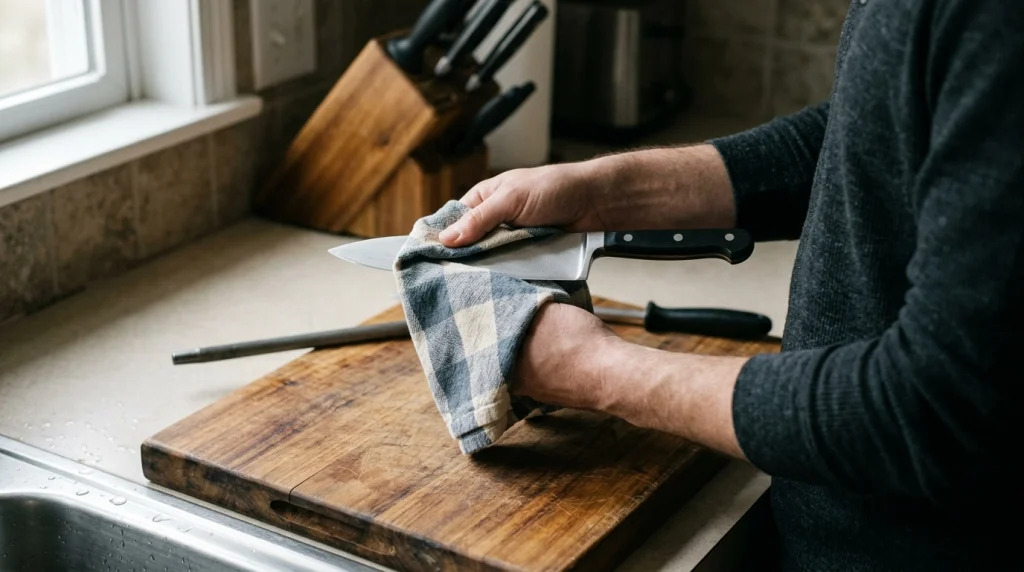
SaveRegardless of the category, a knife performs better when its edge is maintained and its blade is stored safely. Wash and dry it according to the manufacturer’s instructions, keep the edge from contacting hard surfaces unnecessarily, and store it so the blade cannot move freely against other utensils.
A sharp edge also matters for control. When a knife becomes difficult to use, the answer is not always “buy a different knife”; the existing blade may simply need appropriate maintenance. Our guide to cleaning, sharpening, and maintaining kitchen knives covers the maintenance side separately.
Do not use a kitchen knife for a task outside its intended design just because the blade is sharp. The right knife is partly about geometry and control, not only sharpness.
Related Product
8-Inch Chef’s Knife
If a chef’s knife fits your routine, an 8-inch model is a common all-purpose starting point. Choose based on comfort, balance, blade geometry, and the work you actually do.
As an Amazon Associate, we earn from qualifying purchases.
Frequently Asked Questions
What is the main difference between a chef’s knife and a kitchen knife?
A kitchen knife is a broad category covering knives used for food preparation. A chef’s knife is one specific, general-purpose kitchen knife designed for many cutting tasks.
Is a chef’s knife the same as a kitchen knife?
Not exactly. In casual speech, people sometimes use the terms interchangeably, but technically a chef’s knife is a type of kitchen knife.
Can a chef’s knife replace a utility knife?
It can handle many jobs, but not all. A utility knife is useful when a chef’s knife feels too large for smaller slicing or trimming tasks.
Can I use a chef’s knife to cut bones?
A standard chef’s knife should not be treated as a bone-cutting knife. For work around bones, use a suitable boning knife or other purpose-built tool.
What size chef’s knife is best for most home cooks?
An 8-inch chef’s knife is a common starting point because it balances cutting reach with maneuverability, but the best size depends on your hand size, comfort, and typical ingredients.
Which knife should I buy first: a chef’s knife or another kitchen knife?
For many home cooks, a chef’s knife is a practical first choice because it covers a wide range of board-prep tasks. Choose another type first only if your cooking is dominated by a specific task that calls for a different blade.
Conclusion
The phrase “kitchen knife” describes a whole category, while a chef’s knife is one particular member of that category. That is the main difference, and it explains why the two terms can sound interchangeable even though they are not technically equivalent.
For everyday board preparation, a chef’s knife is usually the most versatile starting point. Specialized kitchen knives still have clear roles when a task calls for a serrated edge, smaller blade, narrow flexible profile, or another specific geometry. Instead of choosing by label alone, match the knife to the work you actually do. That approach gives you better control and avoids buying several knives that solve the same problem.