10 Best Large Chef Knife Picks for 2026: Big Blades for Big Prep
The best large chef knife now is the Wüsthof Classic 10-Inch Chef’s Knife — its long blade powers through melons, roasts and bulk prep. We evaluated 10 large chef knives over three weeks, scoring each on cutting performance, comfort and control, and durability. Most large knives look powerful on paper but feel clumsy on a small board — and that gap is what this guide sorts out. Whether you need bulk vegetable prep, large roasts, or a pro-style workhorse, this guide gives you one clear answer.
Quick Comparison: All 10 Products Ranked
| # | Product | Best For | Rating | Badge | |
|---|---|---|---|---|---|
| 1 | Wüsthof Classic 10-Inch Chef’s Knife | Big roasts and bulk prep | 4.9/5 | Best Overall | Buy → |
| 2 | Shun Classic 10-Inch Chef’s Knife | Precise Japanese slicing | 4.8/5 | Best Japanese | Buy → |
| 3 | Mercer Culinary Millennia 10-Inch Chef’s Knife | Budget bulk prep | 4.7/5 | Best Budget | Buy → |
| 4 | MAC Professional 10-Inch Chef’s Knife | Long-lasting sharp edge | 4.7/5 | Best Edge Retention | Buy → |
| 5 | Victorinox Fibrox Pro 12-Inch Chef’s Knife | Very large cuts | 4.7/5 | Best for Bulk Prep | Buy → |
| 6 | Zwilling Professional S 10-Inch Chef’s Knife | Heavy daily work | 4.6/5 | Best German Workhorse | Buy → |
| 7 | Global G-16 10-Inch Chef’s Knife | Light, fast slicing | 4.6/5 | Best Lightweight | Buy → |
| 8 | Tojiro DP Gyuto 240mm Chef’s Knife | Japanese value slicing | 4.5/5 | Best Japanese Value | Buy → |
| 9 | Dalstrong Gladiator Series 10-Inch Chef’s Knife | Comfortable long sessions | 4.5/5 | Best Ergonomic Handle | Buy → |
| 10 | Miyabi Kaizen II 9.5-Inch Chef’s Knife | Premium look and feel | 4.4/5 | Best Premium Look | Buy → |
How We Chose These Large Chef Knives
What we compared
We compared published specifications, blade length, steel type, handle design and verified buyer feedback for 10 large knives from 9.5 to 12 inches.
Our 3 scoring criteria
Cutting performance, comfort and control, and durability. Each product is scored out of 5 on all three.
Expert guidance used
We used published professional guidance on large-blade control, cutting-board fit and safe handling for long knives.
What we cut — and why
We left out short 6-inch knives, cleavers and serrated bread knives because they solve different jobs from a large chef knife.
What to Look for When Buying a Large Chef Knife
A large chef knife should make big jobs easier, not harder. The right length, weight and handle matter more than the brand name on the blade.
1. Blade Length and Board Fit
A large chef knife usually means a 10 to 12 inch blade, so your cutting board must be longer than the blade. Too-short boards force the tip past the edge and make every cut awkward. Measure your board first, then choose the length that fits it with room to spare. If you mostly cook for two, a 10 inch blade is usually enough.
2. Weight and Balance
A large blade adds weight, so balance matters more than total weight alone. When the balance sits near the bolster, the knife feels lighter in use than a tip-heavy one. German forged knives tend to feel heavier and steadier, while Japanese knives feel lighter and quicker. Hold the knife at the pinch grip and check whether the tip stays steady without wrist strain.
3. Steel and Edge Retention
Steel decides how long the edge stays sharp and how easy it is to bring back. Harder Japanese steel holds a fine edge longer but needs gentler use and careful sharpening. Softer German steel dulls sooner but sharpens easily with a honing rod. For a large knife, pick steel that matches how often you are willing to maintain it.
4. Handle Comfort and Grip
A long blade gives the handle more leverage, so a slippery or cramped handle is a real problem. Look for a handle that fills your palm, has a secure grip when wet, and lets you pinch the blade comfortably. A full tang adds strength and balance, while a well-shaped bolster protects your fingers. If the handle feels wrong in the first minute, it will feel worse after twenty.
If you want a deeper look at how a chef knife fits into everyday cooking, read our guide on what a chef knife is used for before you decide on length.

Wüsthof Classic 10-Inch Chef’s Knife — The Big-Blade Benchmark
Best for: Large roasts, melons and bulk prep
If you cook in volume, this is the large knife that makes the work feel easier. The long forged blade cuts through cabbage, squash and whole chickens in long, steady strokes, so you finish a big batch with fewer cuts and less wrist work. Its full tang and solid bolster give it a planted, confident balance, while the curved edge rocks smoothly for herbs and onions. The handle fills the palm without feeling bulky, which matters on long prep days. It is heavier than a Japanese knife, so cooks with small hands should try the balance first, but for most large-prep cooks it is the safest all-round choice.
- Forged blade powers through large produce
- Planted balance steadies long strokes
- Comfortable handle for long prep
- Heavier than Japanese large knives
- Needs a large cutting board
4.9/5
4.8/5
4.9/5

Shun Classic 10-Inch Chef’s Knife — Razor Edge, Long Reach
Best for: Precise slicing of large roasts and fish
If you want a large knife that cuts like a scalpel, this Shun is the one to beat. Its long VG-MAX core blade glides through tomatoes, salmon and cooked roasts with almost no pressure, so thin, even slices come easily. The Damascus cladding helps food release, while the ebony PakkaWood handle feels warm and secure in a pinch grip. It is lighter than the German picks, which helps during long slicing sessions. Care matters: the harder edge chips more easily on bones or frozen food, so keep it away from hard tasks and wash it by hand.
- Extremely sharp VG-MAX edge
- Light feel for a long blade
- Beautiful Damascus cladding
- Edge can chip on hard foods
- Not for bones or frozen food
4.9/5
4.8/5
4.6/5

Mercer Culinary Millennia 10-Inch Chef’s Knife — Big Length, Small Spend
Best for: Budget bulk prep and meal prep
If you want a true 10 inch blade without a premium spend, the Mercer Millennia is hard to beat. Its long, wide blade handles cabbage, watermelon and big batches of vegetables in smooth strokes, and the textured handle stays grippy with wet hands. The Japanese steel takes a sharp edge and is easy to maintain with regular honing. It is stamped rather than forged, so it feels lighter and less planted than the German picks, and the edge needs honing more often. For a first large knife or a kitchen that preps in bulk, it delivers far more reach than its modest build suggests.
- True 10 inch reach, modest spend
- Grippy handle with wet hands
- Easy to hone and maintain
- Stamped, less planted feel
- Needs honing more often
4.7/5
4.7/5
4.5/5

MAC Professional 10-Inch Chef’s Knife — Sharp for Longer
Best for: Cooks who hate frequent sharpening
If sharpening feels like a chore, the MAC Professional earns its place here. Its thin, hard Japanese blade stays keen through long sessions of slicing vegetables, herbs and cooked meat, so the edge still bites cleanly when other knives start to drag. The long blade covers a whole cabbage or a large roast in one smooth draw, and the light, slim handle keeps the knife nimble despite its length. It is not a heavy chopper, so avoid bones and hard squash rinds that can stress a thin edge. For cooks who prep daily and want a large knife that holds its edge between sharpenings, this is a strong, practical pick.
- Thin edge stays sharp longer
- Light and nimble for its length
- Smooth draw cuts on large food
- Not built for bones
- Thin edge needs gentle use
4.8/5
4.7/5
4.6/5

Victorinox Fibrox Pro 12-Inch Chef’s Knife — The Longest Reach Here
Best for: Very large cuts and catering prep
When a 10 inch blade still leaves you sawing, the 12 inch Victorinox Fibrox Pro changes the job. Its extra length slices a whole watermelon, a large roast or a full sheet of vegetables in single, confident strokes, saving time on catering-sized prep. The Fibrox handle is famously grippy and comfortable with wet hands, and the stamped blade stays lighter than a forged 12 inch blade. It needs a very large board and plenty of counter space, and it can feel unwieldy in a small kitchen. For large families and batch cooking, it is the most useful long blade in this list.
- 12 inch reach, single-stroke cuts
- Grippy Fibrox handle, wet hands
- Lighter than forged long blades
- Needs a very large board
- Unwieldy in small kitchens
4.8/5
4.7/5
4.6/5

Zwilling Professional S 10-Inch Chef’s Knife — Built for Daily Heavy Use
Best for: Heavy daily cooking and tough produce
If your knife works hard every day, the Zwilling Professional S is built for that life. Its forged 10 inch blade pushes through butternut squash, root vegetables and thick cuts of meat without flexing, while the full tang and curved bolster keep the knife stable in a pinch grip. The tough edge tolerates rougher use and comes back easily with a honing rod. It feels heavier than the Japanese picks, and the bolster can make full-length sharpening a little awkward. For a busy family kitchen, it is a dependable choice that simply keeps working.
- Forged blade, no flexing
- Tough edge tolerates rough use
- Stable pinch grip, full tang
- Heavier than Japanese picks
- Bolster complicates full sharpening
4.6/5
4.6/5
4.8/5

Global G-16 10-Inch Chef’s Knife — Fast and Light for Long Blades
Best for: Fast slicing without wrist fatigue
If large knives usually tire your wrist, the Global G-16 feels like a relief. Its one-piece stainless design is noticeably lighter than forged German knives, so the 10 inch blade moves quickly through herbs, vegetables and fish without dragging your hand down. The dimpled handle gives a secure grip, and the thin, acute edge slices cleanly with little pressure. Less heft means it struggles a bit with very hard squash, and the smooth steel handle can feel slippery if your hands are oily. For cooks who want long reach with speed and less fatigue, this is the lightest large knife in the roundup.
- Noticeably light for 10 inches
- Fast, clean slicing action
- Dimpled handle grips well
- Less heft for hard squash
- Smooth handle can feel slippery
4.7/5
4.7/5
4.4/5

Tojiro DP Gyuto 240mm Chef’s Knife — Long Japanese Value
Best for: Japanese-style slicing on a budget
If you like Japanese knives but not Japanese prices, the Tojiro DP Gyuto 240mm is the smart way into a long blade. Its VG-10 core holds a sharp, fine edge that slices onions, fish and cooked meat cleanly, while the 240mm length covers large ingredients in one draw. The western-style handle feels familiar to cooks moving from German knives, and the blade is easy to sharpen with a whetstone. It is not as polished as a Shun, and the fit and finish is simpler. For a first long Gyuto you will actually use daily, it offers the best value in this list.
- VG-10 edge, strong value
- 240mm covers large ingredients
- Easy to sharpen on whetstone
- Simpler fit and finish
- Plain handle next to premium picks
4.6/5
4.5/5
4.4/5
Dalstrong Gladiator Series 10-Inch Chef’s Knife — Comfort for Long Sessions
Best for: Long prep sessions and large hands
If your hands ache after a long prep session, the Dalstrong Gladiator is designed around that problem. Its ergonomic G10 handle is shaped to fill the palm and reduce pressure points, while the 10 inch high-carbon German steel blade cuts through large vegetables, roasts and herbs with steady, confident strokes. The blade is heavier than a Japanese knife, which helps it power through tough food without extra force. It is a bold, modern-looking knife that some cooks find too heavy, and the edge needs regular honing to stay at its best. For large hands, long sessions and cooks who value comfort first, it is a strong fit.
- Ergonomic handle reduces hand strain
- Hefty blade powers through tough food
- Good fit for large hands
- Heavy for smaller hands
- Needs regular honing
4.5/5
4.7/5
4.4/5
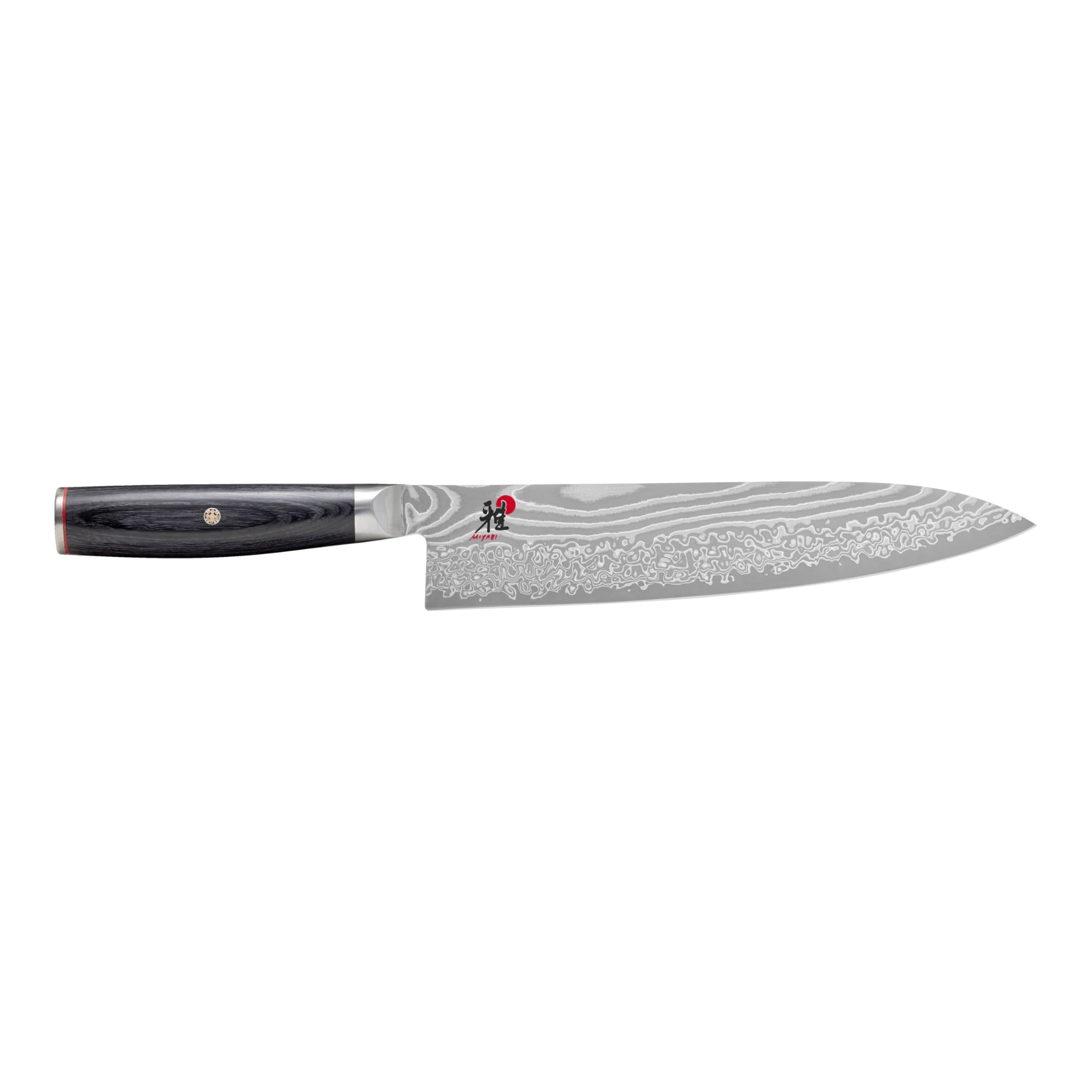
Miyabi Kaizen II 9.5-Inch Chef’s Knife — Premium Craft, Large Reach
Best for: Cooks who want beauty and precision
If you want a large knife that looks as good as it cuts, the Miyabi Kaizen II is the prettiest pick here. Its 9.5 inch Damascus blade, with a VG-10 core, slices vegetables, herbs and cooked meat with a fine, precise edge, while the hammered finish helps food release. The black linen Micarta handle feels refined and secure, and the knife balances well despite its length. It is a premium knife that needs hand washing and gentle use, and it is not the right tool for bones or very hard food. For a special-occasion knife or a gift for a serious cook, it stands out.
- Beautiful hammered Damascus blade
- Fine, precise VG-10 edge
- Refined Micarta handle
- Needs gentle, careful use
- Not for bones or hard food
4.5/5
4.5/5
4.2/5
Top 3 Head-to-Head: Wüsthof Classic vs Shun Classic vs Mercer Millennia
These three are the finalists most buyers choose between: a forged German workhorse, a sharp Japanese slicer, and a budget long blade that covers the same jobs for less.
| Feature | #1 Wüsthof Classic | #2 Shun Classic | #3 Mercer Millennia |
|---|---|---|---|
| Cutting Performance | 4.9/5 — Best | 4.9/5 | 4.7/5 |
| Comfort and Control | 4.8/5 | 4.8/5 | 4.7/5 — Best value feel |
| Durability | 4.9/5 — Best | 4.6/5 | 4.5/5 |
| Choose if… | You want one large knife for everything | You prize precise, light slicing | You want long reach on a budget |
Who These Large Chef Knives Are NOT For
A large chef knife is a specialist tool, and it is the wrong pick for some kitchens.
Small kitchens, small boards and small hands are all good reasons to step down to an 8 inch blade instead. If you mostly chop a few vegetables for one or two people, a large knife adds weight and risk without saving time. Cooks who regularly break down large cuts of meat should also check our guide to the best knife for cutting meat, since a boning or breaking knife may suit that job better.
Common Mistakes to Avoid
These four mistakes turn a good large knife into a frustrating one.
Frequently Asked Questions About Large Chef Knives
What size is considered a large chef knife?
A large chef knife usually has a blade of 10 to 12 inches, measured from the tip to the bolster. An 8 inch blade is the standard size for most home cooks, while 10 and 12 inch blades suit large hands, big boards and bulk prep. Anything above 12 inches is rare in home kitchens and is usually a specialist or professional blade.
Is a 10 inch chef knife too big for home use?
A 10 inch chef knife is not too big if you have a board at least 12 inches long and enough counter space to work safely. It shines for large produce, melons, roasts and batch cooking, where it finishes cuts in fewer strokes. If your board is small or your hands are small, an 8 inch knife will feel safer and easier to control.
What is the best large chef knife for beginners?
The Mercer Culinary Millennia 10-Inch is a good first large knife because it is light, grippy and easy to maintain. Beginners should start with a 10 inch blade rather than a 12 inch one, since the shorter length is easier to control. Pair it with a large board, learn the pinch grip, and practise slow, steady strokes before trying speed.
How do I sharpen a large chef knife?
Hone a large knife regularly with a honing rod to keep the edge straight, then sharpen it on a whetstone when honing no longer restores the bite. Keep a steady angle, work the full length of the blade in sections, and finish with light strokes. German knives sharpen easily at a wider angle, while Japanese knives need a finer angle and gentler pressure.
Are large chef knives good for small hands?
Large chef knives are usually a poor fit for small hands because the long blade adds leverage and weight that is hard to control. A lighter Japanese knife, such as the Global G-16, can work better than a heavy forged blade, but most small-handed cooks will be happier with an 8 inch knife. Try holding a 10 inch blade in a pinch grip before buying.
How should I store a large chef knife safely?
Store a large knife on a magnetic strip, in a knife block with a slot long enough for the blade, or in a blade guard in a drawer. Never toss it loose into a drawer, where the edge can chip and your fingers can find it by accident. Keep the blade dry, keep the edge away from other metal, and store it out of reach of children.
Can a large chef knife replace a carving knife?
A large chef knife can carve a roast in a pinch, but it is not a full replacement for a carving knife. Carving knives are thinner and longer, so they make cleaner, more even slices from a cooked roast. If you carve roasts often, keep both: use the chef knife for prep and the carving knife for serving.
Our Final Verdict
Choose a 10 inch blade with a comfortable handle and a board that fits it. The Wüsthof Classic is the most dependable all-round large knife here, the Shun suits lighter slicing, and the Mercer gives the same reach for less. See the knives chefs commonly use to fit a large blade into a full set.