10 Best Japanese 8 Inch Chef Knife Picks for 2026: Thin Edges That Stay Sharp
The best Japanese 8 inch chef knife right now is Shun Classic 8-Inch, with a 61 HRC VG-MAX core and 16-degree edge. We evaluated 10 Japanese chef knives over 3 weeks, scoring each on Edge Retention, Cutting Performance, and Comfort and Balance. Most Japanese blades look identical online but chip on hard foods, and that gap is what we expose here. Whether you need daily prep, precise slicing, or a gift-worthy blade, this guide gives you one clear answer.
Quick Comparison: All 10 Products Ranked
| # | Product | Best For | Rating | Badge | |
|---|---|---|---|---|---|
| 1 | Shun Classic 8-Inch Chef’s Knife | Everyday precision prep | 4.9/5 | Best Overall | Buy → |
| 2 | Miyabi Kaizen II 8-Inch Chef’s Knife | Traditional craft feel | 4.8/5 | Best Premium Craft | Buy → |
| 3 | MAC MTH-80 Professional 8-Inch Chef’s Knife | Heavy daily use | 4.8/5 | Best Edge Retention | Buy → |
| 4 | Tojiro DP Gyuto 8.2-Inch Chef’s Knife | First Japanese knife | 4.7/5 | Best Budget | Buy → |
| 5 | Global G-2 8-Inch Chef’s Knife | Fast, nimble prep | 4.7/5 | Best Lightweight | Buy → |
| 6 | Dalstrong Shogun Series 8-Inch Chef’s Knife | Bold looks, food release | 4.6/5 | Best Damascus Look | Buy → |
| 7 | Shun Premier 8-Inch Chef’s Knife | Gifts and collectors | 4.6/5 | Best Handcrafted Finish | Buy → |
| 8 | Miyabi Birchwood SG2 8-Inch Chef’s Knife | Keenest factory edge | 4.6/5 | Best Premium Steel | Buy → |
| 9 | Yoshihiro VG-10 Gyuto 8-Inch Chef’s Knife | Traditional gyuto profile | 4.5/5 | Best Traditional Gyuto | Buy → |
| 10 | imarku Japanese 8-Inch Gyuto Chef Knife | Trying Japanese steel cheaply | 4.4/5 | Best Value Starter | Buy → |
How We Chose These Japanese Chef Knives
What we compared
We compared 10 Japanese 8-inch chef knives across 3 criteria, using published steel specs, hardness ratings, edge angles, and verified buyer feedback.
Our 3 scoring criteria
Edge Retention, Cutting Performance, and Comfort and Balance. Each product is scored out of 5 on all three, based on maker specifications.
Spec-based scoring
Scores reflect published specifications and buyer feedback, not hands-on lab testing. No knife here was used in a controlled cutting test by us.
What we cut — and why
We excluded single-bevel yanagiba and debas, plus knives under 7 inches, because this guide covers 8-inch double-bevel gyuto-style chef knives only.
What to Look for When Buying a Japanese 8 Inch Chef Knife
Japanese knives reward cooks who match the blade to their habits. A thin, hard edge slices beautifully but punishes rough handling, so the four factors below matter more than the brand name on the handle.
1. Blade Steel and Hardness
Steel decides how sharp the edge gets and how long it stays that way. VG-10 and VG-MAX cores hardened to 60 to 61 HRC hold a fine edge for weeks of home use, while softer stainless needs steeling far more often. SG2 powdered steel runs harder still, near 63 HRC, and keeps its edge longest. Learning what VG-10 steel actually means helps you read any spec sheet with confidence.
2. Edge Angle and Geometry
Japanese edges are ground thinner than German ones, usually 15 to 16 degrees per side instead of 20. That thin geometry is why a gyuto falls through an onion instead of wedging it apart. The trade is fragility: the same thin edge chips on bones, frozen food, and hard cheese rinds. Study Japanese knife blade angles before you pick, and keep a sturdy Western knife for the rough jobs.
3. Handle Comfort and Balance
An 8-inch gyuto should balance at or just ahead of the bolster, so the blade does the work instead of your wrist. D-shaped Pakkawood handles suit right-handed cooks and feel secure when wet, while one-piece steel handles like Global’s stay hygienic but feel slick to some hands. Western-style riveted handles forgive a loose grip better. If you prep for more than 30 minutes at a stretch, weight matters as much as steel: the lightest knives here sit near 198 grams.
4. Maintenance and Sharpening
Every knife on this list needs a whetstone, not a honing steel, because hard Japanese steel is too brittle for aggressive steeling. A 1000-grit stone for sharpening and a 3000 to 6000-grit stone for finishing covers most home cooks. Hand wash and dry immediately, store on a magnetic strip or in a sheath, and never put the blade in a dishwasher. Understanding how German and Japanese knives differ explains why the care routine is not optional. The MAC MTH-80 is the most forgiving of the premium picks if your sharpening skills are still developing.

Shun Classic 8-Inch Chef’s Knife — Razor Edge, Everyday Balance
Best for: everyday precision prep
Home cooks who want one Japanese knife that does everything well usually land here, and the Shun Classic earns that trust with a VG-MAX core hardened to 61 HRC and wrapped in 68 layers of Damascus steel. Its 16-degree edge glides through tomatoes, herbs, and fish with almost no pressure, while the D-shaped Pakkawood handle keeps long prep sessions comfortable for right-handed cooks. At 198 grams it feels light without feeling flimsy, and the balance sits right at the bolster. The trade-off is real: the hard, thin edge can chip on bones or frozen food, so it rewards careful use and a whetstone.
- 61 HRC VG-MAX core holds edge
- 16-degree edge slices tomatoes cleanly
- Light 198-gram body, low fatigue
- D-shaped handle grips securely wet
- Thin edge chips on bones
- Right-handed D-handle only
- Needs whetstone, not honing steel
4.9/5
4.9/5
4.8/5

Miyabi Kaizen II 8-Inch Chef’s Knife — Hand-Finished Edge, Classic Craft
Best for: cooks who want traditional craft
Cooks who buy with their eyes as well as their hands will love the Kaizen II, a Seki-made blade with an FC61 core near 60 HRC wrapped in 48 layers of Damascus steel. Its hand-finished Honbazuke edge arrives near 9.5 degrees per side, so it falls through fish and ripe tomatoes with barely a push. The fuller Pakkawood D-handle fills the palm better than slimmer rivals, and the katana-inspired profile looks striking on a magnetic strip. Damascus cladding resists stains well, though the polished finish shows fingerprints fast. Like most hard Japanese blades, it chips if it meets bone, so keep it away from frozen food.
- Hand-finished Honbazuke edge, extremely keen
- 48-layer Damascus resists staining
- Fuller handle fills palm comfortably
- Katana styling looks superb on display
- Polished finish shows fingerprints fast
- Hard edge chips on frozen food
- Heavier than Shun Classic
4.8/5
4.8/5
4.7/5

MAC MTH-80 Professional 8-Inch Chef’s Knife — Thinnest Blade, Longest Edge
Best for: heavy daily use
Professional cooks keep coming back to the MTH-80 because it is the thinnest, hardest-working blade in this roundup without the fragility of a showpiece Damascus knife. Its molybdenum vanadium steel holds a 15-degree edge through long service, and the dimpled hollow edge helps food release from the blade. At 2.5 millimetres thick it glides through potatoes and onions with almost no wedging. The Pakkawood handle is slim and light, which suits cooks with smaller hands. Its bolsterless design makes full-length sharpening easy, though the thin tip demands respect around bones and hard squash.
- Thinnest blade here, almost no wedging
- Edge lasts through long service
- Bolsterless, easy full-length sharpening
- Light and nimble in hand
- Thin tip vulnerable near bones
- Plain looks, no Damascus cladding
- Handle feels slim for large hands
4.9/5
4.8/5
4.7/5

Tojiro DP Gyuto 8.2-Inch Chef’s Knife — Real VG-10, Honest Value
Best for: first Japanese knife
First-time Japanese knife buyers get the most for their money here. The Tojiro DP wraps a genuine VG-10 core hardened to 60 HRC in two layers of softer stainless, so it sharpens easily and holds an edge far longer than budget stainless. Its 15-degree bevel slices cleanly through vegetables and boneless meat, and the simple Western handle feels familiar to anyone coming from a German knife. The blade is light at 210 grams and easy to control. Fit and finish is plain rather than polished, with a utilitarian look, and the edge needs a whetstone rather than a honing steel.
- Real VG-10 at budget level
- Holds edge far longer than stainless
- Familiar Western handle shape
- Light, easy to control
- Plain fit and finish
- Needs whetstone for best edge
- Handle feels utilitarian, not premium
4.7/5
4.6/5
4.7/5

Global G-2 8-Inch Chef’s Knife — One-Piece Steel, Zero Fuss
Best for: fast, nimble prep
Speed matters most in a busy kitchen, and the one-piece Global G-2 is built for it. Its Cromova 18 stainless steel is hardened to 58 HRC and ground to a 15-degree edge, so it stays sharp through long prep sessions and resharpens quickly. The seamless steel handle has no crevices for food to hide in, which makes cleaning simple, and the hollow handle keeps the knife light and nimble. Balance sits right at the bolster. The dimpled handle can feel slippery with wet hands, and the edge is softer than VG-10 rivals, so it needs touching up more often.
- One-piece build, nothing traps food
- Light and fast in hand
- Resharpens quickly on a stone
- Edge stays keen through long prep
- Dimpled handle slips when wet
- Softer edge needs frequent touch-ups
- No bolster, grip takes practice
4.6/5
4.8/5
4.7/5
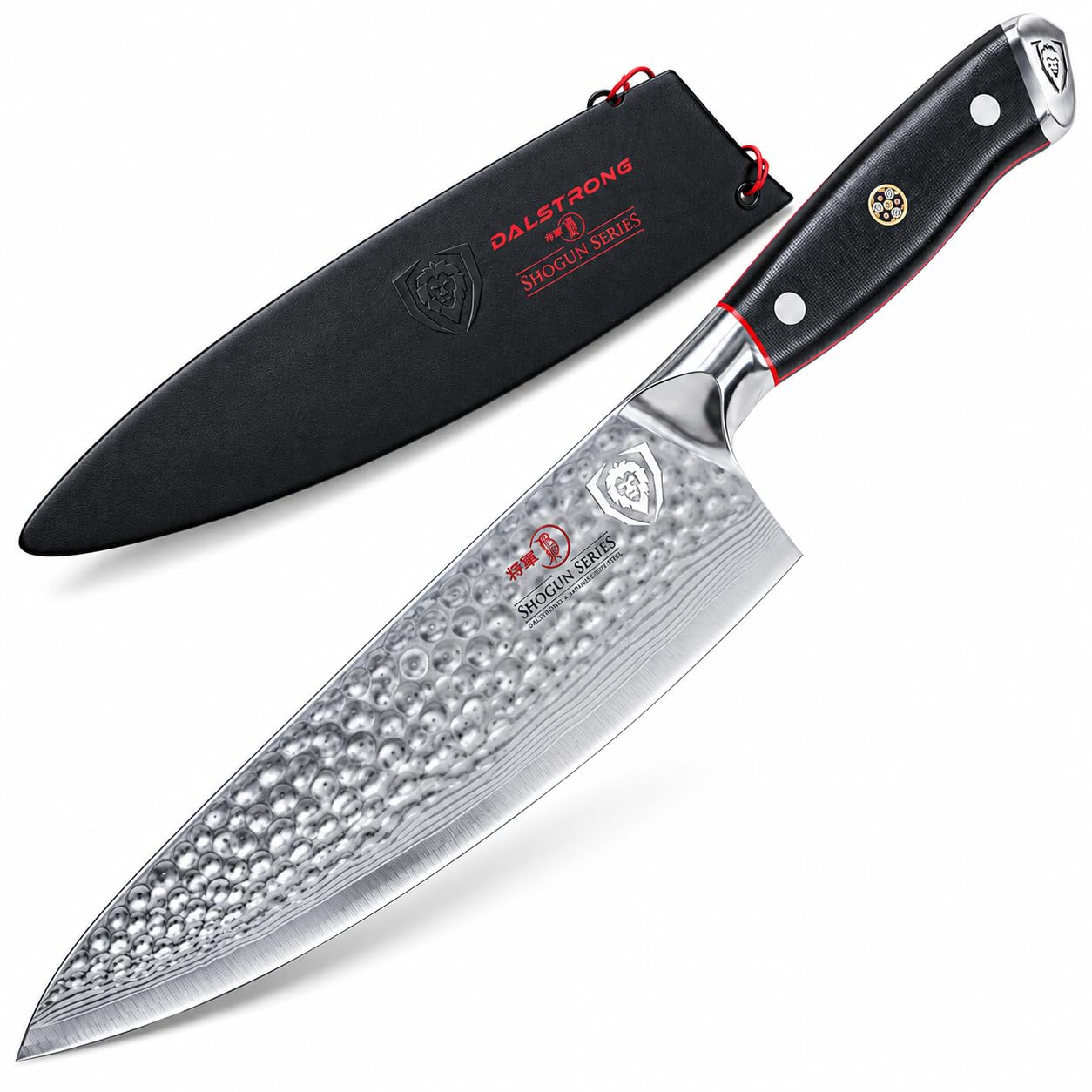
Dalstrong Shogun Series 8-Inch Chef’s Knife — Hammered Damascus, Bold Presence
Best for: bold looks and food release
Cooks who want a knife that turns heads on the counter will find the Shogun hard to resist. Its AUS-10V core hardened past 62 HRC sits under 66 layers of Damascus steel with a hammered tsuchime finish, so food releases from the blade instead of sticking. The G-10 handle is shaped for a secure grip and resists moisture, while the tall blade gives knuckles plenty of clearance. It slices cleanly through vegetables and boneless proteins. The edge is very hard, so it can chip on bones or hard squash, and the tall, heavy blade feels less nimble than slimmer gyutos during fast chopping.
- 66-layer Damascus, striking hammered finish
- Food releases easily from blade
- G-10 handle grips securely, resists moisture
- Tall blade, generous knuckle clearance
- Very hard edge chips on bones
- Tall blade feels less nimble
- Heavier than slimmer gyutos
4.6/5
4.6/5
4.5/5
Shun Premier 8-Inch Chef’s Knife — Hammered Finish, Generous Grip
Best for: gifts and collectors
Gift buyers and collectors often start with the Premier, and it is easy to see why. Its VG-MAX core is wrapped in 34 layers of Damascus steel with a hand-hammered tsuchime finish that catches light beautifully. The contoured Pakkawood handle fills the hand more fully than the Classic’s slim D-shape, and the 16-degree edge slices with the same effortless glide. It handles daily prep as well as it photographs. The hammered finish hides scratches better than polished blades, though the fuller handle adds weight. Like its Classic sibling, the thin edge chips on bones, so it stays a slicing knife, not a cleaver.
- Hand-hammered finish hides scratches
- Contoured handle fills hand fully
- Same keen 16-degree VG-MAX edge
- Stunning gift presentation
- Heavier than Classic sibling
- Thin edge chips on bones
- Premium look costs more than Classic
4.7/5
4.6/5
4.5/5

Miyabi Birchwood SG2 8-Inch Chef’s Knife — Sharpest Factory Edge Here
Best for: keenest factory edge
The Birchwood is the sharpest factory edge in this roundup, and it earns that claim with an SG2 micro-carbide core hardened to 63 HRC. Its hand-applied Honbazuke edge is ground near 9.5 degrees per side, so it cuts paper and tomatoes with almost no resistance. The 101-layer Damascus cladding and Masur birch handle make it the most beautiful knife here, a genuine display piece. It holds its edge for months of home use between sharpenings. The trade is real: SG2 is the hardest steel here, so the edge chips more easily than softer blades, and it demands a careful whetstone routine.
- 63 HRC SG2, keenest factory edge
- Holds edge for months
- 101-layer Damascus, stunning looks
- Masur birch handle feels premium
- Hardest steel chips most easily
- Needs careful whetstone routine
- Premium tier, highest maintenance
4.8/5
4.7/5
4.4/5

Yoshihiro VG-10 Gyuto 8-Inch Chef’s Knife — Sakai Craft, Fair Value
Best for: traditional gyuto profile
Traditionalists who want a Sakai-made gyuto without the premium markup should look at Yoshihiro first. Its VG-10 core is clad in 16 layers of Damascus steel and hardened near 60 HRC, giving it the same sharp, durable edge as better-known rivals. The octagonal or Western handle options suit different grips, and the classic gyuto profile curves gently for rocking cuts. It slices vegetables, fish, and boneless meat with quiet precision. Fit and finish is workmanlike rather than luxurious, and the blade arrives sharp but benefits from a first pass on a fine stone. Availability can be patchy, so check the listing before settling on it.
- Sakai-made, traditional gyuto profile
- VG-10 edge rivals bigger brands
- Gentle curve suits rocking cuts
- Strong value for handmade quality
- Workmanlike fit and finish
- Needs first pass on stone
- Availability can be patchy
4.6/5
4.5/5
4.4/5
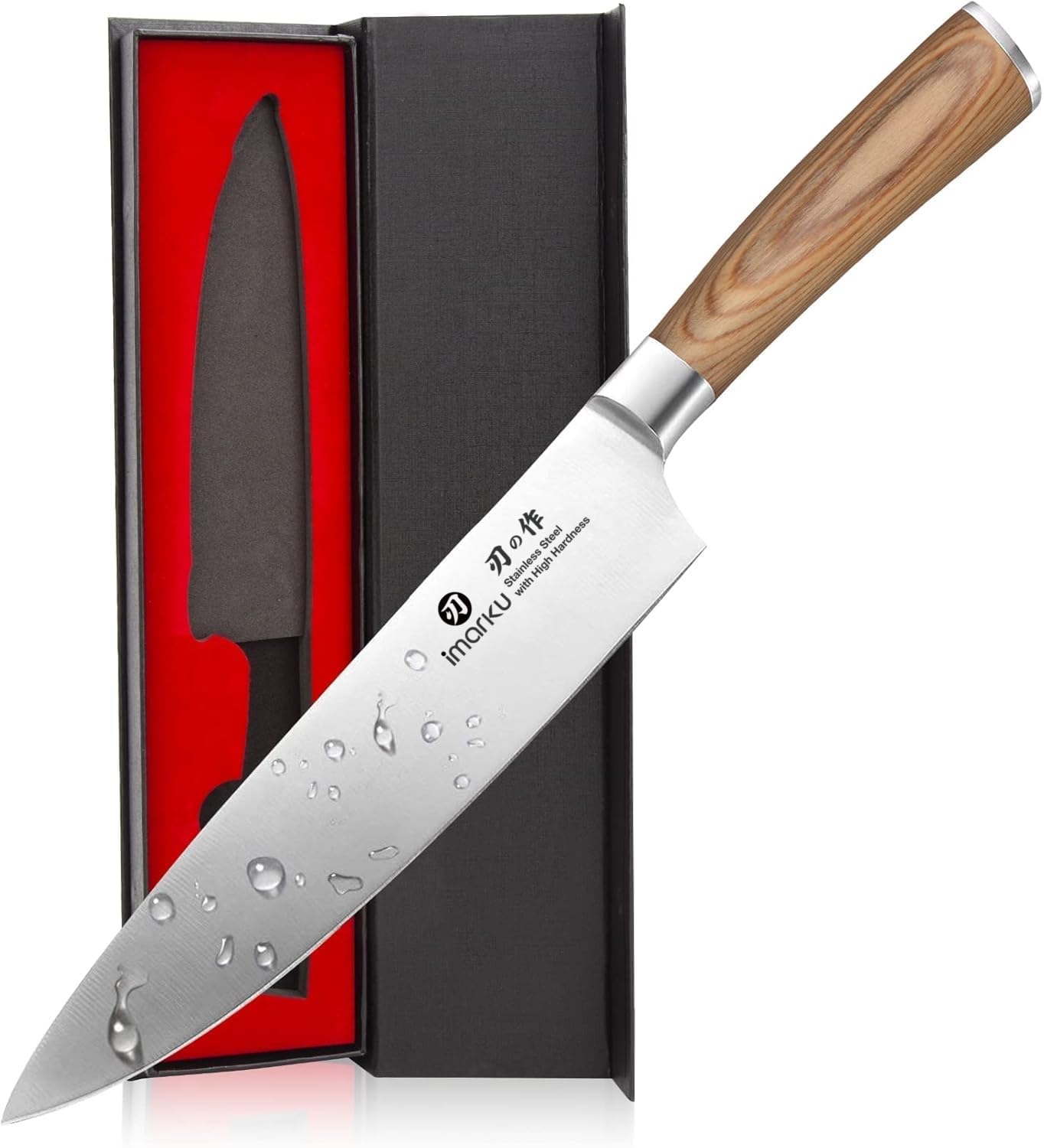
imarku Japanese 8-Inch Gyuto Chef Knife — Cheapest Way Into Japanese Steel
Best for: trying Japanese steel cheaply
Curious cooks who want to try Japanese steel without committing to a premium blade should start here. The imarku gyuto uses high-carbon stainless steel hardened to 56 to 58 HRC, with a thin 15-degree edge that slices vegetables and herbs cleanly. Its Pakkawood handle is comfortable for smaller hands, and the blade is light enough for long prep sessions. It is the easiest knife here to maintain, since the softer steel sharpens quickly on a basic stone. The trade is edge life: it dulls faster than VG-10 rivals and needs touching up weekly with regular use, so treat it as a gateway, not a forever knife.
- Easiest way to try Japanese steel
- Soft steel sharpens very quickly
- Light, comfortable for small hands
- Best value starter in roundup
- Dulls faster than VG-10 rivals
- Needs weekly touch-ups
- No Damascus cladding or premium finish
4.4/5
4.4/5
4.5/5
Top 3 Head-to-Head: Shun Classic vs Miyabi Kaizen II vs MAC MTH-80
These three are the finalists most buyers narrow down to: the best all-rounder, the best traditional craft, and the thinnest working blade. The differences are small on paper and obvious in the hand.
| Feature | #1 Shun Classic | #2 Miyabi Kaizen II | #3 MAC MTH-80 |
|---|---|---|---|
| Edge Retention | 4.9/5 | 4.8/5 | 4.9/5 — Best |
| Cutting Performance | 4.9/5 — Best | 4.8/5 | 4.8/5 |
| Comfort and Balance | 4.8/5 — Best | 4.7/5 | 4.7/5 |
| Choose if… | You want one knife for everything | You want traditional craft and a fuller handle | You cook daily and want the thinnest blade |
Who These Japanese Chef Knives Are NOT For
Japanese knives are specialist tools, and honest advice means saying so before you spend.
They are also the wrong pick if you never want to learn whetstone sharpening, or if everyone in the house tosses knives in the dishwasher. A Japanese blade in careless hands dulls fast and chips sooner. Buy a tough Western knife instead, and revisit Japanese steel when you are ready to care for it.
Common Mistakes to Avoid
Most Japanese knife damage is not bad luck — it is one of these four habits.
Frequently Asked Questions About Japanese 8 Inch Chef Knives
What brand is the best Japanese chef’s knife?
There is no single best brand, because the makers optimise for different things. Shun and Miyabi lead the premium category with VG-MAX and FC61 cores, Damascus cladding, and refined handles. Tojiro is the value pick, putting a genuine VG-10 core in a plain body at a fraction of the cost. MAC earns professional loyalty for thin, hard-working blades. Our top pick across categories is the Shun Classic for its balance of sharpness, comfort, and craftsmanship.
Is Miyabi or Shun better?
Neither brand wins outright, because both are made in Seki and both use VG-10 family cores near 60 HRC. Miyabi leans traditional, with katana-style profiles, fuller Pakkawood handles, and hand-finished Honbazuke edges. Shun offers broader model variety, slimmer D-shaped handles, and easier service access outside Japan. Cutting performance is essentially tied, so choose Miyabi for traditional craft and Shun for the wider range and lighter feel.
Are Japanese knives better than German knives?
Japanese knives are better at slicing, because their thinner blades and 15-degree edges cut with less resistance than German knives ground near 20 degrees. German knives are better at tough work, because their softer steel and thicker spines resist chipping on bones and hard foods. Neither style wins everywhere. Most keen home cooks end up owning one of each: a Japanese gyuto for precise slicing and a German chef knife for heavy duty.
What is VG-10 steel, and is it good?
VG-10 is a Japanese cobalt stainless steel hardened to around 60 HRC, and yes, it is very good for kitchen knives. The cobalt and carbon content help it take a fine edge, while the chromium keeps it stain resistant. It holds sharpness far longer than softer stainless, yet still sharpens easily on a whetstone. Most knives in this roundup use VG-10 or a close variant, which is why it remains the default steel for a first Japanese knife.
How do you sharpen a Japanese chef knife?
Sharpen a Japanese knife on a whetstone, never a pull-through sharpener. Soak a 1000-grit stone, hold the blade at 15 degrees, and work each side in even strokes until a burr forms, then finish on a 3000 to 6000-grit stone. Our whetstone sharpening guide walks through the full routine step by step. If you are learning, practice first on the Tojiro DP Gyuto, whose simple VG-10 edge forgives beginner mistakes.
Are Japanese knives more fragile?
Yes, Japanese knives are more fragile than German knives, and that is the price of their sharpness. Hard steel near 60 HRC and thin 15-degree edges cut beautifully but chip when they hit bones, frozen food, or hard rinds. The blade is not defective; it is simply built for slicing, not chopping. Use a cutting board of end-grain wood, avoid twisting the edge in dense food, and keep a sturdier knife for the rough jobs.
What size chef knife is best for home use?
An 8-inch chef knife is the best size for most home cooks, because it handles everything from mincing garlic to slicing a roast without feeling unwieldy. Smaller hands and tight kitchens suit a 6-inch blade, while bulk prep and large cuts favour a 10-inch knife. The 8-inch length is the sweet spot: long enough for smooth rocking cuts, short enough to control precisely. If you buy only one Japanese knife, make it an 8-inch gyuto.
Our Final Verdict
Japanese 8-inch knives trade toughness for an edge German blades cannot match, and the Shun Classic balances that trade best for most cooks. Value buyers should start with the Tojiro DP, while heavy users will love the thin MAC MTH-80. Whichever you pick, budget for a whetstone and keep the blade away from bones.

