Can Cherry Wood Be Used for a Cutting Board? A Complete Guide
Quick Answer
Yes, cherry wood can be used for a cutting board. American black cherry is a fine-grained hardwood with moderate hardness, making it suitable for everyday food preparation. It offers an attractive surface that is relatively gentle on knife edges. However, proper cleaning, food-safe finishing, and regular maintenance are essential. Follow the USDA food safety guidance when handling raw ingredients.
Why Cherry Wood Works
- Moderate hardness: American black cherry has a Janka hardness of approximately 950 lbf.
- Fine grain: Its relatively smooth texture makes the surface practical for slicing and chopping.
- Knife-friendly feel: Cherry is softer than hard maple, making it an appealing surface for kitchen knives.
- Attractive appearance: Its warm reddish-brown color develops a deeper tone with age.
- Manageable maintenance: Washing, thorough drying, and occasional oiling help preserve the board.
Best Practical Advice
- Choose wisely: Buy a food-contact-safe board without major cracks, open knots, or unsuitable finishes.
- Maintain regularly: Hand-wash, dry promptly, and use food-grade mineral oil when needed.
- Prevent contamination: Use a separate board for raw meat whenever possible.
Cherry wood is one of those cutting board materials that deserves more attention. Its warm appearance looks beautiful in a kitchen, but appearance alone doesn’t determine whether a board is practical.
When comparing cutting board materials, I focus on hardness, grain structure, hygiene, and daily maintenance. This guide explains where cherry performs well, where it falls short, and how to select a board that suits your cooking habits.
Is Cherry Wood Good for Cutting Boards?
Yes, cherry wood is a good material for many home cutting boards. Its combination of moderate hardness, fine grain, and natural beauty makes it especially appealing for everyday slicing and light-to-moderate chopping.
American black cherry, scientifically known as Prunus serotina, is a North American hardwood used in furniture, cabinetry, kitchenware, and cutting boards.
What Makes Cherry Wood Suitable?
A cutting board must provide a stable surface while tolerating repeated contact with sharp knives. Cherry offers a practical balance between surface durability and knife-edge friendliness.
- Fine grain structure: Cherry usually has a relatively smooth, consistent texture.
- Moderate density: It provides a firm chopping surface without the extreme hardness of some tropical hardwoods.
- Good workability: Woodworkers can machine, sand, and finish cherry into smooth kitchen boards.
- Attractive color: Natural shades range from pale pinkish brown to deeper reddish brown.
- Versatile construction: Cherry can be used in both edge-grain and end-grain cutting boards.
Those qualities explain why established cutting board manufacturers offer American cherry products. Still, the quality of construction matters as much as the wood species.
How Hard Is Cherry Wood for a Cutting Board?
American black cherry has a Janka hardness of approximately 950 pounds-force (lbf). This makes it softer than hard maple but reasonably close to American black walnut.
The Janka hardness test measures how much force is needed to embed a standard steel ball into wood. A higher number indicates greater resistance to indentation, not necessarily a better cutting board.
Cherry Wood vs. Other Cutting Board Woods
 Save
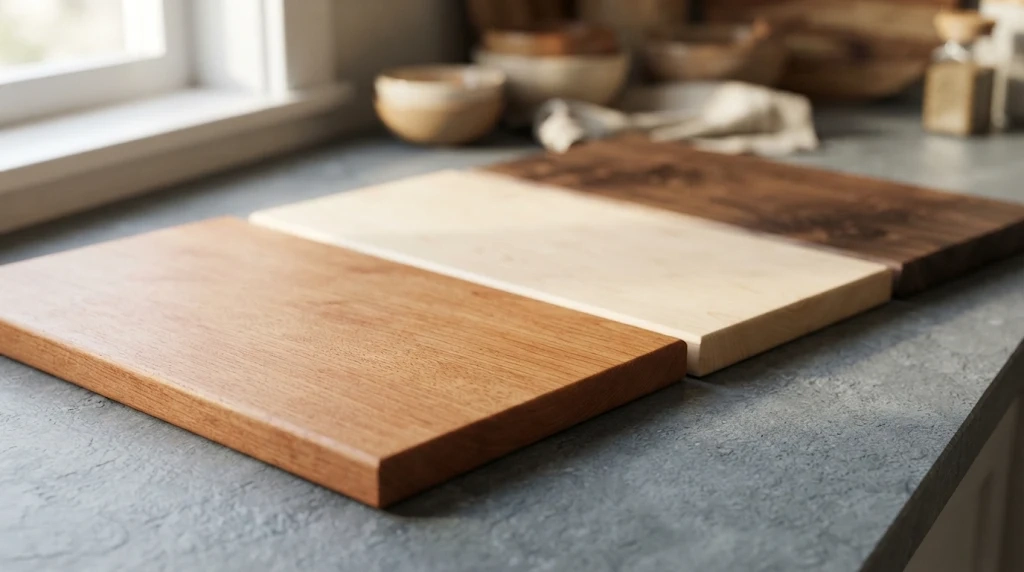
Looking at hardness alongside grain and maintenance needs helps clarify the differences. The table below compares commonly used American hardwoods.
| Wood Type | Janka Hardness | Key Characteristic | Practical Use |
|---|---|---|---|
| American Cherry | 950 lbf | Fine grain, moderate hardness | Everyday food preparation |
| Hard Maple | 1,450 lbf | Hard, close-grained surface | Frequent chopping |
| American Black Walnut | 1,010 lbf | Dark appearance, moderate hardness | Cutting and serving |
| American Beech | About 1,300 lbf | Dense, fine-textured hardwood | General-purpose chopping |
Note: Hardness figures are approximate and vary by species, growing conditions, and the tested sample. They are not food safety ratings.
My practical preference would be cherry for a visually appealing daily board and hard maple for especially demanding chopping. Neither wood eliminates the need for good hygiene and regular inspection.
Is Cherry Wood Safe for Food Preparation?
A properly manufactured cherry wood cutting board can be suitable for home food preparation. Its safety depends on the finished surface, cleanliness, construction, and how the board is maintained.
Wood itself doesn’t make a dirty cutting board safe. Food residue and moisture can remain in damaged surfaces if cleaning is neglected.
What About Bacteria and Food Safety?
Wooden cutting boards can be used hygienically when cleaned and maintained correctly. However, deep grooves, cracks, and persistent moisture make cleaning more difficult.
The University of Illinois Extension cutting board guidance recommends dedicated surfaces for raw meat and ready-to-eat foods.
- Use a clean board before preparing food.
- Wash the surface after each food-preparation task.
- Keep raw poultry, seafood, and meat away from ready-to-eat ingredients.
- Sanitize appropriately after contact with raw animal products.
- Replace boards with deep, hard-to-clean grooves or serious damage.
Is Cherry Wood Approved for Commercial Kitchens?
Home suitability and commercial food-code compliance are different questions. The FDA Food Code specifically references hard maple or equivalently hard, close-grained wood for certain food-contact applications.
Because American cherry is softer than hard maple, don’t assume every cherry board qualifies under that commercial provision. Check the applicable local health regulations before using one professionally.
For reference, consult the FDA Food Code and your local regulatory authority.
What Are the Advantages and Disadvantages of Cherry Cutting Boards?
Cherry offers several appealing characteristics, but it isn’t the best option for every kitchen. Understanding the trade-offs prevents unrealistic expectations.
Advantages of Cherry Wood
- Attractive finish: Cherry develops richer coloring as it ages and receives light exposure.
- Comfortable cutting surface: Its moderate hardness makes it appealing for routine knife work.
- Smooth texture: Fine-grained boards are practical for vegetables, herbs, fruit, and bread.
- Multiple designs: Manufacturers offer rectangular, round, edge-grain, and end-grain versions.
- Long-term potential: A quality board can remain useful for years with appropriate care.
Disadvantages of Cherry Wood
- Visible knife marks: Cherry can dent and scratch more easily than hard maple.
- Moisture sensitivity: Prolonged soaking may encourage swelling, warping, or cracking.
- Regular maintenance: The board needs cleaning, thorough drying, and occasional conditioning.
- Color changes: Natural darkening may be undesirable if you prefer a consistent light color.
- Quality variation: Poorly finished or improperly dried boards can develop problems regardless of species.
The biggest trade-off is surface wear. A softer cutting board can feel pleasant under a knife, but it may show chopping marks sooner.
Should You Choose End-Grain or Edge-Grain Cherry?
 Save
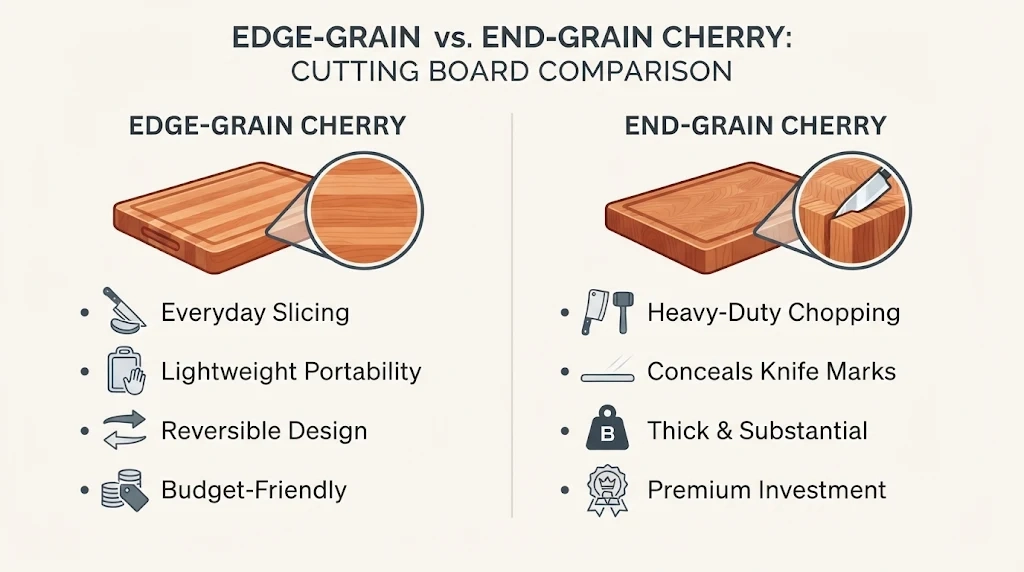
Both construction styles work for cherry cutting boards. The better option depends on your budget, cutting habits, and tolerance for maintenance.
Edge-Grain Cherry Cutting Boards
Edge-grain boards expose the long grain of wooden strips along the cutting surface. They are commonly available in relatively thin or moderately thick rectangular designs.
This construction is practical for everyday preparation and often costs less than comparable end-grain boards.
- Good for slicing vegetables, fruit, and bread.
- Often easier to lift and store.
- Available in reversible designs.
- May show knife marks more clearly with repeated chopping.
End-Grain Cherry Cutting Boards
End-grain boards expose the ends of wood fibers on the cutting surface. This construction allows the knife edge to move between fibers rather than primarily cutting across their length.
End-grain boards are often chosen for substantial chopping blocks, although construction quality and maintenance remain important.
- Useful for repeated chopping tasks.
- Often thicker and heavier than edge-grain alternatives.
- May conceal routine knife marks better.
- Usually more expensive and harder to move.
My buying preference: For most households, I’d start with a quality edge-grain cherry board. An end-grain block makes more sense when chopping space and stability matter more than portability.
Can You Cut Raw Meat on a Cherry Wood Cutting Board?
Raw meat can be prepared on a properly maintained wooden cutting board, but contamination control is essential. A separate board dedicated to raw animal products is the simpler approach.
For a household that regularly handles raw poultry or seafood, I’d favor a dedicated, easily sanitized board. That reduces the chance of transferring contamination to bread or fresh produce.
How to Reduce Cross-Contamination
- Use separate cutting boards for raw animal products and ready-to-eat foods.
- Wash the board with hot, soapy water immediately after use.
- Rinse thoroughly with clean water.
- Apply an appropriate food-contact sanitizing solution when needed.
- Follow the sanitizer’s directions, including contact time and any required rinsing.
- Dry the board completely before putting it away.
The American Cleaning Institute’s cutting board cleaning guidance provides additional practical instructions.
How Do You Clean a Cherry Wood Cutting Board?
Clean cherry boards promptly with mild dish soap and warm water, then dry them thoroughly. Avoid prolonged soaking and routine dishwasher cleaning unless the manufacturer explicitly permits it.
Daily Cleaning Instructions
- Remove debris: Scrape away loose food particles with a suitable utensil.
- Wash gently: Use warm running water, mild dish soap, and a soft sponge.
- Clean all surfaces: Wash both sides and the edges, especially after messy preparation.
- Rinse: Remove soap and food residue completely.
- Dry immediately: Wipe the board with a clean towel.
- Air-dry: Position it so air can reach both major surfaces.
Never leave a cherry cutting board submerged in a sink overnight. Water exposure can affect wood fibers and glued joints.
Can Cherry Wood Go in the Dishwasher?
For most finished cherry cutting boards, hand-washing is the safer maintenance choice. High heat, prolonged moisture, and drying cycles may damage the wood or its construction.
Follow the board manufacturer’s instructions even when general advice for solid hardwood differs. Many premium wooden board makers specifically recommend hand-washing.
How Do You Oil and Maintain a Cherry Cutting Board?
 Save
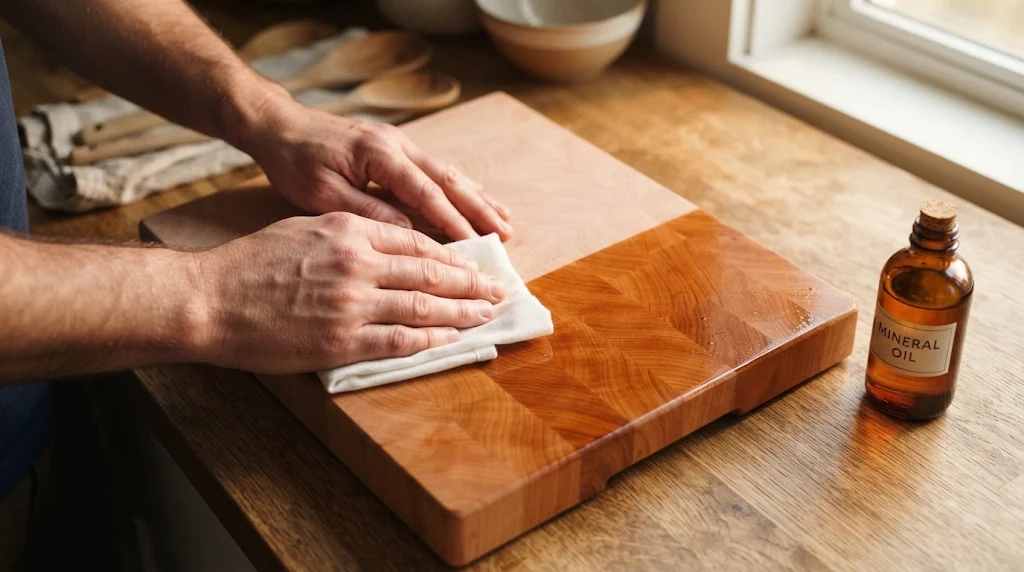
Food-grade mineral oil helps reduce excessive moisture exchange and keeps an unfinished or oil-finished board conditioned. Apply it when the wood looks dry, rather than following an inflexible schedule.
Step-by-Step Oiling Guide
- Wash the board and let it dry completely.
- Inspect for cracks, splinters, and deep grooves.
- Apply a small amount of food-grade mineral oil to a clean cloth.
- Rub the oil over the cutting surface, sides, and edges.
- Allow it to absorb according to the product instructions.
- Wipe off any remaining excess before using the board.
Some manufacturers recommend a board conditioner containing beeswax after oiling. Always check compatibility with the board’s existing finish.
Which Oils Should You Avoid?
- Cooking oils: Olive and many common vegetable oils can become rancid over time.
- Industrial lubricants: Never use products without appropriate food-contact suitability.
- Unknown wood finishes: Avoid stains, preservatives, or coatings not intended for cutting surfaces.
- Fragranced treatments: Strongly scented products may leave unwanted residues or odors.
Mineral oil should be specifically sold for food-contact or cutting board use. A product labeled simply as wood oil isn’t necessarily suitable.
Can You Make a Cutting Board From Cherry Wood?
Yes, cherry is workable for a homemade cutting board if the lumber is suitable and the finished board is constructed safely. The key is selecting clean, properly dried material without unsafe treatments.
Choosing the Right Lumber
- Use reliably identified American cherry lumber.
- Choose clean, kiln-dried or appropriately seasoned boards.
- Avoid pressure-treated, chemically preserved, or unknown reclaimed wood.
- Reject pieces with unstable knots, rot, major checks, or open cracks.
- Use adhesives appropriate for the intended food-contact application when making glued boards.
Basic Construction Process
- Select straight, sound cherry lumber with suitable moisture content.
- Mill the boards flat and square using appropriate woodworking tools.
- Arrange the strips for an edge-grain layout.
- Glue and clamp the pieces using the adhesive manufacturer’s instructions.
- Allow the assembly to cure fully.
- Flatten the board and round sharp edges.
- Sand the surface smooth and remove dust.
- Apply a suitable food-contact finish and follow its curing instructions.
A simple rectangular edge-grain design is a sensible first project. Elaborate end-grain layouts require more precise machining and additional glue joints.
How Can You Prevent Cherry Cutting Boards From Cracking?
The best prevention is controlling moisture changes and avoiding excessive heat. Cherry wood expands and contracts as environmental humidity changes.
- Dry evenly: Allow airflow around the board after washing.
- Avoid soaking: Never leave it sitting in water.
- Protect from heat: Keep it away from hot burners, radiators, and direct heat sources.
- Condition appropriately: Use suitable mineral oil when the surface becomes dry.
- Store carefully: Avoid conditions that keep one side continuously damp.
Oiling helps with maintenance, but it cannot prevent every crack or correct poor construction. A board with serious structural damage should not remain in food preparation service.
When Should You Replace a Cherry Wood Cutting Board?
Replace a board when it becomes difficult to clean safely or develops structural problems. Cosmetic discoloration alone doesn’t automatically mean replacement is necessary.
Important Warning Signs
- Deep knife grooves that trap food residue.
- Open cracks extending into the cutting surface.
- Splinters or loose wooden fragments.
- Separated glue joints.
- Persistent odors after thorough cleaning.
- Severe warping that makes the board unstable.
Minor surface scratches may sometimes be corrected by appropriate sanding and refinishing. Deep structural cracks and contamination-prone damage are different matters.
What Should You Look for When Buying a Cherry Cutting Board?
A good board should combine sound construction, usable dimensions, an appropriate finish, and manageable cleaning. Don’t choose based on appearance alone.
Four Important Buying Factors
- Wood and construction: Look for genuine cherry hardwood, secure joints, and a smooth, well-finished cutting surface.
- Board size: An approximately 18-by-12-inch surface suits many everyday preparation tasks.
- Thickness and stability: Thicker boards can feel solid but may be heavier to lift and wash.
- Care requirements: Verify cleaning directions, finish type, and any manufacturer’s maintenance recommendations.
For smaller kitchens, portability can be just as important as chopping space. A large butcher block may be attractive but inconvenient to clean in a small sink.
Recommended Cherry Wood Cutting Boards
Here are three genuine John Boos cherry cutting board models worth comparing. These selections are based on published construction details and intended uses, not personal product testing.
Editorial suitability ratings below reflect feature comparisons rather than customer review scores. Availability, pricing, and specifications should be checked with the retailer before purchasing.
🏆 Best Overall
John Boos Cherry R-Board Series (CHY-R01)
★★★★☆ 4.5/5 editorial suitability
This American cherry edge-grain board measures 18 x 12 x 1.5 inches in its CHY-R01 configuration. It is reversible and has recessed finger grips.
I’d prioritize this model for everyday vegetable preparation because its dimensions balance useful cutting space with manageable handling.
💪 Best Heavy-Duty Option
John Boos Cherry RA-Board Series (CHY-RA01)
★★★★☆ 4.4/5 editorial suitability
The CHY-RA01 is an 18 x 12-inch American cherry edge-grain cutting board with a substantial 2.25-inch thickness. Its reversible design includes recessed hand grips.
I’d consider it for a dedicated chopping station where a solid, substantial board matters more than low weight.
🍽️ Best for Serving
John Boos Cherry Round R-Board (CHY-R18)
★★★★☆ 4.3/5 editorial suitability
This American cherry board features an 18-inch circular cutting surface, edge-grain construction, and a 1.5-inch thickness. It is also reversible.
I’d choose its round format for serving bread, cheese, and appetizers while retaining a functional cutting surface.
Frequently Asked Questions About Cherry Wood Cutting Boards
Is cherry wood better than maple for cutting boards?
Cherry and maple serve different preferences. Cherry is softer, with a Janka hardness around 950 lbf, and offers warm reddish coloring. Hard maple is harder, around 1,450 lbf, and generally resists dents better. Choose cherry for its appearance and moderate cutting feel, or maple for demanding daily chopping.
Does cherry wood dull knives?
Cherry is generally considered a knife-friendly hardwood because it is moderately hard rather than extremely dense. However, knife wear also depends on blade steel, sharpening, cutting technique, and board construction. No cutting board completely prevents edge wear, and harder surfaces are not automatically better for knives.
Can you use cherry wood for an end-grain cutting board?
Yes, cherry can be used in end-grain cutting boards. End-grain construction exposes the ends of wood fibers, creating a useful chopping surface. The result depends heavily on sound lumber, proper joinery, suitable adhesive, and appropriate finishing. Such boards also require regular cleaning and careful drying.
How often should you oil a cherry cutting board?
Oil the board when its surface becomes noticeably dry or according to the manufacturer’s directions. There is no universal schedule because washing frequency, humidity, and finish condition vary. Use food-grade mineral oil or a suitable board conditioner, let it absorb, and remove any excess before preparing food.
Is cherry wood toxic for cutting boards?
Properly manufactured American cherry heartwood cutting boards are commonly sold for kitchen use. However, this does not make every part of a cherry tree suitable for food contact. Avoid bark, leaves, unknown finishes, chemically treated wood, and damaged material. Choose a board specifically manufactured for food preparation.
Final Verdict: Is Cherry Wood Worth Using for a Cutting Board?
Yes, cherry wood is a worthwhile cutting board material for many home kitchens. Its fine grain, moderate hardness, and warm appearance make it appealing for slicing, chopping, and serving.
For routine food preparation, a well-made edge-grain cherry board is an excellent starting point. If you do extensive heavy chopping, compare thicker boards and end-grain designs before deciding.
Whatever you choose, prioritize food-safe construction, good cleaning habits, thorough drying, and timely replacement when damage becomes serious. A quality board deserves proper care.
Ready to choose? Compare the three cherry cutting boards above, measure your available countertop space, and select the size and construction that fit your kitchen.

