What Cutting Boards Look Like Wood? 5 Alternatives Explained
Quick Answer
What cutting boards look like wood without being traditional hardwood? The main options are bamboo, paper-composite boards, wood-grain plastic, decorative wood-look glass, and melamine serving boards. For everyday chopping, paper-composite cutting boards are particularly practical because they offer a natural appearance, lightweight construction, and convenient cleaning.
Five Wood-Look Options
- Paper composite: Natural-looking material made from resin-bonded paper layers, often with a wood-like texture.
- Bamboo: A fast-growing grass with a warm, wood-like appearance and visible strips.
- Wood-grain plastic: Food-contact plastic featuring a printed or molded wood-style pattern.
- Decorative glass: Tempered glass featuring realistic printed wood designs, better suited to serving.
- Melamine: Lightweight decorative boards with wood-style finishes, generally better for presentation than chopping.
My Recommendation
- Best nonwood alternative: A quality paper-composite cutting board.
- Best natural appearance: Bamboo or genuine hardwood.
- Best decorative choice: A wood-print serving board clearly labeled for food contact.
A wooden cutting board adds warmth and character to a kitchen, but real hardwood isn’t everyone’s first choice. You might want something lighter, easier to clean, or less demanding to maintain.
Fortunately, several cutting board materials resemble natural wood without sharing all its characteristics. I’ll explain which alternatives work for chopping, which suit serving, and what to check before buying.
In This Guide
What Makes a Cutting Board Look Like Wood?
 Save
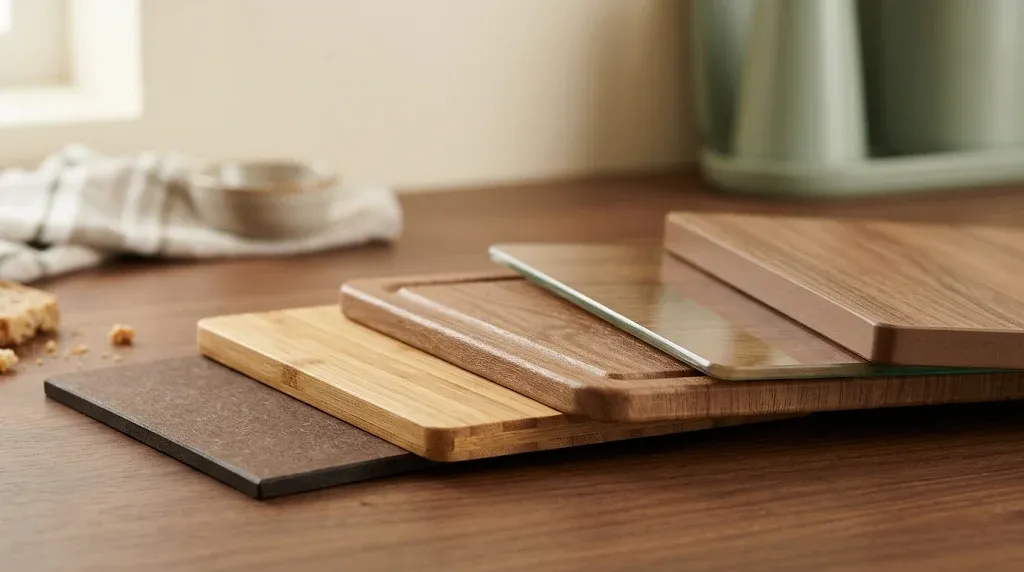
A wood-look cutting board is a food preparation or serving surface designed to resemble natural timber. It may feature genuine plant fibers, simulated grain patterns, or decorative printing.
The important distinction is that appearance doesn’t tell you how a board performs. Two boards with nearly identical colors can behave differently under a kitchen knife.
Natural Texture vs. Printed Wood Grain
Some alternatives resemble wood because they contain plant-based fibers or naturally striped materials. Bamboo and paper-composite boards fall into this general category.
Other boards use printed or molded patterns to create a wooden appearance. Certain plastic and glass products reproduce the appearance of oak, walnut, or another timber.
Common appearance features include:
- Visible grain: Parallel lines or swirling designs that imitate timber.
- Natural colors: Tan, honey, walnut brown, or reddish-brown finishes.
- Matte surfaces: Less reflective finishes that resemble unfinished wood.
- Striped construction: Alternating light and dark sections similar to laminated boards.
- Wood-style edges: Rounded corners or profiles associated with traditional cutting boards.
Why Does the Actual Material Matter?
A cutting board must do more than look attractive. It needs to withstand knife contact, remain stable, and allow proper cleaning.
Hard surfaces can dull knives faster, while unsuitable decorative finishes may become damaged by cutting. That’s why I would prioritize the actual material over the wood-grain pattern.
A useful starting point is the University of Maine’s cutting board safety guidance, which compares materials and explains their maintenance requirements.
Section takeaway: A realistic wood finish doesn’t guarantee good cutting performance. Check the material and intended use before choosing a board.
Which Cutting Board Materials Look Like Wood?
Several materials can provide the warm appearance of a wooden cutting board. However, only some make practical substitutes for daily food preparation.
1. Paper-Composite Cutting Boards
Paper-composite cutting boards are among the most useful alternatives to traditional hardwood. Their brown surfaces and natural texture can resemble dark or lightly finished wood.
Manufacturers typically bond multiple layers of paper using resin, heat, and pressure. The finished material forms a thin, dense cutting surface.
Epicurean is a recognizable example of this category. Its cutting boards use a paper-composite material and include dishwasher-safe models.
Reasons to consider paper composite include:
- Natural-looking brown or dark finishes.
- Relatively lightweight construction.
- Thin profiles that simplify storage.
- Dishwasher compatibility on approved models.
- Less routine conditioning than genuine hardwood.
Paper composite isn’t identical to solid wood. Its relatively firm surface may create a different cutting feel and affect knife edges differently.
That’s especially important if you use delicate or frequently sharpened kitchen knives. Choose the board based on your cutting habits rather than appearance alone.
2. Bamboo Cutting Boards
Bamboo offers one of the most convincing natural wood appearances. Its golden color and striped grain resemble many traditional wooden cutting boards.
Technically, bamboo is a grass rather than a tree. Manufacturers commonly combine bamboo strips into cutting boards using adhesives.
Its main attractions include:
- A warm, natural appearance.
- Attractive light and dark strip patterns.
- Widely available rectangular and paddle shapes.
- Useful surfaces for chopping vegetables and preparing snacks.
- A natural look that works well for serving food.
Bamboo can be harder on some knife edges than softer hardwood options. It also requires appropriate cleaning and drying to help prevent warping or splitting.
I would choose bamboo when appearance matters and handwashing isn’t a problem. A properly maintained board can work for both preparation and presentation.
3. Wood-Grain Plastic Cutting Boards
Some plastic cutting boards feature simulated wood patterns instead of their usual solid colors. These products aim to combine a familiar wooden appearance with plastic’s convenient cleaning characteristics.
The quality of the surface depends on its construction. A pattern may be integrated into the plastic or applied as a decorative finish.
Potential advantages include:
- Lower weight than many thick hardwood boards.
- Minimal conditioning requirements.
- Easy cleaning when the surface is smooth and intact.
- Different wood-style colors and designs.
- Dishwasher compatibility on specifically approved products.
However, not every wood-patterned plastic surface is intended for chopping. Knife contact may damage a printed coating or leave grooves that are difficult to clean.
Look for explicit food-contact and cutting-board suitability information. A decorative plastic tray isn’t automatically a safe chopping board.
4. Wood-Look Glass Cutting Boards
Tempered glass boards can feature realistic printed wood patterns. They often reproduce the appearance of rustic oak, reclaimed timber, or polished walnut.
Glass provides an easy-to-clean, nonporous surface. Yet this doesn’t make it an ideal everyday chopping material.
Glass is much harder than a typical knife edge, which can accelerate dulling. The surface may also feel slippery during food preparation.
For those reasons, I would reserve decorative glass boards for:
- Serving cheese or appetizers.
- Displaying prepared food.
- Kitchen counter presentation.
- Other tasks specifically approved by the manufacturer.
If protecting your knives matters, use a separate knife-friendly cutting board. Glass looks attractive, but it isn’t my preferred chopping surface.
5. Wood-Look Melamine Serving Boards
Melamine products sometimes feature realistic wooden finishes. They can create a rustic presentation without using solid timber.
These products are frequently intended for serving rather than repeated cutting. A knife may scratch or damage their decorative surfaces.
A board’s suitability depends on its particular construction and manufacturer instructions. Food-contact suitability alone does not establish that it can withstand chopping.
Consider a melamine wood-look board for approved serving tasks. Choose a dedicated cutting surface for regular knife work.
What About Acacia, Rubberwood, or Walnut?
Acacia, rubberwood, and walnut aren’t imitation materials. They are genuine woods that naturally provide the appearance people often want from a cutting board.
They can be excellent options when your goal is simply to find an attractive wooden surface. However, they still require care appropriate to the wood and board construction.
Section takeaway: Paper composite and bamboo are the strongest everyday candidates for a natural wood appearance. Printed plastic requires careful product selection, while decorative glass and melamine are better suited to serving.
How Do Wood-Look Cutting Boards Compare?
The most important differences involve cutting performance, maintenance, and intended use. Here’s how the main wood-look materials compare.
| Material | Appearance | Knife Use | Best Use |
|---|---|---|---|
| Paper composite | Natural matte brown | Suitable on cutting-rated models | Everyday meal preparation |
| Bamboo | Natural golden stripes | Suitable, but relatively firm | Vegetables and serving |
| Wood-grain plastic | Printed or molded grain | Only cutting-rated products | Convenient food prep |
| Decorative glass | Realistic printed timber | Poor for knife edges | Serving and presentation |
| Wood-look melamine | Decorative wood finish | Generally not recommended | Food presentation |
| Real hardwood | Authentic wood grain | Often knife-friendly | Everyday chopping |
The table compares general material characteristics rather than every individual product. Surface formulation, coatings, thickness, and manufacturer instructions can change performance.
A useful distinction is dishwasher safety. Some paper-composite boards are dishwasher safe, while bamboo and traditional wooden boards generally benefit from handwashing.
Similarly, a plastic board isn’t necessarily dishwasher safe just because it’s plastic. Always check the instructions for the exact product.
Which Wood-Look Cutting Board Is Best for Everyday Chopping?
 Save
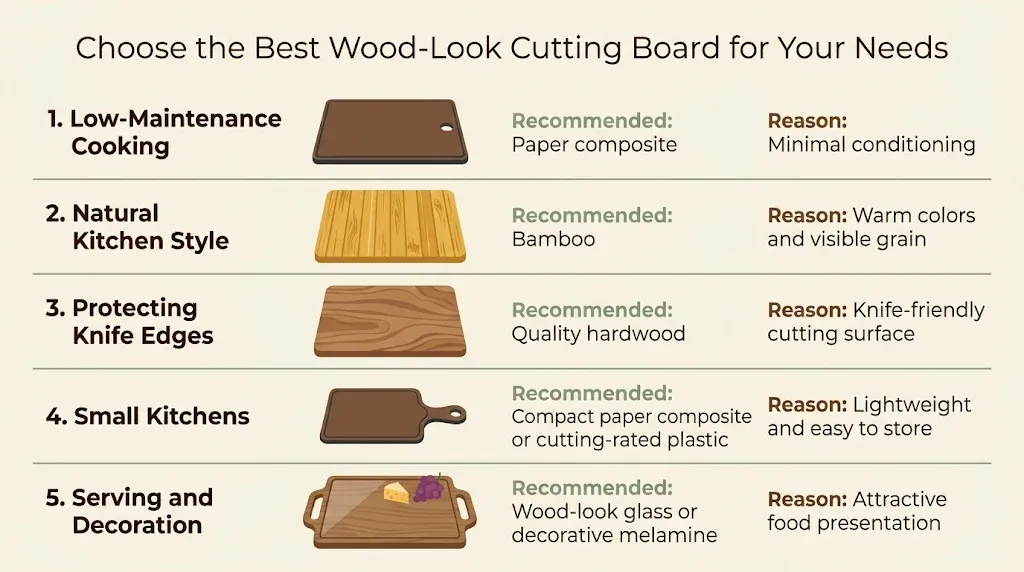
For shoppers who want a nonwood alternative with a natural appearance, paper composite is an appealing choice. It balances everyday usability with a surface that resembles wood.
However, your ideal choice depends on how you cook. Knife maintenance, cleaning preferences, and kitchen space all matter.
Best for Low-Maintenance Cooking
Consider a manufacturer-approved dishwasher-safe paper-composite board. It avoids much of the conditioning associated with traditional wooden cutting boards.
Thin versions also fit easily into a cabinet or drawer. That convenience matters in kitchens with limited storage.
Best for a Natural Kitchen Style
Bamboo is a strong choice if you love warm colors and visible grain. Its striped construction can complement wood cabinets, countertops, and traditional kitchen accessories.
It also looks attractive when serving bread, cheese, or prepared vegetables. Just avoid leaving it soaking in water.
Best for Protecting Knife Edges
When knife longevity is your highest priority, consider quality hardwood or a specifically knife-friendly cutting surface. Don’t assume a material is gentle simply because it resembles timber.
Paper-composite boards can feel firmer than some hardwood options. Bamboo can also wear knife edges faster depending on the blade and board construction.
For comparison, genuine maple and walnut cutting boards are often favored for their balance of durability and cutting feel. Their actual performance still depends on construction and maintenance.
Best for Small Kitchens
Compact paper-composite or cutting-rated plastic boards are convenient options. They are generally easier to lift and store than a thick butcher block.
Look for a usable cutting area of approximately 12 by 18 inches if your counter allows it. Smaller boards work for quick fruit preparation but provide less space for larger ingredients.
Best for Serving and Decoration
Wood-look glass and decorative melamine are more appropriate when appearance matters more than knife performance. They can create an attractive presentation without requiring a hardwood serving board.
Remember that a product labeled as a serving tray isn’t necessarily suitable for cutting. Use it only as its manufacturer intends.
Section takeaway: Choose paper composite for convenient everyday use, bamboo for natural styling, and a suitable hardwood when knife feel is the priority. Reserve decorative finishes for presentation unless cutting use is explicitly approved.
How Can You Choose a Safe Wood-Look Cutting Board?
The safest buying approach is to examine the material, finish, and instructions. A convincing wood-grain design isn’t evidence of food safety.
Check the Product Description
Before purchasing, look for clear answers to these questions:
- Actual material: Is the board bamboo, composite, plastic, or another substance?
- Food-contact suitability: Does the manufacturer approve direct contact with food?
- Cutting suitability: Is the product designed for repeated knife contact?
- Finish durability: Can scratching expose or damage a decorative coating?
- Cleaning method: Can it be safely handwashed or placed in a dishwasher?
- Surface condition: Is the board smooth, intact, and free from cracks?
Be cautious with products that don’t identify their materials. This matters particularly for inexpensive decorative items sold primarily as kitchen accessories.
Look for a Stable, Practical Design
A cutting board should stay still during chopping. Lightweight boards sometimes slide on smooth countertops.
Choose nonslip feet or place an appropriate nonslip mat beneath the board. A clean, damp paper towel can also help stabilize some boards during use.
Surface area is equally important. A board that’s too small encourages ingredients to fall over the edges.
What About Food Safety and Bacteria?
Both wooden and nonwood cutting boards require proper cleaning. No cutting board material eliminates the need for basic food hygiene.
The USDA’s cutting board guidance recommends separating boards used for raw animal products from those used for produce and ready-to-eat foods.
Knife grooves and damaged surfaces can trap food residue. Replace boards when excessive wear makes thorough cleaning difficult.
A decorative coating that begins peeling or flaking is another warning sign. Stop using the affected surface for food preparation.
Do You Need a Special Certification?
Recognized food-contact or sanitation certifications can provide useful reassurance when applicable. However, certification claims should match the exact product being sold.
Look for clear manufacturer documentation rather than relying on generic advertising terms. Claims such as “natural” or “eco-friendly” don’t independently prove cutting suitability.
Section takeaway: Verify both food-contact approval and knife-use suitability. They are different requirements, especially for decorative wood-look products.
How Should You Clean and Maintain a Wood-Look Cutting Board?
 Save
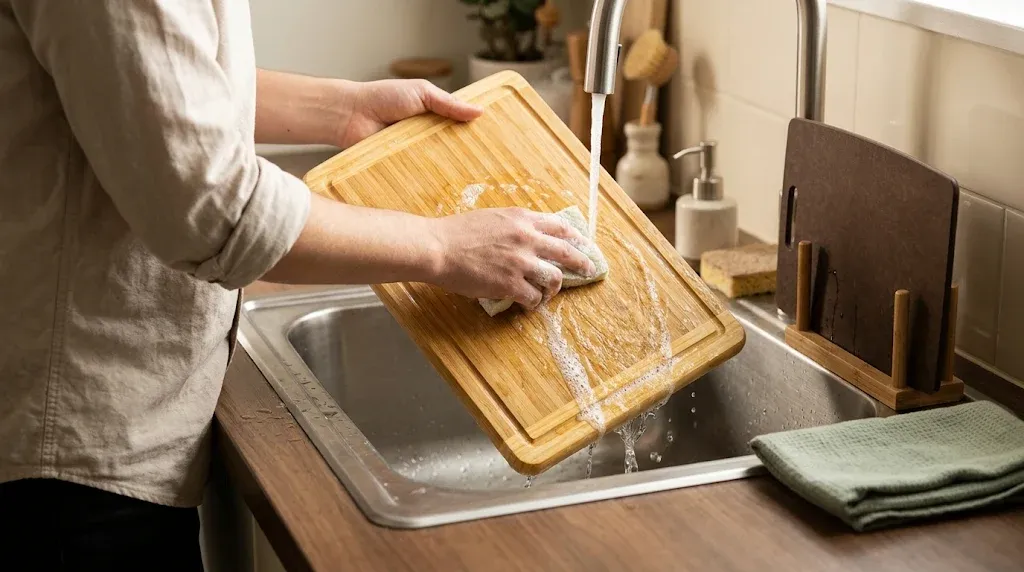
Different wood-look materials require different cleaning routines. The safest approach begins with the manufacturer’s instructions.
Basic Cleaning Steps
- Remove food debris: Scrape away leftover ingredients without damaging the cutting surface.
- Wash thoroughly: Use dish soap and warm or hot water suitable for the board.
- Scrub gently: Pay attention to knife grooves and areas where food may collect.
- Rinse: Remove cleaning residue with clean water.
- Sanitize when appropriate: Follow approved food-contact sanitizer instructions, especially after handling raw animal products.
- Dry completely: Allow the board to air-dry before storage.
The American Cleaning Institute provides additional cutting board cleaning and sanitizing advice.
Paper-Composite Board Maintenance
Paper-composite boards generally need less conditioning than genuine wood. Some manufacturers approve dishwasher cleaning, but compatibility varies.
For dishwasher-safe models, follow the stated washing instructions. Allow the surface to dry completely before storing it.
Don’t assume paper composite requires mineral oil. Some products specifically need no routine oiling.
Bamboo Board Maintenance
Wash bamboo boards by hand unless the manufacturer explicitly permits another method. Avoid soaking them or exposing them to prolonged moisture.
Dry the surface thoroughly and store it where air can circulate. Appropriate conditioning with food-safe mineral oil may help maintain boards that require it.
Don’t use ordinary vegetable oil as a substitute for a recommended board conditioner. Some cooking oils can become sticky or develop unpleasant odors.
Plastic and Decorative Board Maintenance
Plastic boards usually need no oiling. Wash them as instructed and inspect them regularly for deep cuts or surface deterioration.
For decorative glass, check whether the printed side has special cleaning restrictions. Avoid abrasive cleaners when they could damage a coating.
Melamine products should also be cleaned according to their instructions. Discontinue food-preparation use if a surface becomes chipped or damaged.
When Should You Replace a Cutting Board?
Replace a board when cracks, deep grooves, peeling surfaces, or permanent damage prevent proper cleaning. The decision depends on condition rather than a fixed replacement schedule.
Also look for persistent odors, structural separation, and extensive warping. A board that rocks or slides during cutting can become unsafe to use.
For additional food-safety guidance, consult the FDA’s kitchen cleaning recommendations.
Section takeaway: Maintain wood-look boards according to their actual materials. Clean after use, dry thoroughly, and replace surfaces that can no longer be cleaned effectively.
Frequently Asked Questions
What cutting board looks most like real wood?
Bamboo cutting boards often look the most like traditional light-colored wood because they have natural grain-like patterns. Brown paper-composite boards also provide a wood-inspired appearance, although their texture is usually more uniform.
If you want authentic timber grain, genuine hardwood remains the closest match.
Are there plastic cutting boards that look like wood?
Yes, some plastic products feature printed or molded wood-grain patterns. However, not every wood-look plastic item is designed for chopping.
Choose a board specifically intended for food preparation and repeated knife contact. Check that its decorative finish won’t become damaged during normal use.
Are wood-look cutting boards dishwasher safe?
Some are, but dishwasher suitability depends on the material and manufacturer. Certain paper-composite and plastic boards tolerate machine washing.
Bamboo and genuine wooden cutting boards generally benefit from handwashing to reduce the risk of warping or splitting. Always follow the instructions supplied with your particular board.
Is bamboo better than a composite cutting board?
Bamboo is attractive if you want a natural striped appearance and don’t mind handwashing. Paper composite is convenient if you prefer a lightweight board with minimal conditioning requirements.
Neither material is automatically superior. Consider knife compatibility, cleaning preferences, and the exact product’s construction.
Do paper-composite cutting boards damage knives?
Paper-composite cutting boards are designed for knife contact, but some are relatively firm. They may wear certain knife edges faster than softer hardwood cutting surfaces.
Edge retention depends on the board, knife steel, blade geometry, and cutting technique. A quality composite board remains a practical option for many everyday cooking tasks.
Can I use a decorative wood-look serving board for cutting?
Only when the manufacturer approves it for cutting. Decorative boards may have finishes or surfaces unsuitable for repeated knife contact.
Glass is particularly hard on knife edges, while certain decorative coatings can scratch or chip. A dedicated cutting board is the safer choice when suitability is uncertain.
Are faux-wood cutting boards safe for preparing raw meat?
A food-contact-safe, cutting-rated board can be used for raw meat if it can be properly cleaned and sanitized. The material and condition matter more than its appearance.
Use a separate board for produce and ready-to-eat foods whenever possible. Replace any board that develops hard-to-clean grooves or damage.
What is the best alternative to a wooden cutting board?
Paper composite is a good option when you want a natural-looking cutting surface without regular wood conditioning. Cutting-rated plastic is another practical alternative, particularly when easy cleaning is your priority.
Bamboo offers a more traditional natural appearance but still requires careful drying and maintenance.
Final Takeaway: The best cutting board that looks like wood depends on whether you value appearance, knife friendliness, or easy cleaning most.
For everyday food preparation, start by considering a quality paper-composite or bamboo board. If you prefer printed wood-grain designs, confirm the surface is genuinely intended for cutting rather than serving alone.
Choose the material first, then the finish. That simple approach will help you find a board that looks right and performs reliably in your kitchen.

