How to Maintain a Carbon Steel Chef Knife (No Rust Guide)
Quick Answer
To maintain a carbon steel chef knife, hand-wash it with mild soap and warm water immediately after use, wipe it completely dry with a clean towel right away, and apply a thin coat of food-safe mineral oil or Japanese camellia oil before storing. Never soak the blade, leave it wet on a cutting board between tasks, or place it in a dishwasher, because carbon steel lacks protective chromium and can begin oxidizing within minutes of moisture or acid exposure.
Why Carbon Steel Needs Different Care Than Stainless Steel
 Save
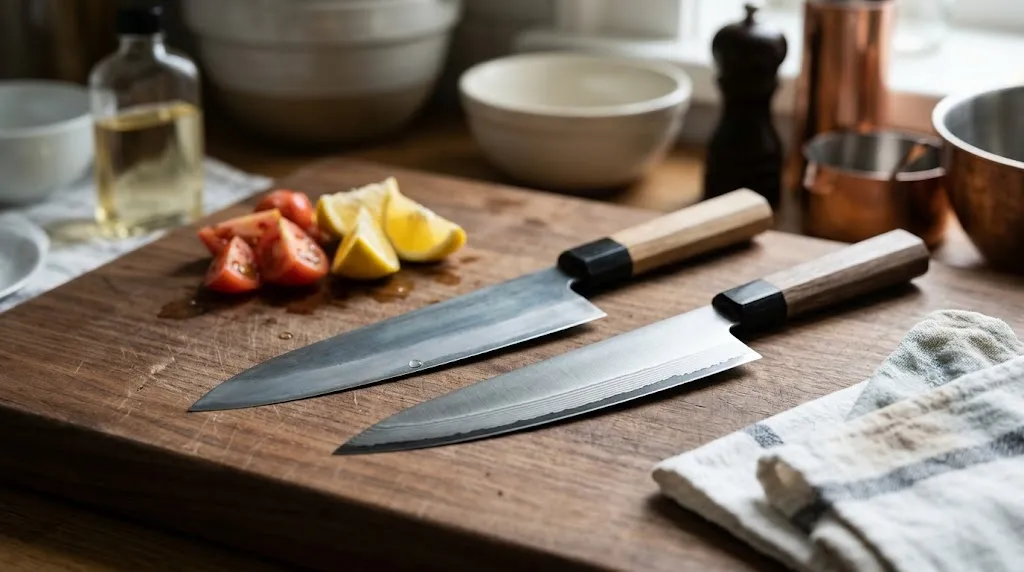
Carbon steel requires strict moisture control because it contains less than 10.5% chromium—and often almost zero—meaning it cannot form the self-healing passive chromium oxide barrier that protects stainless steel from corrosion. Instead, the exposed iron in a carbon steel blade reacts rapidly with oxygen, water, and organic acids found in everyday ingredients like onions, citrus, and tomatoes.
That chemical reactivity is a direct metallurgical tradeoff for cutting performance. High-carbon alloys such as Japanese White Steel (Shirogami #1 and #2), Blue Steel (Aogami #1, #2, and Super), and American 1095 have an ultra-fine carbide grain structure that reaches higher hardness levels—typically 60 to 65 HRC on the Rockwell scale—than standard kitchen stainless steel (usually 54 to 58 HRC). Because the steel is harder and lacks bulky chromium carbides, a carbon steel blade takes a noticeably keener edge, holds its bite longer through heavy vegetable prep, and forms a clean burr much faster on a whetstone.
Understanding whether your blade is full-carbon monosteel (Honyaki or traditional Western carbon) or laminated construction (San Mai or Warikomi) also shapes your maintenance routine. On a stainless-clad San Mai blade, non-reactive stainless steel jackets wrap around both sides of the hard carbon core, leaving only 3 to 6 millimeters of reactive carbon steel exposed along the cutting edge. On a monosteel carbon knife or an iron-clad blade, the entire surface from spine to edge is reactive and requires full-blade moisture protection.
The Core Daily Routine: Wash, Wipe, and Dry During Prep
Preventing red rust happens during active cooking at the cutting board, not just when washing dishes after eating. Leaving a carbon steel knife resting in acidic tomato pulp or lime juice for ten minutes while you sauté aromatics at the stove is the single most common way owners trigger surface pitting.
- Set up a two-towel station at your cutting board: Before making your first cut, fold a lightly damp cotton or microfiber kitchen towel next to your board alongside a second completely dry towel. Whenever you switch between ingredients or pause chopping for more than two minutes, draw the blade spine-first across the damp cloth to clear food residue, then immediately wipe it dry on the second cloth.
- Hand-wash immediately after your final cut: Carry the knife directly to the sink as soon as prep finishes rather than setting it in a pile of dirty cookware. Wash both faces of the blade, the spine, the choil (the curved cutout above the heel), and the bolster area using warm water, mild dish soap, and the non-abrasive soft side of a sponge.
- Dry thoroughly from spine to cutting edge: Pinch the spine of the blade inside a clean, absorbent towel and wipe outward past the edge until zero water droplets remain. Pay special attention to the handle junction where the metal tang enters the wooden ferrule or bolster, as water wicked into that seam causes hidden internal tang rust.
- Let the blade air-dry for five minutes before sheathing: Set the towel-dried knife flat on a dry dish cloth on the counter for three to five minutes. Warm water slightly heats the steel, and allowing a brief air-dry ensures residual microscopic dampness evaporates completely before you slide the blade into a wooden saya, edge guard, or knife block.
Warning
Never place a carbon steel knife in a dishwasher or leave it submerged in a sink full of soapy water. Dishwasher detergents are harsh alkalines, and the combination of high heat, prolonged steam, and water jets will strip protective patina, crack wooden handles, knock the thin cutting edge against dish racks, and coat the steel in heavy orange rust in a single cycle.
Patina vs. Rust: How to Tell Safe Oxidation From Damaging Corrosion
A smooth dark gray, slate blue, or muted violet discoloration on carbon steel is a harmless protective patina, whereas bright orange, reddish-brown, or powdery buildup is destructive rust that must be scrubbed off before food contact.
While both result from iron reacting with oxygen, they form completely different iron oxide compounds. Patina consists primarily of magnetite (Fe3O4), a dense, stable oxide layer that forms when iron reacts briefly with mild food acids and is wiped dry before standing water can accumulate. Because magnetite molecules pack tightly onto the metal surface, a mature patina seals the underlying iron against air and moisture, dramatically slowing down future corrosion and stopping the metallic smell new carbon knives produce.
Destructive red rust is hydrated iron(III) oxide (Fe2O3). Unlike magnetite, red rust forms loose, porous, flaking crystals that expand outward and trap moisture against the fresh steel underneath. If ignored, red rust eats downward into the metal, creating microscopic dark craters (pitting) that weaken the thin cutting apex.
| Diagnostic Feature | Protective Patina (Fe3O4) | Destructive Red Rust (Fe2O3) |
|---|---|---|
| Typical Colors | Charcoal gray, iridescent blue, muted purple, or matte bronze-brown | Vibrant orange, brick red, or bright yellow-brown |
| Tactile Texture | Completely smooth and flush with the steel surface | Rough, raised, gritty, or powdery when lightly scraped with a fingernail |
| White Paper Towel Test | Leaves zero color transfer when rubbed firmly with an oiled white paper towel | Leaves orange or reddish-brown streaks on a white paper towel |
| Impact on Ingredients | Eliminates metallic smell and prevents staining on light vegetables | Transfers iron oxide flakes and bitter metallic taste to food |
| Correct Action | Leave completely alone; continue normal washing and drying | Remove immediately with baking soda paste or a fine rust eraser |
Whenever a warm brownish tint appears after slicing caramelized onions or roasted meats, run the white paper towel test: place a drop of mineral oil on a clean white paper towel and rub the discolored spot firmly. If nothing transfers to the paper and the metal feels glass-smooth, it is stable patina and requires no scrubbing.
Managing Acidic Foods During the First Two Weeks
When a carbon steel knife is brand new—or freshly polished on whetstones—raw iron is completely exposed. Cutting highly acidic or sulfurous ingredients like lemons, limes, pineapples, tomatoes, or white onions during the first few uses triggers a rapid reaction that smells faintly like struck matches, turns cut onion edges gray-brown, and leaves blotchy yellow stains on the blade.
To build a calm, uniform patina before tackling heavy acid prep, use the new knife primarily to slice hot cooked proteins—such as grilled steak, roast pork, or rotisserie chicken—during its first week. Hot proteins release amino acids and fats that turn carbon steel an attractive sky-blue and deep slate gray without etching the metal or tainting raw vegetables. Additionally, inspect your new blade before its first wash: many Japanese blacksmiths coat factory blades in a clear protective lacquer (urushi or food-safe resin) for shipping. If water beads strangely or the blade develops rainbow streaks without patinating, wipe the blade with a cotton pad soaked in pure acetone (nail polish remover), then wash thoroughly with dish soap and warm water to expose the steel.
How to Remove Surface Rust Safely Without Ruining the Finish
If you spot orange rust dots on your blade, remove them promptly using the mildest abrasive possible so you do not mar the blacksmith’s finish or scratch soft cladding.
- Scrub light surface spots with baking soda paste: Mix two tablespoons of baking soda with a few drops of water until it forms a thick, gritty paste. Spread the paste over the orange rust spot and rub gently in the direction of the existing factory grind lines (typically spine-to-edge) using the flat end of a wine cork or a damp cloth. Baking soda is mildly alkaline, neutralizing lingering acid while lifting loose oxide without scratching hardened steel.
- Use a fine rubberized rust eraser for stubborn oxidation: If baking soda leaves behind dark red specks, soak a fine-grit rust eraser (such as a Sabitoru medium/fine block) in water and rub strictly parallel to the vertical grind lines with light pressure. Never scrub in circular motions, which create obvious swirl scratches across the blade face.
- Protect Kuro-uchi (black forged) finishes: If your knife has a traditional rustic black forge scale (Kuro-uchi) on the upper half of the blade, keep rust erasers and abrasive pastes strictly on the lower polished bevel. Scrubbing the dark Kuro-uchi layer strips away the protective black magnetite scale and leaves shiny silver patches.
- Inspect the cutting apex for micro-pitting: After rinsing and drying the cleaned blade, examine the very edge under bright overhead light. If rust formed directly on the cutting apex, a quick 3-minute pass on a 1000-grit sharpening stone will grind away weak, pitted metal and establish a crisp edge.
Never use steel wool, heavy-duty green Scotch-Brite pads, powdered bleach cleansers, or coarse sandpaper for routine rust removal. Aggressive abrasives gouge deep furrows into soft iron or stainless cladding, giving moisture more surface area to cling to in the future.
Oiling the Blade and Conditioning Wooden Handles
Applying a microscopic film of food-safe oil seals the metal pores against ambient atmospheric humidity when the knife rests between meals.
Whether you need to oil after every single wash depends on your environment and blade age. In an air-conditioned or dry winter kitchen (below 50% relative humidity), a daily-use knife with a mature dark patina only needs thorough washing and towel drying. However, you should always apply oil in three specific scenarios: during the first month before a full patina develops, whenever kitchen humidity climbs above 60%, or anytime the knife will sit unused for more than 48 hours.
Choosing the Right Knife Oil
- Japanese Camellia Oil (Tsubaki Oil): Pressed from the seeds of Camellia japonica, this is the traditional standard for Japanese culinary blades. It has low viscosity, spreads in a whisper-thin film, never turns rancid, and leaves zero odor or taste on ingredients.
- USP Food-Grade White Mineral Oil: Inexpensive, colorless, odorless, and chemically inert. Because it is a saturated hydrocarbon rather than a plant fat, it cannot spoil or gum up over time.
- Avoid olive, canola, vegetable, or coconut oil: Everyday cooking oils contain unsaturated fatty acids that oxidize and polymerize when exposed to air, hardening into a sticky, foul-smelling amber varnish that attracts dust and contaminates food flavors.
To oil properly, place two small drops of camellia or mineral oil onto a folded paper towel and wipe both sides of the dry blade, the spine, and the choil. Buff lightly with a dry corner of the towel so the steel looks satin-smooth rather than dripping wet.
Do not neglect the handle. Traditional Japanese Wa-handles (made from unfinished magnolia, walnut, oak, or cherry) and Western rosewood scales dry out from repeated sink washing. Once a month, rub a pea-sized dab of beeswax-mineral oil board conditioner into the wood and around the bolster ferrule. Keeping the wood hydrated prevents shrinkage and seals the tiny gap where the metal tang enters the handle, blocking dishwater from creeping inside and rusting the tang internally.
Cutting Board Selection and Board Technique
Because carbon steel blades are hardened to 60–65 HRC and ground to thin, acute edge angles (often 10 to 15 degrees per side), they lack the ductile flex of softer Western stainless knives. Careless board contact or twisting forces cause micro-chipping rather than simple edge rolling.
- Best cutting boards for carbon steel: End-grain or edge-grain hardwoods with closed pores and moderate hardness—specifically Hard Maple, American Black Walnut, Cherry, or Japanese Hinoki cypress—along with professional soft synthetic rubber boards (such as Hasegawa Wood Core or Asahi Parker Asahi). These surfaces cushion the apex at the bottom of each cut.
- Surfaces that ruin carbon steel edges: Glass, ceramic plates, marble, granite countertops, slate, titanium boards, and inexpensive vertical-grain bamboo boards (which contain hard silica nodes and dense urea-formaldehyde glues that dull high-HRC steel rapidly).
- Essential cutting habits: Always lift ingredients or scrape the board using the flat spine of the knife—never drag the sharp edge sideways across the wood. Keep your wrist aligned straight with the cut, and never twist or pry the blade laterally when halving hard winter squash, sweet potatoes, or crusted meats.
Tip
If your carbon steel chef knife binds or wedges halfway through a dense butternut squash or block of cheddar, pull the blade straight backward toward the handle while lifting upward. Wiggling or twisting the handle left and right to free a wedged blade snaps microscopic triangles right out of a 62 HRC cutting edge.
Edge Maintenance: Honing, Stropping, and Whetstone Sharpening
 Save
Keeping a carbon steel edge razor-sharp requires gentler alignment tools than standard German knives, paired with periodic water-stone maintenance.
Why Ribbed Metal Honing Rods Chip Hard Carbon Steel
Standard grooved steel honing rods come in many Western knife blocks to push rolled 56 HRC stainless edges back into alignment. When you swipe a 61 to 64 HRC carbon steel blade against a ribbed steel rod, the tiny ridges concentrate extreme force onto microscopic points along a brittle edge, fracturing the apex into tiny chips.
For week-to-week maintenance between sharpenings, use a flat paddle leather strop (either bare suede/smooth leather or loaded with 1-micron diamond emulsion) using edge-trailing strokes. If you prefer a rod format, use a smooth, high-grit (2000+ grit) ceramic honing rod with minimal pressure—no heavier than the weight of the knife itself—matching the factory bevel angle (usually 12 to 15 degrees per side).
Sharpening on Whetstones Without Causing Flash Rust
One of the biggest rewards of owning carbon steel is how effortlessly it sharpens on Japanese water stones compared to abrasion-resistant stainless steels. When leather stropping no longer restores instant bite on tomato skins (usually every 6 to 12 weeks of home cooking), follow this sequence:
- Reset the bevel on a 1000-grit medium water stone: Hold a consistent 12- to 15-degree angle and work in sections from heel to tip until you feel a uniform, tiny burr along the entire opposite side of the edge, then flip and repeat. Because carbon steel abrades cleanly, 5 to 8 minutes on a 1000-grit stone is usually sufficient.
- Polish and deburr on a 3000- to 6000-grit finishing stone: Use progressively lighter edge-leading strokes on a fine stone to refine the scratch pattern, increase push-cutting sharpness, and shear away any lingering wire burr.
- Wash and oil immediately to stop flash rust: Whetstone slurry consists of water mixed with microscopic raw iron filings sitting directly on freshly abraded, unpatinated steel. Left wet for even five minutes, freshly sharpened bevels will develop bright orange flash rust. Rinse the knife under warm water with dish soap immediately after leaving the stones, dry completely with a clean towel, and apply a drop of camellia or mineral oil along the fresh bevels.
Safe Storage to Prevent Trapped Moisture and Edge Damage
Proper storage protects both the fragile cutting apex from physical knocks and the reactive steel from stagnant kitchen humidity.
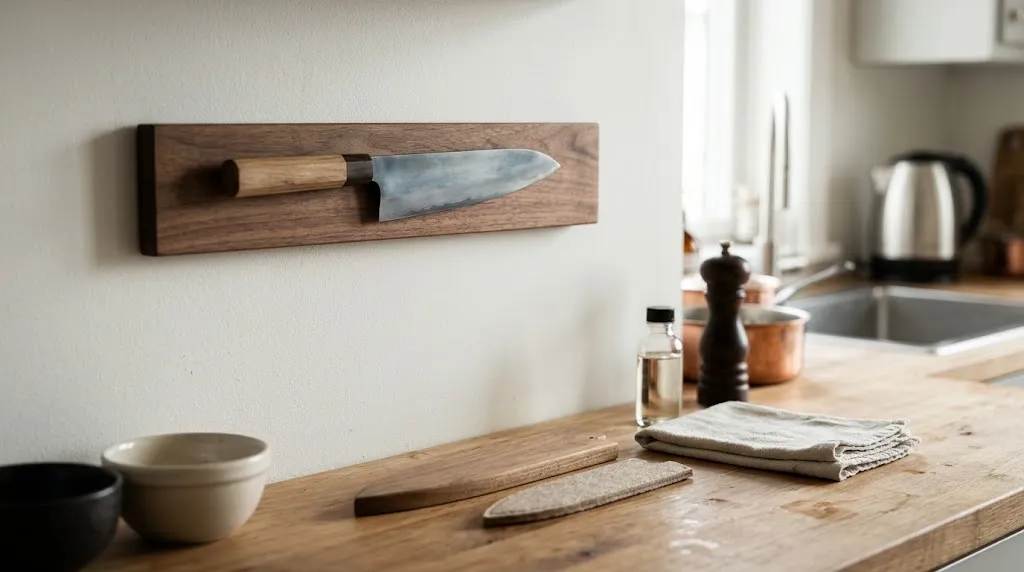
- Wood-faced magnetic wall strips: A smooth walnut, maple, or acacia magnetic bar is the safest everyday storage solution because ambient air circulates freely around both sides of the blade, ensuring zero trapped dampness. Always place the spine of the knife against the magnet first, then roll the flat of the blade gently onto the wood; pull the spine away first when removing it so you never lever the thin cutting edge against the magnet.
- Wooden saya sheaths or felt-lined blade guards: If storing in a drawer or chef roll, fit the blade with a custom balsa or magnolia wood saya or a breathable felt-lined plastic edge guard. Never insert a knife into a wooden saya unless the blade has air-dried for several minutes and carries a thin film of oil; if moisture gets trapped inside raw wood, the interior of the sheath becomes a humid incubator for rust.
- Keep storage away from steam zones: Never mount a magnetic knife strip directly above a kettle, rice cooker, stovetop, sink faucet, or dishwasher steam vent. Rising vapor condenses in microscopic droplets on cool steel and causes pepper-spot rust overnight.
- Avoid long-term storage in leather sheaths: While leather rolls are fine for transporting knives to work, never leave a carbon steel blade inside a closed leather sheath for weeks at a time. Leather absorbs room humidity and contains residual tanning acids and salts that aggressively pit high-carbon steel. For multi-week storage, coat the blade in mineral oil and wrap it in VCI (Volatile Corrosion Inhibitor) paper or parchment paper.
Related Product
Food-Grade Japanese Camellia Oil & Fine Rust Eraser Kit
Keeping pure Tsubaki knife oil and a fine-grit rust eraser in your kitchen drawer makes post-wash moisture protection and safe spot cleanup quick without scratching your blade finish.
As an Amazon Associate, we earn from qualifying purchases.
Frequently Asked Questions
Why does my carbon steel knife smell metallic or turn onions brown when cutting?
A new or freshly polished carbon steel blade has raw, unoxidized iron exposed on its surface that reacts with organic acids and sulfur compounds in onions, shallots, garlic, and citrus. That reaction releases trace hydrogen sulfide gas (causing the metallic smell) and iron salts that discolor pale vegetables. Both issues disappear naturally once the blade builds a stable dark patina over two to three weeks of regular cooking and prompt drying.
Should I force a patina on a carbon steel chef knife with vinegar or mustard?
Forcing a patina is optional if you wipe and dry your knife consistently during prep, as natural cooking builds a stronger, tighter oxide layer over time. However, if you work in a high-humidity kitchen or chop large quantities of acidic tomatoes and citrus immediately, submerging the clean, degreased blade in warm white vinegar for 10 minutes—or dabbing yellow mustard on the bevels—followed by a baking-soda water rinse creates an instant magnetite barrier.
Can I use pull-through or electric knife sharpeners on a carbon steel knife?
No, you should never run a carbon steel chef knife through carbide pull-through slots or motorized electric sharpeners. Pull-through jaws scrape metal off the apex through sheer friction at a wide, preset angle, which tears out microscopic chunks of hard carbon steel (60+ HRC), leaves a jagged edge, and ruins the thin cross-sectional geometry that makes the knife cut effortlessly.
What is the difference between maintaining stainless-clad (San Mai) and full monosteel carbon knives?
A stainless-clad San Mai knife wraps non-reactive stainless steel around both sides of a hard carbon steel core, leaving only a narrow ribbon of carbon steel exposed along the bottom cutting edge. While the upper faces of a stainless-clad blade will not rust if left damp for a few minutes, the exposed carbon cutting edge is just as reactive as a full monosteel carbon knife and requires immediate washing, drying, and oiling to prevent edge pitting.
How often do I need to oil a carbon steel knife if I use it every day?
If you cook with the knife every day in a climate-controlled indoor environment and the blade already carries a well-developed gray-blue patina, washing with soap and wiping bone-dry with a towel is sufficient without daily oiling. You should apply a drop of food-safe mineral or camellia oil whenever relative humidity exceeds 60%, while the knife is brand new, after whetstone sharpening, or whenever the knife will stay stored for more than 48 hours.
Is it safe to prepare food with a knife that has developed light surface rust?
You should always scrub away orange or reddish-brown surface rust using a baking soda paste or fine rust eraser and wash the blade with dish soap before cutting food. Although trace dietary iron oxide is not acutely poisonous, active red rust flakes off onto ingredients, ruins delicate flavors with a harsh metallic bitterness, and rapidly pits the steel deeper if exposed to wet food acids.
Conclusion
Maintaining a carbon steel chef knife comes down to building simple, automatic habits at your cutting board and sink. By keeping a damp and dry cloth within arm’s reach during prep, hand-washing and towel-drying the blade immediately after your final cut, and wiping on a thin film of food-grade mineral or camellia oil before storing, you prevent red rust before it can start. Let your blade develop its natural dark patina over time, cut exclusively on wood or soft rubber boards, and rely on leather strops and water stones rather than ribbed honing steels. With those habits in place, a carbon steel blade will reward you with decades of razor-sharp precision.

