
Is Ironwood Good for a Cutting Board? Pros & Cons
Quick Answer
Ironwood can make a durable cutting board, but its suitability depends on the actual wood species. Extremely dense species, such as desert ironwood, can be too hard for everyday knife work. Commercial Ironwood Gourmet boards made from acacia are generally more practical, while hard maple cutting boards offer a better balance of hardness and knife friendliness for most kitchens.
Key Things to Know About Ironwood:
- Excellent durability: Many ironwood species resist dents and surface wear.
- High wood density: Genuine ironwood can be considerably harder than conventional cutting board woods.
- Knife edge wear: Extremely hard ironwood may cause kitchen knives to lose sharpness faster.
- Attractive appearance: Dark colors and distinctive grain patterns make ironwood appealing for serving boards.
- Species matters: Ironwood is a common name for several different trees, not one specific wood.
- Food-contact safety: Choose a board made from identified wood with a suitable food-contact finish.
My Recommendation:
- Choose hard maple or a quality end-grain acacia board for everyday chopping, and reserve exceptionally hard ironwood for decorative or light-duty applications when food-contact suitability is established.
Ironwood sounds like the perfect cutting board material if durability is your main concern. Its reputation for exceptional hardness makes it an attractive alternative to ordinary wooden boards.
However, I wouldn’t choose a cutting board based on hardness alone. This guide explains how ironwood affects knife sharpness, food safety, maintenance, and everyday kitchen performance.
What Is Ironwood?
Ironwood is a common name given to several tree species that produce exceptionally hard or dense timber. It doesn’t refer to one universally recognized botanical species.
Different woods sold under this name can have different hardness ratings, grain structures, colors, and working properties. These differences directly affect their suitability for kitchen use.
Common Types of Ironwood
- Desert ironwood: A dense hardwood native to parts of the southwestern United States and northwestern Mexico.
- Black ironwood: An exceptionally hard tropical wood commonly associated with the species Krugiodendron ferreum.
- Australian ironwood: A common name applied to several dense Australian tree species.
- Ironwood wattle: A particularly dense Australian acacia species.
- Borneo ironwood: A durable Southeast Asian hardwood also known as belian or ulin.
These woods are not interchangeable. A cutting board made from one ironwood species may perform quite differently from another.
Is Ironwood Gourmet Made From Genuine Ironwood?
Ironwood Gourmet is a kitchenware brand that manufactures cutting boards and other wooden kitchen accessories using acacia wood. Its brand name does not necessarily indicate that its products contain desert ironwood or black ironwood.
According to the Ironwood Gourmet cutting board collection, the company offers several acacia models designed specifically for food preparation.
If you’re considering one of these products, understanding whether acacia wood cutting boards are safe and good will help you evaluate its actual material.
Is Ironwood Good for Everyday Cutting Boards?
Some woods associated with the ironwood name can work well for cutting boards. However, exceptionally hard species are generally less practical for frequent chopping than conventional cutting board hardwoods.
A good cutting surface needs enough strength to resist damage without placing excessive stress on knife edges. Maximum hardness isn’t necessarily an advantage.
Characteristics of a Good Cutting Board
- Moderate hardness that balances durability and knife protection.
- A smooth surface without deep cracks or loose fibers.
- Suitable wood species and food-contact finishes.
- Stable construction that resists splitting and warping.
- A surface that is easy to clean and maintain.
- Enough weight or grip to remain stable during cutting.
Ironwood performs particularly well in terms of hardness and resistance to indentation. Its main disadvantage is that certain species may provide a less forgiving cutting surface.
How Hard Is Ironwood Compared to Other Cutting Board Woods?

Desert ironwood has a Janka hardness rating of approximately 3,260 pounds-force, while hard maple measures approximately 1,450 pounds-force. This makes desert ironwood considerably more resistant to indentation.
The Janka hardness test measures how strongly wood resists indentation from a steel ball. It provides a useful material comparison, although it doesn’t directly measure knife wear.
The following figures are based on species-specific information from The Wood Database.
| Wood Type | Janka Hardness (lbf) | Knife Friendliness | Best Application |
|---|---|---|---|
| Desert Ironwood | 3,260 | Low | Specialty projects |
| Ironwood Wattle | 4,050 | Low | Specialty woodworking |
| Hard Maple | 1,450 | Good | Everyday food preparation |
| Black Walnut | 1,010 | Very good | Precision slicing |
| Black Cherry | 950 | Very good | General kitchen use |
| Acacia | Varies by species | Varies | Chopping and serving |
Knife-friendliness assessments are general material-based estimates, not laboratory knife-wear test results. Grain orientation, board finish, and cutting technique also affect performance.
For a frequently used kitchen board, I prefer a balanced hardness level rather than the hardest available timber. Hard maple provides a useful reference point when comparing unfamiliar wood species.
Benefits of Using an Ironwood Cutting Board
Ironwood offers several appealing properties, particularly for buyers who value durability and natural wood aesthetics. Some advantages depend heavily on the species and board construction.
1. Excellent Resistance to Dents
Dense ironwood species resist indentation from everyday contact with kitchen tools. Their hard surfaces may develop fewer visible dents than softer woods under similar conditions.
This property can be useful for specialty wooden kitchen accessories that experience frequent handling.
2. Attractive Natural Appearance
Many ironwood species feature deep brown tones and distinctive grain patterns. Their appearance makes them attractive for decorative kitchen pieces and serving accessories.
A properly finished board can complement both traditional and modern kitchen designs.
3. Substantial Weight and Stability
High-density wood can produce a heavy board relative to its size. That extra weight may help reduce movement on a suitable countertop.
However, a heavy cutting board still needs a flat base or appropriate non-slip support.
4. Potentially Long Service Life
A well-constructed board made from suitable wood may last for many years with proper maintenance. Dense wood can withstand considerable surface wear.
Longevity still depends on moisture exposure, construction quality, cleaning practices, and the condition of any glued joints.
5. Decorative and Specialty Applications
Ironwood can be an appealing material for decorative kitchen accessories where knife contact is limited. Identified species with suitable finishes may also work for certain serving applications.
Disadvantages of Ironwood Cutting Boards
Despite its durability, ironwood has several characteristics that can make it less convenient than maple, walnut, or conventional acacia cutting boards.
1. It May Dull Kitchen Knives Faster
Exceptionally hard wood creates a less forgiving surface when a knife edge makes contact. Repeated chopping may accelerate edge wear, especially with thin or delicate blades.
I would avoid using an unidentified, exceptionally hard ironwood board with expensive Japanese chef knives.
2. Ironwood Can Be Difficult to Work With
Very dense ironwood can be challenging to cut, drill, sand, and shape. Some species also create difficulties during gluing or finishing.
These woodworking challenges can increase manufacturing costs and complicate future board repairs.
3. Heavy Boards Can Be Inconvenient
A thick ironwood board may be uncomfortable to lift, wash, or move around the kitchen. This becomes more noticeable when preparing several meals each day.
A board should feel manageable enough that you’ll clean it properly after every use.
4. Food-Contact Suitability May Be Unclear
The ironwood label alone doesn’t establish whether a particular species is appropriate for direct food contact. Some exotic woods have limited information about their suitability for cutting boards.
Before purchasing an unfamiliar wooden board, learn whether you can use any wood for a cutting board and which material characteristics matter.
5. Responsible Sourcing Can Be Difficult
Certain ironwood species may come from sensitive habitats or regions with harvesting restrictions. Buyers should check the botanical species, origin, and legality of the timber.
A sustainably sourced conventional hardwood can be a simpler choice when the origin of exotic wood is uncertain.
Is Ironwood Food Safe for Cutting Boards?
Ironwood is not automatically food safe simply because it is dense, natural, or sold as hardwood. Food-contact suitability depends on the specific species, its treatment, and the materials used to manufacture the board.
Commercial boards designed for food preparation generally provide clearer product information than unidentified pieces of exotic lumber.
The FDA Food Code recognizes hard maple and woods with equivalent hardness and close grain for specified food-contact applications. This does not mean every exceptionally hard exotic wood automatically qualifies.
What to Check Before Using Ironwood With Food
- Wood identification: Confirm the botanical species or clearly documented commercial material.
- Intended purpose: Select a product specifically intended for cutting or food preparation.
- Surface finish: Confirm that the manufacturer considers the finish suitable for food contact.
- Chemical treatment: Avoid pressure-treated lumber, unknown coatings, and contaminated reclaimed wood.
- Adhesives: Check the suitability of construction materials in laminated boards.
- Surface condition: Avoid boards with deep cracks, loose pieces, or damaged finishes.
As of 2026, I would still prioritize an identified, established cutting board material over an exotic wood with uncertain food-contact properties.
Does Ironwood Dull Knives?
Extremely hard ironwood species may contribute to faster knife dulling than more forgiving wooden cutting surfaces. The actual amount of wear depends on the blade, cutting technique, grain orientation, and wood species.
Hardness alone doesn’t determine exactly how quickly a knife will lose its edge.
Ironwood and Different Kitchen Knives
- Western chef knives: Generally have more forgiving edge geometry, although hard cutting surfaces can still accelerate wear.
- Japanese chef knives: Thin cutting edges may benefit from a more forgiving wooden board.
- Ceramic knives: Brittle blades are better suited to manufacturer-recommended cutting surfaces.
- Utility knives: Light slicing generally places less impact stress on the edge than repeated chopping.
- Cleavers: Heavy chopping requires a board specifically constructed for that application.
Consider a simple kitchen example: mincing herbs requires repeated contact between the knife and board. A surface that is easier on the edge becomes more valuable as those contacts accumulate.
For frequent meal preparation, I’d choose an end-grain board made from an established cutting board hardwood.
Is End-Grain Ironwood Better Than Edge-Grain Ironwood?
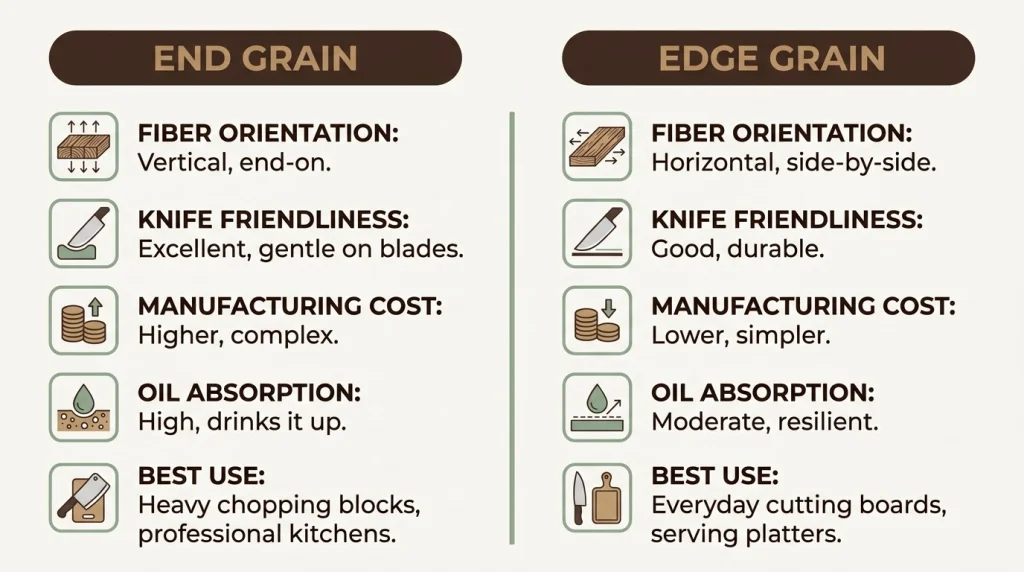
End-grain construction can provide a more forgiving cutting surface than edge-grain construction made from the same wood. However, it cannot completely overcome the exceptional hardness of certain ironwood species.
| Feature | End Grain | Edge Grain |
|---|---|---|
| Fiber orientation | Fiber ends face upward | Long fibers face upward |
| Knife friendliness | Generally better | Generally less forgiving |
| Manufacturing cost | Usually higher | Usually lower |
| Oil absorption | Often greater | Often lower |
| Best use | Frequent chopping | General slicing and preparation |
If you’re interested in woodworking, this guide on how to make an end-grain cutting board explains the construction process using more conventional hardwoods.
Ironwood vs Maple Cutting Boards
Hard maple is generally the better choice for everyday cutting boards because it balances hardness, durability, and knife friendliness. Exceptionally dense ironwood offers greater resistance to indentation but may increase knife wear.
- Choose maple: For daily chopping, vegetable preparation, and regular chef knife use.
- Choose suitable ironwood: For specialty or decorative applications where extreme hardness is desirable.
Maple also has a long history of use in professional butcher blocks and kitchen work surfaces. Its established suitability makes purchasing decisions more straightforward.
Ironwood vs Walnut Cutting Boards
Walnut is softer and generally more forgiving on kitchen knives than exceptionally dense ironwood. Its dark natural color also provides a decorative appearance without requiring extreme wood hardness.
Ironwood may resist indentation better, while walnut offers a practical balance for everyday slicing and chopping.
How to Clean an Ironwood Cutting Board
Clean a food-contact-suitable ironwood board after every use with warm water and mild dish soap. Follow the manufacturer’s instructions because cleaning requirements vary between solid and laminated products.
- Remove loose food particles from the cutting surface.
- Wash the board using warm water, dish soap, and a soft brush or sponge.
- Rinse away soap and remaining food residue.
- Sanitize when necessary using a method appropriate for the board.
- Wipe away excess moisture with a clean towel.
- Allow the board to finish drying upright with adequate airflow.
Food safety guidance from the USDA Food Safety and Inspection Service recommends separating raw animal products from ready-to-eat foods during preparation.
Never rely on wood density or supposed natural antibacterial properties as a replacement for proper cleaning and sanitation.
How to Oil and Maintain an Ironwood Cutting Board

Use a food-grade mineral oil or a manufacturer-approved cutting board conditioner to maintain suitable unfinished wooden boards. Regular conditioning can help manage moisture changes and reduce excessive drying.
Steps for Oiling an Ironwood Board
- Clean the cutting board and let it dry completely.
- Apply a small amount of suitable cutting board oil.
- Spread the oil across exposed wooden surfaces with a clean cloth.
- Allow the oil to penetrate according to the product instructions.
- Remove any excess oil from the surface.
- Repeat conditioning when the wood begins looking dry.
Dense woods may absorb oil differently from more porous materials. Avoid applying excessive amounts when the surface no longer absorbs the conditioner.
For more detailed maintenance instructions, follow this guide on how to oil a wooden cutting board.
Common Maintenance Mistakes to Avoid
- Leaving wooden cutting boards submerged in water.
- Putting laminated wooden boards in the dishwasher.
- Applying furniture polish or unidentified wood finishes.
- Using ordinary cooking oils that may become rancid.
- Storing damp boards inside enclosed cabinets.
- Continuing to use boards with deep splits or loose joints.
Who Should Buy an Ironwood Cutting Board?
An ironwood cutting board may appeal to someone who values distinctive wood grain and surface durability. However, the intended application and actual wood species should guide the purchase.
Consider an Ironwood Board If:
- You can verify its food-contact suitability.
- You appreciate unusual hardwood grain patterns.
- You mainly perform light cutting or serving tasks.
- You don’t mind handwashing and periodic conditioning.
- You’re buying a purpose-made acacia board from Ironwood Gourmet.
Choose Another Material If:
- You frequently mince herbs or chop vegetables.
- You use thin-edged premium kitchen knives.
- You prefer a lightweight cutting board.
- You need a cutting board with clearly established material properties.
- You cannot confirm the identity or origin of the ironwood.
For most home cooks, a conventional maple, walnut, or quality acacia cutting board is the more straightforward investment.
Recommended Ironwood Cutting Boards and Accessories
If you like the appearance of ironwood but want a practical kitchen cutting surface, consider purpose-made acacia boards from Ironwood Gourmet. A suitable cutting board conditioner can also help maintain the wood.
Affiliate disclosure: As an Amazon Associate, I earn from qualifying purchases. The recommendations below are based on published product specifications and intended applications.
🏆 Best for Everyday Chopping
Ironwood Gourmet Carolina 14-Inch End Grain Chopping Board
This acacia wood chopping board features end-grain construction and a juice channel. I’d choose it for general vegetable preparation and everyday kitchen chopping.
🥩 Best for Carving
Ironwood Gourmet Hudson Acacia Carving Board
The 15-by-20-inch board features a juice well and grip pad. I’d consider this model for carving cooked roasts and preparing larger portions of food.
💧 Best for Board Maintenance
Ironwood Gourmet Butcher Block Oil
This 16-ounce cutting board oil is intended for wooden food preparation surfaces. I’d consider it for routine conditioning of compatible unfinished wooden boards.
Frequently Asked Questions
Is ironwood too hard for a cutting board?
Some ironwood species, including desert ironwood, are harder than most traditional cutting board woods and may be unnecessarily abrasive to knife edges during repeated chopping. Hard maple, walnut, or suitable acacia generally offers a more practical balance for everyday kitchen use.
Is ironwood the same as acacia wood?
No, ironwood is a common name applied to several different tree species, while acacia refers to a particular group of trees. Some acacia species have ironwood-related common names, and Ironwood Gourmet uses acacia for many of its commercial cutting boards.
Can you cut raw meat on an ironwood cutting board?
You can use a properly manufactured, food-contact-suitable wooden board for raw meat if you clean and sanitize it appropriately. However, using a separate cutting board for raw meat, poultry, and seafood helps reduce the risk of contaminating ready-to-eat foods.
Can ironwood cutting boards go in the dishwasher?
Handwashing is the safer default for ironwood and commercial acacia cutting boards unless the manufacturer explicitly permits dishwasher cleaning. Prolonged exposure to hot water and drying cycles may damage the wood, weaken glued joints, or cause warping and cracking.
Is ironwood better than maple for cutting boards?
Ironwood may offer greater resistance to indentation, but hard maple is generally better suited to regular kitchen chopping. Maple combines established food-contact applications, moderate hardness, and good durability without the disadvantages associated with some exceptionally dense exotic hardwoods.
Final Verdict: Is Ironwood Good for a Cutting Board?
Ironwood can be an attractive and durable material, but the name alone doesn’t guarantee that a board is suitable for kitchen use. Exceptionally hard species may create unnecessary knife wear and present challenges involving weight, maintenance, and material verification.
Ironwood Gourmet acacia cutting boards are a more practical option for buyers who enjoy distinctive natural wood grain. Their suitability depends on the actual product construction rather than the ironwood brand name.
For everyday chopping, I recommend prioritizing a food-contact-suitable hardwood with moderate hardness and reliable construction. Hard maple, walnut, and quality acacia remain sensible choices.
Bottom line: Choose your cutting board for its balance of food safety, knife friendliness, durability, and ease of maintenance rather than simply selecting the hardest available wood.

