
Is Maple Wood Good for Cutting Boards? Yes, Here’s Why
Quick Answer
Yes, hard maple is one of the best woods for a cutting board. It rates 1,450 lbf on the Janka scale, has a tight closed grain that resists moisture, and stays kind to knives in end grain form. Not every wood belongs in the kitchen, so the species and build matter more than the label on the box.
Why maple wins
- Hardness that lasts: At 1,450 lbf, hard maple resists dents and deep knife scars far longer than walnut or cherry.
- Closed grain: Tiny, even pores give liquids and food residue few places to hide.
- Knife-friendly surface: End grain fibers part under the blade, then close back up after oiling.
- Food-safe standard: Hard maple is named in the FDA Food Code language for cutting boards and blocks.
- Fair price: Maple costs less than walnut in most sizes, so a thick board stays within reach.
Watch out for
- Pale surface: Beets, turmeric, and red wine stain maple faster than dark woods.
- Soft maple trap: Soft maple rates near 950 lbf, so check the species before you buy.
- Water damage: Never soak maple or run it through the dishwasher.
I’ve cooked on the same hard maple board for six years, and it still sits flat on my counter. It has survived daily onions, weekly roasts, and one dropped cast iron skillet.
This guide goes past the short answer and shows you when maple shines, when it stains, and how to pick the right build. You’ll also see how it stacks up against walnut, cherry, and bamboo, with care steps that keep it going for a decade or more.
What Is Hard Maple, Exactly?
Hard maple is Acer saccharum, also called sugar maple or rock maple. It grows across eastern North America and ranks among the hardest domestic hardwoods used in kitchens.
The Janka test measures how much force it takes to press a steel ball halfway into wood. Hard maple scores 1,450 lbf, which puts it near the top of the practical range for boards.
- Species: Acer saccharum, sold as hard, sugar, or rock maple.
- Color: Pale cream to light tan, with fine, low-contrast grain.
- Grain type: Diffuse-porous, which means small pores spread evenly with no large open vessels.
- Weight: About 44 lb per cubic foot when dry, so a thick board feels solid and stays put.
Diffuse-porous sounds technical, but the idea is simple. The wood has no wide tubes for juice to pool in, so the surface wipes clean with less effort.
That tight structure also explains why maple shows knife marks as fine lines, not deep grooves. Your blade meets even fiber, not hard and soft bands.
Is Maple Wood Good for Cutting Boards?
Yes, hard maple is a top pick for daily prep. It balances hardness, hygiene, and knife care better than most woods at its price.
I noticed the difference within a month of switching from bamboo. My chef’s knife stayed sharp longer, and the board stopped skating across the counter.
- Daily vegetables and fruit: Maple handles onions, carrots, and citrus without soaking up odor.
- Bread and pastry: The pale, smooth surface keeps flour visible and releases dough cleanly.
- Meat prep: A thick maple block takes cleaver work, though I keep a separate board for raw poultry.
- Serving: Edge grain maple looks clean on the table and wipes down fast after cheese night.
As of 2026, hard maple still leads most pro kitchen recommendations for one-board homes. The reasons have not changed: it lasts, it cleans well, and it costs less than darker hardwoods.
My own test sold me. I chopped a full bag of onions on maple, then on bamboo, then checked both edges under a lamp. The bamboo board left more visible nicks on the blade after one session.
Hard Maple vs Soft Maple: Which One Should You Buy?
Buy hard maple, not soft maple. Soft maple rates near 950 lbf, so it dents and scars far sooner under daily chopping.
Labels cause most of the confusion here. A listing that says only “maple” may hide soft maple, which includes red and silver maple species.
- Hard maple: 1,450 lbf, tight grain, best for heavy daily use.
- Soft maple: Around 950 lbf, still closed grain, but better for light prep or serving.
- How to check: Look for Acer saccharum, “sugar maple,” or “rock maple” in the specs.
- Red flag: Skip a board when the seller won’t name the species at all.
Price often hints at the answer. A large board priced far below other maple boards may use soft maple or thin stock.
I use a John Boos Maple Reversible Cutting Board for heavy prep, and the species is listed right on the product page. That kind of clear labeling is what you want from any maker.
How Does Maple Compare to Other Board Woods?
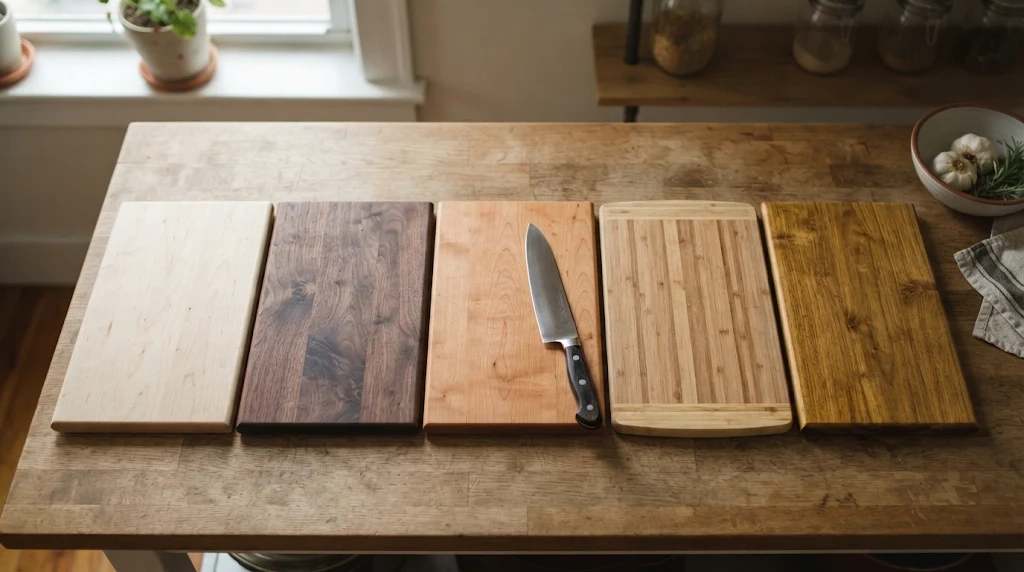
Maple wins on hardness and value, walnut wins on looks and knife softness, and cherry sits between them. Bamboo looks tough on paper, but it treats knives worse than the numbers suggest.
The table below uses Janka figures from the Wood Database, a standard reference for wood hardness. Use it to compare species at a glance, then read the notes below it.
| Wood | Janka hardness | Grain | Knife friendliness | Stain visibility | Typical price |
|---|---|---|---|---|---|
| Hard maple | 1,450 lbf | Closed, diffuse-porous | Excellent in end grain | High | $$ |
| Black walnut | 1,010 lbf | Closed | Excellent | Low | $$$ |
| American cherry | 950 lbf | Closed | Very good | Medium | $$$ |
| Bamboo | Around 1,400 lbf | Grass, dense and brittle | Fair | Medium | $ |
| Teak | 1,155 lbf | Open, naturally oily | Good | Low | $$$ |
Janka hardness alone does not tell the full story. Bamboo scores high, yet its silica content and glue lines wear edges faster than maple.
Maple also holds an edge in daily upkeep. Its light color shows stains early, so you clean them before they set.
Is Maple Safe for Food?
Yes, hard maple is food safe when you clean and oil it as directed. It is the one wood named by species in the FDA Food Code language for cutting boards.
The FDA Food Code permits “hard maple or an equivalently hard, close-grained wood” for cutting boards, blocks, and baker’s tables. Most states adopt that language, which gives maple a standing no other common board wood holds.
- Wash fast: Scrub with hot water and mild soap right after use.
- Dry upright: Stand the board on edge so air reaches both faces.
- Sanitize for meat: Use a food-safe spray or diluted vinegar after raw meat, then rinse and dry.
- Keep boards separate: Use one board for raw meat and one for produce, no matter the wood.
UC Davis research by Dr. Dean Cliver found bacteria drawn into wood did not return to the surface in later tests. Knife-scarred plastic, by contrast, proved hard to clean and disinfect by hand.
The USDA Food Safety and Inspection Service still stresses proper cleaning for any board material. Wood is not self-sanitizing, so prompt washing and full drying do the real work.
Does Maple Dull Knives?
Maple is gentler on knives than glass, stone, ceramic, or bamboo. It is slightly harder on edges than walnut, since 1,450 lbf pushes back more than 1,010 lbf.
Grain direction matters more than species here. An end grain maple board treats a blade better than a face grain walnut board, even though walnut is softer.
- End grain: The edge slips between vertical fibers, which part and close again.
- Edge grain: The edge cuts across horizontal fibers, so marks stay and edges wear faster.
- Face grain: The widest, flattest cut shows scars most and suits light prep or serving.
I sharpen my chef’s knife every few weeks with an end grain maple board in daily use. On bamboo, that gap shrank to about 10 days.
Keep your board oiled and your knife will thank you. A dry board drags more, and drag wears steel faster than a smooth, conditioned surface.
End Grain vs Edge Grain Maple: Which Is Better?
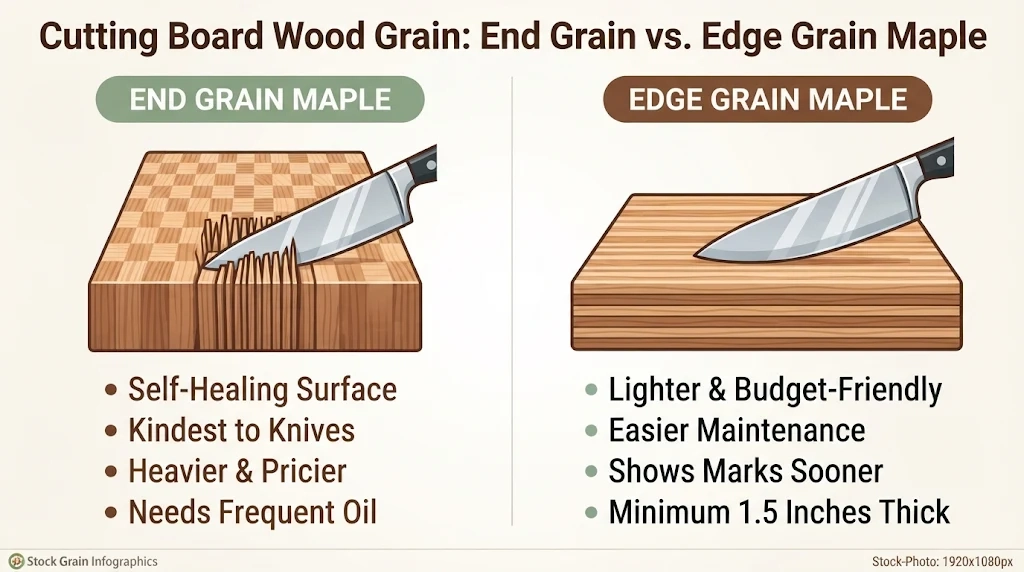
End grain is better for heavy daily chopping, while edge grain is better for a lighter, cheaper everyday board. Your budget and counter space decide the winner.
End grain turns the fibers upright, so you cut into the ends of thousands of small wood tubes. That layout lets the surface self-heal light cuts between oilings.
- End grain pros: Kindest to knives, hides cuts well, lasts decades with care.
- End grain cons: Heavier, pricier, and needs oil more often.
- Edge grain pros: Lighter, cheaper, and more forgiving when oiling slips a week.
- Edge grain cons: Shows knife marks sooner and wears edges a bit faster.
Look for a board at least 1.5 inches thick if you want it to stay flat. Thin boards cup and bow far sooner, no matter the grain.
If you like woodworking, read how to make an end grain cutting board before you buy lumber. The glue-up takes patience, and maple rewards careful clamping with a board that outlasts store stock.
Maple Cutting Board Pros and Cons
Maple earns its spot as the default board wood, but it has clear trade-offs. Knowing them up front keeps the pale color from catching you off guard.
Pros
- Durable: Resists dents, chips, and deep scars under daily chopping.
- Hygienic: Closed grain resists moisture and wipes clean with soap and water.
- Knife-friendly: End grain maple keeps edges sharp longer than bamboo or plastic.
- Stable: Holds flat with basic oiling and upright drying.
- Neutral: No strong taste or tannin, so it suits bread, fruit, cheese, and meat.
- Good value: Costs less than walnut or cherry in the same size and thickness.
Cons
- Shows stains: Beets, turmeric, and red wine mark the pale surface fast.
- Needs oil: Skip oiling and the board dries, cracks, or warps.
- Heavy in end grain: A 2-inch thick block can top 15 lb, so it lives on the counter.
- Hand wash only: Dishwasher heat and soaking will crack the glue joints.
None of those cons are deal-breakers for most cooks. They are maintenance habits, and they take about five minutes a month once you learn them.
How to Care for a Maple Cutting Board (So It Lasts 10+ Years)
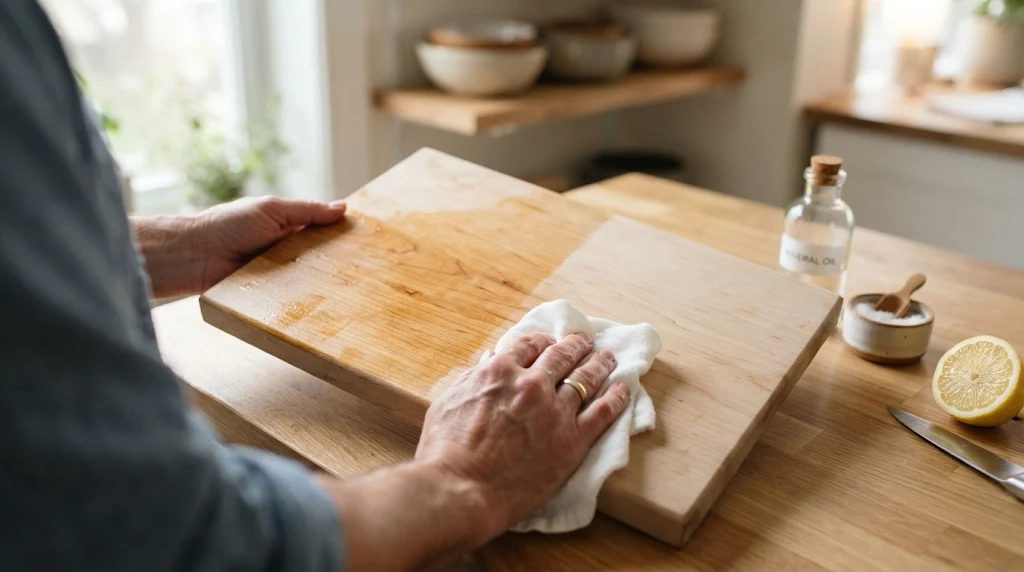
Care comes down to three habits: wash fast, dry upright, and oil on schedule. Do those three and a maple board can last 10 to 25 years.
Start with food-grade mineral oil, not cooking oil. Cooking oils turn rancid in wood pores, while mineral oil stays stable and food safe.
- Wash: Scrub with hot water and mild dish soap, then rinse.
- Dry: Towel dry, then stand the board upright for full airflow.
- Oil: Rub a thin coat of mineral oil over all faces, then let it soak for 4 hours or overnight.
- Wipe: Buff off the extra oil with a clean cloth the next morning.
- Wax monthly: Add board butter, a mix of mineral oil and beeswax, for a water-beading finish.
Oil a new board once a week for the first month, then once a month after that. End grain boards drink more oil, so check them every 3 weeks at first.
For stains, sprinkle coarse salt, rub with half a lemon, and let it sit for 5 minutes. Rinse, dry, and re-oil the spot.
- Do: Use both sides in turn, so moisture stays even.
- Do: Store upright, never flat against a damp counter.
- Don’t: Soak the board or leave it in a sink full of water.
- Don’t: Use vegetable, olive, or coconut oil as a finish.
Warping starts with uneven drying, not with one spill. Learn how to prevent a cutting board from warping and you’ll save a board that might otherwise cup past repair.
Maple vs Walnut vs Cherry: Which Wood Wins for Daily Use?
Hard maple wins for daily prep, walnut wins for serving and looks, and cherry wins for light use with a warm patina. Pick by how you cook, not by color alone.
A walnut cutting board feels softer under the knife and hides stains well. Its dark grain looks rich on a counter, but it scars sooner and costs more than maple in thick sizes.
A cherry cutting board darkens with age into a deep amber tone. It suits charcuterie and light slicing, yet its 950 lbf hardness means heavy chopping leaves marks fast.
- Choose maple: You chop daily, want low cost, and don’t mind pale wood.
- Choose walnut: You serve often, hate visible stains, and want a softer board.
- Choose cherry: You prep lightly and love how wood ages over time.
My kitchen runs a two-board setup. Maple takes the daily beating, and walnut comes out for bread, cheese, and guests.
When Maple Is NOT the Best Choice
Maple is not the pick when you want zero upkeep or a board that hides every stain. It also falls short for cooks who need a feather-light board they can stash in a drawer.
- Low-maintenance kitchens: A quality plastic board suits a rental or shared kitchen better.
- Stain-heavy cooking: Daily turmeric and beet work will tint maple fast, even with prompt washing.
- Small spaces: A thick end grain block needs counter room and a strong shelf.
In those cases, keep maple for bread and produce, and use a second board for messy work. You still get the knife care, without the stain stress.
Which Maple Cutting Board Should You Buy?
If you’re ready to pick one, here’s what I’d actually recommend. I looked for thick stock, clear species labeling, and a finish you can re-oil at home.
🏆 Best Overall
John Boos Maple End Grain Butcher Block
★★★★★
Thick end grain hard maple with a self-healing surface and a weight that stays put. I pick this one for daily chopping because it hides cuts and holds flat year after year.
💰 Best Budget
Virginia Boys Kitchens Maple Cutting Board
★★★★☆
Solid edge grain maple at a fair price, with a juice groove option for meat prep. I recommend it as a first maple board because it teaches good oiling habits without a big spend.
🔪 Best for Daily Prep
Ironwood Gourmet Maple Cutting Board
★★★★☆
A mid-size maple board that fits small counters and still offers a full cutting zone. I keep one like this for quick produce work when the big block stays put for heavy prep.
Frequently Asked Questions About Maple Cutting Boards
Is hard maple better than bamboo for a cutting board?
Yes, hard maple is better than bamboo for most kitchens because it treats knives more kindly and resists deep scarring. Bamboo scores high on hardness, yet its silica and glue lines wear edges faster than maple grain.
Is maple safe for cutting raw meat?
Yes, maple is safe for raw meat when you wash it with hot soapy water right after use and let it dry fully. Keep a separate board for raw poultry and meat, and sanitize the surface before you switch to produce.
How often should you oil a maple cutting board?
Oil a new maple board once a week for the first month, then once a month for regular use. End grain boards need oil more often, so check the surface every 3 weeks and oil when water stops beading.
Can you put a maple cutting board in the dishwasher?
No, never put a maple cutting board in the dishwasher because heat and long soaking crack glue joints and warp the wood. Hand wash with hot water and mild soap, towel dry, and stand the board upright to air dry.
Does maple stain easily?
Yes, maple stains more visibly than walnut or cherry because its pale surface shows beets, turmeric, and red wine fast. Wipe spills at once, scrub fresh stains with salt and lemon, and re-oil the area after cleaning.
The Bottom Line on Maple Cutting Boards
Hard maple is good for cutting boards, and for most cooks it is the best starting point. It resists dents, cleans well, treats knives fairly, and costs less than walnut or cherry.
Pick a thick end grain board in Acer saccharum, oil it once a month, and keep it out of the dishwasher. Do that, and your maple board will still feel solid ten years from now.

