Do Non-Plastic Cutting Boards Shed Microplastics?
Quick Answer
Most non-plastic boards shed no microplastics at all. Solid wood, bamboo, glass, stone, and metal contain no plastic, so the tiny bits they release are wood fiber, mineral dust, or metal flecks. The exception is composite boards that hide resin inside, and those can shed plastic particles. I cover the plastic side of this question in my guide to whether plastic cutting boards release microplastics.
What each material actually sheds
- Solid wood: Sheds tiny wood fibers that break down naturally and are not plastic.
- Bamboo: Sheds grass fibers, with only the glue between strips worth a second look.
- Glass and stone: Shed almost nothing at all, since they chip before they shed.
- Metal and titanium: Shed almost no particles, and your knife edge wears faster than the board.
- Composite boards: Can shed resin particles, since wood fiber and paper boards often use plastic resin as a binder.
The quick check before you buy
- Read the label for melamine, phenolic, or epoxy resin.
- If a board feels like plastic and says “wood fiber,” treat it as a composite.
I switched my kitchen to wood boards years ago, and the microplastics question still came up at my own table. A friend asked whether her bamboo board was any better than the plastic one she replaced.
This guide gives you the straight answer, material by material. You’ll also learn which “non-plastic” boards hide plastic inside, and how to spot them before you buy.
What Are Microplastics, Exactly?
Microplastics are plastic particles smaller than 5 millimeters — about the size of a sesame seed or smaller. Nanoplastics are smaller still, under 1 micrometer, and invisible to the naked eye.
That size limit is the key to this whole question. A particle only counts as a microplastic if it comes from plastic in the first place.
Three things that count as microplastics:
- Plastic fragments under 5 millimeters.
- Synthetic fibers from fabric and rope.
- Resin dust from composite boards.
Wood dust is not a microplastic, and neither is stone dust. Both are just tiny bits of a natural material.
Cutting boards shed material every time a knife crosses them. A sharp edge slices cleanly, while a dull edge tears and drags more material loose.
Researchers at NOAA track microplastics in oceans and food chains, and kitchen plastics are one small source among many. Your board is not your biggest exposure, but it is one you control.
Are microplastics from cutting boards harmful?
What does the science say about health effects? So far, the honest answer is that researchers are still working it out.
The National Institute of Environmental Health Sciences notes that microplastics are widespread and that studies on human health effects are ongoing.
That uncertainty is exactly why many cooks switch boards. You don’t need a scary headline to prefer a board with no plastic in it.
Do Wood Cutting Boards Shed Microplastics?
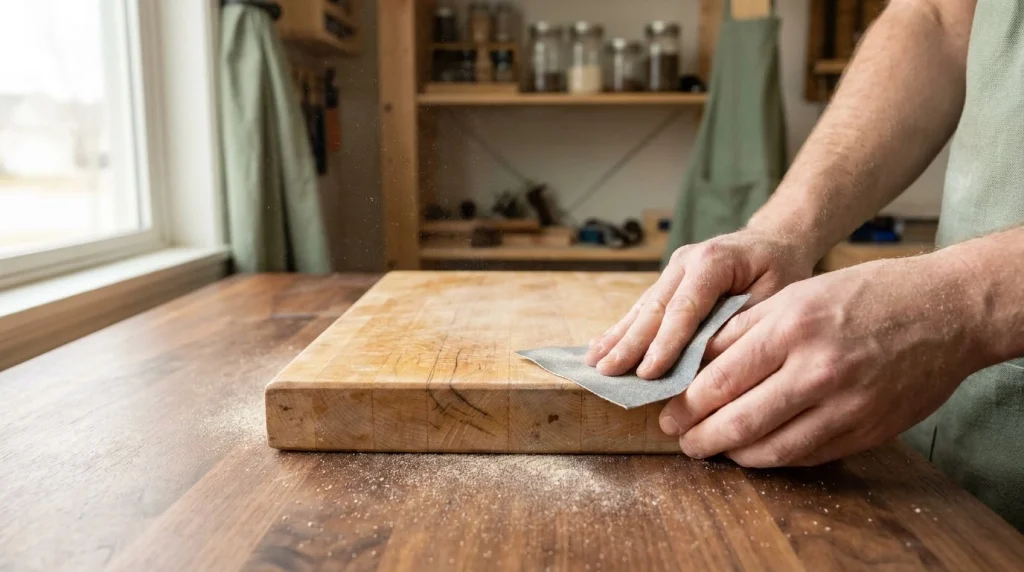
No. A solid wood board cannot shed microplastics, because it contains no plastic at all.
What it does shed is wood fiber. Wood is mostly cellulose and lignin, the same plant fibers in paper and vegetables, and those fibers break down naturally.
What a wood board actually sheds:
- Fine wood fiber from knife cuts.
- A trace of board oil after fresh oiling.
- Nothing plastic.
I see this clearly each time I sand my maple board. A few passes with 220-grit paper leave a small pile of fine, pale dust on the bench.
That dust is the same stuff a knife removes, just faster. It smells like fresh timber, not chemicals, and it sweeps up like sawdust because that is what it is.
What about the glue in a wood cutting board?
There is one small caveat: glue lines. Most wood boards are strips of timber joined with food-safe wood glue, and that glue is a polymer.
The amount is tiny, though, and most of it sits below the cutting surface. End-grain boards have more glue lines, but the glue still stays a fraction of a percent of the board.
If you want one wood to start with, maple is my go-to. Hard maple is dense and tight-grained, so I wrote a full guide on whether maple wood is good for cutting boards.
What About Bamboo, Glass, Stone, and Metal Boards?
Wood gets most of the attention, but it is not the only plastic-free choice. Here’s how the other common materials stack up.
Does bamboo shed microplastics?
No. Bamboo is a grass, not a plastic, so it sheds grass fibers instead of microplastics.
Bamboo boards are usually strips glued into panels, like wood boards. That means the same small glue caveat applies, so check that the maker uses a food-safe adhesive.
Bamboo is harder than most woods, which is a mixed blessing. It resists deep cuts, but it is tougher on knife edges than maple or walnut.
Do glass cutting boards shed microplastics?
No. Tempered glass sheds nothing you could call a particle, plastic or otherwise.
Glass is too hard for a knife to shave. Instead, the edge skips and slides, and the board can chip at the corners if you drop it.
That hardness is also the drawback: glass dulls knives fast, and a chipped edge can leave sharp flakes on the counter. I use glass for serving cheese, never for cutting.
Do stone and marble boards shed microplastics?
No. Stone and marble are minerals, so there is no plastic to shed.
A knife can leave faint scratches and a trace of mineral dust on stone. That dust is rock, not plastic, and it rinses off with water.
Stone boards are heavy and hard on blades, much like glass. They shine as pastry slabs and serving pieces, not as daily chopping boards.
Do titanium and stainless steel boards shed microplastics?
No. Titanium and stainless steel contain zero plastic, so microplastics are off the table entirely.
These boards shed almost nothing at all. In practice, your knife loses metal to the board faster than the board loses metal to your food.
That knife wear is the real trade-off with metal boards. They suit raw meat prep and easy sanitizing, so read my guide on whether titanium cutting boards are safe before you buy.
What Is the Hidden Plastic Problem With Composite Boards?
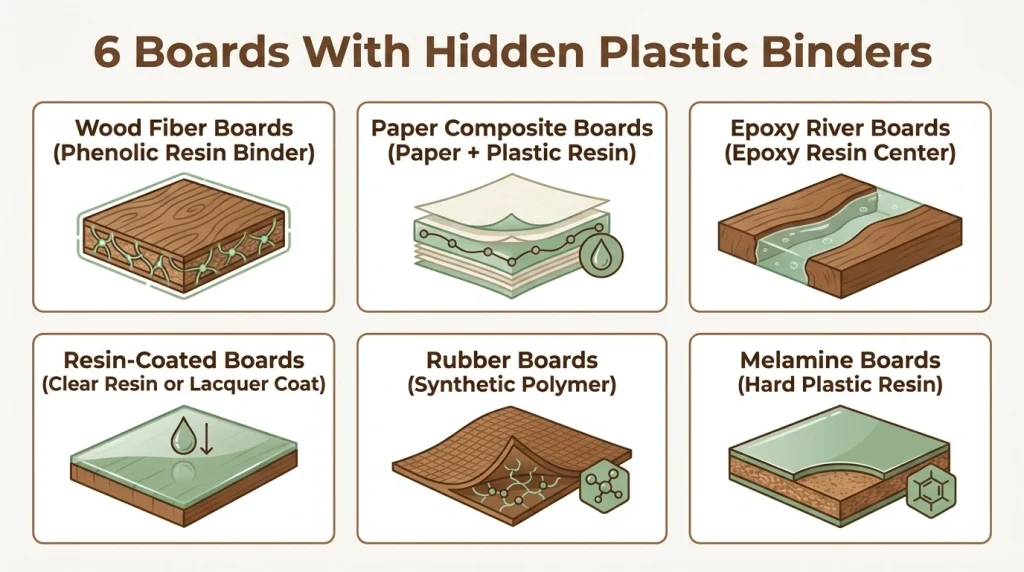
Some boards look like wood and feel like wood, yet contain plastic. These composites are the trap in this whole topic.
A composite board bonds wood fiber, paper, or bamboo with a resin binder. That resin is a polymer, which means it is a plastic by any honest definition.
- Wood fiber boards: Brands like Epicurean press wood fiber with phenolic resin into thin, dishwasher-safe sheets. Knife cuts can release tiny resin particles along with the fiber.
- Paper composite boards: Richlite and similar materials use paper and resin. They feel warm like wood, but the binder is still plastic.
- Epoxy river boards: Epoxy resin is plastic, full stop. A board with a resin-filled center puts plastic right on the cutting surface.
- Resin-coated boards: Some decorative boards carry a clear resin or lacquer coat. That coat wears into food as it breaks down.
- Rubber boards: Synthetic rubber is a polymer too. Commercial rubber boards shed rubber particles, not wood fiber.
- Melamine boards: Melamine is a hard resin, not a ceramic. It resists stains well, but it is still plastic.
No honest writer can call composites dangerous yet, and I won’t pretend the science is settled. But if your goal is a plastic-free board, a composite misses the point — you swapped one plastic for plastic with wood dust in it.
Plastic boards raise a second question beyond particles: the chemicals inside them. My batch companion piece on whether plastic cutting boards contain BPA or PFAS covers that side of the story.
Food-contact rules in the United States come from the U.S. Food and Drug Administration, which clears specific materials for touching food. A “food-safe” label means the material passed those rules, not that it is plastic-free.
Non-Plastic vs Plastic: How Does Shedding Compare?
A side-by-side view makes the pattern clear. Only boards with plastic in them can shed microplastics, and the table below shows where each material lands.
| Material | Sheds microplastics? | What it sheds instead | Knife friendliness |
|---|---|---|---|
| Solid wood (maple, walnut) | No | Wood fibers | Gentle |
| Bamboo | No* | Grass fibers | Medium |
| Glass | No | Nothing (chips instead) | Very harsh |
| Stone and marble | No | Trace mineral dust | Very harsh |
| Titanium and stainless steel | No | Negligible metal | Harsh |
| Wood fiber composite | Yes, resin particles | Resin and fiber mix | Medium |
| Plastic (HDPE, polypropylene) | Yes | Microplastics | Gentle |
*Bamboo boards use adhesive between strips, so a trace of glue sits in the joints. The board itself is still plastic-free.
Wood wins the practical trade-off for most cooks: it sheds no plastic, treats knives kindly, and lasts for years with basic care. Plastic boards shed the most particles, and one widely reported 2023 study found they release millions of microplastics over a year of regular use.
The U.S. Environmental Protection Agency tracks plastic waste and microplastic pollution, and your board choice is one small daily part of it. If you are weighing the two classic options, my full comparison of wood vs plastic cutting boards covers hygiene, cost, and lifespan side by side.
How Can You Tell If Your Board Has Hidden Plastic?
Labels rarely shout “contains plastic” on a board that looks like wood. Use this five-step check before you buy or keep using one.
- Read the materials line: Look for melamine, phenolic, epoxy, resin, or composite. Any of those words means plastic is in the mix.
- Check the weight and feel: Composites feel dense, smooth, and slightly plasticky. Solid wood feels warm and shows open grain.
- Look at the edge: Layers, uniform color, or a paper-like cross-section point to composite. Real wood shows grain running through the edge.
- Search the brand plus “resin”: A quick search of the brand name and the word resin usually settles it. Makers rarely hide the binder in their spec sheets.
- Ask the maker: Email the company if the listing stays vague. A straight answer about the binder tells you everything.
I ran this check on a “wood fiber” board a reader sent me last year. The spec sheet listed phenolic resin in the second line, and that settled it in under a minute.
How Do I Cut Down on Particles From Any Board?
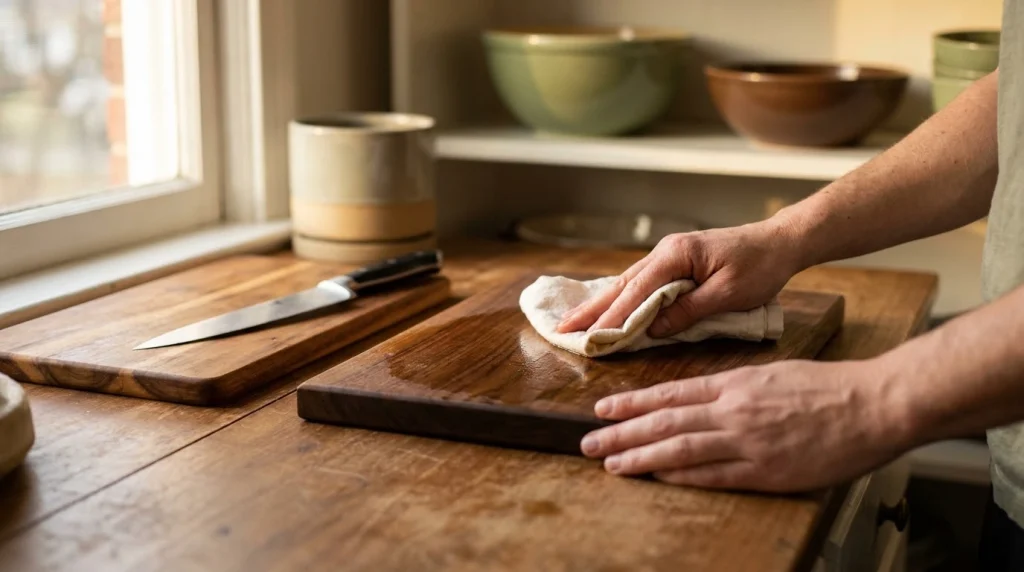
No board sheds zero material. A knife is a cutting tool, and cutting removes something every time.
Good habits keep that shedding to a minimum, whatever your board is made of. Here is what I do in my own kitchen as of 2026.
- Keep knives sharp: A sharp edge slices with one clean pass. A dull edge tears, drags, and gouges out more material.
- Oil wood boards monthly: A coat of food-grade mineral oil keeps wood fibers tight and sealed. Dry wood frays and sheds more.
- Sand out deep grooves: Grooves trap food and shed more with each cut. A quick sand with 220-grit paper and a fresh coat of oil resets the surface.
- Retire grooved boards: If grooves stay dark after cleaning, the board has done its job. Replace it rather than cutting deeper into it.
- Skip the dishwasher for wood: Heat and soaking warp wood and open the grain. Hand wash, dry upright, and let air do the rest.
- Use two boards: Keep one board for raw meat and one for produce. Both last longer, and cross-contamination drops too.
If you’re ready to pick one, here’s what I’d actually recommend:
🏆 Best Overall
John Boos Reversible Maple Wood Cutting Board
★★★★★
End-grain hard maple, 18 x 12 inches, with a juice groove on one side. This is the board I reach for daily, and it has outlasted every plastic board I’ve owned.
💰 Best Budget
Royal Craft Wood Bamboo Cutting Board Set
★★★★☆
Three organic bamboo boards in large, medium, and small sizes, with juice grooves. I use the small one for fruit and the large one for bread, and the set costs less than one premium wood board.
🌳 Best Hardwood Upgrade
Teakhaus Marine Teak Cutting Board
★★★★☆
Solid marine teak, 20 x 15 inches, naturally water-resistant and rich in oils. I recommend it when someone wants a board that needs less oiling and still looks great on the counter.
Frequently Asked Questions
Do wooden cutting boards release microplastics?
No. Wood contains no plastic, so a wooden board cannot release microplastics.
It sheds tiny wood fibers instead, which break down naturally. The only plastic-like material is the small amount of food-safe glue in the joints.
Is bamboo safer than plastic for microplastics?
Yes. Bamboo sheds grass fibers rather than plastic particles, which puts it well ahead of any plastic board.
Bamboo panels use adhesive between strips, so check that the maker uses a food-safe glue. Oil the board monthly to keep fibers sealed.
Do Epicurean cutting boards shed microplastics?
They can shed resin particles. Epicurean boards press wood fiber with phenolic resin, and that resin is a plastic binder.
Knife cuts can release tiny bits of resin along with the fiber. If you want a fully plastic-free board, choose solid wood instead.
What is the safest cutting board for microplastics?
A solid end-grain wood board is the safest everyday pick, since it sheds only wood fiber and treats knives kindly.
Titanium and stainless steel also shed no plastic, but they dull knives faster. Avoid composites and epoxy boards if plastic-free is your goal.
Can you get microplastics from a glass cutting board?
No. Glass contains no plastic and is too hard for a knife to shave particles from.
A glass board may chip if dropped, but chips are glass, not plastic. The main downside is knife wear, since glass dulls edges very quickly.
The Bottom Line
True non-plastic boards shed no microplastics. Wood sheds fiber, stone sheds dust, and metal sheds almost nothing at all.
The only trap is the composite board that hides resin behind a wood look. Check the label, and you will spot it in seconds.
If one board in your kitchen worries you, start there. Swap the worst offender first, and the rest can follow when you are ready.