
Do Plastic Cutting Boards Release Microplastics? What Science Says in 2026
Quick Answer
Yes, plastic cutting boards release microplastics when knives scrape and cut their surfaces. Research has detected particles from polyethylene and polypropylene boards during food preparation. However, finding microplastics does not automatically mean they cause harm. The FDA’s assessment of microplastics in food explains that current evidence does not demonstrate a human health risk at detected food levels.
What You Should Know
- Particle release: Knife contact can produce microscopic plastic fragments.
- Research findings: A 2023 study estimated millions of particles annually under modeled cutting conditions.
- Exposure uncertainty: Released particles do not necessarily equal particles swallowed or absorbed.
- Health evidence: Scientists have not established the health consequences of normal cutting-board exposure.
- Practical alternatives: Suitable hardwood and bamboo boards avoid shedding conventional plastic board material.
A Sensible Precaution
- Inspect regularly: Replace boards with deep grooves, peeling material, cracks, or difficult-to-clean damage.
- Separate foods: Keep a dedicated board for raw meat and another for ready-to-eat foods.
Plastic cutting boards are convenient, affordable, and easy to clean. Yet the tiny marks left by everyday chopping raise an important question about what enters our food.
I prefer examining the research before recommending that anyone replace useful kitchen equipment. This guide explains the evidence, the uncertainties, and the practical alternatives.
Do Plastic Cutting Boards Actually Shed Microplastics?
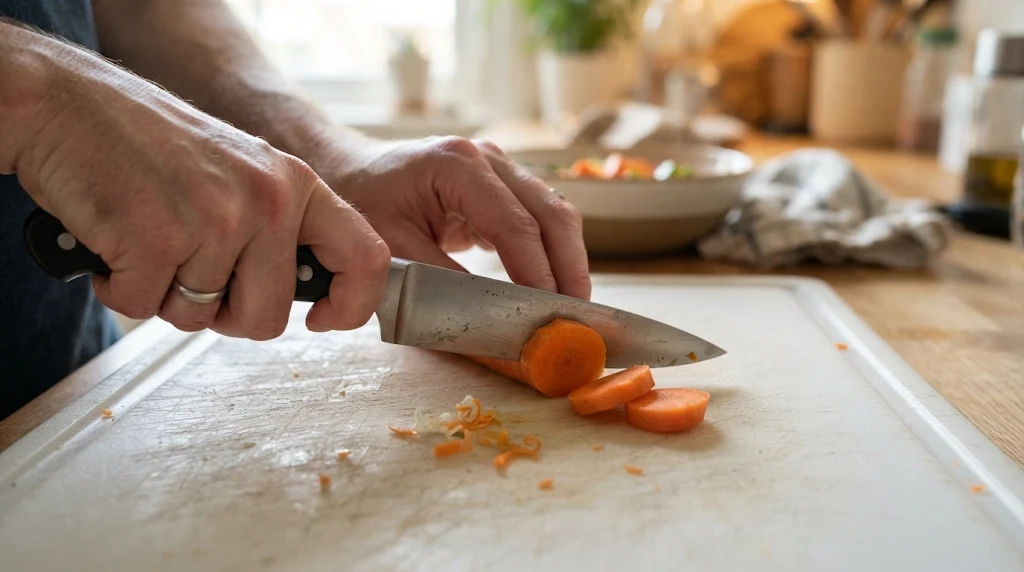
Yes, scientific experiments have shown that plastic cutting boards can release microscopic fragments during chopping. Both the board material and cutting conditions influence particle production.
Microplastics are small plastic particles, commonly defined as smaller than 5 millimeters. They may form when larger plastic objects break down through friction, cutting, or environmental wear.
How Does Chopping Create Plastic Particles?
A knife repeatedly presses against the cutting surface. Each stroke may scrape or dislodge small amounts of board material.
Some fragments remain on the surface, while others may mix with chopped ingredients. Most particles cannot be identified through ordinary visual inspection.
Several variables influence this process:
- Cutting pressure: Greater force can increase damage to the board surface.
- Knife movement: Repeated chopping and scraping create mechanical wear.
- Board composition: Different polymers respond differently to knife contact.
- Ingredient texture: Cutting hard vegetables may require different forces than slicing soft ingredients.
- Existing damage: Rough or deeply scored surfaces may behave differently from new boards.
- Cutting frequency: Regular chopping increases opportunities for abrasion.
These factors help explain why particle measurements differ between experiments. A single laboratory result cannot represent every kitchen.
For a broader discussion of everyday use, see my guide on plastic cutting board safety.
What Does Scientific Research Say About Cutting Board Microplastics?
A 2023 study published in Environmental Science & Technology provided direct evidence of plastic particle release during food preparation. Researchers examined polyethylene and polypropylene cutting boards.
The findings were significant because researchers measured material released through controlled cutting activities. They also explored differences related to chopping conditions.
What Did the 2023 Study Find?
The researchers estimated annual particle release using experimental measurements and assumptions about cutting-board use. Their modeled figures were substantial.
- Polyethylene boards: Approximately 14.5 million to 71.9 million particles annually.
- Polypropylene boards: Approximately 79.4 million particles annually.
- Cutting conditions: Chopping patterns and materials affected measured particle release.
- Study limitation: Estimates were not direct measurements of every person’s actual ingestion.
These figures describe modeled scenarios rather than a universal household exposure rate. They should not be interpreted as proof of an equivalent health risk.
You can examine the published research through the National Library of Medicine research record.
What Has Research Added in 2026?
Research published in 2026 also investigated nanoscale particles associated with plastic cutting-board use. These particles can be smaller than the microplastics measured in earlier studies.
One study examined how chopping can release plastic fragments and produce nanoscale material associated with polymer components. It used laboratory techniques to characterize those emissions.
The findings expand our understanding of possible exposure. However, laboratory detection cannot establish how much reaches human tissues or whether ordinary household exposure causes disease.
The study is available through Communications Materials.
Are Microplastics From Plastic Cutting Boards Dangerous?
Plastic cutting boards can produce microplastics, but their specific health effects remain uncertain. Detecting particles is different from demonstrating that exposure causes harm.
Scientists must consider the particles’ size, chemical composition, quantity, and behavior inside the body. Reliable human exposure measurements are also necessary.
What Health Effects Are Researchers Investigating?
Researchers are investigating several biological processes that may be affected by microplastics. Much of the mechanistic evidence comes from laboratory or animal studies.
- Inflammation: Whether certain particles trigger inflammatory responses.
- Oxidative stress: Whether exposure affects cellular stress pathways.
- Chemical exposure: Whether substances associated with plastic particles contribute to biological effects.
- Particle movement: How different particle sizes behave after entering the body.
- Long-term exposure: Whether repeated dietary exposure produces measurable health consequences.
These are important research questions, not established outcomes from using a plastic cutting board. Current evidence does not support predicting an individual’s disease risk from a board’s scratches.
What Do Food Safety Authorities Recommend?
The FDA has stated that current scientific evidence does not demonstrate that microplastics detected in foods pose a human health risk. It also recognizes important limitations in available research.
European researchers and regulators continue evaluating particle release from food-contact materials. The European Food Safety Authority describes ongoing work to address remaining evidence gaps.
As of 2026, there is no established cutting-board-specific particle exposure limit that consumers can use to judge their individual risk. Precautionary material choices remain reasonable without treating every plastic board as hazardous.
Which Cutting Board Materials Release Microplastics?
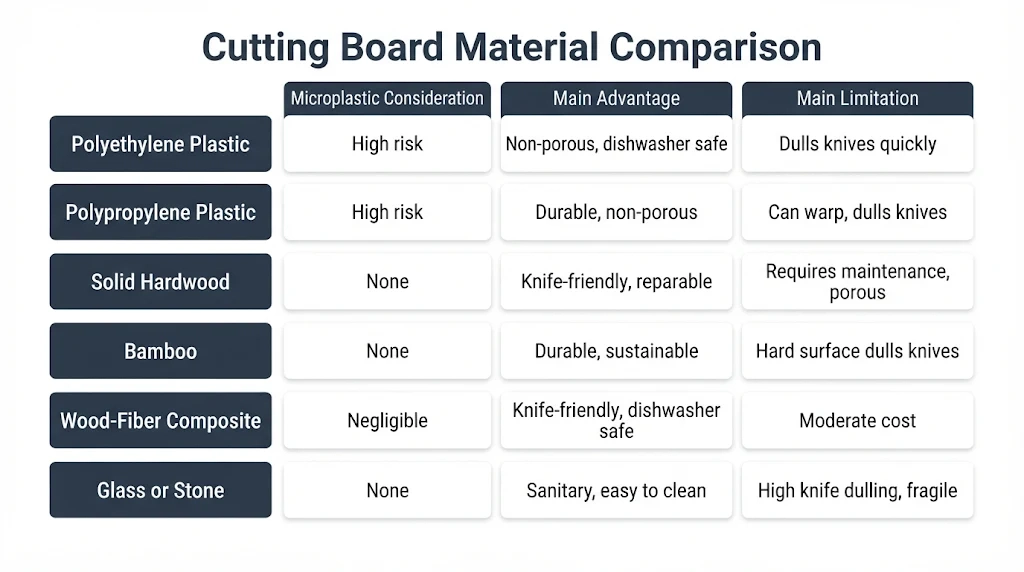
Polyethylene and polypropylene are common plastic cutting-board materials with documented particle release during cutting. Natural hardwood boards do not generate those same conventional plastic polymer fragments from their wooden surfaces.
That distinction does not make every alternative automatically superior. Cleaning requirements, knife wear, durability, and other material components still matter.
Cutting Board Material Comparison
| Material | Microplastic Consideration | Main Advantage | Main Limitation |
|---|---|---|---|
| Polyethylene plastic | Particle release demonstrated | Easy cleaning | Knife scratches and wear |
| Polypropylene plastic | Particle release demonstrated | Practical food preparation | Surface abrasion |
| Solid hardwood | No conventional plastic board surface | Knife-friendly options | Handwashing and maintenance |
| Bamboo | Plant-based surface; adhesives may be present | Lightweight and durable | Relatively hard cutting surface |
| Wood-fiber composite | Depends on resin and construction | Often convenient to maintain | Not necessarily polymer-free |
| Glass or stone | No plastic surface abrasion | Nonporous surface | Hard on knife edges |
The table compares material properties rather than proven human health outcomes. No research establishes a complete health-risk ranking for all cutting-board materials.
For a fuller comparison of maintenance and food safety, read my wood versus plastic cutting board guide.
Are Wooden Cutting Boards Better for Avoiding Microplastics?
A solid wooden cutting board is a reasonable choice for reducing exposure from plastic cutting-board abrasion. Maple, walnut, and cherry are common hardwood options.
Wooden boards can release wood particles during cutting, but those are not plastic microplastics. A suitable board still requires cleaning, drying, and inspection.
Why I Prefer Hardwood for Everyday Vegetable Preparation
My practical preference is a substantial hardwood board for routine vegetable chopping. It provides enough working space without relying on a conventional plastic cutting surface.
For example, an 18-by-12-inch maple board offers room for chopping onions, carrots, and herbs. A stable, generously sized surface also makes ingredient organization easier.
Hardwood boards have several useful characteristics:
- Suitable surfaces for most everyday chef knives.
- Multiple sizes and grain constructions.
- Potential for long service life with proper care.
- Resurfacing options for certain solid boards.
- No polyethylene or polypropylene cutting surface.
Wood has tradeoffs, including moisture sensitivity and maintenance. It should never be treated as self-sanitizing.
Is Bamboo a Good Plastic-Free Alternative?
Bamboo is another practical option for cooks who want to avoid conventional plastic board surfaces. Most commercial bamboo boards use laminated bamboo pieces.
Bamboo is generally hard and can be less forgiving on delicate knife edges than suitable hardwood. Construction quality and adhesives also deserve attention.
If you’re considering both materials, explore my bamboo versus wood cutting board comparison.
What About Wood-Fiber Composite Boards?
Wood-fiber composite boards may use paper or wood fibers bonded with cured resins. They are not necessarily equivalent to a solid hardwood board.
A composite board’s material composition determines whether polymer-related abrasion deserves consideration. Avoid assuming that every wood-colored board is entirely plastic-free.
My guide to Epicurean cutting board materials and safety explains this distinction in more detail.
How Can You Reduce Microplastic Release From Cutting Boards?
The most direct precaution is to use a suitable nonplastic cutting surface for some food preparation. If you continue using plastic, keep it in good condition.
No ordinary cleaning routine has been proven to eliminate all microscopic particles released during chopping. Prevention and appropriate maintenance are more practical goals.
Simple Steps to Reduce Unnecessary Board Wear
- Choose a suitable surface. Consider hardwood for frequent vegetable and fruit preparation.
- Keep your knife maintained. Use controlled cutting rather than forcing a poorly performing blade through food.
- Avoid unnecessary force. Do not strike the cutting board harder than necessary.
- Lift ingredients properly. Use a bench scraper instead of dragging a sharp knife edge sideways.
- Inspect the board. Look for peeling, cracks, deep grooves, or loose fragments.
- Replace damaged plastic. Do not continue using a surface that is shedding visible material.
- Follow cleaning instructions. Use only the washing methods approved for your board.
These measures can limit unnecessary damage and support food hygiene. They should not be presented as proven methods for achieving a specific reduction in microplastic intake.
How Should You Clean Plastic Cutting Boards Safely?
Wash plastic cutting boards after every food preparation session. Proper cleaning removes food residue and helps prevent cross-contamination.
Microplastic exposure and bacterial contamination are separate issues. Even a board that releases few particles can become unsafe through poor hygiene.
Everyday Cleaning Procedure
- Remove leftover food with an appropriate utensil.
- Wash the surface thoroughly with warm water and dish soap.
- Scrub grooves and edges to remove trapped residue.
- Rinse using clean running water.
- Sanitize when appropriate, following food-contact-safe product directions.
- Allow the board to dry completely before storage.
For dishwasher-safe plastic boards, follow the manufacturer’s instructions. Not every plastic board tolerates the same cleaning conditions.
The USDA provides guidance on choosing, cleaning, and replacing cutting boards.
Can You Wash Microplastics Away?
Washing may remove loose surface debris, but it cannot reverse physical damage. It also cannot guarantee the removal of every microscopic plastic fragment.
Additional particles may form during later chopping. Replacing severely damaged boards is more sensible than relying on repeated washing alone.
When Should You Replace a Plastic Cutting Board?
Replace a plastic board when surface damage becomes excessive or cleaning becomes difficult. No universal replacement interval applies to every household.
A frequently used board may deteriorate faster than one used occasionally. Its physical condition matters more than its age.
Warning Signs to Watch For
- Deep knife grooves: Scratches that trap food and resist cleaning.
- Peeling material: Visible fragments separating from the surface.
- Cracks: Openings that collect residue or compromise the board.
- Persistent odors: Unpleasant smells that remain after proper washing.
- Permanent warping: A distorted board that moves during chopping.
- Loose fragments: Plastic shavings appearing around damaged areas.
Minor discoloration alone does not necessarily require replacement. However, visible plastic shedding is a strong reason to stop using the board.
Is a Plastic Cutting Board Still Suitable for Raw Meat?

Yes, a food-contact-safe plastic board remains a practical option for handling raw meat. Its nonporous surface and compatibility with appropriate cleaning methods are useful advantages.
Raw meat preparation creates a separate concern: bacteria and cross-contamination. Choosing a board involves balancing hygiene, maintenance, and material preferences.
A Practical Two-Board Setup
I favor assigning different boards to different food groups. This provides a clear routine and reduces opportunities for raw-food contamination.
- Board one: A suitable hardwood board for vegetables, fruit, bread, and other ready-to-eat ingredients.
- Board two: A dedicated, easily sanitized board for raw meat, poultry, and seafood.
- Cleaning rule: Wash and sanitize boards appropriately after raw animal products.
- Replacement rule: Remove any board with excessive damage or hard-to-clean grooves.
This setup reduces the amount of chopping performed on plastic without requiring you to abandon its cleaning advantages. A separate, properly maintained wooden board may also be used for raw meat if handled safely.
What About Wooden Board Maintenance?
Wooden boards need proper cleaning and drying to prevent moisture damage. Conditioning may also help maintain the wood’s surface.
Wash with dish soap and water, then dry both faces promptly. Avoid leaving wooden boards submerged in a sink.
How to Maintain a Hardwood Cutting Board
- Remove food residue immediately after use.
- Wash both sides with soapy water.
- Rinse thoroughly without prolonged soaking.
- Dry with a clean towel and allow airflow.
- Apply manufacturer-approved food-safe mineral oil when needed.
- Inspect for cracks, raised grain, or separated joints.
Oiling is maintenance, not sanitation. It should never replace proper cleaning after food preparation.
For a more detailed routine, see my guide on how to oil a wooden cutting board.
Recommended Cutting Boards for Different Kitchen Needs
If you’re reviewing your cutting-board setup, these three products serve different needs. The selections reflect their materials and intended uses rather than laboratory microplastic testing.
The scores below are editorial suitability estimates, not verified customer ratings or results from personal product tests. Check current specifications before purchasing.
🏆 Best Hardwood Option
John Boos R01 Maple Cutting Board
★★★★☆ 4.5/5 Editorial Fit
This 18-by-12-inch, 1.5-inch-thick edge-grain maple board provides a substantial wooden cutting surface. I favor this type of board for regular vegetable preparation and cooks who want to reduce conventional plastic cutting surfaces. It needs handwashing and appropriate wood care.
💰 Best Bamboo Set
Totally Bamboo 3-Piece Cutting Board Set
★★★★☆ 4.0/5 Editorial Fit
This Moso bamboo set includes three board sizes for different preparation tasks. I like the flexibility of using a smaller board for fruit and a larger one for vegetables. Bamboo is relatively hard, so knife care and proper cleaning remain important.
🍗 Best for Easy Raw-Meat Cleanup
OXO Good Grips 2-Piece Cutting Board Set
★★★☆☆ 3.5/5 Editorial Fit
This set offers non-slip feet and easy-clean cutting surfaces. I’d consider it for a dedicated raw-meat preparation area where convenient sanitation matters. These are still plastic boards, so they do not eliminate concerns about plastic particle release.
Affiliate disclosure: As an Amazon Associate, this website may earn from qualifying purchases made through the links above, at no additional cost to you.
Frequently Asked Questions
Do All Plastic Cutting Boards Release Microplastics?
Plastic cutting boards can release microscopic particles when knives abrade their surfaces. However, the amount depends on polymer type, cutting conditions, and board wear. It would be inaccurate to claim that every board releases an identical quantity or that all released particles are swallowed.
Can Microplastics Get Into Food While Chopping Vegetables?
Yes, laboratory studies indicate that knife-generated plastic fragments can transfer toward food during cutting. The amount reaching a meal depends on several factors. Researchers have not established a reliable household formula for calculating how many particles an individual consumes from ordinary chopping.
Are Wooden Cutting Boards Safer Than Plastic?
Wooden boards avoid abrasion of a conventional plastic cutting surface, but this does not establish that they are universally safer. Food safety also depends on cleaning, drying, surface condition, and cross-contamination prevention. Both materials can support safe food preparation when appropriately maintained.
Does a Dishwasher Remove Microplastics From a Cutting Board?
A dishwasher can clean compatible plastic boards, but it cannot restore damaged material. Washing may remove some loose debris without guaranteeing the elimination of all microscopic fragments. Continued knife contact can generate additional particles, so replace boards with excessive wear.
Should I Stop Using Plastic Cutting Boards Immediately?
There is no established scientific basis for requiring everyone to discard undamaged food-grade plastic cutting boards immediately. If reducing potential plastic particle exposure matters to you, consider switching some preparation tasks to hardwood or bamboo. Continue following food-safety practices regardless of material.
Final Verdict: Should You Avoid Plastic Cutting Boards?
Plastic cutting boards can release microplastics during normal cutting activities. Scientific research supports that finding, although the health implications of ordinary household exposure remain uncertain.
You do not need to assume that every plastic board is dangerous. At the same time, choosing a suitable nonplastic surface is a reasonable way to reduce one potential source of exposure.
My preferred approach is straightforward:
- Use a quality hardwood board for frequent vegetable preparation.
- Keep a separate board for raw meat and poultry.
- Wash and sanitize all boards appropriately.
- Replace boards that become deeply damaged or difficult to clean.
- Follow new research without treating preliminary findings as proven health outcomes.
Start by inspecting your current cutting board under good lighting. If its surface is badly worn, consider a replacement that matches your cooking routine, cleaning preferences, and knife needs.

