Do Plastic Cutting Boards Contain BPA or PFAS?
Quick Answer
Most plastic cutting boards do not contain BPA or PFAS. Standard boards are made from HDPE or polypropylene, and neither plastic is made with BPA or PFAS. The risks come from older boards, recycled plastic, and melamine boards used with hot food, so check the resin code and the condition of your board. For the bigger safety picture, see our guide on are plastic cutting boards safe.
What to check on your board
- Check the resin code: Look for #2 HDPE or #5 PP on the back, and treat #7 with caution.
- Skip melamine for heat: Melamine boards can release chemicals when heated, so keep hot food off them.
- Replace deep grooves: Deep knife scars trap bacteria and shed more plastic particles.
- Buy labeled boards: Reputable brands now label boards BPA-free, so look for that claim.
- Watch recycled plastic: Unlabeled recycled boards carry the highest contamination risk.
If you’re unsure
- Replace any board with no label, deep cuts, or warping.
- Switch to wood or a certified composite board for peace of mind.
I’ve stared at the back of my own cutting boards more than once, wondering what’s in the plastic my food touches each day. BPA and PFAS show up in so many headlines that it’s hard to know whether a simple board is worth worrying about.
This guide cuts through the noise with plain facts. You’ll learn which plastics contain these chemicals, how to check your own boards, and when it’s time to replace one.
What Are BPA and PFAS, Exactly?
These two chemical groups differ, and they show up in different products. BPA is a building block for hard polycarbonate plastic, while PFAS are a large family of chemicals used for nonstick and stain-resistant coatings.
BPA is short for bisphenol A, a chemical used to make polycarbonate plastic and epoxy resins. PFAS stands for per- and polyfluoroalkyl substances, thousands of man-made chemicals called “forever chemicals” because they break down slowly in nature and the body.
Here’s where each one hides:
- BPA: Polycarbonate bottles, epoxy can linings, and thermal paper receipts.
- PFAS: Nonstick pans, stain-resistant fabrics, and some food packaging.
Health concerns differ for each group. BPA can mimic estrogen in the body, so researchers study it as an endocrine disruptor.
PFAS build up over time, and long-term exposure has been linked to a range of health effects. The National Institute of Environmental Health Sciences funds research on both chemical groups, and its work helps regulators decide where limits are needed.
Here’s the key point for your kitchen: neither chemical is a standard ingredient in a plain plastic cutting board. The details below show where the exceptions hide.
Do Plastic Cutting Boards Contain BPA?
Most plastic cutting boards do not contain BPA. The boards in most kitchens are HDPE or polypropylene, and neither of these plastics is made with BPA.
BPA belongs to polycarbonate, a hard, clear plastic used in some water bottles and food containers. Polycarbonate is rarely used for cutting boards because it costs more than HDPE and dulls knives faster.
So where could BPA still show up? These are the cases I watch for:
- Polycarbonate boards: Hard, clear, glass-like boards may be polycarbonate, so check the label before you buy one.
- Resin code #7: Code #7 means “other,” and it can include polycarbonate, so treat unmarked #7 boards with caution.
- Older boards: Boards made before BPA-free labeling became common may lack any safety marking at all.
- Unlabeled imports: Cheap boards with no brand, code, or country of origin give you nothing to verify.
The U.S. Food and Drug Administration still allows BPA in some food-contact materials. It banned BPA in baby bottles and sippy cups years ago.
That split tells you regulators take BPA seriously, even while the science continues.
My rule is simple: if a board has no resin code and no BPA-free claim, I don’t keep it. A labeled #2 or #5 board costs little and removes the guesswork.
Do Plastic Cutting Boards Contain PFAS?
Standard plastic cutting boards are not made with PFAS. PFAS are used in coatings, not in solid HDPE or polypropylene boards.
PFAS show up in nonstick pans, stain-resistant fabrics, and some food packaging. A plain plastic board has no nonstick coating to apply them to, so the PFAS risk stays low for most boards on store shelves.
Two exceptions deserve attention:
- Coated boards: A board sold with a stain-resistant or nonstick coating could contain PFAS-based treatments.
- Recycled plastic: Boards made from recycled plastic can carry trace contamination from their source material.
The U.S. Environmental Protection Agency tracks PFAS across water, food packaging, and consumer goods. As of 2026, federal rules focus on drinking water and a handful of products, and cutting boards are not a named PFAS source in those rules.
I treat PFAS as a low risk for plain boards and a real question for coated or recycled ones. When a listing brags about a special coating, I read the fine print, and if it won’t name the coating, I skip it.
Which Plastics Are Used in Cutting Boards?
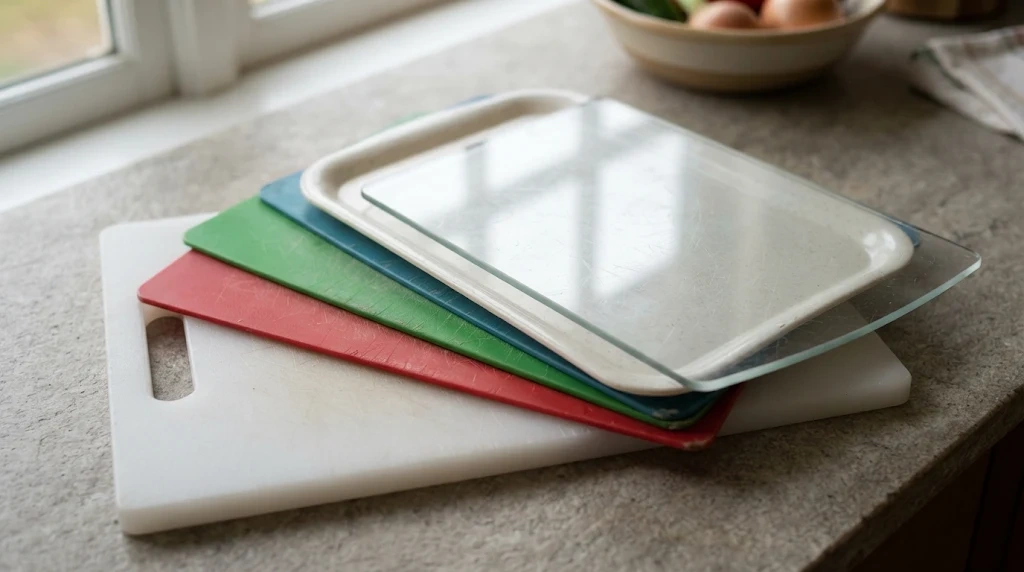
Five plastics cover nearly every board you’ll find in a store. The table below shows which ones carry BPA or PFAS risk, so you can judge a board in seconds.
| Plastic | Resin code | BPA risk | PFAS risk | Notes |
|---|---|---|---|---|
| HDPE | #2 | No | No | Most common board plastic; tough and knife-friendly |
| Polypropylene | #5 | No | No | Light and flexible; common in color-coded sets |
| Melamine | No code | No | No | Hard and slick; keep away from heat and microwaves |
| Polycarbonate | #7 | Yes | No | Rare in boards; hard and clear; avoid for food prep |
| Recycled blends | Varies | Possible | Possible | Highest uncertainty; buy labeled BPA-free boards instead |
HDPE and polypropylene dominate for good reason. Both plastics resist moisture, handle daily knife work, and clean up in the dishwasher, and they sit at the safe end of the table above.
Melamine needs a separate note. It contains no BPA or PFAS, but heat and acidic foods can push melamine and formaldehyde out of the surface.
The FDA advises against microwaving melamine for this reason. I use melamine boards only for cold foods like bread and cheese.
Does Heat Make Plastic Cutting Boards Release Chemicals?
Yes, heat increases chemical migration from plastic in general. Hot food, boiling water, and high dishwasher heat all speed up the process.
Heat softens plastic and opens the surface to faster leaching. A board that is fine at room temperature can release more chemicals under a steaming roast, and worn boards leach faster still.
These habits keep heat risk low:
- Cool food first: Let roasts and baked goods rest before they meet a plastic board.
- Skip hot pans: Never set a hot pan or pot straight onto plastic.
- Use the top rack: Place boards on the top dishwasher rack, away from the heating element.
- Keep melamine cool: Never microwave melamine boards or serve piping-hot food on them.
Our guide to can you put hot food on a plastic cutting board covers the heat question in full. The short version is to let food cool for a few minutes first, since that small pause protects the board and your meal.
I learned this the hard way with a warped board. I set a sheet pan of roasted vegetables on it straight from the oven, and the board bowed in the middle and never sat flat again.
What About Microplastics From Cutting Boards?
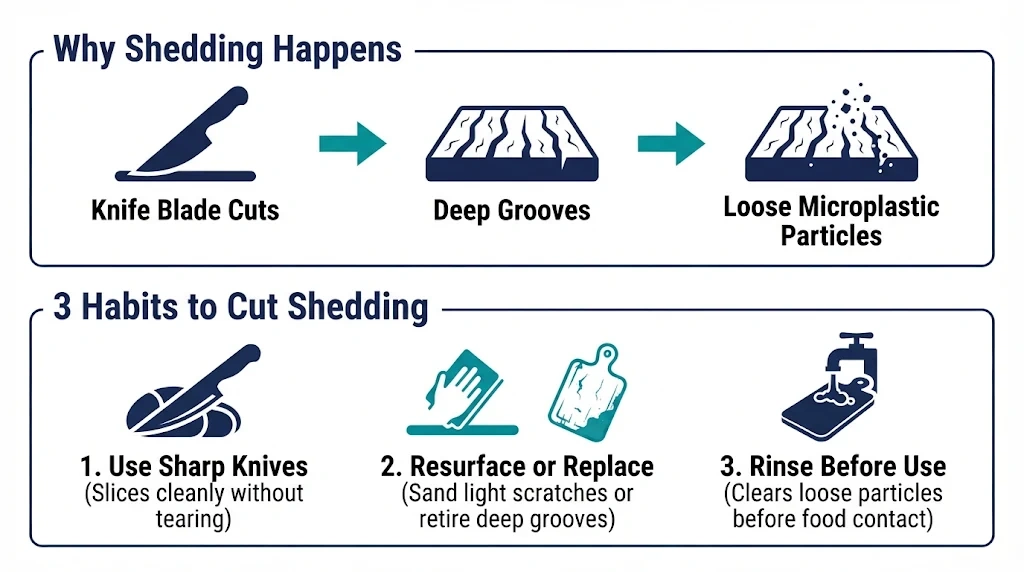
Knife cuts shed tiny plastic particles from any plastic board. The wear is small on a new board, and it grows as grooves deepen.
Each slice drags the blade across the surface and shaves off fine particles. Some stay on the board, and some can mix into food, and lab tests confirm worn boards shed more than smooth ones.
Three habits cut shedding fast:
- Use sharp knives: A sharp blade slices cleanly instead of tearing the surface.
- Resurface or replace: Sand out light scratches or retire boards with deep grooves.
- Rinse before use: A quick rinse clears loose particles before food touches the board.
Our guide on do plastic cutting boards release microplastics looks at the evidence in detail. The takeaway is practical rather than scary: a board in good shape sheds far less than a scored, grooved one.
Microplastics differ from BPA and PFAS: they are physical particles, not dissolved chemicals, and scientists are still studying their health effects. Reducing them comes down to board care and timely replacement.
How Can I Tell If My Cutting Board Is BPA-Free and PFAS-Free?
Start with the label and the resin code on the back of the board. A board marked BPA-free with a #2 or #5 code is the safest bet.
Work through this check in order. It takes under a minute, and it settles most doubts.
- Flip the board over: Read the recycling triangle and note the number inside it.
- Look for BPA-free wording: Trust clear on-pack claims from known brands over vague “food-safe” wording.
- Ask about coatings: Skip boards that advertise a coating without naming what it is.
- Check for NSF certification: NSF-certified boards meet published food-equipment standards.
- Buy from known brands: Established makers publish safety data and answer questions about materials.
Certification matters more than marketing claims. Our guide to do cutting boards need to be made in a certified facility explains what those labels mean in practice.
A certified board has passed tests a marketing claim never faces.
When a board fails this check, don’t overthink it: replace it with a labeled HDPE board and move on. Consumer Reports regularly tests kitchen gear for chemical safety, and its guides are a useful second opinion before you buy.
When Should You Replace a Plastic Cutting Board?
Replace a plastic cutting board once deep grooves, warping, or stains set in. Those signs mean the surface no longer cleans well and sheds more particles.
Deep cuts trap moisture and food bits where a sponge can’t reach. Bacteria can survive in those grooves even after washing, and a board that smells after cleaning has passed its useful life.
Watch for these replacement signals:
- Deep knife grooves: Cuts you can feel with a fingernail trap bacteria and shed plastic.
- Warping or cracks: A board that rocks on the counter is unsafe and hard to clean.
- Stains that stay: Dark marks that survive scrubbing show the surface has broken down.
- Lingering odors: Smells from garlic or fish that won’t wash out mean the plastic has absorbed them.
- Missing labels: A board with no resin code and no brand can’t be verified, so retire it.
With daily use, a plastic board often lasts one to three years before grooves take over. Lighter use stretches that span, and I check my boards each season and retire any that fail the fingernail test.
What Are the Safest Alternatives to Plastic Cutting Boards?
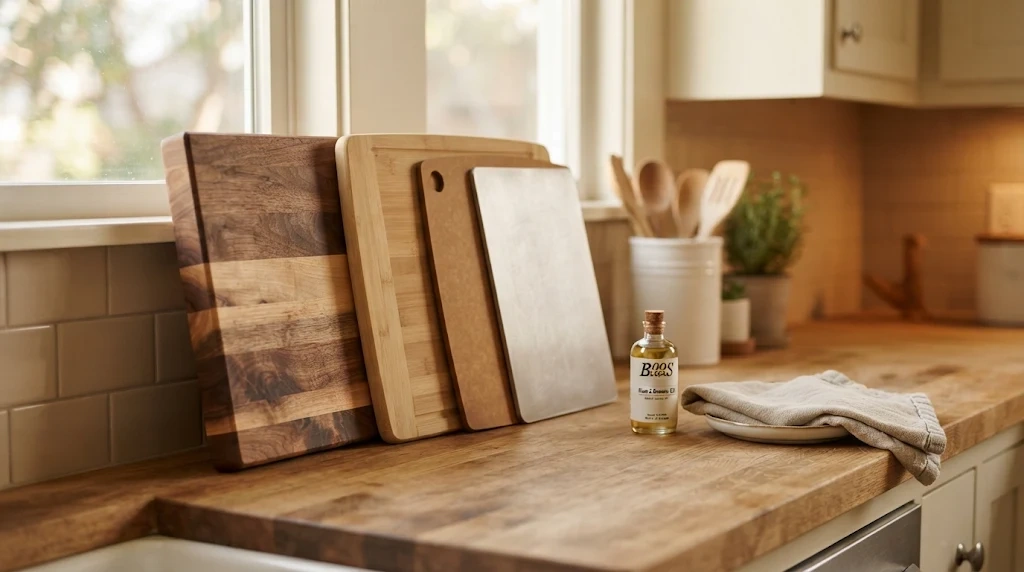
Wood, bamboo, and paper-composite boards are the safest common alternatives to plastic. None of them contain BPA or PFAS, and each suits a different style of cooking.
- Hardwood (maple, walnut): Closed grains resist bacteria, and boards last for years with regular oiling.
- Bamboo: Harder and cheaper than maple, though it can dull knives faster.
- Paper composite (Epicurean): Wood fiber pressed with resin into thin, dishwasher-safe boards with NSF certification.
- Steel and glass: Chemical-free but hard on knife edges, so I keep steel for raw meat only.
If hygiene is your top worry, our guide to what is the most sanitary cutting board compares every material side by side. The right pick depends on what you cook and how you clean.
If you’re ready to pick a safer board, here’s what I’d recommend:
🏆 Best Overall
OXO Good Grips Utility Cutting Board
★★★★★
BPA-free HDPE with a non-slip grip edge and juice groove. I’ve used this board for years, and it stays flat and cleans up fast.
💰 Best Budget
Farberware BPA-Free Plastic Cutting Board Set
★★★★☆
A set of color-coded polypropylene boards for meat, produce, and bread. I like the color system for keeping raw chicken away from salad prep.
🌿 Best Non-Plastic Pick
Epicurean Kitchen Series Cutting Board
★★★★☆
NSF-certified wood-fiber composite, dishwasher-safe and gentle on knives. I reach for this one when I want zero plastic in the picture.
Frequently Asked Questions
Are all plastic cutting boards BPA-free?
No, but most are: boards made from HDPE (#2) and polypropylene (#5) contain no BPA by design. Polycarbonate boards and unlabeled #7 plastic are the exceptions, so check the resin code and buy boards with a clear BPA-free label.
Is HDPE safe for cutting boards?
Yes, HDPE is one of the safest plastics for food contact: it contains no BPA or PFAS, resists moisture, and stands up to daily knife work. Replace the board once deep grooves appear, since worn surfaces trap bacteria and shed more particles.
Can I put hot food on a plastic cutting board?
It’s best to let food cool for a few minutes first, since heat speeds chemical migration from plastic and can warp the board. Never place a hot pan on plastic, and keep melamine boards away from microwaves and piping-hot dishes.
What is the safest cutting board material?
Hardwood boards like maple and walnut rank high for safety and knife care, and they contain no BPA or PFAS. Paper-composite boards such as Epicurean are a strong plastic-free option too, but the safest pick is the one you clean well and replace on time.
The Bottom Line
Most plastic cutting boards contain neither BPA nor PFAS. A labeled HDPE or polypropylene board in good shape is a safe, practical choice.
Check the resin code, keep hot food off plastic, and retire boards once grooves deepen. Do those three things, and your board stays one of the safest tools in your kitchen.