Are Titanium Cutting Boards Safe? Benefits, Risks, and Expert Advice
Quick Answer
Yes, titanium cutting boards are generally safe for food preparation when made from genuine, food-contact-suitable titanium. They resist corrosion, don’t absorb food juices, and are relatively easy to clean. However, their rigid metal surface can wear down knife edges faster than suitable wood or plastic. If knife protection matters most, consider a knife-friendly wooden cutting board instead.
Key Safety Considerations
- Material safety: Genuine titanium is corrosion-resistant and suitable for food contact when properly manufactured.
- Cleaning: Its nonporous surface doesn’t absorb food juices, but it still needs washing and proper sanitation.
- Knife wear: Rigid metal can accelerate edge wear compared with forgiving cutting surfaces.
- Scratches: Titanium can develop knife marks and should be inspected for damage.
- Product quality: Confirm the metal grade, construction, and food-contact suitability before buying.
My Recommendation
- Choose titanium: If you prioritize a durable, nonabsorbent surface and don’t mind possible knife wear.
- Choose hardwood: If maintaining sharp knife edges is your main priority.
Titanium cutting boards are attracting attention as an alternative to traditional wood and plastic boards. Their metallic appearance and low-maintenance design certainly sound appealing.
But are titanium cutting boards safe for everyday cooking? I think the answer depends on more than whether the material is considered food-safe.
In this guide, I’ll explain the food safety benefits, potential drawbacks, knife damage concerns, cleaning requirements, and practical alternatives.
What Is a Titanium Cutting Board?
 Save
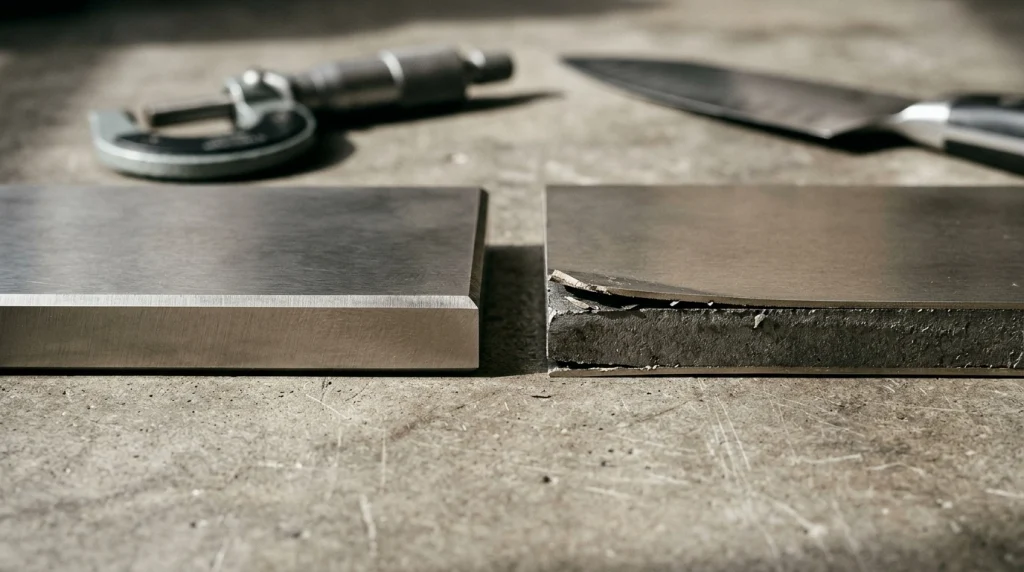
A titanium cutting board is a food preparation surface made from titanium metal or a product marketed as containing titanium. Genuine titanium offers corrosion resistance, low weight relative to many other metals, and a nonabsorbent surface.
Not every product advertised as titanium has the same construction. Some may combine different metals or use coatings, so checking the manufacturer’s material specifications is essential.
What Makes Titanium Different From Other Cutting Board Materials?
Titanium forms a stable protective oxide layer on its surface. This helps the metal resist corrosion under ordinary conditions.
Unlike wood, solid titanium doesn’t contain a network of absorbent wood fibers. Unlike plastic, it doesn’t rely on a polymer cutting surface.
- Corrosion resistance: Titanium resists rust and many forms of ordinary kitchen corrosion.
- Nonporous construction: A smooth metal surface does not absorb food liquids like porous materials can.
- Durability: Solid titanium is unlikely to crack or warp from normal water exposure.
- Low moisture absorption: Cleaning water stays on the surface rather than soaking into the metal.
- Rigid cutting feel: Knife blades contact a firm surface with limited cushioning.
These characteristics make titanium interesting for kitchen equipment. However, they don’t automatically make it the best material for every cutting task.
Are Titanium Cutting Boards Food Safe and Non-Toxic?
Genuine titanium is generally considered a stable, corrosion-resistant material. A properly manufactured titanium cutting board can provide a suitable food-contact surface.
The important qualification is product quality. Material identity, surface finish, contamination, and manufacturing standards all influence the safety of the finished board.
Does Titanium Leach Harmful Chemicals Into Food?
Solid titanium has high corrosion resistance, which makes substantial metal release less likely during normal food preparation. However, this doesn’t establish that every product labeled titanium has passed food-contact testing.
For greater confidence, look for clear material specifications and credible food-contact compliance information from the manufacturer.
- Choose products with clearly identified titanium grades.
- Confirm that the manufacturer intends the surface for direct food contact.
- Avoid unexplained coatings, finishes, or decorative treatments.
- Check for damage, loose particles, or unusual surface residue.
- Be cautious of vague claims such as “100% medical grade” without supporting documentation.
Are Titanium Cutting Boards Free From BPA and Microplastics?
A solid, uncoated titanium cutting surface does not contain the plastic polymer associated with BPA. It also doesn’t generate plastic fragments through ordinary knife contact because the cutting surface isn’t plastic.
That does not mean every titanium-branded board is entirely plastic-free. Handles, feet, adhesives, or coatings may use other materials.
Scraping any cutting surface can produce wear particles under some conditions. Titanium should not be described as completely particle-free without reliable testing.
Does Titanium Naturally Kill Bacteria?
Ordinary titanium metal should not be treated as a self-sanitizing cutting board. Its nonporous construction makes cleaning easier, but bacteria can still contaminate its surface.
Some specialized titanium-based coatings have been studied for antimicrobial properties. Those findings should not be applied automatically to ordinary solid titanium boards.
The FDA’s food preparation guidance emphasizes cleaning cutting boards and separating raw animal products from ready-to-eat foods.
Do Titanium Cutting Boards Dull Knives?
Yes, titanium cutting boards can dull knives faster than softer, more forgiving cutting surfaces. Their rigid metal construction provides little cushioning when a knife edge contacts the board.
How quickly a blade dulls depends on the board’s actual surface properties, knife steel, edge geometry, cutting technique, and frequency of use.
Why Does Surface Hardness Matter?
Every chopping motion brings a thin knife edge into contact with the cutting surface. A rigid surface can concentrate stress on that delicate edge.
Repeated impact may contribute to microscopic edge deformation or wear. This is particularly relevant when using thin, finely sharpened kitchen knives.
- Japanese chef knives: Thin, hard edges may be more sensitive to rough or rigid cutting surfaces.
- Western chef knives: Tougher blades still experience wear from repeated contact.
- Paring knives: Light slicing may cause less impact than forceful chopping.
- Cleavers: Forceful chopping against metal can place considerable stress on the cutting edge.
I would avoid using a titanium board as my primary chopping surface with an expensive, thin-edged chef knife. A quality wooden board offers a more forgiving contact surface.
For another comparison, read my guide on whether composite cutting boards are good for knives.
Titanium vs. Wood vs. Plastic Cutting Boards: Which Is Better?
 Save
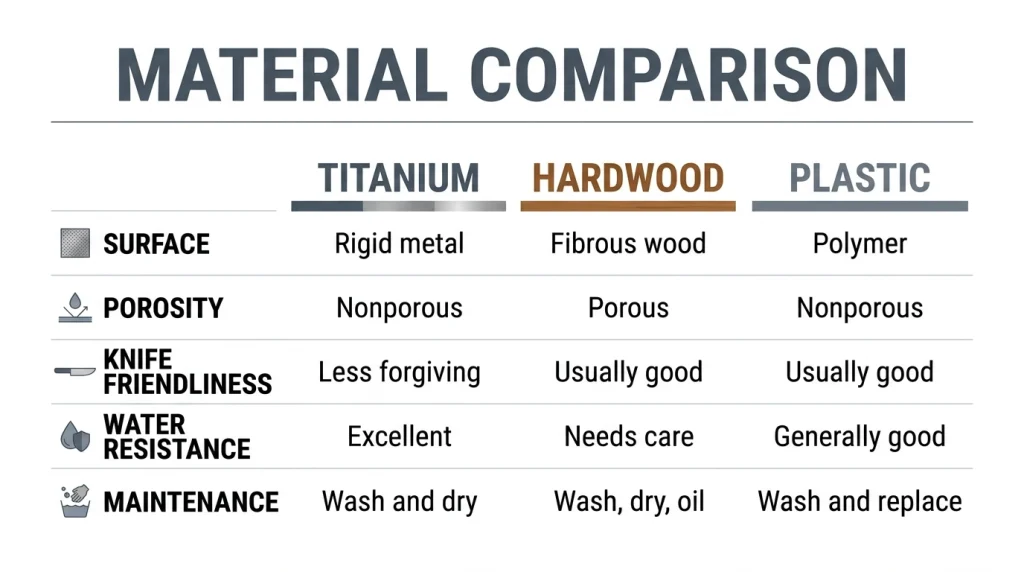
No single cutting board material wins in every category. The best choice depends on cleaning preferences, knife protection, maintenance, and durability.
| Feature | Titanium | Hardwood | Plastic |
|---|---|---|---|
| Surface | Rigid metal | Fibrous wood | Polymer |
| Porosity | Nonporous | Porous | Nonporous |
| Knife friendliness | Generally less forgiving | Usually good | Usually good |
| Water resistance | Excellent | Needs care | Generally good |
| Maintenance | Wash and dry | Wash, dry, oil as needed | Wash and replace when worn |
| Dishwasher suitability | Check manufacturer | Usually hand-wash | Many are dishwasher-safe |
| Common drawback | Knife wear | Moisture damage | Deep grooves |
| Best suited for | Easy-clean metal surface | Frequent chopping | Convenient everyday prep |
These are general material comparisons, not laboratory measurements of specific boards. Design and manufacturing quality can change the experience substantially.
Is Titanium Better Than Stainless Steel?
Titanium weighs less than stainless steel at the same volume and offers excellent corrosion resistance. However, both materials create relatively rigid cutting surfaces.
Neither is my preferred choice for frequent chopping with delicate kitchen knives. I would prioritize the cutting experience over differences in metal weight.
Is Titanium Better Than Wood?
Titanium offers easier moisture management and does not require regular oiling. Hardwood generally provides a more forgiving cutting surface.
If you’re considering wooden alternatives, explore my guide to acacia wood cutting board safety.
What Are the Main Disadvantages of Titanium Cutting Boards?
Titanium boards can be useful, but they have several practical limitations. Understanding these drawbacks helps prevent expensive purchasing mistakes.
- Knife edge wear: Firm metal contact may increase sharpening requirements.
- Cutting noise: Metal contact can produce a sharper sound than wood or plastic.
- Surface scratches: Titanium isn’t scratch-proof and may develop visible marks.
- Slipping: Smooth metal boards may slide without suitable nonslip supports.
- Price: Genuine titanium can be more expensive than common board materials.
- Questionable listings: Some online listings provide little evidence of material grade or construction quality.
Can Titanium Cutting Boards Scratch?
Yes, titanium can scratch despite its durability. Knife marks may gradually change the appearance and texture of its surface.
Light cosmetic scratches don’t necessarily make a board unsafe. Deep damage, sharp burrs, loose coatings, or difficult-to-clean areas are more concerning.
Are Titanium Cutting Boards Slippery?
Some titanium boards may slide across smooth countertops, especially if they have no rubber feet. A moving board creates an unnecessary cutting hazard.
Place a food-safe nonslip mat underneath when needed. Confirm the board remains stable before handling sharp knives.
How Do You Clean a Titanium Cutting Board Safely?
Clean a titanium cutting board after each use with warm water and dish soap. Rinse thoroughly and dry it before storage.
A simple cleaning routine helps control food contamination without relying on special treatments.
- Remove food scraps: Clear remaining ingredients and visible debris.
- Wash thoroughly: Use warm water, mild dish soap, and a soft sponge.
- Clean both sides: Pay attention to handles, seams, and nonslip feet.
- Rinse: Remove detergent and loosened residue.
- Sanitize when needed: Use a food-contact-approved sanitizer compatible with the complete board, following label instructions.
- Dry: Use a clean towel or allow the board to air-dry fully.
For detailed recommendations, consult the USDA cutting board cleaning guidance.
Can Titanium Cutting Boards Go in the Dishwasher?
Some solid titanium cutting boards may tolerate dishwasher conditions. However, dishwasher safety depends on the entire product, not just its metal surface.
Rubber feet, adhesives, coatings, and composite layers may have different limits. Follow the manufacturer’s care instructions rather than assuming every titanium board is dishwasher-safe.
Should You Use Titanium for Raw Meat?
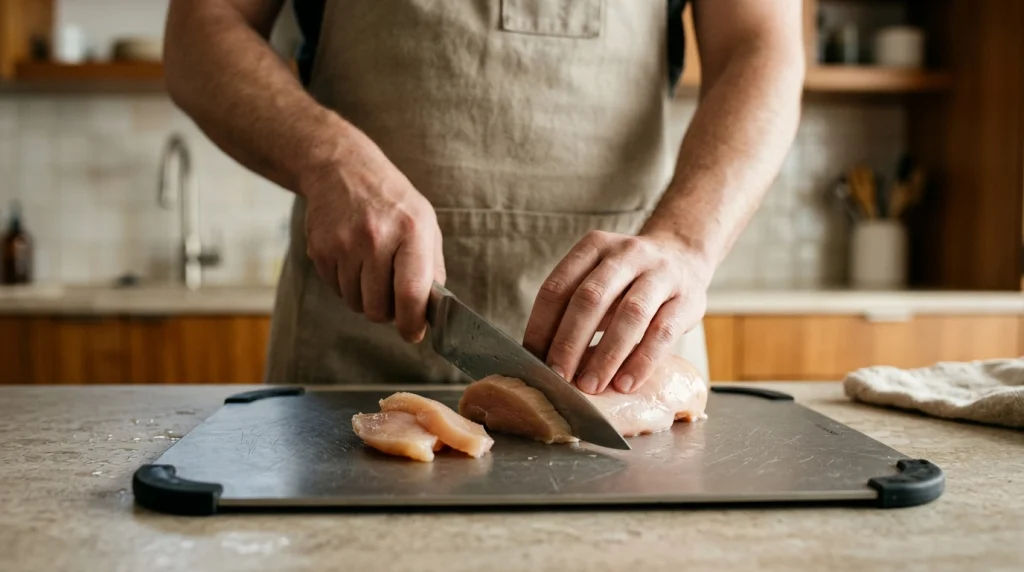
A properly manufactured and clean titanium board can be used for raw meat preparation. Its nonporous surface is convenient for washing away food residue.
However, you must still prevent cross-contamination. Use a separate board for ready-to-eat foods whenever practical.
The University of Illinois Extension recommends dedicated cutting surfaces for raw animal products and replacing boards with hard-to-clean damage.
How Can You Tell Whether a Titanium Cutting Board Is Genuine?
Product descriptions alone aren’t reliable evidence of material identity. Look for transparent specifications from a manufacturer willing to explain its construction.
Before buying, I would check these details:
- Material grade: Does the seller identify the titanium grade or alloy?
- Solid or coated: Is the board solid metal, clad, or coated?
- Food contact: Is there documentation supporting food-contact suitability?
- Surface finish: Are the edges smooth, with no peeling or loose material?
- Manufacturer details: Can you identify the actual producer and customer support channel?
- Cleaning instructions: Are dishwasher use and sanitizer compatibility clearly explained?
Can a Magnet Identify Genuine Titanium?
Pure titanium is not strongly attracted to an ordinary magnet. However, a magnet test cannot reliably prove that a board is genuine titanium.
Many other metals and alloys can also show little magnetic attraction. Material certificates or credible independent testing provide stronger evidence.
Are Titanium Cutting Boards Worth Buying in 2026?
Titanium cutting boards may be worth considering if you prioritize corrosion resistance, a nonabsorbent surface, and simple upkeep. They are less compelling when knife-edge protection is your highest priority.
As of 2026, I would be cautious about unverified marketing promises. Claims that a metal board is simultaneously scratch-proof, completely particle-free, and exceptionally gentle on knives deserve scrutiny.
Who Should Consider a Titanium Cutting Board?
 Save
- Home cooks interested in a durable, nonabsorbent metal surface.
- People seeking an alternative to plastic cutting surfaces.
- Users comfortable with more frequent knife maintenance.
- Shoppers who can verify the board’s material and food-contact suitability.
Who Should Avoid Titanium Cutting Boards?
- People who frequently use delicate Japanese kitchen knives.
- Cooks who want the most forgiving everyday chopping surface.
- Anyone sensitive to loud metal-on-metal cutting sounds.
- Buyers unable to verify a product’s construction or material claims.
For many kitchens, a practical combination works better than relying on one material. I would choose wood for regular chopping and a washable, nonporous board for raw meat preparation.
Cutting Boards Worth Considering Instead
If you are reconsidering titanium, these established cutting board models offer practical alternatives. The recommendations below reflect documented product characteristics, not personal hands-on testing.
🏆 Best for Everyday Prep
OXO Good Grips Utility Cutting Board
★★★★☆ Editorial suitability: 4/5
This double-sided, nonporous board includes nonslip feet and a juice-catching groove. It is dishwasher-safe and offers a more forgiving cutting surface than rigid metal. I would choose it for convenient everyday preparation.
🔪 Best Wood Alternative
OXO Good Grips Acacia Wood Utility Cutting Board
★★★★☆ Editorial suitability: 4/5
This acacia board includes a juice groove and carrying handles. It requires hand-washing and periodic conditioning. I would favor its wooden surface for regular knife work over titanium.
💰 Best Compact Option
OXO Good Grips Everyday Cutting Board
★★★★☆ Editorial suitability: 4/5
This smaller dishwasher-safe cutting board provides a double-sided surface and a drip-catching design. I would consider it for kitchens where convenient cleaning and storage matter more than premium materials.
These editorial scores are assessments of suitability for the use cases described, not customer review averages. Always verify specifications and current product availability before buying.
Frequently Asked Questions
Are titanium cutting boards safer than plastic?
Genuine titanium does not contain plastic polymers and offers a nonabsorbent cutting surface. However, that alone does not make every titanium board safer than plastic. Both materials can support safe food preparation when properly manufactured, cleaned, and maintained.
Can titanium cutting boards damage expensive knives?
Yes. A rigid titanium cutting surface may accelerate knife-edge wear compared with suitable hardwood or softer plastic. Delicate knives can be particularly sensitive to repeated hard contact. A forgiving wooden cutting board is generally a better choice for protecting premium knife edges.
Can you cut raw chicken on titanium?
Yes, a properly manufactured titanium board can be used for raw chicken. Wash and sanitize it appropriately afterward, following product and sanitizer instructions. Keep raw poultry away from foods that will not be cooked to prevent cross-contamination.
Do titanium cutting boards release metal particles?
Titanium cutting boards are not guaranteed to be particle-free. Repeated cutting can create surface wear, depending on the material, knife, and technique. Avoid boards with rough burrs, flaking finishes, or unexplained residue, and contact the manufacturer if damage appears.
How long does a titanium cutting board last?
A well-made titanium board may provide many years of service because the metal resists corrosion and ordinary moisture damage. Its usable lifespan still depends on construction quality, surface condition, and maintenance. Replace it if damage makes cleaning unsafe or reliable use impossible.
Final Verdict: Are Titanium Cutting Boards Safe?
Yes, a genuine, properly manufactured titanium cutting board can be safe for everyday food preparation. Its corrosion resistance and nonporous surface are useful advantages.
However, food-contact safety and knife friendliness are different questions. Titanium may be convenient to clean while remaining less forgiving to cutting edges than hardwood or suitable plastic.
My recommendation is to buy titanium only when its material specifications and intended food-contact use are clear. If knife protection matters most, a quality hardwood cutting board is usually the more practical choice.
Before choosing your next board, you can also explore whether Epicurean cutting boards are worth considering for everyday kitchen use.

