Are Epicurean Cutting Boards Good? An Honest Review
Quick Answer
Yes, Epicurean cutting boards are good for everyday cooking, especially if you want a lightweight, dishwasher-safe board that requires little maintenance. Their durable paper-composite construction resists moisture, stains, and odors. However, the firm surface may dull certain knives faster than softer wood or rubber boards. For most home kitchens, the Epicurean cutting board collection offers practical alternatives to traditional wooden boards.
What Makes Epicurean Boards Worth Considering?
- Easy Cleaning: Dishwasher-safe construction simplifies cleanup after preparing meals.
- Durable Material: Dense paper composite resists moisture and everyday wear.
- Lightweight Design: Thin boards are easy to lift, carry, and store.
- Minimal Maintenance: No regular mineral-oil treatment is required.
- Heat Resistance: Many models withstand temperatures up to 350°F (176°C).
- Knife Trade-Off: Their relatively hard surface may increase blade wear compared with softer alternatives.
My Recommendation
- Choose the Kitchen Series for simple daily preparation.
- Choose the All-in-One Series for better grip and liquid control.
- Choose a softer wood or rubber board if knife-edge preservation matters most.
Choosing a cutting board sounds simple until you start comparing materials, cleaning requirements, and knife performance. Epicurean boards stand out because they offer several practical benefits without demanding much upkeep.
I’m Michael, and in this guide, I’ll examine their construction, everyday advantages, drawbacks, and value. I’ll also explain which models make sense for different cooking habits.
What Are Epicurean Cutting Boards Made Of?
 Save
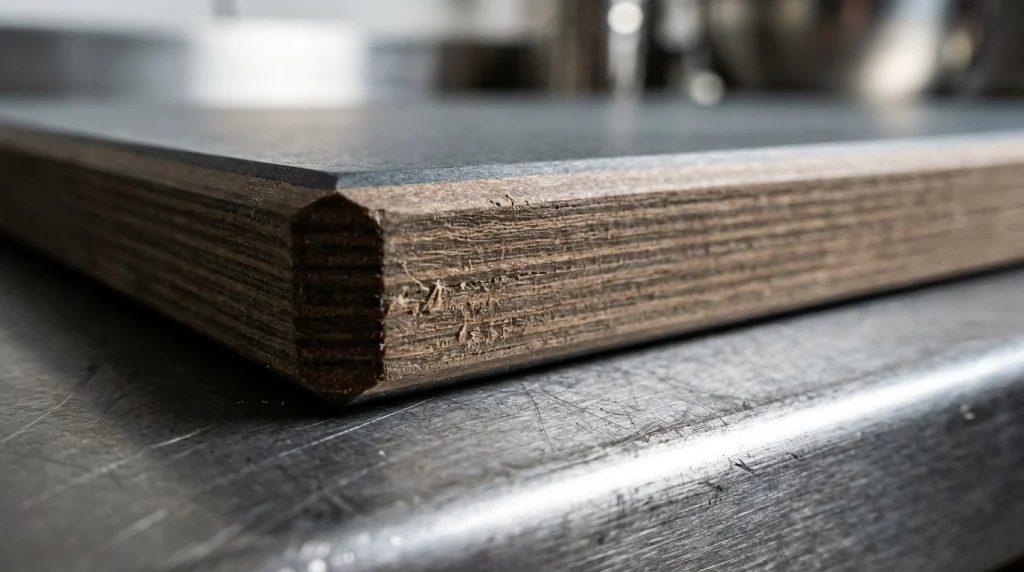
Epicurean cutting boards are made from a dense paper-composite material rather than solid hardwood or ordinary plastic. The material combines layers of paper with thermosetting resin under heat and pressure.
This process creates a solid cutting surface with a wood-like appearance. The finished material is commonly associated with Richlite, a paper-composite product.
How Does Paper Composite Work?
The manufacturing process bonds multiple paper layers into a rigid sheet. This construction gives the board its distinctive thin profile and moisture-resistant surface.
- Paper fibers: Form the primary structural material.
- Thermosetting resin: Bonds the paper layers together.
- Heat and pressure: Create a dense, stable composite.
- Finished surface: Provides a durable area for food preparation.
Unlike solid wood, the finished board doesn’t need regular oiling. The composite is also designed to tolerate dishwasher cleaning.
Epicurean describes its cutting-board material as NSF-certified, although buyers should check certification details for their specific model. You can learn more about the manufacturer’s construction process through Epicurean’s material information.
Are Epicurean Cutting Boards Actually Good?
Yes, Epicurean boards are particularly good for cooks who value convenient cleaning, compact storage, and everyday durability. They are less ideal for people seeking a soft, quiet cutting surface.
The main trade-off involves the relationship between surface hardness and knife wear. A cutting board can be durable without being the gentlest possible surface for a sharp blade.
Advantages of Epicurean Cutting Boards
- Dishwasher compatibility: Most standard models can be cleaned without hand-washing.
- Low-maintenance surface: They don’t need regular seasoning or oiling.
- Easy handling: Their thin construction makes transferring ingredients convenient.
- Moisture resistance: The composite resists absorbing liquids during normal use.
- Space-saving profile: Many boards fit easily into narrow kitchen storage areas.
- Practical versatility: Models with grooves work well for juicy ingredients.
Disadvantages Worth Knowing
- Hard cutting surface: Some knives may lose sharpness faster than on softer boards.
- Noticeable chopping noise: The rigid material produces a sharper sound than many wooden or rubber surfaces.
- Visible knife marks: Repeated cutting can leave scratches and surface wear.
- Possible movement: Lightweight models without gripping feet can slide on smooth counters.
- Higher cost: Some models cost more than basic plastic alternatives.
- Limited cushioning: The rigid surface has less give than soft rubber.
Independent comparisons highlight these trade-offs. In particular, testing has found Epicurean boards convenient to clean but relatively hard on knife edges.
That doesn’t make them unsuitable for cooking. It means buyers should match the board material to their knives and cutting habits.
Epicurean vs. Wood vs. Plastic Cutting Boards
 Save
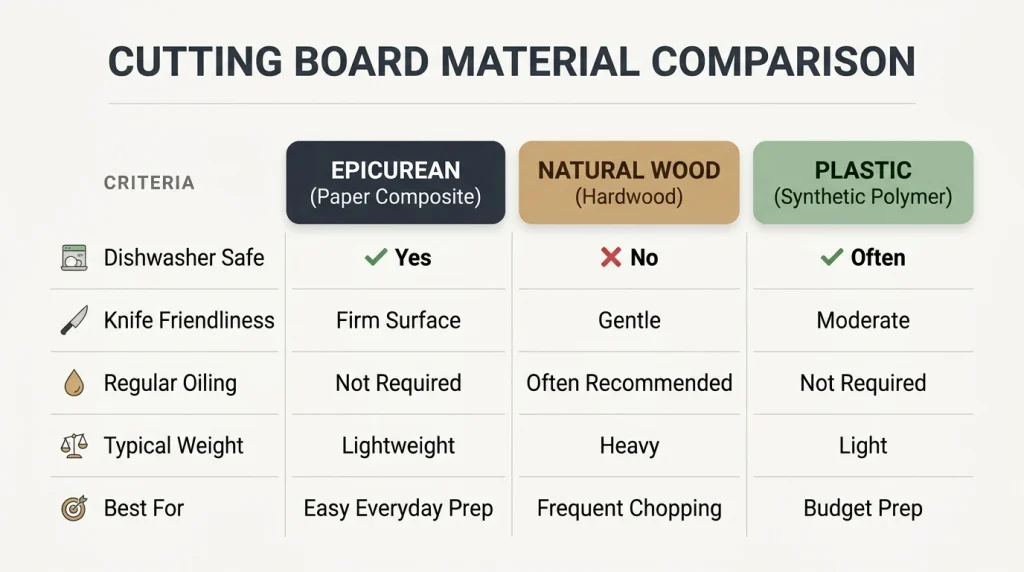
Epicurean, wooden, and plastic boards each serve different kitchen priorities. The best material depends on cleaning convenience, knife protection, and personal preferences.
Here’s how these common options compare.
| Feature | Epicurean | Wood | Plastic |
|---|---|---|---|
| Material | Paper composite | Natural hardwood | Synthetic polymer |
| Dishwasher Safe | Yes | Generally not recommended | Often, depending on model |
| Knife Friendliness | Firm surface | Generally gentle | Varies by material |
| Regular Oiling | Not required | Often recommended | Not required |
| Typical Weight | Lightweight | Medium to heavy | Light to medium |
| Surface Wear | Knife scratches | Knife marks | Knife grooves |
| Best For | Easy everyday prep | Frequent chopping | Budget and easy cleanup |
My practical preference is to think about how frequently you’ll use your knives. Someone preparing vegetables daily may appreciate a softer board, while occasional cooks may value dishwasher convenience more.
Do Epicurean Cutting Boards Dull Knives?
Epicurean cutting boards can dull knife edges faster than softer wood or rubber boards. The amount of wear depends on blade steel, cutting technique, pressure, and frequency of use.
Epicurean markets its boards as knife-friendly because the surface allows some scoring. However, knife-friendly doesn’t mean every cutting surface protects blades equally.
Why Does Surface Hardness Matter?
Every time your knife touches a cutting board, the edge experiences mechanical contact. Harder surfaces generally provide less cushioning during repeated chopping.
A softer surface can reduce impact on delicate edges. That’s especially relevant when using thin Japanese chef’s knives or finely sharpened blades.
How Can You Reduce Knife Wear?
- Use controlled cutting pressure instead of striking the board forcefully.
- Keep your chef’s knife properly sharpened.
- Avoid scraping ingredients sideways with the sharp knife edge.
- Use a softer board for prolonged chopping sessions.
- Reserve Epicurean boards for lighter preparation if your knives have delicate edges.
For ordinary slicing tasks, an Epicurean board may be perfectly acceptable. If preserving expensive knife edges is your highest priority, I’d choose a quality end-grain wood or soft rubber board instead.
Are Epicurean Cutting Boards Safe for Food Preparation?
Epicurean cutting boards are designed for food-contact use and can be a safe choice when properly cleaned and maintained. Their dense composite surface helps resist liquid absorption.
Still, no cutting board remains hygienic without appropriate cleaning. Raw meat juices, contaminated utensils, and poor storage practices can create food-safety problems on any material.
Can You Cut Raw Meat on an Epicurean Board?
Yes, you can prepare raw meat on an Epicurean cutting board if you follow proper food-safety practices. The dishwasher-safe construction makes thorough cleaning more convenient.
The FDA’s food preparation guidance recommends separating raw animal products from foods that will be eaten without cooking.
- Use separate boards for raw meat and ready-to-eat foods when possible.
- Wash the board immediately after handling raw animal products.
- Sanitize when appropriate using a food-contact-safe method.
- Allow the board to dry before storage.
- Replace boards with deeply damaged, difficult-to-clean surfaces.
Are Epicurean Boards Non-Toxic?
Epicurean uses a cured paper-and-resin composite intended for food-contact applications. Its manufacturing and certification information supports using the material as directed.
However, the board isn’t simply untreated natural wood. Buyers specifically avoiding synthetic resins should understand that resin is part of the composite construction.
Certifications and manufacturer statements also shouldn’t be interpreted as proof that every possible exposure concern has been independently eliminated. Follow the intended-use instructions and replace severely damaged boards.
Can Epicurean Cutting Boards Go in the Dishwasher?
Yes, dishwasher compatibility is one of Epicurean’s most useful features. Unlike many traditional wooden boards, its paper-composite boards are designed to handle dishwasher cleaning.
This can make a meaningful difference in busy kitchens. You can clean the cutting surface without following a separate wood-conditioning routine.
How to Clean an Epicurean Cutting Board
- Remove food scraps: Scrape away remaining ingredients using a suitable scraper.
- Wash thoroughly: Use warm water and dish soap, or a dishwasher according to the manufacturer’s instructions.
- Check knife grooves: Clean areas where food particles might remain.
- Rinse when hand-washing: Remove detergent and loosened residue.
- Dry completely: Allow the board to air-dry before putting it away.
Clean the board after every food-preparation session. When switching between raw meat and ready-to-eat ingredients, clean and sanitize as appropriate.
For general cutting-board cleaning and replacement guidance, consult the USDA Food Safety and Inspection Service.
Do Epicurean Boards Need Oiling?
No, Epicurean cutting boards don’t require the regular mineral-oil treatment commonly used on wooden boards. Their composite construction provides moisture resistance without this maintenance step.
This is an important convenience advantage. You won’t need to build a separate oiling schedule around everyday board care.
How Long Do Epicurean Cutting Boards Last?
Epicurean boards are designed for long-term kitchen use, but their actual lifespan depends on handling and surface wear. There’s no universal number of years that applies to every kitchen.
Light vegetable preparation causes different wear than heavy daily chopping. Dishwasher frequency, storage, and accidental damage can also influence longevity.
Signs Your Cutting Board Needs Replacing
- Deep grooves: Knife damage becomes difficult to clean thoroughly.
- Separation: Material layers appear to split or delaminate.
- Persistent warping: The board no longer sits securely on a flat surface.
- Severe damage: Cracks, chips, or structural defects affect safe use.
- Persistent contamination: The surface cannot be adequately cleaned.
Normal surface scratches don’t automatically mean the board is unsafe. Look for deeper damage that interferes with effective cleaning or stable cutting.
The University of Illinois Extension also recommends replacing cutting boards when excessive grooves make them harder to maintain safely.
Which Epicurean Cutting Board Is Best?
 Save
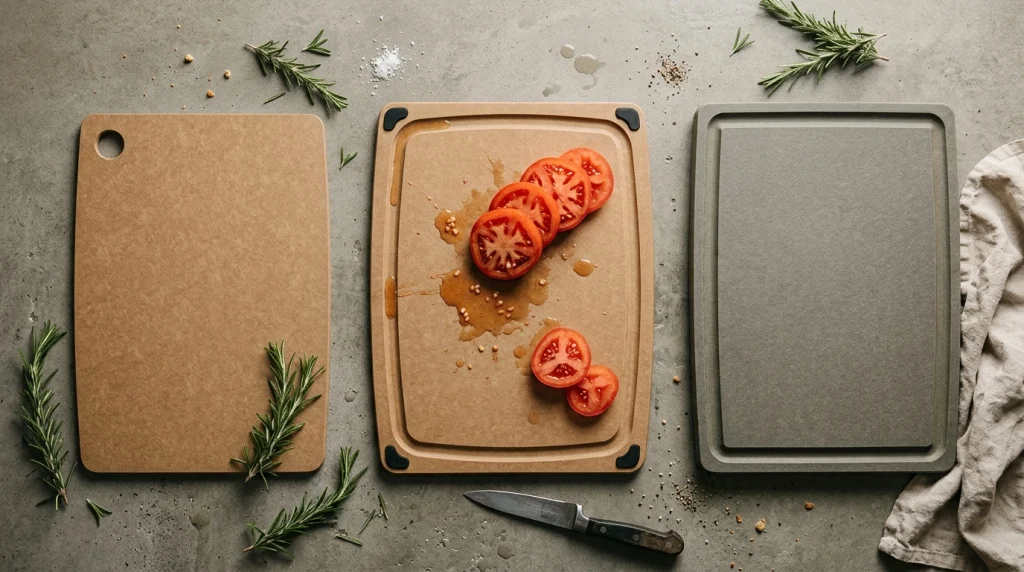
The best Epicurean model depends on your available counter space and preferred cutting tasks. Three popular series address different needs.
Epicurean Kitchen Series
The Kitchen Series is the straightforward everyday option. Its simple, reversible design prioritizes lightweight handling and easy storage.
- Common sizes include 8 × 6, 11.5 × 9, 14.5 × 11.25, and 17.5 × 13 inches.
- Standard thickness is 1/4 inch.
- Includes a convenient hanging hole.
- Dishwasher-safe construction requires no regular oiling.
I’d consider this series for vegetables, sandwiches, herbs, and quick meal preparation. A damp cloth or non-slip mat underneath can improve stability when needed.
Epicurean All-in-One Series
The All-in-One Series adds useful features for more demanding meal preparation. Its silicone feet improve stability, while the juice groove helps contain liquids.
- Quarter-inch composite profile.
- Reversible cutting surfaces.
- Juice groove on one side.
- Non-slip silicone feet.
- Multiple sizes for different counter spaces.
This is my preferred configuration for someone purchasing a single versatile Epicurean board. The extra stability addresses one common limitation of thin cutting boards.
Epicurean Gourmet Series
The Gourmet Series offers a thicker and more substantial cutting surface. It also includes a juice groove for handling moisture from meats and produce.
The roughly 3/8-inch profile gives it a different feel from the thinner Kitchen Series. That makes it worth considering for larger preparation tasks.
Is an Epicurean Cutting Board Worth the Money?
An Epicurean cutting board is worth considering if easy cleanup and low maintenance justify its price. It may offer less value if knife protection or cutting comfort is your main concern.
As of 2026, Epicurean’s official US store lists starting prices around $15.99 for Kitchen Series boards, $24.99 for All-in-One boards, and $61.99 for Gourmet boards. Exact prices vary with size, style, and retailer.
Who Should Buy One?
- Home cooks who prefer dishwasher-safe kitchen tools.
- People with limited cutting-board storage.
- Busy households seeking simple cleaning routines.
- Cooks who dislike maintaining wooden boards.
- Anyone wanting a thin, lightweight preparation surface.
Who Might Prefer Another Material?
- People frequently using delicate Japanese knives.
- Professional cooks performing extended chopping sessions.
- Buyers seeking the quietest possible cutting surface.
- People who prefer completely natural solid wood.
- Budget shoppers satisfied with basic plastic boards.
For my buying criteria, the All-in-One Series offers the most balanced feature set. Its grip and groove provide practical benefits beyond the standard composite surface.
My Recommended Epicurean Cutting Boards
If you’ve decided that easy cleaning matters more than maximum knife-edge protection, these three options are worth comparing. The ratings below reflect the manufacturer’s displayed customer-review averages, not independent testing scores.
🏆 Best Overall
Epicurean All-in-One Series
★★★★★ 4.9/5 brand-site rating
This quarter-inch board combines silicone feet, reversible surfaces, and a practical juice groove. It’s my first recommendation for buyers seeking one versatile board with better countertop stability.
💰 Best Simple Everyday Board
Epicurean Kitchen Series
★★★★★ 4.9/5 brand-site rating
The classic Kitchen Series features a quarter-inch profile, reversible design, and hanging hole. I’d choose it for everyday vegetable preparation where simple handling and compact storage matter most.
🍖 Best for Larger Prep Tasks
Epicurean Gourmet Series
★★★★★ 4.9/5 brand-site rating
The Gourmet Series has a thicker 3/8-inch profile and a juice groove for liquid control. I recommend considering it when you want a more substantial board for carving and larger ingredients.
Frequently Asked Questions
Are Epicurean cutting boards better than wooden cutting boards?
Epicurean boards are generally more convenient to clean and maintain than traditional wooden boards because they are dishwasher-safe and don’t require regular oiling. However, many quality wooden boards provide a softer cutting surface that is gentler on knife edges. The better choice depends on your priorities.
Do Epicurean cutting boards contain plastic?
Epicurean boards are made from paper fibers bonded with thermosetting resin, rather than conventional solid plastic. They aren’t the same as ordinary polyethylene cutting boards, but they also aren’t untreated natural wood. Buyers should consider the resin-based construction when comparing materials.
Can Epicurean cutting boards warp?
Epicurean designs its composite boards to resist moisture and tolerate dishwasher cleaning. However, warping isn’t impossible under every condition. Improper heat exposure, physical damage, and manufacturing defects can affect flatness. Inspect the board if it stops sitting securely on a countertop.
Are Epicurean cutting boards good for expensive chef’s knives?
Epicurean boards can be used with chef’s knives, but they may not provide the best protection for delicate edges. Their relatively rigid surface can contribute to faster dulling than softer materials. For frequent use with premium Japanese knives, a quality soft rubber or end-grain wood board may be preferable.
Do Epicurean cutting boards need special cleaning products?
No special cleaning products are necessary for routine washing. Warm water, ordinary dish soap, and a suitable dishwasher are generally sufficient. After handling raw meat, poultry, or seafood, follow appropriate cleaning and sanitizing practices. Replace the board when deep damage prevents thorough cleaning.
Final Verdict: Should You Buy an Epicurean Cutting Board?
Yes, Epicurean cutting boards are a good investment for home cooks who prioritize easy cleanup, lightweight construction, and minimal maintenance. Their paper-composite material offers a useful combination of features that traditional wooden boards don’t always provide.
However, the hard cutting surface remains an important drawback. Frequent cooks who care deeply about knife-edge preservation may prefer a softer alternative.
My recommendation is to start with the Epicurean All-in-One Series if you want a versatile board with extra grip. Choose the Kitchen Series for simpler everyday tasks, or the Gourmet Series when you want a thicker preparation surface.
Ultimately, the best cutting board is one that fits your cooking routine, protects your equipment appropriately, and is easy to keep clean. Epicurean gets many of those everyday details right.

