Chef Knife vs Nakiri: Which Knife Should You Choose?
Quick Answer
A chef knife is the better all-purpose choice for chopping vegetables, slicing meat, mincing herbs, and handling everyday kitchen tasks. A nakiri is a Japanese vegetable knife with a broad, rectangular blade and a relatively flat cutting edge, making it especially suitable for straight-down chopping and precise vegetable slices. Choose a chef knife for versatility or a nakiri if vegetable preparation is your main priority. For basic cutting technique and safety, see this practical knife-skills guide.
Key Differences at a Glance
- Blade shape: Chef knives usually have a curved edge and pointed tip; nakiris have a straighter edge and squared-off tip.
- Best use: Chef knives handle mixed ingredients, while nakiris specialize in vegetables.
- Cutting motion: Chef knives support rocking and push cuts; nakiris excel at straight chopping and push cuts.
- Versatility: A chef knife is generally more versatile as your only kitchen knife.
- Vegetable prep: A nakiri’s flat edge can make consistent slices easier across much of the blade.
A Simple Buying Rule
- Choose a chef knife if you need one knife for most cooking tasks.
- Choose a nakiri if you regularly prepare large quantities of vegetables.
Choosing between a chef knife and a nakiri comes down to what you cook and how you prefer to cut. Both can produce clean, accurate slices, but their blade shapes serve different purposes.
In this guide, I’ll compare their designs, cutting techniques, strengths, limitations, and maintenance needs. You’ll also learn when buying a second knife makes sense and when your existing chef knife is already enough.
What Is the Difference Between a Chef Knife and a Nakiri?
 Save
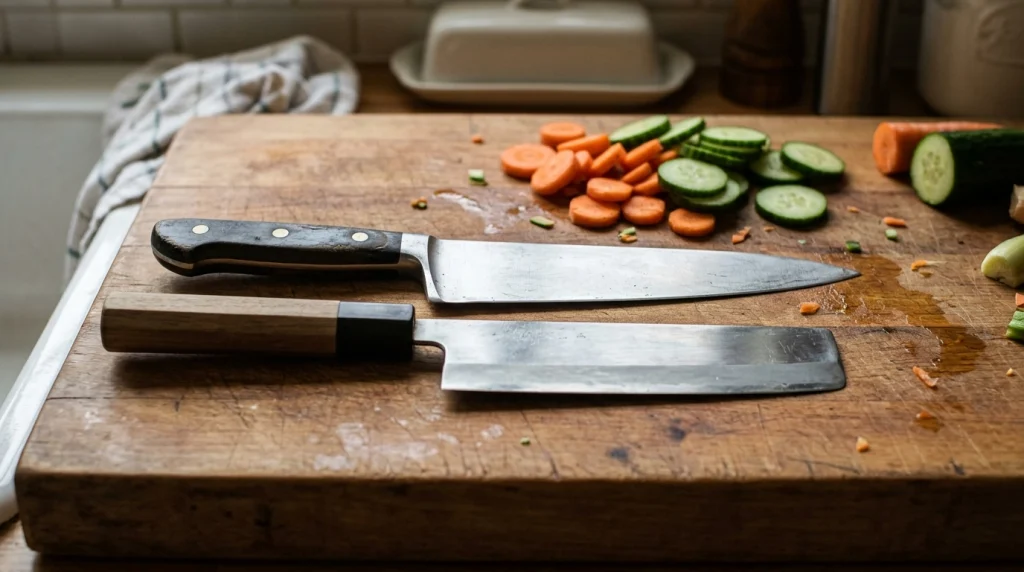
A chef knife is a general-purpose kitchen knife with a pointed tip and a curved cutting edge. A nakiri is a Japanese vegetable knife with a broad, rectangular blade and a nearly straight cutting edge.
The most important difference is the work each knife is designed to handle. A chef knife offers greater versatility, while a nakiri focuses on efficient vegetable preparation.
| Feature | Chef Knife | Nakiri |
|---|---|---|
| Blade shape | Curved edge, pointed tip | Broad, rectangular blade |
| Typical length | About 8 inches, with shorter and longer options | Often around 6–7 inches |
| Cutting edge | Curved or gently curved | Relatively flat |
| Tip | Pointed | Usually squared off |
| Main purpose | General food preparation | Vegetable preparation |
| Preferred motion | Rocking, slicing, push cutting | Straight chopping and push cutting |
| Meat preparation | Suitable for boneless meat and trimming | Not the preferred choice |
| Best as a first knife | Usually yes | Best for vegetable-focused cooks |
These are general design characteristics, not universal specifications. Exact blade length, weight, edge curvature, steel, and balance vary by manufacturer and model.
What Is a Chef Knife Best Used For?
A chef knife is designed to handle a broad range of kitchen tasks with one tool. Its curved edge, pointed tip, and balanced blade make it useful for everyday preparation.
It is a practical starting point if you prepare different ingredients throughout the week rather than concentrating on vegetables alone.
1. Chopping and slicing vegetables
A chef knife handles onions, carrots, bell peppers, potatoes, cabbage, and many other vegetables. Its curved edge allows you to use a rocking motion when chopping smaller ingredients.
You can also make straight push cuts. The best motion depends on the blade profile, the ingredient, and your cutting habits.
2. Mincing herbs and garlic
The curved edge of many chef knives makes repeated rocking cuts convenient. This works well for parsley, cilantro, garlic, and other ingredients that need fine chopping.
Keep the knife tip near the board during a controlled rocking motion. Avoid swinging the blade aggressively or placing your fingers beneath its edge.
3. Preparing boneless meat and fish
A chef knife can slice boneless chicken, trim fat, divide portions, and cut cooked meat. Its pointed tip also helps with small, controlled cuts that require precision.
For delicate filleting, removing bones, or cutting through joints, a specialized knife may work better. A standard chef knife is not a substitute for a proper boning knife or cleaver.
4. Handling mixed kitchen tasks
The biggest advantage of a chef knife is that it can move from one ingredient to another without requiring a different blade for every task. That makes it useful for meal preparation, from chopping vegetables to slicing cooked protein.
If you are building a small kitchen setup, a comfortable, sharp chef knife is often the most practical first purchase.
What Is a Nakiri Knife Best Used For?
A nakiri is a Japanese-style vegetable knife designed for chopping, slicing, and dicing produce. Its broad blade and relatively flat edge support controlled cuts that bring much of the cutting edge into contact with the board.
Unlike a traditional chef knife, a nakiri does not rely on a pronounced curved edge or pointed tip. Its design favors direct, vertical cutting motions.
1. Slicing carrots, cucumbers, and radishes
A nakiri can make consistent rounds or strips from firm vegetables. Its straight cutting profile is particularly useful when you want repeated slices with a similar thickness.
For example, you can cut a cucumber into even rounds using controlled downward strokes. The result still depends on your technique, blade sharpness, and the way you position the ingredient.
2. Chopping cabbage and leafy greens
The wide blade and straight edge work well for chopping cabbage, slicing leafy greens, and preparing vegetables for salads or stir-fries. The broad blade can also help transfer chopped ingredients from the board to a bowl.
Use the blade’s side to move food gently, but avoid scraping the cutting edge sideways across the board. That habit can dull or damage the edge over time.
3. Dicing onions and root vegetables
A nakiri is useful for dicing onions, carrots, potatoes, and similar produce. Its relatively flat edge can make full contact with the board across more of the blade than a strongly curved knife.
That contact is especially helpful when cutting firm vegetables into cubes or thin strips. You still need a stable cutting board and a controlled grip.
4. Preparing vegetables in larger quantities
If vegetables make up most of your cooking, a nakiri can become a comfortable everyday tool. Its specialized profile suits repeated chopping and slicing without requiring a rocking motion.
However, a nakiri is not automatically faster for every cook. Someone who prefers rocking cuts may find a curved chef knife more natural, even when preparing mostly vegetables.
Is a Nakiri Better Than a Chef Knife for Vegetables?
A nakiri can be better for straight-down vegetable chopping, especially when preparing large quantities of produce. A chef knife remains highly capable and may be more convenient if you switch between rocking, slicing, and other cutting motions.
The distinction is about blade geometry and personal technique, not a guarantee that one knife will always produce better results.
- Choose a nakiri for repeated vertical cuts, thin vegetable slices, and consistent chopping across a broad range of produce.
- Choose a chef knife if you frequently mince herbs with a rocking motion or alternate between vegetables, meat, and other ingredients.
- Consider your cutting board because a stable, suitable surface affects control and cutting consistency with either knife.
For most home cooks, a sharp chef knife can handle everyday vegetable preparation without difficulty. A nakiri becomes more appealing when its flatter profile matches the way you prefer to work.
Can You Use a Nakiri for Meat and Fish?
A nakiri can physically cut some boneless meat or fish, but vegetables remain its intended specialty. Its broad blade, squared tip, and relatively flat edge are less suited to tasks that benefit from a pointed tip or specialized slicing geometry.
For regular mixed-ingredient cooking, a chef knife is usually the more practical choice.
When a nakiri may work
- Cutting small portions of boneless, tender meat when the blade and manufacturer guidance permit it.
- Slicing soft, boneless ingredients with a controlled downward or push-cut motion.
- Preparing vegetables alongside separately handled meat and fish.
When to choose another knife
- Bone-in meat: Use appropriate butchery tools instead of forcing a thin kitchen knife through bones.
- Fish filleting: A flexible or specialized fillet knife offers better control around bones and skin.
- Precision trimming: A pointed chef knife or utility knife is generally more convenient.
- Hard, dense ingredients: Follow the manufacturer’s guidance and avoid twisting or prying with a thin blade.
A knife’s ability to cut an ingredient does not mean it is the safest or most suitable tool for the task. Using the right blade reduces unnecessary force and helps protect the edge.
Which Knife Is Easier for Beginners?
A chef knife is generally the better first knife because it covers more kitchen tasks. A nakiri can also be beginner-friendly, especially for someone who prefers straightforward chopping and prepares mostly vegetables.
Neither knife is inherently safe simply because of its shape. Both require a secure grip, a stable board, and controlled movements.
| Beginner’s Priority | Better Starting Point | Reason |
|---|---|---|
| One knife for most meals | Chef knife | Handles vegetables, boneless meat, and herbs. |
| Mostly vegetable preparation | Nakiri | Its straight edge supports direct chopping. |
| Frequent rocking cuts | Chef knife | Its curved edge supports this motion. |
| Consistent vertical cuts | Nakiri | Its flatter profile supports board contact. |
Before choosing, hold the knife if possible. Check whether the handle feels secure, the weight is comfortable, and the blade length gives you enough clearance on your cutting board.
Do Chef Knives and Nakiri Knives Need Different Care?
Both knives need regular cleaning, careful storage, and periodic sharpening. The main differences in maintenance come from the steel, blade geometry, edge construction, and the manufacturer’s recommendations.
Cleaning and drying
Wash either knife according to the manufacturer’s instructions and dry it promptly. Avoid leaving a knife soaking in a sink, where moisture, other utensils, and accidental contact can damage the blade or cause injury.
Handwashing is a sensible default for quality kitchen knives unless the manufacturer explicitly states otherwise. Dishwasher heat, detergents, and movement can damage edges and handles.
Sharpening the edge
A sharp edge helps a knife cut with less unnecessary pressure. Use a sharpening method suited to the knife’s steel and edge geometry, and follow the manufacturer’s guidance if the blade has a specialized grind.
Do not assume that every Japanese-style knife needs the same sharpening angle. Nakiris commonly have double-beveled edges, but individual models differ.
Choosing a cutting board
Use a stable cutting board made from a suitable material, such as wood or an appropriate plastic. Avoid cutting directly on glass, stone, ceramic, or other hard surfaces that can damage the edge.
Never twist a thin blade sideways while it is embedded in a dense ingredient. This is especially important when using a vegetable knife with a relatively thin edge.
Storing the knife safely
- Use a knife block, blade guard, or suitable magnetic storage system.
- Keep the blade away from loose utensils and unprotected drawers.
- Store the knife dry and out of children’s reach.
- Keep the cutting board from sliding by using a suitable non-slip base.
For further practical guidance, consult the KYOCERA knife skills and safety guide and the CUTCO knife care guide.
Should You Buy Both a Chef Knife and a Nakiri?
Buying both can make sense if you cook frequently and want a dedicated knife for vegetables alongside a versatile general-purpose blade. You do not need both to prepare good meals, though.
The right choice depends on how often you cook, what you prepare, and whether the second knife offers a meaningful improvement over your existing setup.
- Buy a chef knife first if you own few kitchen knives or regularly prepare mixed ingredients.
- Add a nakiri if you chop substantial amounts of vegetables and prefer straight cutting motions.
- Keep one knife if your current chef knife is comfortable, sharp, and suitable for your usual meals.
For example, someone preparing salads, stir-fries, and vegetable-heavy meals every day may appreciate a nakiri’s specialized shape. Someone cooking chicken, vegetables, herbs, and occasional roasts will usually benefit more from a versatile chef knife.
The goal is not to collect more knives. It is to choose tools that make your regular cooking tasks easier and more controlled.
Chef Knife vs Nakiri: What Should You Buy in 2026?
In 2026, the basic decision remains the same: match the knife to your cutting habits rather than buying based on its country of origin or appearance. A well-made, comfortable knife that suits your technique is more useful than an expensive blade that feels awkward.
Before purchasing, compare these practical details:
- Blade length: Choose a size that fits your hands, ingredients, and cutting board.
- Handle comfort: Check the grip, balance, and overall control.
- Steel and care: Consider corrosion resistance, sharpening needs, and your willingness to maintain the blade.
- Edge profile: Choose a curve for rocking cuts or a flatter edge for straight chopping.
- Budget: Prioritize comfortable handling, reliable construction, and a suitable edge over decorative finishes.
Neither a premium steel nor a particular knife shape guarantees better results. Cutting technique, edge condition, and comfort have a major effect on day-to-day performance.
Product Recommendations: Chef Knives and Nakiri Knives
 Save
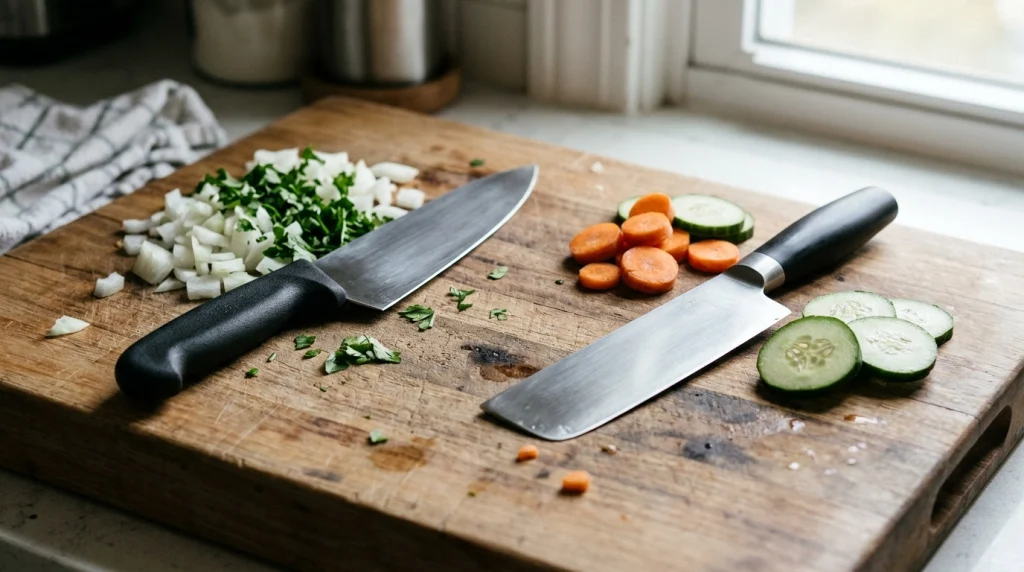
If you are ready to compare specific models, start with one versatile chef knife and one dedicated vegetable knife. The following are established models worth investigating, not products claimed to have been personally tested for this article.
🏆 Versatile Everyday Option
Victorinox Fibrox Pro 8-Inch Chef’s Knife
This general-purpose chef knife is worth considering for chopping vegetables, mincing herbs, and preparing boneless meat. Compare the handle feel, blade length, and current specifications before choosing it for your kitchen.
🥬 Dedicated Vegetable Knife
ZWILLING Four Star Nakiri
This Japanese-style vegetable knife is designed for controlled chopping and precise produce preparation. Check the exact model’s dimensions, price, and care instructions before buying.
These recommendations represent different priorities rather than a universal ranking. Current prices, availability, ratings, and exact specifications should be checked on the retailer’s listing before purchase.
Frequently Asked Questions
Is a nakiri sharper than a chef knife?
Not necessarily. Sharpness depends on the edge condition, sharpening, steel, and blade geometry rather than the knife’s name alone. A well-maintained chef knife can be just as sharp as a nakiri, although their different shapes may produce different cutting experiences.
Can a nakiri replace a chef knife?
A nakiri can replace a chef knife for someone whose cooking mainly involves vegetables. However, its squared tip and specialized blade shape make it less convenient for some meat preparation, trimming, and pointed-tip tasks. A chef knife is generally the better single-knife choice for mixed cooking.
Is a nakiri the same as a vegetable cleaver?
No. Although a nakiri has a broad, rectangular blade, it is a vegetable knife rather than a heavy-duty cleaver. Many nakiris have relatively thin edges intended for slicing and chopping produce. They should not be used to split bones or perform heavy chopping.
Which knife is better for cutting onions?
Both knives work well for onions. A chef knife suits cooks who prefer rocking cuts, while a nakiri supports straight-down chopping and repeated vertical slices. Choose the knife that gives you better control and feels comfortable during repeated cuts.
Should I buy a chef knife or nakiri first?
For most home cooks, a chef knife is the better first purchase because it handles a wider range of ingredients and cutting tasks. Choose a nakiri first only if you primarily prepare vegetables and prefer its flatter blade profile. You can add the other knife later if your cooking habits justify it.
Final Verdict: Chef Knife or Nakiri?
A chef knife is the stronger all-around choice for most kitchens because it handles vegetables, herbs, boneless meat, and many everyday cutting tasks. Its curved edge and pointed tip provide flexibility across different ingredients and techniques.
A nakiri is the more specialized option for cooks who spend much of their time preparing vegetables. Its broad, relatively flat blade makes straight chopping and consistent slicing comfortable when the knife suits your technique.
My recommendation: Start with a chef knife if you need one dependable kitchen knife. Choose a nakiri if vegetable preparation is your main focus, or add one when your existing chef knife no longer matches the way you prefer to cut.
The best knife is the one you can handle confidently, maintain properly, and use safely for the food you prepare most often.

