Flat Grind Chef Knife: Geometry, Benefits & Usage Guide
Quick Answer
A flat grind chef knife features a blade with a primary bevel that tapers smoothly and flatly from the spine straight down to the cutting edge, without a secondary bevel hump or convex belly. This geometry provides exceptional slicing performance and minimal food wedge resistance, making it ideal for precise, clean cuts in professional and home kitchens.
What Is a Flat Grind Chef Knife?
A flat grind chef knife is defined entirely by its cross-sectional blade geometry. Unlike blades with convex grinds (which curve outward like a traditional German chef knife) or hollow grinds (which curve inward to create a lightweight hollow road), a flat grind tapers in a straight, uninterrupted line from the thick spine down to the apex of the edge.
This blade profile creates a thin, highly efficient cross-section. Because the side of the blade presents a flat plane rather than a rounded shoulder, it encounters less friction when moving through dense ingredients like root vegetables, hard cheeses, and dense squashes.
Understanding this geometry helps home cooks and culinary professionals choose the right knife for specific prep tasks, as blade grind directly influences cutting feel, food release, and sharpening maintenance.
How Flat Grinds Compare to Other Kitchen Knife Grinds
 Save
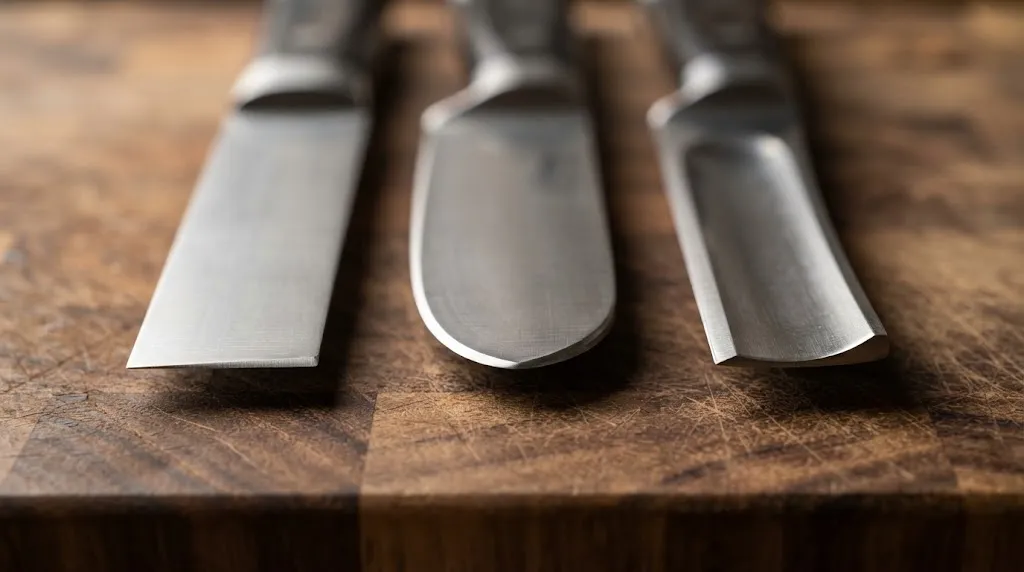
Knife geometry dictates how a blade interacts with food. To appreciate why a flat grind performs the way it does, it helps to compare it directly against the other two most common blade grinds found in kitchen cutlery.
Flat Grind vs. Convex Grind
A convex grind curves outward toward the edge, resembling an apple seed profile. This shape adds structural steel behind the edge, making the blade exceptionally durable and robust. Heavy-duty German chef knives often use a partial convex or robust V-grind to withstand twisting, heavy impacts, and rocking cuts on dense bones.
In contrast, a flat grind trades a small amount of that heavy-duty wedge durability for significantly enhanced slicing efficiency. Because the flat taper is thinner behind the edge, it slides through ingredients with less downward force.
Flat Grind vs. Hollow Grind
A hollow grind uses a grinding wheel to scoop out a concave depression on each side of the blade, resulting in an extremely thin, laser-like edge commonly found on santoku knives or specialized slicers. While hollow grinds cut effortlessly through soft items, the shoulder left behind the hollow can sometimes cause the blade to wedge or bind in thick, hard items like sweet potatoes.
A flat grind strikes a balanced middle ground: it maintains more structural stability than a hollow grind while offering superior slicing ease compared to a thick convex grind.
Key Insight
Blade grind determines how food behaves upon contact. Flat grinds minimize lateral friction, preventing dense food from binding against the side of the blade during long vertical cuts.
Key Benefits of Using a Flat Grind Chef Knife
Choosing a flat grind chef knife impacts everyday kitchen workflows in several distinct ways. Cooks who prioritize clean technique and effortless prep often gravitate toward this geometry.
- Reduced Wedging Resistance: The flat plane reduces friction, preventing the blade from getting stuck halfway through hard produce.
- Enhanced Precision Slicing: Thin geometry allows for paper-thin slices of meats, vegetables, and garnishes without tearing delicate cellular structures.
- Consistent Performance: As the knife is sharpened over time, a properly executed flat grind maintains a stable behind-the-edge thickness much longer than heavy convex profiles.
- Clean Food Release: While not completely non-stick, flat surfaces often release sliced food more cleanly than deeply indented hollow grinds that create suction pockets.
Potential Limitations and Drawbacks
No single knife geometry excels at every kitchen task. Flat grind chef knives come with specific trade-offs that every buyer should consider before adding one to their knife block.
- Lower Lateral Strength: Because the blade tapers thinly toward the edge, prying, twisting, or cutting through frozen foods can cause chipping or micro-fractures.
- Food Sticking: Flat, smooth steel surfaces can cause moist items like potatoes or cucumbers to cling to the side of the blade via surface tension.
- Sharpening Technique Required: Maintaining a flat primary bevel on whetstones requires steady muscle memory to ensure the entire flat surface rests correctly against the abrasive stone.
Warning
Never use a thin flat-grind chef knife to chop through bone, frozen items, or dense hard squash rinds by striking the spine with a mallet. The fine steel geometry is optimized for clean cutting pressure, not heavy impact chopping.
How to Maintain and Sharpen a Flat Grind Knife
 Save
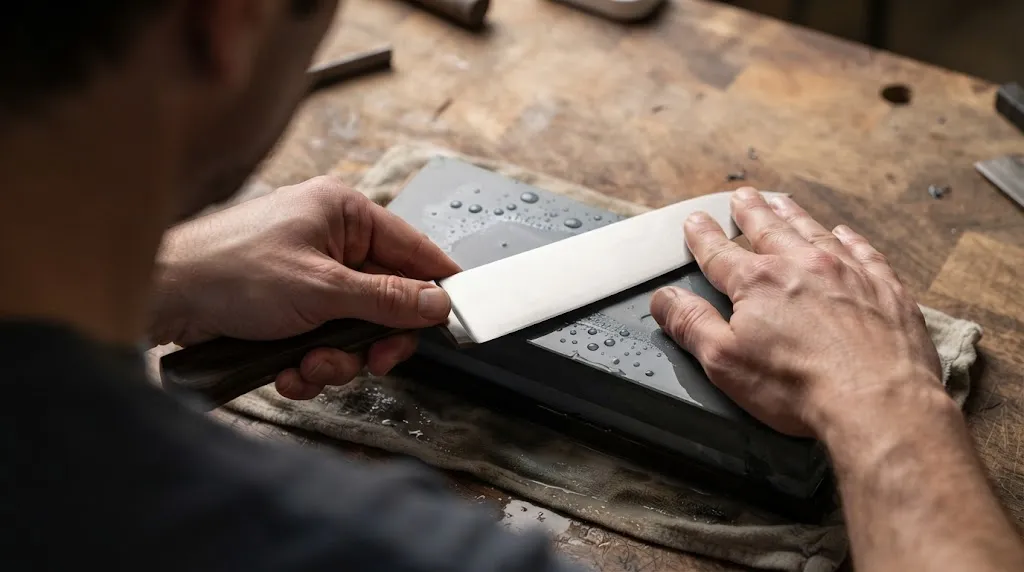
Proper maintenance ensures that a flat grind chef knife retains its slicing efficiency over years of regular use. Because the bevel is completely flat, the sharpening process differs slightly from rounded or convex edges.
When sharpening on whetstones, lay the flat primary bevel flush against the stone rather than guessing an arbitrary angle. This preserves the original factory geometry and keeps the blade thin behind the edge.
Regular honing on a fine ceramic rod or smooth steel realigns microscopic edge rolling between sharpening sessions. Always store the knife in a wooden block, on a magnetic strip, or inside a protective edge guard to prevent accidental impact damage to the thin apex.
Tip
Wash your flat grind chef knife immediately after use with mild soap and warm water, then dry it completely with a soft towel. Leaving moisture on high-carbon or premium stainless steels can cause pitting or staining along the flat bevel.
Who Should Choose a Flat Grind Chef Knife?
A flat grind chef knife suits cooks who value precision, clean push-cuts, and effortless slicing performance above all else. It is an exceptional choice for home cooks, culinary students, and vegetable-forward prep chefs who spend considerable time slicing onions, bell peppers, herbs, and boneless proteins.
Conversely, cooks who frequently process whole poultry, hack through small bones, or prefer a heavy, rugged chopper that tolerates rough kitchen treatment may find a thicker, convex-ground utility or German-style knife better suited to their habits.
Related Product
Kitchen Knife Sharpening Stone Set
A dual-grit whetstone helps maintain the precise flat bevel geometry required for optimal slicing performance and edge retention.
As an Amazon Associate, we earn from qualifying purchases.
Frequently Asked Questions
What is the main advantage of a flat grind chef knife?
The primary advantage is reduced cutting friction. Because the sides taper flatly without bulging shoulders, the blade slices through dense food smoothly without binding or wedging.
Are flat grind knives harder to sharpen?
They require a steady hand to maintain proper contact angle on a whetstone, but many sharpeners find them easier than convex edges because the flat surface provides a natural guide against the stone.
Can I use a flat grind chef knife for rocking cuts?
You can perform light rocking cuts, but flat grinds are primarily optimized for push-cuts, pull-cuts, and chopper-style vertical slicing due to their flatter edge profile.
Do flat grind chef knives chip easily?
They can be more susceptible to chipping than thick convex blades if twisted in hard materials or used on bones, because the steel behind the edge is thinner.
Is a flat grind better than a hollow grind for everyday cooking?
It depends on personal preference. Flat grinds offer greater durability and versatility for general kitchen prep, whereas hollow grinds excel mainly at thin slicing of boneless ingredients.
How can I tell if my chef knife has a flat grind?
Look closely at the cross-section of the blade from the spine down to the edge. If the sides form a straight, flat V-shape without curving inward or outward, it is a flat grind.
Conclusion
A flat grind chef knife offers an ideal balance of cutting efficiency, geometry stability, and versatile performance for everyday kitchen tasks. By understanding how its straight taper reduces friction and enhances slicing precision, you can decide whether this blade profile fits your cooking style. Proper care, correct cutting technique, and sensible maintenance will ensure your flat grind knife remains a reliable, high-performing tool for years to come.

