Can You Use a Chef Knife to Cut Meat? Cuts, Limits & Safety
Quick Answer
Yes, you can use a chef knife to cut almost any boneless raw or cooked meat, including chicken breasts, steaks, roasts, and pork chops. However, a chef knife should never be used to hack through dense mammalian bones, split frozen meat blocks, or carve paper-thin slices of large roasts, as these tasks risk chipping, rolling, or permanently cracking the fine bevel of the blade.
A standard 8-inch chef knife serves as the primary workhorse in culinary prep, engineered with a balanced balance of blade height, curve, and taper. When processing proteins, home cooks frequently reach for this single tool to handle trimming, dicing, portioning, and slicing.
While the knife excels across a broad spectrum of butchery tasks, its edge geometry imposes distinct mechanical boundaries. Understanding what a chef knife handles effortlessly—and where specialized cutlery must step in—protects both your culinary results and the longevity of your cutlery.
What Meat Prep Tasks a Chef Knife Handles Well
A standard Western or Japanese-style chef knife manages the vast majority of day-to-day meat fabrication tasks. Because the blade profile tapers from a sturdy spine down to an acute cutting edge, it provides both structural stability and slicing precision.
When working with boneless proteins, the heel, belly, and tip of the knife perform complementary functions:
- Portioning whole boneless cuts: Dividing beef tenderloins, trimming pork loins into cutlets, or halving boneless chicken thighs into uniform strips.
- Cubing stew meat: Chopping chuck roast or pork shoulder into clean, square bite-sized portions without tearing the muscle fibers.
- Trimming surface connective tissue: Using the acute tip to glide beneath silverskin and excess exterior fat caps without gouging usable muscle tissue.
- Slicing resting steaks: Gliding through medium-rare flank steak, ribeye, or flat iron across the grain to optimize tenderness prior to plating.
- Dicing cooked poultry: Chopping poached, roasted, or grilled chicken breasts cleanly for salads, fillings, or quick stir-fry assemblies.
The gentle curve or “belly” along the forward half of a Western-style chef knife allows for a smooth rocking motion during uniform dicing, while the flatter profile of a French-style or gyuto blade facilitates clean, single-draw push cuts through dense proteins.
The Hard Limits: When You Must Never Use a Chef Knife
Using a chef knife outside its mechanical design parameters leads to edge degradation, chipped bevels, or severe slippage. The cutting bevel of a quality culinary knife is honed to an angle between 15 and 20 degrees per side, creating an apex only a few microns wide that cannot tolerate high-impact lateral twisting or extreme resistance.
Warning
Never strike a chef knife against beef, pork, or lamb bones, and never strike the spine with a mallet. Hard bone exerts counter-pressure that exceeds the tensile yield strength of hardened steel, resulting in immediate micro-chipping or catastrophic blade fracture.
Three specific preparations demand that you set the chef knife aside immediately:
- Chopping dense mammalian bones: Beef marrow bones, ham shanks, and pork ribs require a dedicated heavy cleaver with a thick wedge geometry (typically ground at 25 to 30 degrees) designed to absorb high percussive impact without deforming.
- Dividing frozen meat blocks: Deeply frozen muscle tissue forms a rigid, crystal-dense matrix comparable to hard wood. Forcing a fine blade into sub-zero meat creates extreme lateral friction, snapping fragile hard-tempered steels or permanently bowing softer alloys.
- Prying frozen patties or joints apart: Using the tip of a chef knife as a wedge or lever introduces torsional stress. Thin knife tips lack lateral flexibility and snap off under minimal torque.
Chef Knife vs. Specialized Meat Knives
 Save
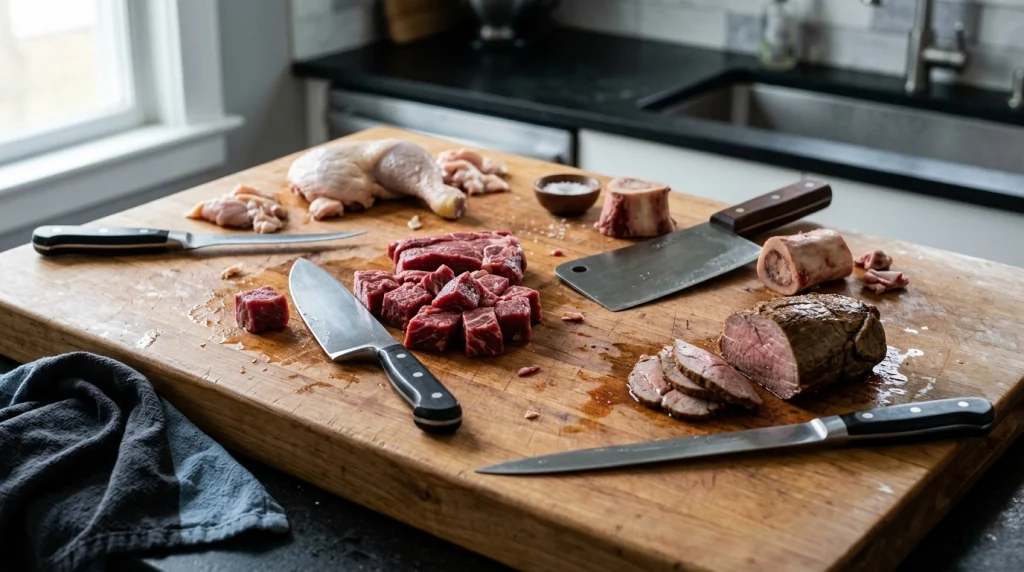
SaveSelecting the right blade depends entirely on the anatomical structure of the cut you are preparing. While a chef knife covers general ground, dedicated butcher knives optimize safety and speed across specialized operations.
| Knife Type | Primary Purpose | Blade Profile | Can a Chef Knife Replace It? |
|---|---|---|---|
| Chef Knife | General prep, dicing, boneless slicing | Broad blade, 8–10 in, curved belly | Baseline standard tool |
| Boning Knife | Working around joints, ribs, and cartilage | Narrow, stiff or flexible, 5–6 in | Partially; clumsy in tight cavities |
| Meat Cleaver | Splitting bone, heavy chopping, cartilage | Heavy rectangular blade, steep bevel | No; chef knife will chip or shatter |
| Carving/Slicing Knife | Single-stroke slices of roasts and hams | Long, narrow blade, 10–14 in | Yes for small roasts; poor on large hams |
The comparative data shows clear operational boundaries: while a chef knife handles general portioning seamlessly, it cannot match the tight maneuverability of a boning knife around internal poultry frames, nor can it provide the single-stroke clean pass of a long slicing knife across an expansive prime rib roast.
Cutting Technique: Raw Meat vs. Cooked Meat
Processing raw meat requires a fundamentally different cutting motion than portioning cooked proteins. Raw animal muscle is elastomeric and spongy, whereas cooked muscle exhibits set, coagulated protein strands that separate cleanly under tension.
Working With Raw Meat
Avoid pressing straight down into raw poultry or beef. Downward crushing force compresses the pliable muscle tissue, squeezing out moisture and creating jagged, uneven edges. Instead, place the heel of the chef knife on the cut and execute a long, smooth slicing draw backwards, letting the acute edge part the connective tissue.
For fine dicing or ultra-thin slicing intended for stir-fries, chill the raw meat in the freezer for 15 to 20 minutes before cutting. This short chill firms the external lipid layers and hardens free water within the muscle fibers without freezing the core solid, providing the blade with sufficient structural resistance to achieve paper-thin slices.
Carving Cooked Roasts and Steaks
When slicing cooked roasts, always allow the meat to rest so internal juices redistribute evenly. Slicing immediately after removing protein from heat sources creates hydrostatic internal pressure that purges liquid out onto your cutting surface, leaving the meat fibrous and dry.
Examine the grain orientation before making a single cut. Muscle tissue runs in parallel fibrous bundles; positioning your chef knife perpendicular to these bundles cuts the fibers short, drastically reducing the bite force required to chew the finished portion.
Key Insight
Blade height determines surface friction. The wide flank of an 8-inch chef knife creates surface drag against dense, warm cooked roasts. If you notice the meat tearing or accordioning as the knife passes through, wipe surface fat from the blade sides and execute continuous drawing passes rather than downward chops.
Deboning Poultry: How Far Can a Chef Knife Go?
Home cooks frequently wonder if they need a dedicated boning knife to break down a whole raw chicken. A standard chef knife can break down whole poultry completely, provided you articulate the joints rather than cutting through calcified bone.
When removing leg quarters, wings, or breasts, use your free hand to hyperextend the joint until the white cartilage ball pops from the socket. Guide the tip of the chef knife directly through the tendon gap between the bone ends. The knife cleanly severs cartilage and soft tendons without encountering the hard skeletal framework.
However, when trimming intricate breast cages or deboning small game like quail or rabbit, the tall heel of a chef knife obscures your direct line of sight. For delicate seam butchery requiring your blade to hug rib curves closely, a narrow, flexible boning knife remains noticeably superior.
Board Selection and Cross-Contamination Safety
Cutting raw proteins introduces microbiological risks that dictate specific board hygiene and material choices. Selecting an improper cutting surface also dulls an acute chef knife faster than the meat itself.
Hard end-grain wood cutting boards or high-density food-grade polyethylene boards are optimal surfaces. Hard materials like glass, granite, marble, and ceramic plates possess compressive hardness values far greater than steel; cutting meat on these surfaces dulls or rolls your knife apex in just a few passes.
To eliminate cross-contamination risks during prep sessions, follow these foundational kitchen protocols:
- Dedicate board surfaces: Use separate, non-porous color-coded plastic boards exclusively for raw poultry and red meats, reserving end-grain wooden boards for cooked meats, bread, and produce.
- Sanitize immediately: Wash both the chef knife and board with hot water and dish soap immediately after fabricating raw protein. Never let raw meat juices dry along the knife bolster or handle joints.
- Avoid dishwasher exposure: Never place a quality chef knife in the dishwasher. High-heat drying cycles expand wooden handles, weaken synthetic resin rivets, and expose the tempered edge to caustic alkaline detergents that chemically pit fine steel.
Maintaining Your Edge After Heavy Meat Prep
 Save
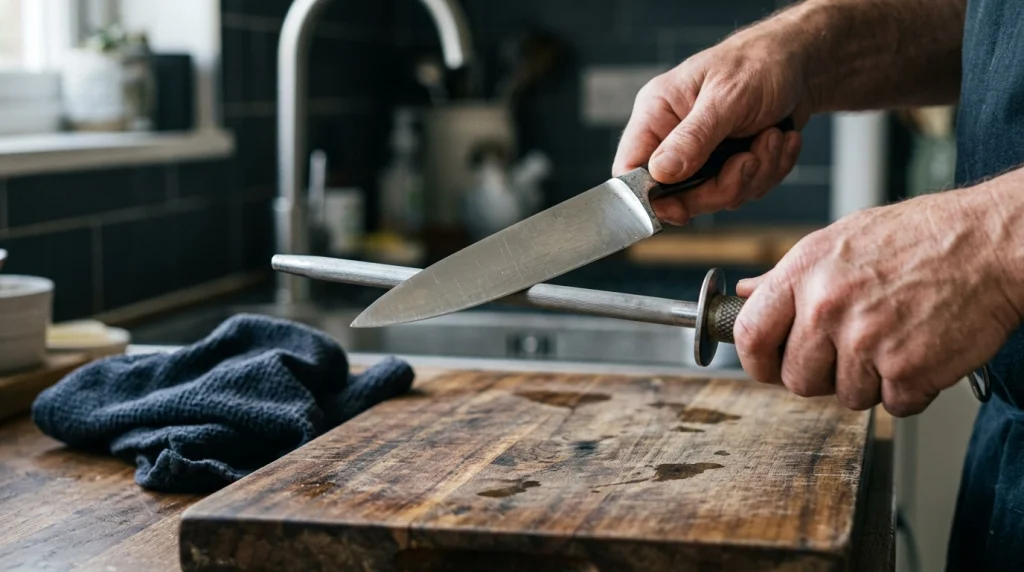
SaveAnimal proteins contain varying amounts of firm fat, fibrous connective tissue, and dense collagen. While these tissues do not chip a blade like bone does, processing high volumes of meat causes the thin apex of the edge to shift, micro-roll, or accumulate greasy residue.
A smooth or lightly grooved honing steel should be used before and after extensive fabrication sessions. Holding the blade at its factory angle (typically 15 to 20 degrees), swipe the edge along the steel 4 to 5 times per side. Honing does not grind away metal; it pushes microscopic rolled sections back into vertical alignment, restoring effortless slicing aggression.
Tip
If your chef knife begins sliding or skidding across the tough exterior skin of pork belly or raw chicken, stop cutting. A dull blade forcing its way through greasy connective tissue requires dangerous downward muscle pressure, drastically increasing the likelihood of slipping and cutting your guiding hand.
When regular honing no longer restores clean cutting action across tomato skins or raw connective tissue, the edge requires abrasive stone sharpening. Sharpening on a dual-grit synthetic water stone restores the secondary bevel and re-establishes a razor-sharp profile suited for dense meat cuts.
Related Product
Dual-Grit Whetstone Sharpening Kit
Keep your chef knife razor-sharp and maintain correct edge angles after intensive meat preparation sessions with a balanced water stone.
As an Amazon Associate, we earn from qualifying purchases.
Frequently Asked Questions
Can you cut through small chicken bones with a chef knife?
You can cut through soft poultry cartilage and tiny wing tips using the heel of a heavy Western-style chef knife, but you should never chop directly into thick leg bones or dense backs. Striking hard chicken bones can easily chip Japanese hard-steel knives or roll the acute edge of standard cutlery.
Is an 8-inch or 10-inch chef knife better for slicing meat?
An 8-inch chef knife offers maximum agility for general kitchen tasks like trimming fat caps and portioning poultry. A 10-inch blade provides a longer continuous cutting edge, making it superior for slicing broad cooked roasts, briskets, and prime rib in a single clean drawing stroke.
Can you use a Santoku knife instead of a chef knife for meat?
A Santoku knife cuts boneless meat exceptionally well, especially when dicing or slicing raw beef and chicken into strips. However, its straighter edge profile requires up-and-down push cuts rather than rocking cuts, and its thinner, harder steel makes it even more susceptible to chipping on bone contact.
Why does raw meat stick to the side of my chef knife?
Raw muscle tissue contains surface moisture, natural fats, and proteins that form a tight vacuum against the broad, flat flank of a chef knife. Knives featuring a granton edge (scalloped dimples ground into the blade face) introduce small air pockets that help raw slices release cleanly from the steel.
Should raw meat be room temperature before cutting with a chef knife?
No, raw meat is substantially easier and safer to cut when thoroughly cold. Warm meat softens and deforms under the blade, resulting in ragged, uneven portions, whereas cold, firm proteins hold their shape against the edge for clean, uniform cuts.
Does raw meat dull a chef knife faster than vegetables?
Meat tissue itself is softer than rigid vegetables like root carrots or winter squash and does not accelerate edge wear on its own. However, repeated forceful contact with the underlying cutting board, accidental bone strikes, and sliding through dense, tough tendons will gradually roll and degrade the blade apex over time.
Conclusion
A quality chef knife is fully capable of handling the vast majority of everyday meat preparation, from portioning boneless steaks to breaking down poultry at natural joint junctions. As long as you respect the physical limitations of its acute edge by avoiding frozen blocks and dense mammalian bones, your knife will deliver clean, precise cuts without premature dulling. Pair proper drawing slice techniques with regular honing on a steel and a resilient cutting board, and your chef knife will remain your most reliable tool across all everyday protein prep.