Can You Use a Chef Knife to Cut Chicken? Safety & Cut Guide
Quick Answer
Yes, you can use a chef knife to cut chicken, but only for boneless meat, trimming skin or fat, and slicing cleanly through soft joint cartilage. Never use a standard chef knife to hack or chop directly through hard, dense bones like leg or thigh bones, as the thin edge will chip, dull, or slip and cause injury.
A standard 8-inch chef knife is the most versatile cutting tool in your kitchen, and it handles the vast majority of chicken prep effortlessly. Whether you are slicing boneless chicken breasts into tender strips, dicing thighs for a stir-fry, or separating whole birds at their connective joints, a sharp chef knife gives you clean control.
However, chicken anatomy presents a major hazard: hard poultry bone. Misunderstanding what a chef knife can safely slice versus what demands a heavy cleaver is the primary reason kitchen blades chip and home cooks suffer accidental slips.
What Chicken Cuts a Chef Knife Can Safely Handle
 Save
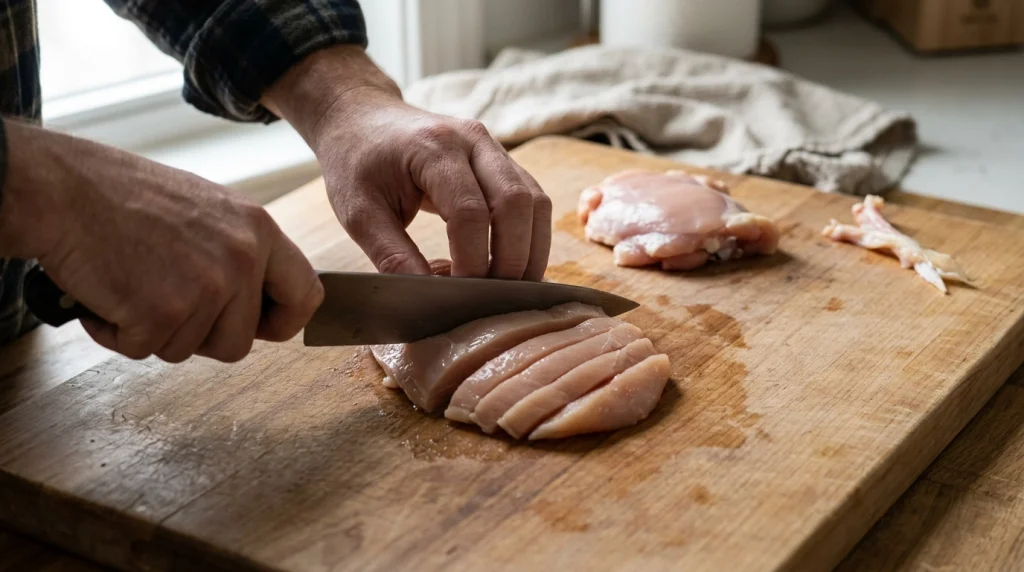
SaveA chef knife is engineered for slicing, rocking, and gliding motions rather than high-impact chopping. Its blade geometry tapers down to an acute edge—typically ground to an angle of 15 to 20 degrees per side—which easily parts soft muscle tissue.
You can confidently reach for your chef knife when preparing the following cuts:
- Boneless, skinless breasts: Slicing cutlets, butterflying, cubing, or stripping raw chicken breast requires a long, clean stroke that a chef knife executes smoothly.
- Boneless thighs: Trimming excess surface fat, removing skin pockets, and portioning dense thigh meat.
- Trimming tenders and tendons: Sliding the sharp edge alongside white connective tendons to remove them cleanly.
- Dividing quarters through connective cartilage: Severing leg quarters from the carcass by separating the ball-and-socket joint, where the blade glides through soft cartilage instead of dense bone.
- Splitting cooked poultry: Carving roasted or poached chicken along natural muscle boundaries, provided you steer clear of rigid internal frames.
Because chicken tissue contains slippery surface moisture and connective fibers, using a chef knife with adequate blade length lets you complete cuts in single, continuous drawing motions rather than sawing back and forth.
Why You Should Never Chop Chicken Bones With a Chef Knife
The boundary where a chef knife fails is hard, calcified bone. Attempting to force a chef knife directly through a chicken drumstick, split a thick thigh bone, or hack through the breastbone will almost certainly damage your cutlery.
Chef knife blades are hardened to maintain an ultra-keen cutting edge across soft vegetables, herbs, and boneless proteins. High steel hardness, however, increases brittleness along the microscopic edge. When an acute blade encounters dense, tubular bone, the steel cannot flex or absorb the blunt resistance.
Warning
Never strike or mallet the spine of your chef knife to push it through poultry bone. Forcing the blade causes severe micro-chipping, rolling of the apex, or catastrophic edge snapping, while increasing the risk of the blade deflecting into your guide hand.
Beyond blade ruin, chopping bone with a slicing knife creates an immediate physical safety hazard. Bones have cylindrical, slick surfaces. A fine edge that fails to bite into the bone immediately deflects sideways, causing sudden slipping across your cutting board.
Chef Knife vs. Alternative Tools for Prepping Chicken
Professional butchers and seasoned home cooks match the specific tool to the physical resistance of the task. Understanding where a chef knife fits among other butchering cutlery prevents unnecessary wear on your gear.
| Tool Type | Best Used For | Bone Capability | Blade Characteristics |
|---|---|---|---|
| Chef Knife | Portioning boneless meat, dicing, trimming fat, finding open joints | Soft cartilage only; no hard bone | Broad, 8–10 inch blade, acute 15–20° edge |
| Meat Cleaver | Splitting whole carcasses, hacking through ribs and drumsticks | Cuts directly through heavy bone | Thick spine, heavy mass, durable blunt angle (25–30°) |
| Boning Knife | Scraping meat tight against carcasses, working around intricate joints | Navigates around bone; does not cut bone | Narrow, semi-flexible, needle-sharp tip |
| Poultry Shears | Spatchcocking, removing backbones, clipping wing tips | Crushes and cuts rib bones and cartilage | Spring-loaded handles, thick notched steel jaws |
If you regularly break down whole chickens, combining an 8-inch chef knife with a dedicated set of heavy shears provides maximum control without exposing your main culinary blade to structural risk.
How to Safely Cut Down a Whole Chicken With a Chef Knife
You can break down an entire whole chicken into eight distinct culinary cuts—breasts, thighs, drumsticks, and wings—using nothing more than a chef knife, provided you trace natural anatomical seams.
Key Insight
Butchering poultry cleanly with a chef knife is a game of anatomy, not leverage. Every major limb connects to the body through a soft cartilage joint. If you feel rigid resistance, stop pushing—reposition your blade tip a few millimeters to slide through the joint space.
Follow these sequential anatomical steps to break down a bird safely:
- Remove the leg quarters: Pull the leg away from the carcass to stretch the taut skin between the thigh and breast. Slice through the skin only. Bend the leg backward until the hip ball pops free from its socket. Slide the flat of your chef knife behind the ball joint and slice down through the release point to detach the quarter completely.
- Separate the drumstick from the thigh: Lay the leg quarter skin-side down on your board. Locate the thin white line of fat running crosswise across the knee joint. Position your chef knife directly over that line, resting the blade parallel to the seam. Press smoothly straight down; the blade will glide cleanly through the cartilage disk without striking bone.
- Detach the wings: Pull each wing outward from the torso to expose the shoulder junction. Slice through the skin and tendon over the top of the joint, flex the wing downward until the joint ball reveals itself, and drop your knife straight through the soft gap.
- Remove the breasts from the carcass: Set the chicken upright on its tail end or flat on its back. Run the tip of your chef knife along one side of the central keel bone from top to bottom. Using short, smooth strokes, peel the breast meat outward while gliding the edge flush against the rib cage until the whole breast releases.
Essential Hygiene and Safety Protocols for Raw Poultry
Handling raw poultry introduces microscopic pathogen risks that require deliberate board discipline. The USDA Food Safety and Inspection Service guidance on chicken safety highlights cross-contamination from raw meat fluids as a leading domestic kitchen hazard.
Maintain these food safety rules whenever cutting chicken with your chef knife:
- Use a dedicated, stable cutting surface: Work on non-porous plastic, composite, or dense hardwood cutting boards. Never cut raw chicken on slick stone, glass, or marble, which simultaneously dulls your knife edge and allows raw meat juices to spill freely. Place a damp cloth under your board to eliminate wobbling.
- Establish a one-direction hygiene barrier: Keep raw chicken prep isolated from ready-to-eat vegetables, garnishes, and cooked foods. Wash your hands thoroughly with soap and warm water for at least 20 seconds immediately after touching raw poultry tissue.
- Wash cutlery immediately: Do not let raw poultry juice dry onto your knife. Wash the chef knife by hand using hot water, mild dish detergent, and a non-abrasive sponge. Dry the blade completely with a clean towel before placing it back on a magnetic strip or in a sheath.
- Keep knives out of the dishwasher: Dishwashers expose cutlery to harsh abrasive detergents, high thermal expansion, and mechanical vibration against dish racks, which will dull the delicate cutting edge and warp or crack wooden handles.
Tip
If you struggle to slice raw chicken breasts into neat cutlets or thin strips, place the meat in your freezer for 15 to 20 minutes before cutting. Chilling firms the exterior moisture and proteins without freezing the meat solid, giving the chef knife edge firm traction for paper-thin slices.
How to Maintain Your Chef Knife After Cutting Poultry
 Save
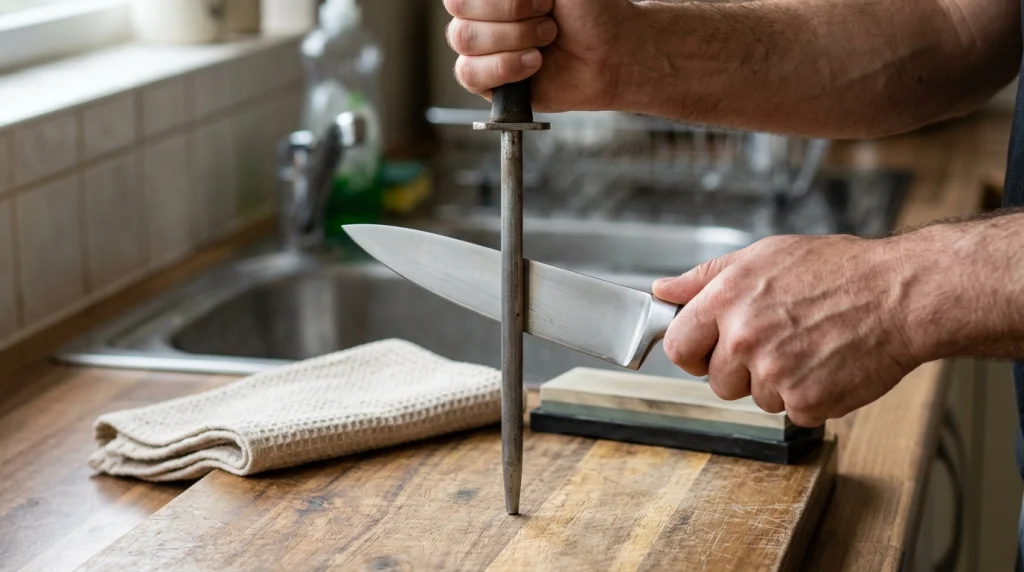
SaveChicken fat, acidic marinades, and repetitive friction against cutting boards gradually degrade your knife edge. Proper post-prep maintenance keeps the blade performing cleanly for your next prep session.
A dull knife requires excessive downward force to penetrate chicken skin, which drastically increases the likelihood of a dangerous slipping accident. Make it a habit to realign the micro-teeth along your blade edge using a honing steel before or after every substantial butchering task.
Hold your honing steel vertically against your counter, tilt your blade to approximately 15 to 20 degrees, and pull the knife downward from heel to tip along the rod four or five times on each side. When light honing no longer produces effortless cuts through raw poultry skin, sharpen the blade on a water stone or precision whetstone to re-establish a pristine primary bevel.
Related Product
Heavy-Duty Poultry Shears
Spring-loaded kitchen shears allow you to cut through tough chicken backbones and cartilage cleanly without risking chips or dullness on your chef knife.
As an Amazon Associate, we earn from qualifying purchases.
Frequently Asked Questions
Can cutting chicken dull your chef knife quickly?
Cutting boneless chicken meat, skin, and soft cartilage will not prematurely dull a quality chef knife. What dulls the blade rapidly is dragging the edge across hard cutting boards, striking dense internal bones, or washing the knife in a high-temperature automatic dishwasher.
Can you use a chef knife to butterfly chicken breast?
Yes, an 8-inch chef knife is ideal for butterflying chicken breast. Place your non-dominant hand flat on top of the breast, position the knife horizontally along the thicker edge, and slice through the center toward the opposite edge, stopping just before cutting through completely so the breast opens like a book.
Is a santoku knife better than a chef knife for chicken?
A santoku knife works just as well as a Western chef knife for boneless chicken cuts and precision dicing. However, a Western chef knife has a pointed tip and curved belly that makes maneuvering around tricky joint sockets and separating whole bird limbs slightly easier.
What should you do if your knife gets stuck in a chicken bone?
Never twist, wrench, or hammer the blade sideways to free it, as lateral torque snaps hard steel edges instantly. Instead, firmly grasp the knife handle with one hand, lift both the chicken and knife together slightly off the board, and gently wiggle the chicken meat away from the blade until it releases.
Can you use a serrated knife to cut raw chicken?
While a serrated knife can saw through slippery raw chicken skin, it tends to shred and tear delicate raw poultry muscle fibers, producing jagged, uneven edges. A sharp, straight-edged chef knife produces much cleaner cuts without bruising the meat.
How do you know if you are cutting through cartilage or bone?
Cartilage offers firm but smooth, rubbery resistance that gives way cleanly under steady knife pressure without creating popping or grinding sounds. Bone feels rock-hard and unyielding; if your blade stops dead and requires chopping force, you are hitting solid bone.
Conclusion
A standard chef knife is fully capable of handling your everyday chicken prep, provided you respect the physical limitations of its cutting edge. Use its length and keen bevel to slice boneless breasts, dice thighs, and separate whole birds cleanly through the soft cartilage of natural joints. Whenever your recipe demands hacking through dense leg bones or cleaving carcasses in half, set the chef knife aside and reach for dedicated poultry shears or a heavy cleaver to protect your cutlery and keep your hands safe.