Can You Use a Chef Knife to Cut Chicken? Explained
Quick Answer
Yes. A sharp chef knife can cut chicken breasts, thighs, wings, and a whole chicken into portions, especially when you cut through natural joints rather than hard bones. For detailed deboning or working closely around the skeleton, a narrow boning knife gives better control. Kitchen shears are also useful for the backbone and other awkward cuts.
A chef knife is versatile enough to handle most everyday chicken preparation. Its broad, sharp blade makes quick work of boneless breasts, thighs, skin, cartilage, and many of the joints you encounter while breaking down a whole bird.
The limitation is bone. A normal chef knife is designed for slicing and controlled cutting, not for repeatedly chopping through thick, hard bones. Knowing where to cut matters more than simply using more force.
What Chicken Cuts Can a Chef Knife Handle?
A chef knife works well for most cuts where the blade passes through meat, skin, cartilage, or a natural joint. That covers considerably more chicken preparation than many home cooks expect.
You can comfortably use one for:
- Cutting boneless chicken breasts into strips, cubes, or cutlets
- Trimming excess skin and fat
- Separating a thigh from a drumstick at the joint
- Removing legs from a whole chicken
- Separating wings at their joints
- Portioning breast meat
- Cutting cooked chicken into serving pieces
The U.S. Department of Veterans Affairs’ Healthy Teaching Kitchen instructions for cutting up a whole poultry bird specifically include a chef knife among the equipment and describe using it to separate leg, wing, and breast portions.
The important detail is that most of these cuts are made through joints or softer connective tissue rather than directly through solid bone.
When a Chef Knife Is Not the Best Choice
A chef knife becomes less convenient when the job requires the blade to trace closely around irregular bones. Its relatively broad blade gives excellent stability on a cutting board, but that width makes tight curves around a chicken carcass harder to follow.
Three situations usually favor another tool.
Removing Meat Closely From Bone
For deboning thighs, following the breastbone, removing the wishbone, or trimming around the rib cage, a boning knife is easier to maneuver.
Its narrower blade and pointed tip can enter small spaces without requiring the wide blade of a chef knife to twist around the skeleton. If this is a task you do regularly, see the guide on how to properly use a boning knife.
Removing the Backbone
Kitchen shears are often more convenient for cutting along both sides of a chicken backbone. They give you mechanical leverage in an area where a chef knife can feel awkward.
You can still use a chef knife for many other parts of the breakdown after the backbone is removed.
Chopping Through Hard Bone
This is where you should be cautious. A standard chef knife is not a substitute for a heavy cleaver designed for bone work.
Striking hard bone with a thin cutting edge can chip, roll, or otherwise damage the edge. More force also makes the knife harder to control.
Warning
Do not swing a normal chef knife into thick chicken bones simply because the blade feels heavy. Find the joint, use kitchen shears where appropriate, or choose a tool specifically designed for heavier bone cutting.
Chef Knife vs Boning Knife for Chicken
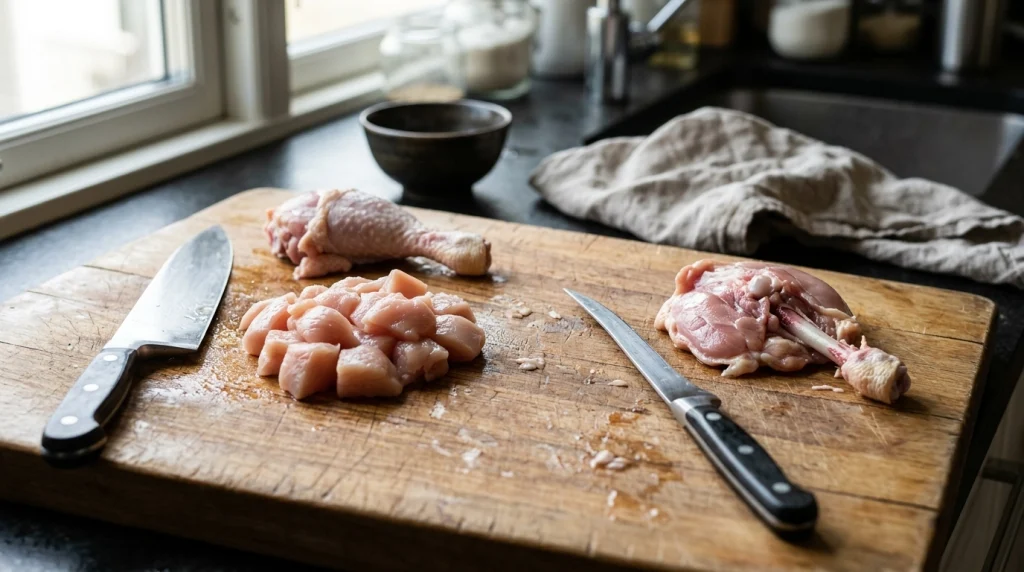 Save
SaveThe better knife depends on what you are actually trying to cut. Neither tool replaces the other completely.
| Task | Chef Knife | Boning Knife |
|---|---|---|
| Cubing breast meat | Excellent | Usable, but unnecessary |
| Separating joints | Very good | Very good |
| Deboning a thigh | Possible | Better control |
| Following the rib cage | Awkward | Well suited |
| General kitchen use | Excellent | Specialized |
If you only occasionally break down chicken, you do not necessarily need to buy another knife. A sharp chef knife plus sturdy kitchen shears can cover most tasks.
If you regularly remove meat from bones, however, the advantages of the specialized blade become more noticeable. The explanation of what a boning knife does differently from other knives covers those close-to-bone tasks in more detail.
How to Cut a Whole Chicken With a Chef Knife
The safest approach is to let the chicken’s anatomy guide the blade. You are looking for spaces between bones rather than trying to overpower the skeleton.
- Place the chicken securely. Put it on a stable cutting board with enough room to turn the bird without reaching awkwardly across the blade.
- Remove a leg. Pull the leg away from the body and cut through the skin where the thigh meets the breast. Bend the leg outward until you can identify the hip joint, then slice through the joint.
- Separate thigh and drumstick. Bend the leg section and locate the joint between the two bones. Cut through the soft joint rather than the ends of the bones.
- Remove the wings. Pull each wing away from the body, locate the joint, and slice through it with controlled pressure.
- Remove or portion the breasts. Depending on the result you want, cut alongside the breastbone to remove boneless breast meat or portion the breast section after the rest of the bird has been separated.
- Use shears when the carcass becomes awkward. If you need to remove the backbone, kitchen shears can be easier to control than forcing a chef knife through the rib and backbone area.
Tip
If the blade suddenly needs much more pressure, stop and reposition it. You may be pressing against bone rather than passing through the joint.
How Sharp Should the Chef Knife Be?
The knife should be sharp enough to cut chicken skin cleanly without repeated sawing or excessive downward pressure.
Chicken skin can expose a dull edge quickly because it tends to stretch instead of separating. A dull blade can also encourage you to compensate with additional force, which reduces control.
Before cutting a whole chicken, make sure the edge is properly sharpened. Honing can realign an edge that is still fundamentally sharp, but a genuinely dull blade needs sharpening.
Sharpness does not mean you should rush. Controlled movements and accurate joint placement matter more than speed.
Keep Raw Chicken From Contaminating Other Food
Knife choice is only one part of safe chicken preparation. Raw poultry can carry harmful microorganisms, so the knife, cutting board, hands, and nearby surfaces need appropriate handling.
The USDA Food Safety and Inspection Service recommends keeping raw poultry and its juices away from foods that will not be cooked and cooking poultry to a safe minimum internal temperature of 165°F.
After cutting raw chicken:
- Wash the knife with hot, soapy water.
- Clean the cutting board before using it for another food.
- Wash your hands after handling the chicken.
- Clean surfaces that contacted raw chicken or its juices.
- Avoid placing cooked chicken back on an unwashed surface that held it raw.
USDA also recommends considering separate cutting boards for raw meat and poultry versus produce and bread. Its cutting-board food-safety guidance explains cleaning and cross-contamination prevention in more detail.
Do You Need a Special Knife Just for Chicken?
 Save
SaveNo. For occasional chicken preparation, a chef knife is usually enough, especially if you are mainly slicing boneless meat or separating a whole chicken into standard pieces.
A specialized knife becomes worthwhile when your goal changes from portioning to precise deboning.
Choose a chef knife when:
- You mainly cut boneless chicken.
- You break a whole bird into basic portions.
- You want one multipurpose kitchen knife.
- You do poultry preparation only occasionally.
Consider a boning knife when:
- You frequently debone thighs or whole chickens.
- You want to remove meat very closely from bones.
- You need better control around joints and the rib cage.
- You regularly trim connective tissue and awkward areas.
If that describes your cooking, the comparison of the best boning knives for chicken can help you understand the blade styles designed specifically for poultry work.
Related Product
Boning Knife for Chicken
A narrow boning knife can make deboning thighs, following the breastbone, and trimming closely around joints easier than using a wide chef knife. It is useful if you prepare bone-in chicken regularly, but it is not required for basic portioning.
As an Amazon Associate, we earn from qualifying purchases.
Frequently Asked Questions
Can a chef knife cut through a chicken joint?
Yes. A sharp chef knife can cut through most chicken joints when the blade is positioned in the soft space between the bones. If you encounter strong resistance, reposition the joint rather than forcing the blade through bone.
Can a chef knife cut chicken bones?
It may cut through very small or softer parts of the carcass, but routinely chopping hard bones with a standard chef knife is not recommended. A heavy cleaver or appropriate poultry shears are better suited to demanding bone work.
Is an 8-inch chef knife good for chicken?
Yes. An 8-inch chef knife provides enough blade length for portioning a whole chicken while remaining manageable for common kitchen tasks. Blade sharpness and control are more important than choosing an exact length.
Is a chef knife or boning knife safer for chicken?
Either can be used safely when sharp and controlled. A chef knife provides stability for general cutting, while a boning knife’s narrower blade can offer better control when working closely around bones and tight joints.
Should I wash chicken before cutting it?
No. USDA does not recommend washing raw poultry because splashing water can spread bacteria to sinks, countertops, utensils, and other foods. Proper cooking, rather than rinsing, is what destroys harmful bacteria.
Should I use a separate cutting board for raw chicken?
Using a separate board for raw poultry is a practical way to reduce cross-contamination. USDA recommends considering one board for raw meat, poultry, and seafood and another for produce and foods that will not be cooked.
The Bottom Line
You can absolutely use a chef knife to cut chicken. For breasts, thighs, wings, portioning, and cutting through properly located joints, it is one of the most useful tools you can have.
The main rule is simple: cut through joints instead of forcing the blade through hard bone. Add kitchen shears for awkward carcass cuts or a boning knife for detailed deboning, and a chef knife can remain your primary tool for most chicken preparation.