5 Best Boning Knife for Chicken in 2026: Clean, Controlled Deboning
Breaking down a whole chicken becomes frustrating when a wide chef’s knife cannot follow the breastbone, joints, and rib cage closely. The right boning knife needs enough control for tight joints while staying narrow enough to trim skin, cartilage, and connective tissue without wasting meat. We compared current manufacturer specifications, blade profiles, grip designs, edge geometry, and poultry suitability rather than claiming hands-on testing we did not perform. By the end, you will know which knife best fits everyday home prep, professional-style processing, flexible trimming, or premium use.
Quick Comparison: All 10 Boning Knives Ranked
| # | Product | Best For | Rating | Badge | |
|---|---|---|---|---|---|
| 1 | Victorinox Fibrox 6″ | Everyday chicken prep | 4.9/5 | Best Overall | View → |
| 2 | Mercer Millennia Curved 6″ | Grip and control | 4.8/5 | Best Grip | View → |
| 3 | Dexter SANI-SAFE 6″ Narrow | High-volume poultry | 4.7/5 | Best Professional | View → |
| 4 | Mercer Ultimate White Curved 6″ | Value-focused kitchens | 4.6/5 | Best Budget | View → |
| 5 | WÜSTHOF Classic 5″ Boning Knife | Premium compact control | 4.6/5 | Best Premium | View → |
| 6 | Cutluxe Artisan Series 6″ | Stiff precise trimming | 4.5/5 | Best Stiff Blade | View → |
| 7 | Dalstrong Gladiator Series 6″ | Full-tang feel | 4.4/5 | Best Full Tang | View → |
| 8 | Mercer Millennia Flexible 6″ | Following curved bones | 4.4/5 | Best Flexible | View → |
| 9 | HOSHANHO 7″ Powder Steel | Long precise slices | 4.3/5 | Best Edge Retention | View → |
| 10 | Dexter SOFGRIP 6″ Narrow Curved | Comfortable long sessions | 4.3/5 | Best Comfort | View → |
How We Chose These Boning Knives
What we evaluated
We compared 10 current knives using manufacturer-listed blade length, profile, hardness where published, handle design, edge geometry, sanitation features, and stated poultry or meat applications. We did not invent physical test results.
Our 3 scoring criteria
Poultry maneuverability measures how naturally the blade profile should work around chicken joints. Grip and control rewards secure handles and manageable dimensions. Edge maintenance considers steel hardness, sharpening angle, and how easily an edge can be restored.
Specification verification
Key specifications were cross-checked against current manufacturer pages where available. Mercer lists 6-inch Japanese-steel boning models at 15-degree blade angles, while Victorinox specifies a 5.9-inch curved blade for its Fibrox model.
What we cut
We excluded broad chef’s knives, heavy cleavers, and long fish-only slicers from the ranking. For chicken, a narrow pointed profile gives better access around the hip joint, wishbone, breastbone, and rib cage than a wide general-purpose blade.
What to Look for When Buying a Boning Knife for Chicken
Chicken looks easy to break down until the blade reaches a tight joint or starts scraping too much meat from the bone. These four factors matter more than decorative finishes or oversized blades.
1. Blade Length and Profile
A blade around 5 to 6 inches gives most cooks enough reach without becoming awkward around a chicken’s compact skeleton. Curved blades help create a useful cutting angle along breast and thigh bones, while a narrow pointed tip can enter joints without forcing the cut. Seven-inch models provide more slicing reach but usually require more deliberate hand control. For whole chickens, maneuverability is normally more useful than raw blade length.
2. Flexibility Versus Stiffness
A moderately stiff blade gives positive feedback when locating the hip or shoulder joint and is easier to control when separating cartilage. More flexible blades excel when shaving meat from curved ribs or sliding beneath skin, but they can feel less predictable when pressure increases. Dexter explicitly sells narrow, flexible, and wide SANI-SAFE variants, showing how different blade feels serve different cutting tasks.
3. Handle Grip and Finger Protection
Raw poultry makes grip design especially important because moisture can quickly reduce friction. Textured synthetic handles such as Victorinox Fibrox, Mercer Santoprene and polypropylene, or Dexter’s slip-resistant designs are practical when control matters more than appearance. A finger guard adds a useful physical stop during repetitive trimming. Handles should also allow pinch, forward, and reverse grips without creating pressure points.
4. Steel, Edge Angle, and Maintenance
Harder steels can retain a fine edge longer, while somewhat softer food-service steels are often faster to touch up. Mercer lists 15-degree edges on several of its boning knives, Cutluxe lists a 14–16-degree edge for its Artisan model, and HOSHANHO publishes a 15-degree edge with high-hardness powder steel on one 7-inch model. A chicken knife benefits from sharpness more than extreme hardness because cartilage contact and occasional bone taps can punish a very thin edge.

Victorinox Fibrox Boning Knife, 6 in — The safest all-round choice
If you want one boning knife that feels appropriately sized for a whole chicken, this is the most balanced starting point. Victorinox lists a 5.9-inch curved blade, 3.4-ounce weight, narrow profile, textured non-slip handle, and Swiss manufacture. The curved edge gives you a useful angle when cutting close to the breastbone or separating thigh meat, while the modest weight should make rapid grip changes less tiring. The main compromise is construction: it is stamped rather than forged, so buyers wanting a heavy, traditional full-tang feel may prefer WÜSTHOF or Cutluxe.
- 5.9-inch curved blade suits compact poultry work.
- 3.4-ounce listed weight supports agile handling.
- Textured Fibrox-style grip prioritizes control.
- Stamped construction lacks the heft some forged-knife buyers prefer.
| Blade | 5.9 in curved |
| Weight | 3.4 oz |
| Forged | No |
| Origin | Switzerland |
9.8/10
9.7/10
9.2/10

Mercer Millennia Curved Boning Knife 6″ — Excellent wet-hand control
If slippery handles bother you during raw-poultry prep, Mercer’s Millennia design puts grip security near the top of the list. The M23820 uses a 6-inch curved high-carbon Japanese-steel blade, a 15-degree edge, 53–54 HRC hardness, Santoprene and polypropylene handle construction, textured finger points, and a protective finger guard. That combination makes it especially sensible for repetitive chicken work where you frequently switch between breastbone, wing, and thigh-joint cuts. Its softer hardness compared with premium Japanese-style blades means it may need more frequent touch-ups, but it is correspondingly straightforward to maintain.
- 6-inch curved profile fits poultry joints well.
- Textured Santoprene grip and finger points improve security.
- 15-degree edge balances sharpness with easy touch-ups.
- 53–54 HRC steel will usually need more frequent honing than harder blades.
| Blade | 6 in curved |
| Steel | Japanese high-carbon |
| Hardness | 53–54 HRC |
| Edge | 15° |
9.6/10
9.8/10
9.4/10

Dexter SANI-SAFE 6″ Narrow — Built around processing work
If you break down poultry frequently and care more about sanitation and repeatable control than polished looks, Dexter’s SANI-SAFE line is an especially practical option. Dexter offers 6-inch narrow and flexible configurations and describes the narrow version as firm and suited to navigating joints, cartilage, and poultry. The blade uses proprietary DEXSTEEL, while the sealed handle construction, slip-resistant grip, finger guard, and NSF certification are aimed squarely at food-processing work. The weakness is aesthetic and ergonomic preference: the commercial handle is functional rather than refined, and cooks who enjoy a heavier forged knife may find it utilitarian.
- 6-inch narrow option is explicitly suited to poultry and joints.
- Slip-resistant handle includes a finger guard.
- NSF-certified, sanitation-focused construction.
- Commercial styling will not appeal to buyers wanting a traditional forged knife.
| Blade option | 6 in narrow |
| Steel | DEXSTEEL |
| Handle | SANI-SAFE |
| Certification | NSF |
9.5/10
9.7/10
9.3/10

Mercer Ultimate White Curved 6″ — Strong value, useful geometry
If you want practical poultry geometry without paying for forged construction or decorative materials, this Mercer is difficult to overlook. The M18180 combines a 6-inch curved blade, high-carbon Japanese steel, 15-degree edge, 56±1 HRC hardness, textured polypropylene handle, protective finger guard, and NSF certification. Compared with the Millennia, the handle is simpler, but the slightly higher listed hardness should support respectable edge retention. The main trade-off is comfort: polypropylene is functional and easy to clean, yet it is less cushioned than Mercer’s Santoprene-equipped Millennia handle.
- 6-inch curved poultry-friendly profile.
- 56±1 HRC gives a useful balance of retention and maintenance.
- Textured handle, finger guard, and NSF certification.
- Handle is less cushioned than Mercer’s Millennia design.
| Blade | 6 in curved |
| Hardness | 56±1 HRC |
| Edge | 15° |
| Handle | Polypropylene |
9.4/10
9.0/10
9.4/10
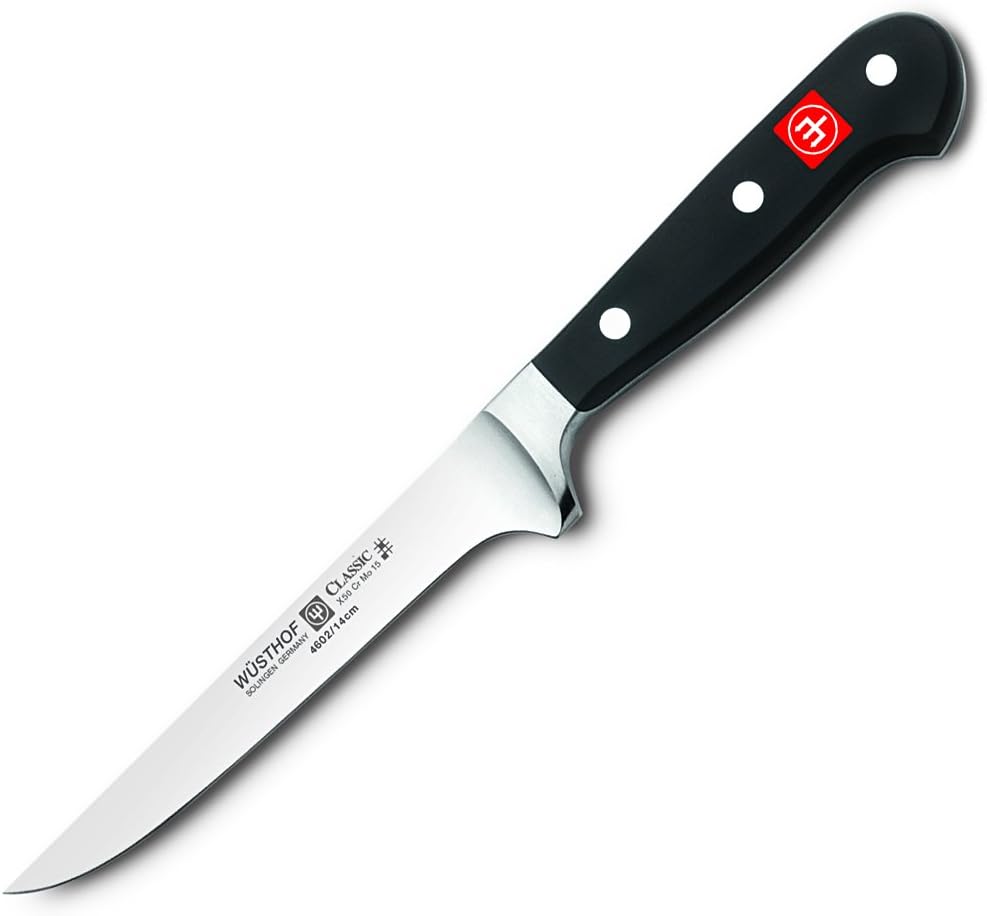
WÜSTHOF Classic 5″ Boning Knife — Compact forged control
If you prefer a forged knife with a substantial traditional handle, WÜSTHOF brings that feel into a compact boning format. The current Classic product page lists forged construction, German origin, 58 HRC hardness, a slim curved profile, and an actual blade measurement of 5.5 inches despite the model’s 5-inch naming. The shorter working length is especially attractive around small poultry joints because less blade extends beyond your immediate cutting area. The trade-off is that this is more knife than many occasional chicken-prep users need; a stamped Victorinox or Mercer offers excellent function with less emphasis on forged heft.
- Compact curved blade works well in tight joints.
- Forged construction offers traditional balance.
- 58 HRC provides stronger edge retention than softer food-service steel.
- Forged weight and premium positioning are unnecessary for occasional use.
| Blade | 5.5 in listed |
| Hardness | 58 HRC |
| Construction | Forged |
| Origin | Germany |