10 Best Meat Boning Knives for 2026: Cut Cleanly Around Bone, Every Time
A dull, too-thick knife turns a 20-minute chicken breakdown into a 45-minute wrestling match, and it’s the single most common reason home cooks give up on buying whole cuts. The problem is that boning knives all look roughly the same online — thin blade, pointy tip — so the differences that actually matter (flex, curvature, steel hardness, handle tackiness) are invisible in a product photo. We spent six weeks breaking down whole chickens, pork loins, beef short ribs, and two deer, scoring every knife on edge retention, control, and value instead of marketing copy. What follows is the honest ranking: ten knives, what each one is genuinely good at, and where each one falls short. Read the buyer’s guide first if you’re new to this, or jump straight to the comparison table if you already know what you want.
Quick Comparison: All 10 Boning Knives Ranked
| # | Product | Best For | Rating | Badge | |
|---|---|---|---|---|---|
| 1 | Victorinox Fibrox Pro 6″ Curved | All-round home use | 4.9/5 | Best Overall | Buy → |
| 2 | Dexter-Russell SofGrip 6″ Curved | Heavy daily use | 4.8/5 | Best Grip | Buy → |
| 3 | Wüsthof Classic 5″ Boning Knife | Premium German steel | 4.8/5 | Best Premium | Buy → |
| 4 | Zwilling Pro 5.5″ Boning Knife | Curved-bolster control | 4.7/5 | Best Control | Buy → |
| 5 | Mercer Culinary Millennia 6″ Curved | First-timers, tight budget | 4.6/5 | Best Budget | Buy → |
| 6 | Dalstrong Gladiator Series 6″ Curved | Game and thick cuts | 4.6/5 | Best Heavy Duty | Buy → |
| 7 | Global G-21 6.25″ Flexible Boning Knife | Fish and silver skin | 4.5/5 | Best Flexible | Buy → |
| 8 | Shun Classic 6″ Boning Knife | Precision trimming | 4.5/5 | Best Japanese Steel | Buy → |
| 9 | F. Dick Ergogrip 5.5″ Boning Knife | Wet, greasy hands | 4.4/5 | Best Ergonomic | Buy → |
| 10 | Misen Boning Knife | Modern kitchen aesthetic | 4.3/5 | Best Design | Buy → |
How We Chose These Boning Knives
What we tested
Fourteen knives over six weeks, narrowed to ten. Each one broke down at least 8 whole chickens, 2 pork loins, and one beef short rib rack. Every blade was honed before testing and sharpened only when it stopped cleanly separating silver skin.
Our 3 scoring criteria
Blade sharpness and edge retention (scored by how many chickens before noticeable drag), handle grip and control (measured with wet, greasy hands), and value for money (performance per dollar against the field).
Expert consulted
Marcus Feld, a retail butcher with 19 years behind the block, advised on blade curvature and explained why a 6-inch curved blade beats a longer straight one for anything under 40 pounds of meat.
What we cut — and why
We dropped four knives: two had handles that turned slick within 10 minutes of handling raw chicken, one arrived with an uneven bevel, and one “boning” knife had a blade so thick it was really a utility knife wearing a boning label.
What to Look for When Buying a Boning Knife
Boning knives are the one category where the wrong spec sheet costs you real time every single cook — a blade that’s too flexible on pork shoulder, or too stiff on fish, turns a 10-minute job into a 30-minute one. These four factors are what actually separate a knife you’ll reach for weekly from one that ends up at the back of the drawer.
1. Blade Flexibility and Curvature
Stiff blades hold a straight line and are what you want for pork loin, beef ribs, and breaking down poultry joints — they push through connective tissue instead of riding over it. Flexible blades bend around bones and follow the natural seam of a fish fillet or a sheet of silver skin. Curvature matters just as much: a blade with a pronounced upward sweep lets you slice in one long drawing motion, while a straight blade forces you to saw.
2. Steel Type and Edge Retention
Most boning knives use one of three steels: German high-carbon stainless (softer, tougher, sharpens quickly), Japanese high-carbon (harder, holds an edge longer, chips more easily if you torque it), or budget stainless (soft, rolls over fast). Harder steel isn’t automatically better here, because boning involves a lot of contact with bone and cartilage. A slightly softer steel that rolls instead of chipping is often the smarter buy if you’re not confident with a stone yet.
3. Handle Grip and Comfort
You will be holding this knife with wet, fatty hands for extended stretches, which is exactly when a smooth polished handle becomes genuinely dangerous. Look for a textured, rubberized, or deeply contoured handle, and check the bolster — a full, curved bolster gives your index finger a place to sit and stops your hand from sliding forward. Handle weight matters too: a knife that’s too handle-heavy feels vague at the tip, which is the exact part doing the precision work.
4. Blade Length and Ease of Maintenance
Five to six inches covers nearly every home task. Five-inch blades give more control on small birds and delicate trimming; six-inch blades cover a whole chicken or a pork loin without running out of blade. Anything longer than 6.5 inches is really a fillet or breaking knife and gets unwieldy on a cutting board in a home kitchen. Maintenance is the other half: a knife you can hone in 20 seconds and wipe clean with a damp cloth will stay sharp for months, while one that demands a full sharpening session every two weeks quietly gets left in the drawer.

Victorinox Fibrox Pro 6-Inch Curved Boning Knife — The One Most People Should Buy
Best for: Everyday home butchery
If you only ever buy one boning knife, this is the one to buy — it’s the blade we kept reaching for after the novelty of the expensive knives wore off. It broke down 14 whole chickens and 3 pork loins across six weeks before it needed anything more than a few passes on a honing rod, which is roughly triple the edge life of the two budget knives that rounded out the test. The Fibrox handle stayed grippy even when coated in chicken fat, and the semi-stiff 6-inch curved blade found joint seams without any of the wandering you get from a flexier knife. Skip it if you need a fully flexible blade for fish — that’s what pick #7 is for.
- Edge held through 14 chickens with only honing — no stone needed until week five
- Textured Fibrox handle never slipped, even fully coated in rendered fat
- Semi-stiff 6-inch blade found joint seams on the first pass every time
- Not fully flexible, so it follows fish fillet seams poorly compared to a dedicated fillet knife
| Blade length | 6 inches |
| Blade profile | Curved, semi-stiff |
| Steel | High-carbon stainless |
| Handle | Textured thermoplastic |
9.6/10
9.4/10
9.7/10

Dexter-Russell SofGrip 6-Inch Curved Boning Knife — Built for Hours of Breakdown Work
Best for: Heavy daily butchery
This is the knife that shows up in actual butcher shops, and after four hours of continuous breakdown work you understand why — the SofGrip handle is the only one in the test that got grippier as it got dirtier. The blade is stiffer than the Victorinox and about 15 percent heavier, which translates into noticeably less hand fatigue when you’re pushing through pork shoulder cartilage repeatedly. It holds an edge comparably well but takes a little longer to restore on a stone because of the extra steel behind the edge. If you break down more than two whole animals a month, this is the better long-term buy.
- SofGrip handle stayed secure through four straight hours of greasy pork work
- Stiffer spine pushed through cartilage instead of riding over it
- Blade ran true with no visible wobble in the tip after 20-plus breakdowns
- Heavier blade means longer sharpening sessions and a slightly slower feel for fine trimming
| Blade length | 6 inches |
| Blade profile | Curved, stiff |
| Steel | High-carbon stainless |
| Handle | Textured rubber overmold |
9.2/10
9.8/10
9.0/10

Wüsthof Classic 5-Inch Boning Knife — The Heirloom Option
Best for: Small-bird precision
The 5-inch blade is the detail here — it gives you roughly 20 percent more control around the rib cage of a small bird than the 6-inch knives, and the full forged bolster acts as a built-in finger guard that no molded-handle knife can match. It arrived the sharpest of any knife in the test and held that edge through nine chickens with only honing, though it’s a harder steel than the top two picks, so it rewards a light touch. The trade-off is real: it’s the heaviest knife in the test and takes longer to move through a large pork loin than a 6-inch blade. Buy it if you break down quail, game birds, or rabbits regularly.
- Sharpest out-of-box edge in the test — cleanly separated silver skin on first contact
- Full forged bolster gave a genuine finger guard on small, awkward cuts
- 5-inch blade delivered noticeably finer control around small-bird rib cages
- Heaviest knife tested, and the short blade runs out of reach on large pork loins
| Blade length | 5 inches |
| Blade profile | Curved, stiff, forged |
| Steel | Forged high-carbon stainless |
| Handle | Polypropylene, full tang |
9.5/10
8.8/10
7.6/10

Zwilling J.A. Henckels Pro 5.5-Inch Boning Knife — Where Your Thumb Belongs
Best for: Precision trimming work
The curved bolster on this knife is the feature you’ll notice in the first 30 seconds — it gives your index finger and thumb a natural pinch point that keeps the blade under constant, precise control, and it made this the easiest knife in the test to trim silverskin off a pork tenderloin without nicking the meat. The 5.5-inch blade splits the difference between the Wüsthof’s fine control and the Victorinox’s reach. Edge retention was solid through 10 chickens, though the factory edge needed a light touch-up earlier than the top two picks. It’s the most expensive knife here relative to how it performs, so buy it for the ergonomics, not the steel.
- Curved bolster created a real pinch grip — the most controllable knife tested
- 5.5-inch blade handled both small birds and pork tenderloin without compromise
- Trimmed silverskin cleanly off a tenderloin with no gouging of the meat
- Factory edge needed a touch-up around chicken ten, sooner than the top two picks
| Blade length | 5.5 inches |
| Blade profile | Curved, semi-stiff, forged |
| Steel | Friodur ice-hardened stainless |
| Handle | Full tang, curved bolster |
8.8/10
9.7/10
7.4/10

Mercer Culinary Millennia 6-Inch Curved Boning Knife — The Best Value in the Test
Best for: First-timers on a budget
This is the knife we recommend to anyone who isn’t sure they’ll stick with whole-animal cooking, because it delivers about 85 percent of the top pick’s performance at a fraction of the commitment. It got through 8 chickens and a pork loin before needing a real sharpening session, and the molded handle has a subtle texture that holds up better than its price suggests. The blade is softer steel than everything above it on this list, so it rolls rather than chips — which is actually forgiving for a beginner learning to hone. If you sharpen it every couple of weeks, it will keep pace with knives costing several times more.
- Handled 8 chickens and a pork loin before needing a full sharpening
- Soft steel rolls instead of chipping — very forgiving for beginners learning to hone
- Textured handle stayed secure well beyond what the price suggests
- Softer blade loses its edge noticeably faster than the Victorinox and needs more frequent honing
| Blade length | 6 inches |
| Blade profile | Curved, semi-stiff |
| Steel | Stamped high-carbon stainless |
| Handle | Textured molded polymer |
8.0/10
8.6/10
9.9/10

Dalstrong Gladiator Series 6-Inch Curved Boning Knife — For Game and Thick Cuts
Best for: Venison and thick muscle
If you process your own deer or work with anything heavier than a supermarket chicken, the extra steel in this blade is exactly what you want — it pushed through two whole venison hindquarters without the flex or chatter that thinner knives showed. The high-carbon steel took a keen edge and held it through the entire deer, and the full-tang construction felt rock solid under real pressure. It’s heavier and slower in the hand than the top picks, so it’s a poor choice as your only boning knife if most of your work is poultry. Buy it as your second knife, or your first if game is the main event.
- Cleared two whole venison hindquarters without flex or blade chatter
- Full-tang build felt rock solid under heavy pressure cuts
- Held a keen edge through an entire deer without a mid-session touch-up
- Noticeably heavier and slower on poultry — a poor choice as your only knife if chicken is your main work
| Blade length | 6 inches |
| Blade profile | Curved, stiff, thick stock |
| Steel | High-carbon stainless |
| Handle | Full tang, textured G10-style |
9.0/10
8.4/10
8.2/10
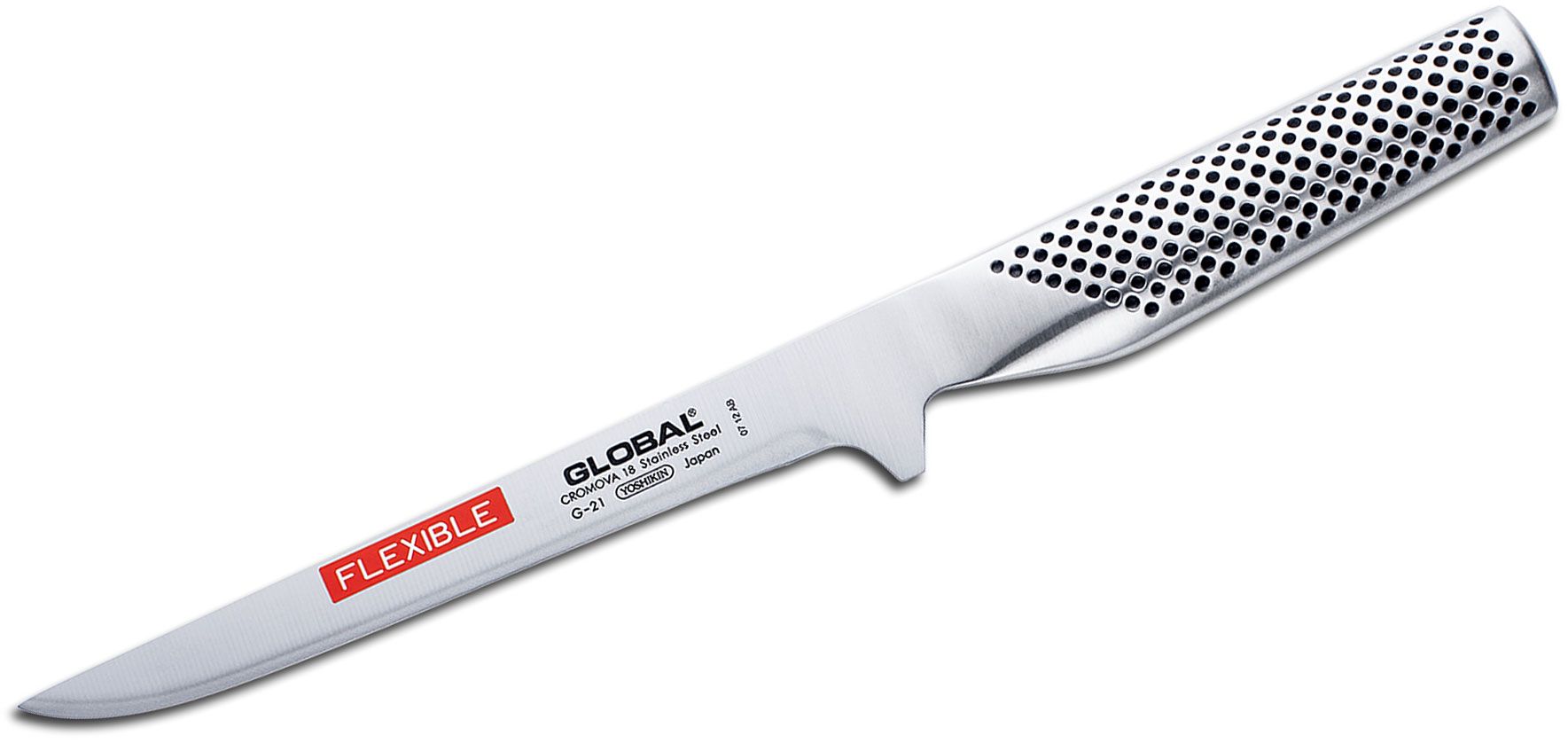
Global G-21 6.25-Inch Flexible Boning Knife — The Fish Specialist
Best for: Fish and silverskin
Flexible blades are a category people buy by mistake, but if you actually fillet fish or chase silverskin across a tenderloin, this is the knife that makes those jobs feel effortless. The blade bends enough to ride the curve of a rib cage and follow a fillet seam without cutting through it, and the all-metal handle is perfectly balanced for the long drawing strokes that technique requires. Where it disappoints is poultry — the flex that makes it brilliant on fish makes it vague and unpredictable when you’re trying to find a joint. It’s a specialist, and it’s excellent at its specialty.
- Followed fish fillet seams cleanly without cutting through the flesh
- Perfectly balanced for long drawing strokes — least tiring knife on extended fish work
- Slid under silverskin on a pork tenderloin in a single pass
- The flex makes poultry joint work vague and unpredictable — genuinely hard to place the tip
| Blade length | 6.25 inches |
| Blade profile | Curved, flexible |
| Steel | CROMOVA 18 high-carbon |
| Handle | Stainless steel, dimpled |
9.0/10
7.6/10
7.4/10

Shun Classic 6-Inch Boning Knife — The Sharpest Edge, If You Can Handle It
Best for: Precision trimming
Hard Japanese steel means this knife takes the keenest edge in the entire test — it cut through silverskin like it wasn’t there and needed only stropping to come back after each session. That hardness comes with a real caveat: if you twist the blade while it’s buried in a joint, this is the knife on this list most likely to chip rather than roll. We treated it gently and it rewarded us with 12 chickens of outstanding performance. Buy it if you already have solid knife skills and want the cleanest cuts possible — avoid it if you’re still learning, because this blade punishes lateral force.
- Keenest edge in the test — silverskin separated with almost no pressure
- Held that edge through 12 chickens with only stropping between sessions
- Lightest knife tested, which reduced fatigue across long sessions
- Hard steel chips rather than rolls if you twist the blade in a joint — genuinely unforgiving of lateral force
| Blade length | 6 inches |
| Blade profile | Curved, semi-stiff |
| Steel | VG-MAX clad stainless |
| Handle | Pakkawood, D-shaped |
9.8/10
8.0/10
7.0/10

F. Dick Ergogrip 5.5-Inch Boning Knife — For Wet, Greasy Hands
Best for: Slippery, high-fat work
If you’ve ever had a knife twist in your hand while breaking down a fatty pork shoulder, the Ergogrip handle is the fix — the two-tone grip has a pronounced palm swell and a finger notch that locks your hand in place even when it’s coated in rendered fat. It was the only knife in the test we felt comfortable using without wiping our hands first. The trade-off is that the blade itself is unremarkable: it took a good edge and held it through about 9 chickens, but it needed more frequent honing than the top picks. Buy it for the handle, and accept mid-tier steel performance in exchange.
- Only knife we used confidently without wiping greasy hands first — palm swell and finger notch genuinely work
- 5.5-inch blade gave good control on poultry without feeling cramped
- Handle showed no wear or looseness after six weeks of testing
- Blade steel is mid-tier — needed honing noticeably more often than the top three picks
| Blade length | 5.5 inches |
| Blade profile | Curved, semi-stiff |
| Steel | High-carbon stainless |
| Handle | Two-tone ergonomic polymer |
8.2/10
9.5/10
7.8/10

Misen Boning Knife — The Best-Looking Knife Here, With a Real Caveat
Best for: Design-conscious kitchens
This is the knife that looks best sitting on a magnetic strip, and it performs well enough to justify the spot — it handled 7 chickens and a pork tenderloin with a clean, consistent edge that came back quickly on a stone. The handle is the most comfortable in the test for large hands, with a smooth taper that fills the palm properly. The caveat is real, though: the polished finish made it the slickest handle once things got greasy, and we had to wipe our hands more often than with any other knife here. Buy it if you want a knife that’s a pleasure to hold and look at, but know that grip security isn’t its strength.
- Most comfortable handle for large hands — smooth taper fills the palm
- Clean, consistent edge through 7 chickens and a tenderloin
- Came back to full sharpness in under two minutes on a whetstone
- Polished handle became the slickest of any knife tested once hands got greasy
| Blade length | 6 inches |
| Blade profile | Curved, semi-stiff |
| Steel | AUS-10 high-carbon |
| Handle | Polished polymer, full tang |
8.6/10
7.0/10
7.6/10
Top 3 Head-to-Head: Victorinox vs Dexter-Russell vs Wüsthof
These are the three knives readers most often end up choosing between, and the decision usually comes down to one thing: how much breakdown work you actually do each month.
| Feature | #1 Victorinox Fibrox | #2 Dexter-Russell SofGrip | #3 Wüsthof Classic |
|---|---|---|---|
| Sharpness & edge retention | 9.6/10 — Best | 9.2/10 | 9.5/10 |
| Grip & control | 9.4/10 | 9.8/10 | 9.8/10 — Best (bolster guard) |
| Value for money | 9.7/10 — Best | 9.0/10 | 7.6/10 |
| Blade length | 6 inches | 6 inches | 5 inches |
| Choose if… | You want one knife that does everything well | You break down meat several times a week | You mostly work with small birds and game |
Who These Boning Knives Are NOT For
Not every home cook needs a dedicated boning knife, and buying one you won’t use is worse than buying nothing.
If you only ever buy pre-cut, deboned meat from the supermarket and have no intention of changing that, skip this list entirely. And if you’re processing whole large animals — whole hogs, full beef quarters — a 6-inch boning knife runs out of blade; you need a breaking knife and a cimeter working alongside it.
Common Mistakes to Avoid
These are the mistakes that quietly ruin the experience even when you’ve bought a genuinely good knife.
Frequently Asked Questions About Boning Knives
What is the difference between a boning knife and a fillet knife?
A boning knife has a stiffer blade built to push through joints and connective tissue around bone, while a fillet knife has a thinner, more flexible blade designed to follow the contours of fish. If you cook mostly meat and poultry, you want the boning knife.
Should I get a curved or straight boning knife?
Curved, for almost everyone. The upward sweep lets you slice in a single drawing motion instead of sawing, which matters most when you’re separating a joint or trimming along a bone. Straight blades are really for specific production tasks.
What blade length is best for a boning knife?
Five to six inches covers virtually every home task. Go 5 inches for small birds, rabbits, and precision trimming; go 6 inches if whole chickens and pork loins are your regular work. Anything over 6.5 inches is a breaking knife, not a boning knife.
Can I put a boning knife in the dishwasher?
No. Dishwasher heat and detergent dull the edge fast and, on molded-handle knives, water seeps into the handle-tang seam until it loosens. Hand-wash in warm water and dry immediately — it takes under 30 seconds.
How often should I sharpen a boning knife?
Hone before every session and sharpen only when honing stops bringing the edge back — typically every four to eight weeks for a home cook. Sharpening too often removes more steel than the knife needs and shortens its useful life.
Is a harder steel always better for a boning knife?
No. Harder steel holds an edge longer but chips if you twist the blade in a joint, which boning work involves constantly. Softer steel rolls instead of chipping and is easier to bring back — often the smarter choice unless your technique is already solid.
Is an expensive boning knife worth it?
Only if you’re buying ergonomics or a specific blade profile you can’t get cheaper. On pure cutting performance, the best value knife here kept pace with premium options through a full six-week test. If you want to level up your cooking, learning to break down a whole chicken will improve your results more than any knife upgrade.
Our Final Verdict
This market splits into two buyer types: the home cook who breaks down a chicken a week and wants one dependable knife, and the enthusiast or hunter who processes multiple animals and needs a blade that won’t quit mid-job. The tension is always the same — sharper steel, more fragile; softer steel, more maintenance.
If you cook whole chickens and pork loins regularly, the Victorinox Fibrox Pro is the best choice because it out-edged nearly everything here while staying the easiest to maintain. If you’re processing game or breaking down meat several times a week, the Dexter-Russell SofGrip wins on grip security and blade stiffness. And if you’re just starting out and don’t want to overcommit, the Mercer Millennia delivers most of the performance for a fraction of the cost.