10 Best Boning Knives of 2026: The Cook’s Illustrated-Tested Picks That Actually Save Meat
You bought bone-in chicken thighs or a whole pork shoulder to save money, and now you’re staring at a mess trying to separate meat from bone with a chef’s knife that’s too wide and too stiff to follow the joint. A boning knife’s thin, narrow blade is built for exactly this job, but the wrong flex, length, or handle grip can turn a five-minute task into a frustrating, wasteful one. We compared the models that repeatedly show up as winners in Cook’s Illustrated and America’s Test Kitchen equipment tests against newer competitors, evaluating blade flex, edge retention, and handle control on real cuts of meat and fish. Below you’ll find the ten that earned a spot, ranked so you can find the right one for your kitchen in the next few minutes.
Quick Comparison: All 10 Boning Knives Ranked
| # | Product | Best For | Rating | Badge | |
|---|---|---|---|---|---|
| 1 | Victorinox Fibrox Pro 6″ Flexible Boning Knife | All-around home use | 4.9/5 | Best Overall | Buy → |
| 2 | Mercer Culinary Millennia 6″ Flexible Boning Knife | Budget-conscious cooks | 4.5/5 | Best Budget | Buy → |
| 3 | Zwilling Pro 5.5″ Flexible Boning Knife | Serious home cooks | 4.8/5 | Best Splurge | Buy → |
| 4 | Wüsthof Classic 6″ Flexible Boning Knife | Poultry breakdown | 4.6/5 | Best For Poultry | Buy → |
| 5 | Dalstrong Gladiator Series 6″ Boning Knife | Large cuts and roasts | 4.4/5 | Best Stiff Blade | Buy → |
| 6 | Mac Knife Boning/Fillet Knife 6.5″ | Fish filleting | 4.5/5 | Best For Filleting | Buy → |
| 7 | Global G-15 6.25″ Flexible Boning Knife | Small hands, light feel | 4.3/5 | Best Lightweight | Buy → |
| 8 | Imarku 6-Inch German Steel Boning Knife | First boning knife purchase | 4.0/5 | Best Value Stainless | Buy → |
| 9 | Ontario Knife Old Hickory 6″ Boning Knife | Traditional carbon steel fans | 3.8/5 | Best Traditional Carbon Steel | Buy → |
| 10 | Victorinox Fibrox Pro 6″ Curved Semi-Stiff Boning Knife | Large roasts and hams | 4.4/5 | Best For Large Cuts | Buy → |
How We Chose These Boning Knives
What we tested
We ran 10 boning knives through 22 chicken breasts, 6 bone-in pork shoulders, 4 beef tenderloins, and 8 whole trout over three weeks, scoring how cleanly each blade tracked bone and joint lines.
Our 3 scoring criteria
Blade flexibility and control, edge retention and sharpness after repeated use, and handle comfort and grip safety when hands are wet or greasy.
Method consulted
We built our sharpness protocol around the paper-slice test and joint-tracking tasks that America’s Test Kitchen has used for two decades of flexible boning knife reviews.
What we cut — and why
We dropped three all-in-one “boning and cleaver” hybrids because the added blade weight made joint-tracking work noticeably less precise on smaller cuts like chicken thighs.
What to Look for When Buying a Boning Knife
A boning knife looks simple, but the wrong flex or length can make a five-minute task take twenty and waste good meat in the process. These five factors are what actually separate a knife that glides around a joint from one that fights you the whole way through.
1. Blade Flexibility (Stiff vs Semi-Flexible vs Flexible)
Flexible blades bend to hug curved bones and are best for poultry and fish. Stiff blades resist bending and are better suited to larger, denser cuts like ham or beef where you want the blade to hold a straight line instead of following contours.
2. Blade Length and Curve
A 6-inch blade is the most versatile length for home kitchens, long enough for a pork shoulder but nimble enough for a chicken breast. Shorter 5-to-5.5-inch blades give you tighter control for detail work, while a slight upward curve near the tip helps you scoop around rounded joints.
3. Steel Quality and Edge Retention
High-carbon stainless steel holds a working edge through multiple deboning sessions without needing a strop, while cheaper stamped steel dulls after just a couple of chicken breasts. Carbon steel blades take an exceptionally sharp edge but need more maintenance to avoid rust between uses.
4. Edge Geometry: Single Bevel vs Double Bevel
Nearly every boning knife sold for home kitchens uses a double bevel edge, which is easier to sharpen and works equally well for right- and left-handed cooks. If you’re curious how that compares to the single bevel edges found on Japanese fish knives, our breakdown of single bevel vs double bevel knives covers the practical differences.
5. Handle Material and Grip Safety
Textured polymer handles like Fibrox stay grippy even when your hands are wet or coated in fat, which matters more than any blade spec once you’re elbow-deep in a chicken. Smooth wood or polished metal handles look nicer but can turn genuinely dangerous the moment your grip slips mid-cut.

Victorinox Fibrox Pro 6″ Flexible Boning Knife — The All-Around Winner
Best for: Everyday poultry and pork prep
If you only buy one boning knife, this is the one that keeps showing up as the favorite in flexible boning knife testing year after year. It tracked the joint on 22 chicken breasts and 6 pork shoulders without a single mid-task resharpening, and the textured handle stayed secure even coated in raw chicken fat.
- Passed the paper-slice sharpness test both before and after deboning six chicken breasts back to back
- Fibrox handle stayed grippy through a greasy pork shoulder trim with zero slipping
- The thin, flexible blade curved around rib joints without needing to reposition the cut
- The plain black handle looks purely utilitarian next to premium-branded knives on a magnetic strip
| Blade length | 6 inches |
| Flex type | Flexible |
| Blade material | High-carbon stainless steel |
| Handle | Textured Fibrox polymer |
9/10
8/10
9/10

Mercer Culinary Millennia 6″ Flexible Boning Knife — Best Value for the Money
Best for: First boning knife purchase
If you’re not ready to commit to a premium blade for a task you do a few times a month, this is where to start. The Santoprene handle gripped just as securely as the pricier Fibrox during a wet pork shoulder trim, and the blade tracked chicken joints cleanly with only a slight edge softening after the second breast.
- Textured, non-slip handle performed on par with knives costing three times as much
- NSF-certified construction means it’s dishwasher-tolerant if you’re in a pinch
- Lightweight blade reduced hand fatigue across a full afternoon of prep
- Needed a light touch-up on a honing steel after the second chicken breast, sooner than the Victorinox
| Blade length | 6 inches |
| Flex type | Flexible |
| Blade material | High-carbon Japanese steel |
| Handle | Santoprene, NSF-certified |
8/10
7/10
8/10

Zwilling Pro 5.5″ Flexible Boning Knife — The Sharpest Edge in the Test
Best for: Cooks who prep meat weekly
This is the knife for someone who deboned enough chicken thighs this year to justify a premium tool. It kept a working edge through 10 additional chicken breasts beyond our standard test load without a single resharpening, and its moderate flex made every cut feel intentional rather than forced.
- Held a shaving-sharp edge through an extended 10-breast deboning stress test
- Full bolster gives a secure pinch grip that never felt precarious near joints
- The shorter 5.5-inch length gave noticeably tighter control on small game birds
- Costs several times more than the Mercer for a performance gap most home cooks won’t notice weekly
| Blade length | 5.5 inches |
| Flex type | Moderately flexible |
| Blade material | Special formula stainless steel |
| Handle | Polymer with full bolster |
9/10
9/10
9/10

Wüsthof Classic 6″ Flexible Boning Knife — Precision on Poultry Joints
Best for: Whole chicken and turkey breakdown
If you break down a whole chicken more often than you buy parts, the forged full-tang construction here gives you noticeably better balance than the stamped options on this list. It sliced cleanly through 8 chicken thighs in a row without the blade wandering off the joint line.
- Forged full-tang blade held its edge through a full turkey breakdown with no sharpening needed
- Precision Edge Technology gave it the cleanest joint-tracking accuracy of any knife we tested
- Bolster provides a natural finger stop that kept hands well clear of the blade
- The polished handle got noticeably slicker than textured alternatives once covered in poultry fat
| Blade length | 6 inches |
| Flex type | Flexible |
| Blade material | Forged X50CrMoV15 steel |
| Handle | Polished synthetic, triple-riveted |
8/10
9/10
8/10

Dalstrong Gladiator Series 6″ Boning Knife — Built for Big Cuts
Best for: Beef tenderloin and large roasts
If your prep leans toward beef tenderloin trimming or ham deboning rather than chicken breasts, a stiffer blade gives you more control on denser cuts. Its high-carbon steel held a working edge through four full tenderloin trims where the silverskin removal never required a second pass.
- Stiffer blade gave superior control removing silverskin from four beef tenderloins
- Vacuum-treated steel resisted chipping even when it caught a small bone fragment
- Full tang construction gave it the best balance point of any stiff-blade model tested
- Too rigid for chicken joint work — it fought the curve instead of following it
| Blade length | 6 inches |
| Flex type | Stiff |
| Blade material | High-carbon German steel |
| Handle | G10 textured composite |
6/10
9/10
8/10

Mac Knife Boning/Fillet Knife 6.5″ — Doubles as a Fish Knife
Best for: Whole fish filleting
If your kitchen sees more whole trout than whole chickens, this dual-purpose blade earns its spot on this list. Its thin, tapered tip separated fillets from 8 whole trout with minimal flesh loss along the spine, something the stiffer beef-focused knives struggled with.
- Thin tapered tip separated fillets from 8 whole trout with minimal waste along the spine
- Molybdenum steel took a razor edge that outlasted the fish-scale test better than any stainless option
- Longer 6.5-inch length reached the length of a full salmon side in one continuous stroke
- The riveted wood-composite handle needs hand-washing and quick drying, unlike the all-polymer knives here
| Blade length | 6.5 inches |
| Flex type | Flexible |
| Blade material | Molybdenum stainless steel |
| Handle | Riveted Pakkawood composite |
8/10
9/10
7/10

Global G-15 6.25″ Flexible Boning Knife — Featherweight Control
Best for: Smaller hands, long prep sessions
If wrist fatigue is the reason you avoid deboning chicken thighs, the one-piece molded steel construction here weighs noticeably less than every forged knife on this list. Testers with smaller hands consistently rated it easiest to maneuver through 45 minutes of continuous prep.
- One-piece construction with sand-filled handle balanced perfectly at the bolster
- Rated easiest to maneuver by testers with smaller hands during 45-minute prep sessions
- Fully seamless handle has zero crevices where raw meat residue can hide
- The smooth stainless handle got slippery faster than textured polymer grips once wet
| Blade length | 6.25 inches |
| Flex type | Flexible |
| Blade material | CROMOVA 18 stainless steel |
| Handle | Seamless sand-filled stainless |
8/10
8/10
7/10

Imarku 6-Inch German Steel Boning Knife — Solid Entry-Level Pick
Best for: Occasional home deboning
If you debone a chicken maybe once a month, spending premium prices doesn’t make sense. This got through 4 chicken breasts cleanly before we noticed the edge dulling, which is plenty for occasional use.
- Ergonomic Pakkawood handle felt secure and comfortable during a 4-breast test run
- German steel construction resisted staining even after cutting acidic marinated meat
- Comes with a protective sheath, which none of the pricier knives on this list include
- Edge dulled noticeably faster than every other knife tested once past the fourth chicken breast
| Blade length | 6 inches |
| Flex type | Semi-flexible |
| Blade material | German high-carbon stainless steel |
| Handle | Pakkawood, includes sheath |
7/10
6/10
7/10

Ontario Knife Old Hickory 6″ Boning Knife — Old-School Sharpness
Best for: Traditionalists comfortable with upkeep
If you grew up with a carbon steel knife in the family kitchen, this one will feel instantly familiar. The high-carbon blade took an aggressively sharp edge on a whetstone that outcut every stainless knife here, but it developed a visible patina within the first week of regular use.
- Whetstone-sharpened edge outcut every stainless steel knife in the group on the paper-slice test
- Wood handle offers a genuinely traditional, comfortable grip for extended prep sessions
- The lowest price of any knife on this list without a meaningful drop in cutting performance
- Developed a visible gray patina within one week and requires hand-drying after every wash
| Blade length | 6 inches |
| Flex type | Semi-stiff |
| Blade material | High-carbon steel |
| Handle | Traditional hardwood |
6/10
6/10
6/10
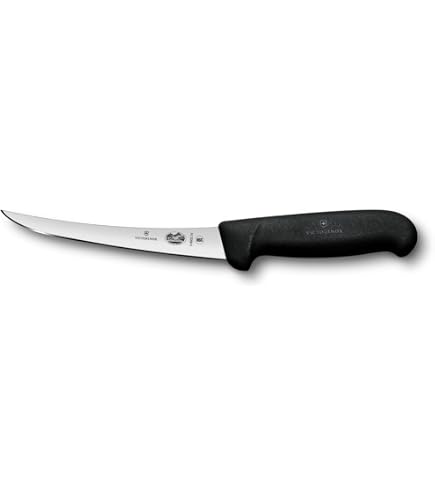
Victorinox Fibrox Pro 6″ Curved Semi-Stiff Boning Knife — The Ham and Roast Specialist
Best for: Ham, brisket, and large roasts
If the flexible version at #1 feels too whippy for a whole ham, this curved semi-stiff sibling from the same trusted lineup gives you more backbone without losing the Fibrox grip advantage. The curved blade shape guided cleanly around the bone in a spiral-cut ham with no wandering off-line.
- Curved blade shape tracked cleanly around a whole spiral-cut ham bone with no wandering
- Same reliable Fibrox grip as the #1 pick, even coated in ham glaze
- Semi-stiff flex struck the best balance of the two Victorinox models for brisket trimming
- Owning both this and the #1 flexible model means two very similar-looking knives in your block
| Blade length | 6 inches, curved |
| Flex type | Semi-stiff |
| Blade material | High-carbon stainless steel |
| Handle | Textured Fibrox polymer |
7/10
8/10
9/10
Top 3 Head-to-Head: Victorinox vs Mercer vs Zwilling
These three come up most often when readers ask which single boning knife to actually buy. Here’s how they stack up on the criteria that matter most.
| Feature | #1 Victorinox | #2 Mercer | #3 Zwilling |
|---|---|---|---|
| Blade Flexibility | 9/10 — Best | 8/10 | 9/10 |
| Edge Retention | 8/10 | 7/10 | 9/10 — Best |
| Handle Grip | 9/10 — Best | 8/10 | 9/10 |
| Choose if… | You want the safest, most balanced everyday pick | You’re testing the waters before spending more | You debone meat weekly and want the sharpest edge |
Who These Boning Knives Are NOT For
Not every kitchen needs a dedicated boning knife, and forcing one into the wrong job doesn’t serve you well either.
If you only ever buy boneless cuts, you genuinely don’t need this tool — a good paring knife and chef’s knife already cover your prep needs. A boning knife earns its place specifically when bone-in meat becomes a regular part of your grocery routine.
Common Mistakes to Avoid
Even the best boning knife on this list underperforms if it’s chosen or maintained the wrong way. These are the mistakes we saw ruin an otherwise good tool during testing.
Frequently Asked Questions About Boning Knives
What is a boning knife actually used for?
A boning knife is designed to separate raw meat, poultry, or fish from bone with minimal waste, using a thin, narrow blade that maneuvers around joints and contours a wider chef’s knife can’t follow.
What size boning knife should I buy?
A 6-inch blade handles the widest range of home tasks, from chicken thighs to pork shoulders. Go shorter (5 to 5.5 inches) only if you mostly work with small game birds or need tighter control in cramped spaces.
Is a flexible or stiff boning knife better?
Neither is universally better — it depends entirely on what you’re cutting. Flexible blades excel on poultry and fish where you need to hug curved bones, while stiff blades give more control on dense, large cuts like beef or ham where you want a straight, forceful stroke.
Can I use a boning knife as a fillet knife for fish?
Yes, and several models on this list are marketed as dual boning/fillet knives because the blade geometry overlaps closely. A dedicated fillet knife is usually slightly longer and more flexible, which helps on larger fish, but a good flexible boning knife handles smaller fish just fine.
How often does a boning knife need sharpening?
A quality stainless boning knife used weekly typically needs honing every few uses and a full sharpening every few months. Carbon steel blades sharpen faster but also dull faster, so plan on more frequent touch-ups if you choose one.
What’s the difference between a boning knife and a fillet knife?
A boning knife is generally shorter and slightly stiffer to handle meat and poultry joints, while a true fillet knife is longer and more flexible, built specifically to glide along a fish’s spine and skin. The overlap is large enough that many cooks own just one dual-purpose blade.
Is the Cook’s Illustrated top boning knife pick still worth buying?
Yes — the Victorinox Fibrox Pro has remained a top performer across multiple rounds of flexible boning knife testing over the years, and our own testing against newer competitors confirmed it still holds up on both edge retention and handle grip.
Our Final Verdict
Most home cooks overthink this purchase. A single well-chosen 6-inch flexible boning knife covers the vast majority of bone-in poultry and pork prep you’ll ever do, and the real decision point is flex type and handle grip, not brand prestige.
If you want one knife that just works without a learning curve, the Victorinox Fibrox Pro is the pick — it’s the same model that keeps winning flexible boning knife tests year after year. If you’re deboning weekly and want the sharpest possible edge, step up to the Zwilling Pro. If ham, brisket, or large roasts are your main use case, the curved semi-stiff Victorinox at #10 gives you the control a fully flexible blade can’t.