Can You Use a Chef Knife to Mince Garlic? Technique Guide
Quick Answer
Yes, a standard 8-inch chef’s knife is the most versatile and widely recommended tool for mincing garlic. Its curved belly allows a smooth rocking motion across the cutting board, while its broad flat blade lets you crush cloves to release skins and flatten cells into an ultra-fine paste without needing a specialized gadget.
Mincing garlic is one of the most frequent prep tasks in savory cooking. Home cooks often wonder whether reaching for a large, eight-inch chef’s knife is overkill for a clove that barely measures an inch across.
In culinary schools and professional kitchens, the chef’s knife is not just acceptable for mincing garlic—it is standard equipment. The knife’s weight, surface area, and blade curvature offer greater leverage, consistency, and texture control than smaller utility blades or specialized presses.
Why a Chef’s Knife Works Best for Garlic
Handling small aromatics with a large blade feels counterintuitive at first. However, a standard Western or Japanese-style chef’s knife provides three structural advantages that smaller blades lack.
- Blade Curvature: The gentle curve along the belly of a Western chef knife allows the edge to maintain constant contact with the cutting board during an alternating rocking cut.
- Surface Area: The broad, flat side of the blade functions as an impact plate. It lets you safely crush the clove with the heel of your hand before you ever make a slice.
- Blade Weight: The heft of an eight-inch forged blade does most of the mechanical work, requiring less downward muscle pressure and reducing wrist fatigue during batch prep.
When you use a small paring knife, your hand must support the entire downward pressure, and the blade cannot rock cleanly against the board. A chef’s knife balances stability with cutting leverage, making uniform mincing faster and safer once the basic motion is mastered.
Key Insight
Blade sharpness matters as much as size. A dull chef knife will crush and bruise garlic cells erratically, squeezing out flavorful juices onto your cutting board rather than slicing cleanly through cell walls to retain them in the mince.
How Cutting Garlic Changes Its Flavor: The Allicin Reaction
The method and tool you use to process garlic directly dictates how pungent your dish tastes. Raw, intact garlic cloves contain virtually no aroma because the aromatic compounds are kept physically separated inside individual plant cells.
Inside the plant tissue, an amino acid derivative called alliin is stored in cell vacuoles, while an enzyme called alliinase resides in the surrounding cytoplasm. When cell walls are ruptured by cutting or crushing, alliinase contacts alliin, catalyzing the rapid synthesis of allicin—the organosulfur compound responsible for garlic’s intense, sharp bite.
The finer you mince garlic, the more cell walls rupture, and the more allicin develops. A rough chop yields a milder, sweeter flavor when cooked, whereas an ultra-fine mince or knife-blade paste creates an assertive, pungent profile suited for dressings, marinades, and quick sautés.
| Prep Cut | Cell Wall Rupture | Allicin Level | Best Cooking Application |
|---|---|---|---|
| Smashed Whole | Minimal | Very Low | Infusing cooking oils, braises, slow-simmered sauces |
| Thinly Sliced | Low to Moderate | Moderate | Pasta aglio e olio, stir-fries, crispy garlic chips |
| Chef Knife Mince | High (Controlled) | High | Pan sauces, soups, sautéed vegetables, fillings |
| Garlic Press / Grater | Maximum (Sheared) | Intense / Pungent | Raw vinaigrettes, aioli, marinades, compound butters |
Because a chef’s knife allows you to transition seamlessly from a light slice to an ultra-fine mince, you hold complete culinary control over the final potency of the dish.
Step-by-Step: How to Mince Garlic with a Chef Knife
 Save
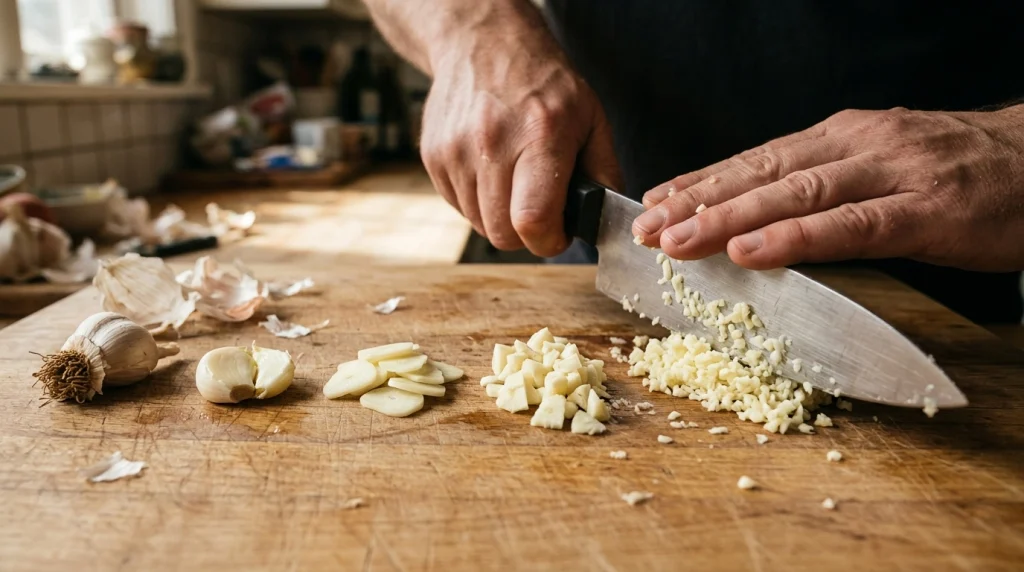
SaveExecuting a safe, even mince relies on correct hand placement, steady blade anchoring, and controlled knife movement. Follow this four-stage technique to achieve uniform pieces.
- Trim the Root and Peel: Place the unpeeled clove flat on your cutting board. Slice off the dry root end with the heel of the knife. Lay the flat side of the blade over the clove with the sharp edge facing away from your body. Rest the heel of your palm on the broad side of the blade and press firmly until you hear the skin crack. Slip the papery skin off with your fingers.
- Slice Thinly Across the Clove: Position your non-dominant hand into a “claw” grip, curling your fingertips inward with your knuckles resting lightly against the side of the blade. Slice the clove thinly from end to end using forward-and-down slicing strokes.
- Roughly Cross-Cut: Turn the pile of garlic slices 90 degrees. Cut through the slices perpendicularly to produce a rough, coarse dice.
- Rock the Blade to Final Texture: Place your non-dominant hand flat across the spine near the tip of the blade, keeping fingers well above the cutting edge. Keep the front tip of the knife anchored against the cutting board. Pivot the handle up and down in a smooth rocking arc, moving the blade across the garlic pile from left to right. Scrape the pile back into a tight mound periodically with the dull spine of the knife and repeat until the bits reach your desired size.
Warning
Never scrape garlic off the cutting board using the sharp edge of your knife. Dragging the delicate cutting bevel sideways across wood or plastic folds the apex and blunts the blade rapidly. Always flip the knife over and scrape using the thick, unsharpened spine.
How to Turn Minced Garlic into a Paste with Your Knife
If a recipe calls for garlic paste or crushed garlic, you do not need a mortar and pestle or a microplane grater. A chef’s knife can grind minced garlic into a silky paste using a standard French bistro technique.
Once you have reduced your garlic to a fine mince, sprinkle a pinch of coarse kosher salt over the pile. The salt crystals act as a gentle abrasive that grips the garlic fibers while drawing out moisture through osmotic pressure.
Angle the knife blade at roughly 30 degrees to the board. Hold the handle firmly with one hand and press two or three fingertips of your other hand flat against the side of the blade near the tip. Press down firmly and drag the edge across the garlic, smearing the pieces against the board surface.
Gather the mixture back into a mound with the spine, rotate the pile, and repeat the smearing motion three to four times. The sharp cells will collapse completely into a smooth paste that dissolves evenly into sauces without leaving detectable chunks.
Tip
Remember that the salt used as an abrasive stays in the garlic. Adjust the seasoning in the rest of your recipe accordingly so your finished dish does not end up over-salted.
Chef Knife vs. Garlic Press vs. Microplane: Tradeoffs
While the chef’s knife is the most adaptable prep tool, kitchen alternatives have specific advantages and drawbacks depending on your volume, time constraints, and recipe demands.
| Tool | Cleanup Effort | Texture Uniformity | Primary Advantage | Main Drawback |
|---|---|---|---|---|
| Chef’s Knife | Fast (One wipe) | High (Customizable) | No extra tools; versatile cuts from coarse to paste | Requires practice and knife safety discipline |
| Garlic Press | Moderate to Difficult | Variable | Can crush unpeeled cloves instantly | Leaves fibrous residue trapped in chamber holes |
| Microplane / Rasp | Fast (Rinse immediately) | Fine Puree | Creates instant, smooth puree without salt | Risk of grating fingertips on tiny nub ends |
A garlic press excels when you need to process one or two cloves without peeling them. However, cleaning the sieve basket often takes longer than mincing with a knife. A microplane works brilliantly for raw emulsion dressings like Caesar salad, but it cannot produce discrete, sauté-friendly bits.
For everyday cooking, the chef’s knife remains the most practical choice because it is already on your cutting board for onions and other vegetables, eliminating tool switching.
Common Mistakes When Mincing Garlic with a Knife
 Save
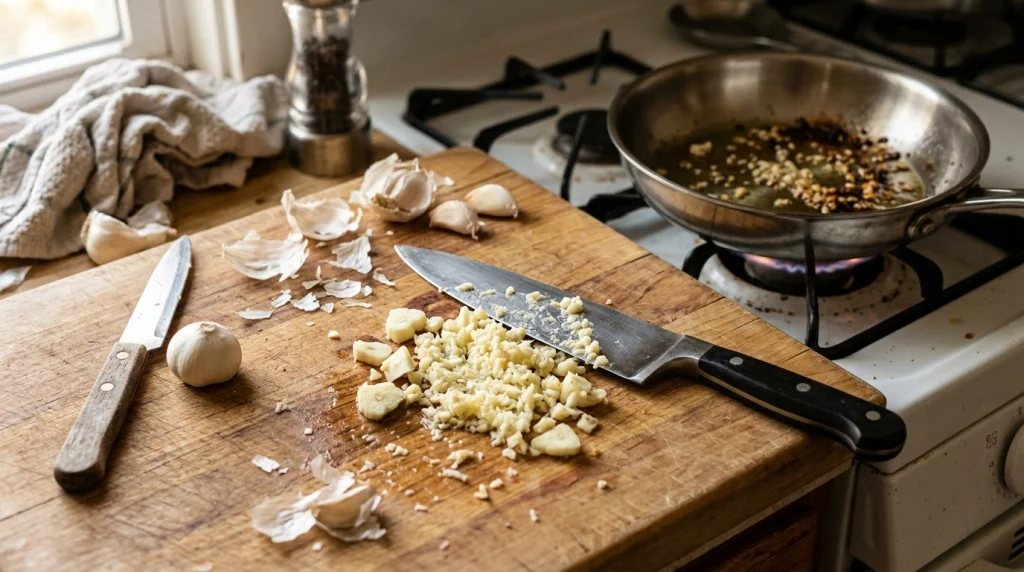
SaveMincing garlic is straightforward, but minor errors in execution can create bitter flavors, uneven browning, or dull blades. Watch out for these four frequent issues:
- Smashing with Uncontrolled Force: When crushing the clove to loosen the skin, use gentle, controlled palm pressure. Striking the knife flat with a clenched fist risks having the blade tilt or slip off the slippery garlic skin, endangering your hand.
- Letting Pieces Clump Unevenly: When you rock the knife back and forth, garlic tends to stick to the blade face and build up on the edges. If you do not scrape it down frequently, you will end up with tiny pulverized dust mixed with large chunks. Uneven cuts burn in the skillet before larger bits have cooked through.
- Using a Lightweight Dull Knife: Attempting to mince garlic with an unsharpened steak knife or dull paring knife causes the blade to slide off the rounded clove surface. Always ensure your chef knife has a honed apex.
- Adding Finely Minced Garlic Too Early to Hot Oil: Because fine mincing creates tiny particles with high surface area, garlic burns in hot fat within 30 to 45 seconds. Add your minced garlic during the final minute of sautéing aromatics rather than at the start with long-cooking onions.
Related Product
8-Inch Stainless Steel Chef Knives
A well-balanced 8-inch chef’s knife provides the blade curve, weight, and board clearance needed for precise rocking cuts and effortless garlic prep.
As an Amazon Associate, we earn from qualifying purchases.
Frequently Asked Questions
Is a chef knife better than a paring knife for mincing garlic?
Yes. A chef knife offers a wide, curved belly that stays anchored to the board during a rocking cut, whereas a short, straight paring knife forces you to pick the entire blade up and down with every cut. The wider blade also makes crushing cloves and scraping boards safer and faster.
Can you mince garlic with a Santoku knife instead?
Yes, a Santoku knife works well for mincing garlic. Santoku knives feature a flatter profile, meaning you perform an up-and-down push cut rather than the circular rocking cut typical of Western chef knives. The broad blade also crushes cloves effectively.
Why does minced garlic stick to the knife blade?
Garlic contains natural sugars and moisture that release when cell membranes are cut, creating a tacky surface tension that makes thin slices cling to steel. Dipping your knife blade in cold water before mincing or periodically scraping the blade down with your cutting board scraper eliminates sticking.
Does mincing garlic with a knife make it taste stronger than using a press?
No, garlic from a press typically tastes stronger. A garlic press crushes and extrudes tissue under high mechanical pressure, rupturing more cell walls simultaneously and triggering maximum allicin production. Slicing and mincing with a sharp knife causes cleaner cuts with less cellular shearing, producing a bright but balanced flavor.
Should I remove the green germ before mincing garlic with a knife?
You should remove the green shoot if you plan to use the garlic raw or in a lightly cooked dish. The green germ inside older cloves contains bitter chemical compounds that survive quick cooking. If you are roasting whole cloves or cooking a long-simmered stew, removing it is unnecessary.
How fine should garlic be minced for a basic sauté?
For most sautés, pieces should be between one and two millimeters in size—roughly the size of coarse sand or sesame seeds. Cutting them finer increases the risk of scorching in hot fat, while larger pieces will remain crunchy and sharp.
Conclusion
Using a chef’s knife to mince garlic is not only possible—it is the culinary gold standard for speed, texture control, and kitchen efficiency. Its broad blade simplifies crushing and peeling, while its curved belly enables an effortless rocking motion that produces uniform bits without extra gadgets. By mastering the rocking mince and the kosher salt paste technique, you gain complete command over garlic’s aromatic potency in every recipe you cook.