Can You Use a Chef Knife to Chop Nuts? Safe Technique Guide
Quick Answer
Yes, an 8-inch or 10-inch chef knife is one of the best tools for chopping nuts. Because nuts are hard and rounded, they roll and scatter easily under downward pressure. To chop them safely, use a rocking cross-chop motion while keeping your non-dominant hand flat on the front third of the knife spine, or stabilize whole nuts beneath a kitchen towel or wide blade before reducing them.
Home cooks frequently hesitate before cutting whole walnuts, pecans, almonds, or hazelnuts. A standard straight downward slice tends to split hard tree nuts along natural fracture lines, sending small, hard fragments flying off the cutting board. When executed properly, however, the curved profile and wide surface of a standard Western or hybrid chef knife offer far superior control compared to utility or paring knives.
Why a Chef Knife Works Well for Nuts (And Why Nuts Go Flying)
A classic Western chef knife features a gradual belly curve along the cutting edge. This curvature allows continuous contact with the cutting surface throughout the cutting stroke. When cutting soft vegetables like onions or cucumbers, moisture and soft fibers give way under linear downward force. Tree nuts behave entirely differently due to density and cellular structure.
Tree nuts such as almonds and Brazil nuts are dense cellular solids with very low moisture content. When the sharpened bevel of a knife wedges into a dry nut, high lateral pressure builds until tensile failure occurs. If the blade pushes straight down without stabilizing the nut, the accumulated energy releases instantly, popping the nut halves outward.
The width of an 8-inch chef knife blade works to your advantage here. The tall blade acts as an active physical barrier that deflects stray pieces back toward the cutting board rather than allowing them to bounce across your kitchen counters. Furthermore, the overall weight of the knife provides the mechanical momentum necessary to slice clean edges through tough skins and outer shells without requiring dangerous levels of downward muscle force.
The 3 Best Chef Knife Techniques for Chopping Nuts
 Save
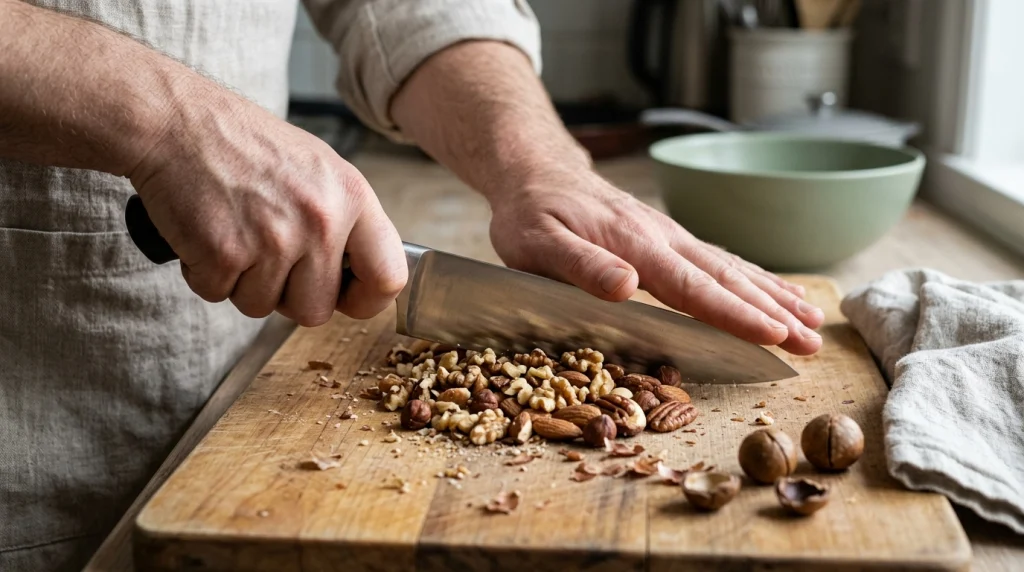
SaveControlling nuts on a cutting board comes down to blade mechanics and hand placement. Rather than attempting to cut each nut individually, culinary prep favors batch methods that restrict movement.
1. The Rocking Cross-Chop (Best for Large Batches)
The rocking cross-chop is the standard culinary technique for converting a pile of nuts into a medium or fine chop for baking and garnishes.
- Mound a cup of nuts in the center of a spacious cutting board. Do not spread them out; keeping them gathered minimizes scattering.
- Grip the knife handle with your dominant hand using a standard pinch grip—thumb and index finger gripping the blade base just forward of the bolster.
- Rest the curved tip of the knife blade on the cutting board just beyond the pile of nuts.
- Place the open palm of your non-dominant hand flat on the top spine of the knife, approximately two inches back from the tip. Never wrap your fingers over the cutting edge or beneath the blade.
- Keep the tip anchored to the board and pump the handle up and down in a steady rhythm, pivoting the knife in a semi-circular arc across the pile.
- Stop every 15 to 20 seconds to scrape the nuts back into a tight pile using the blunt spine or a bench scraper, then repeat until you reach the desired coarseness.
2. The Flat-Blade Crush (Best for Firm, Round Nuts)
Spherical nuts like hazelnuts, macadamias, and whole almonds present a high rolling hazard. Slicing directly into a rolling hazelnut can cause the knife edge to slip sideways toward your fingers.
To eliminate this rolling hazard, place the wide flat side of your chef knife directly over two or three nuts at a time. Keep the sharp edge facing away from your body. Press firmly downward with the heel of your free hand against the flat of the blade until you hear a light crunch. This fractures the spherical structure and creates a flat base, keeping the nuts stationary for a quick rocking chop.
3. The Kitchen Towel Trick (Zero Mess Method)
If you are working with slippery nuts or want to avoid any cleanup of flying fragments, fold a clean, lint-free tea towel over your pile of nuts on the board. Rest the flat of the chef knife or a heavy rolling pin over the cloth to break them into coarse chunks before finishing them with the bare knife edge. The cloth absorbs kinetic energy and traps all dust and oils.
Tip
Toasting whole nuts before chopping them makes them significantly easier to cut. Heat drives out internal moisture and causes oils to redistribute, making the nut brittle and crumbly rather than leathery and elastic.
Board Setup and Knife Geometry: What Protects Your Blade
A common concern among cooks is whether hard nuts will damage, chip, or prematurely dull an expensive kitchen knife. The outcome depends largely on blade steel hardness, edge angle, and cutting board material.
| Knife Style | Typical Edge Angle | Steel Hardness (HRC) | Nut Chopping Suitability |
|---|---|---|---|
| German / Western Chef Knife | 18° – 22° per side | 56 – 58 HRC | Excellent (Doughy, ductile steel resists chipping) |
| Japanese Gyuto / Santoku | 12° – 15° per side | 60 – 64+ HRC | Caution (Hard, acute edge can micro-chip on hard nuts) |
| Chinese Chef Knife / Cleaver | 18° – 20° per side | 56 – 58 HRC | Excellent (Tall blade profile catches fragments easily) |
As outlined above, softer German high-carbon stainless steels are structurally ideal for tough chopping tasks because the steel bends rather than chips when subjected to torsional stress. High-hardness Japanese blades sharpened to very steep angles should be used with a straight up-and-down slicing motion rather than an aggressive twisting rock, as twisting a thin, brittle edge against hard nuts can cause micro-chipping.
Your cutting board choice is equally critical. Always use an end-grain or edge-grain wood board, or a high-density polyethylene cutting surface. Never chop nuts on glass, ceramic, marble, or granite surfaces. Rigid countertops offer zero shock absorption, instantly dulling your blade and dramatically increasing the risk of the edge slipping on a rolling nut.
Warning
Never slide your knife blade edge-first across the wooden board to collect chopped nuts. Scraping with the sharpened edge folds the microscopic apex and blunts the knife rapidly. Always flip the knife over and scrape using the blunt spine, or use a stainless steel bench knife.
How Nut Density Changes the Cutting Approach
Not all nuts display the same structural density. Modifying your prep technique to match the specific variety saves time and keeps food uniform.
Soft & Layered Nuts: Walnuts and Pecans
Walnuts and pecans consist of delicate, convoluted lobes filled with natural air pockets. They contain high amounts of polyunsaturated oils and soft cellular walls. Because they lack dense solid mass, they crumble under moderate pressure. You do not need to pre-crush them; simply pile them together and execute a light rocking cross-chop. Keep strokes gentle to prevent crushing them into an oily meal.
Solid & Tough Nuts: Whole Almonds and Brazil Nuts
Whole raw almonds are notoriously dense and have a teardrop shape that loves to slide on flat boards. Trying to cross-chop a pile of whole, raw almonds directly will cause pieces to scatter uncontrollably. For whole almonds, rough-crush them under the flat side of your blade first, or make a deliberate, steady push-cut through small clusters before initiating a rocking chop.
Round Nuts: Hazelnuts and Macadamias
Due to their spherical geometry, whole hazelnuts and macadamias roll the moment pressure touches them. If you attempt to chop them with a fast rocking motion without pre-cracking, you run a real risk of the blade sliding off the curve. Always flatten them under the wide face of the knife first to break their spherical symmetry.
Chef Knife vs. Food Processors, Nut Choppers, and Rolling Pins
 Save
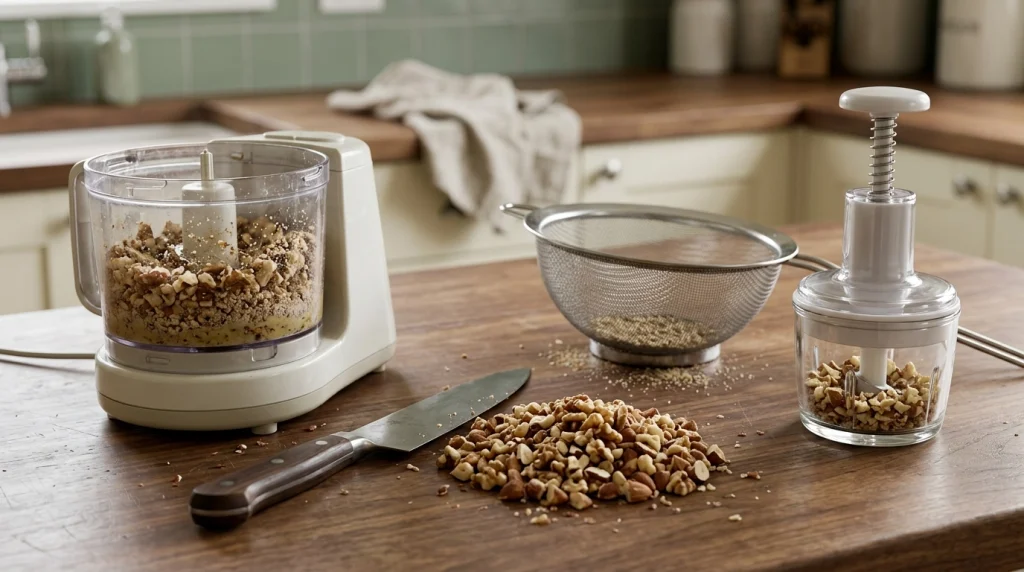
SaveWhile an 8-inch chef knife remains the standard everyday culinary choice, mechanical tools offer tradeoffs in speed, consistency, and texture.
Electric Food Processors: An electric food processor breaks down large volumes of nuts in seconds using spinning S-blades. However, food processors chop unevenly because nuts closest to the bottom blade are pulverized into dust and paste before the nuts at the top are cut. Unless you pulse very carefully, food processors release friction heat that draws out oils, turning your mixture gummy.
Rotary Hand Choppers: Manual spring-loaded plunger or rotary hand-crank choppers work well for small, immediate garnishes like sundae toppings. However, their internal blades are stamped steel that dulls quickly, and their small chambers make processing more than a half-cup tedious.
Chef Knife: Chopping by hand with a chef knife takes approximately two to three minutes for a cup of nuts, but it yields distinct, clean edges with virtually no powdery dust. Hand-chopped pieces retain their individual structure, providing better textural crunch in baked pastries and savory sauces.
Key Insight
When baking delicate pastries, sift your hand-chopped nuts through a coarse mesh colander before folding them into your batter. This removes fine nut meal and powdery residue, ensuring your baked goods maintain their rise and don’t take on excess oil.
Related Product
Stainless Steel Bench Scraper
A wide bench scraper gathers chopped nuts and clears cutting boards instantly without dulling your chef knife’s sharp edge.
As an Amazon Associate, we earn from qualifying purchases.
Frequently Asked Questions
Will chopping nuts ruin or dull my chef knife?
Chopping nuts on a wooden or plastic board will not ruin a quality knife. While cutting dense materials causes normal edge wear over time, significant damage only occurs if you use a brittle, ultra-thin Japanese edge with a twisting motion, or if you cut on hard surfaces like glass, stone, or ceramic.
Is a serrated knife better than a chef knife for nuts?
A serrated utility knife can bite into slippery outer skins of smooth nuts like whole almonds, preventing initial slippage. However, serrated blades cannot perform a continuous rocking motion on the cutting board, making them far slower and less efficient for chopping moderate or large quantities.
What knife size is best for cutting nuts?
An 8-inch chef knife provides the ideal balance of blade length, curve, and weight. It offers enough height to shield against flying pieces and sufficient length to keep the tip anchored to the board while rocking through a generous pile of ingredients.
Why do nuts turn into a paste when chopped?
Nuts turn into a paste when excessive crushing force ruptures their microscopic lipid pockets, releasing oils. This happens when using a dull blade that crushes rather than cuts, or when over-processing nuts in a high-speed electric food processor.
Should nuts be toasted before or after chopping?
Toasting nuts whole before chopping is generally best. Whole nuts roast more evenly in an oven without burning small edges. Additionally, the heat dries out their moisture, making them crisp and brittle, which allows your knife to slice cleanly through them with minimal resistance.
How can I prevent chopped nuts from scattering across the counter?
Keep your non-dominant palm flat on the front spine to stabilize the knife tip on the board, keep the pile concentrated in the center, and pause every few strokes to push the nuts back together using a bench scraper or the knife’s blunt back spine.
Conclusion
Using a chef knife to chop nuts is an essential culinary technique that offers unmatched precision and texture control. By pairing a standard 8-inch Western blade with an anchored rocking cross-chop, you can cut cleanly through almonds, pecans, or walnuts without sending stray pieces across your countertop. Pre-crush spherical nuts using the flat of the blade to stabilize them, use an appropriate end-grain wood or plastic board to safeguard your cutting edge, and scrape your pile together using the blade’s blunt spine to preserve your knife sharpness for years to come.